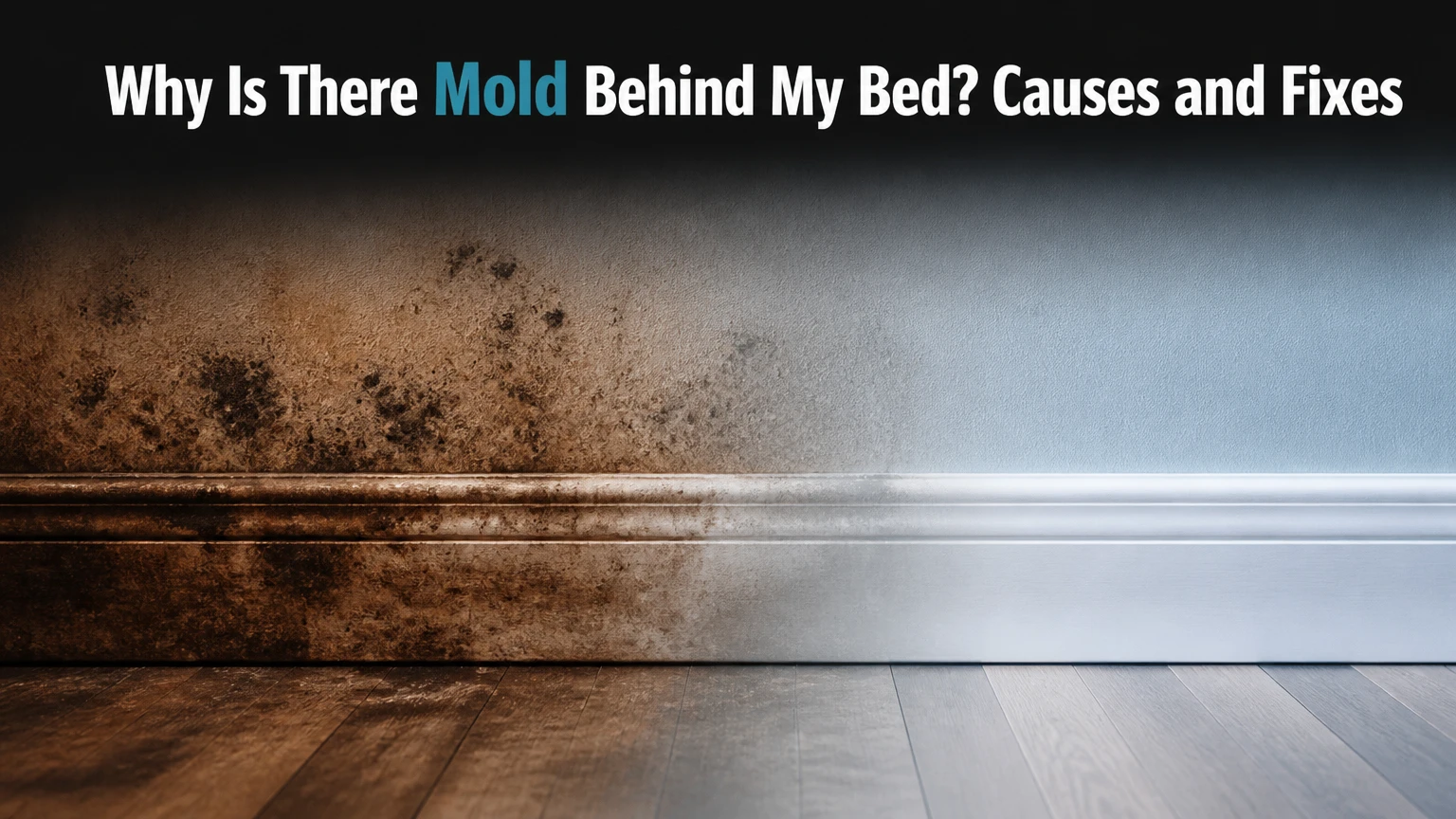
Why Is There Mold Behind My Bed? Causes and Fixes
Mold behind a bed usually means moisture is collecting in a poorly ventilated space, most often from condensation on a cold exterior wall, excessive indoor humidity, or a hidden water leak. The bed restricts airflow and traps dust, fabric, wood, or drywall paper, giving mold both the damp surface and organic material it needs to grow.
Key Facts at a Glance
- Mold behind a bed requires moisture, a surface that can support growth, and time; blocked airflow alone does not create mold.
- A cold exterior wall can reach the dew point even when the room air feels comfortable, causing water to form behind the headboard.
- A 2-4 inch gap can improve ventilation, but no single clearance prevents mold in every bedroom.
- Indoor relative humidity of 30%-50% is a practical prevention target; a hygrometer is more reliable than guessing.
- Mold color cannot identify species or prove that a colony is toxic.
- Small visible growth on a washable surface may be cleaned, but moldy drywall, insulation, carpet, and upholstered materials may need removal.
Why Is There Mold Behind My Bed?
Mold appears behind a bed when a hidden surface stays damp long enough for spores to germinate. The most common sequence is warm humid bedroom air, a colder wall or headboard, reduced air movement, condensation, and growth on dust, wallpaper adhesive, wood, fabric, or paper-faced drywall.
The bed creates a small microclimate. A mattress, solid headboard, or storage bed blocks room air from circulating across the wall, while people add moisture through breathing, perspiration, wet towels, and drying laundry. The effect becomes stronger in winter, when an exterior wall or poorly insulated corner is much colder than the room.
The moisture source may be condensation, but it may also be a plumbing leak, roof defect, failed window seal, gutter problem, or damp basement wall. Cleaning the visible patch without identifying that source usually produces a temporary cosmetic result.
How does condensation create mold?
Condensation forms when a surface temperature falls below the dew point of the surrounding air. For example, air at 68°F and 60% relative humidity has a dew point near 53°F, so a cold wall near that temperature can collect water even when the bedroom does not feel wet.
The dew point changes with humidity. At 68°F and 40% relative humidity, the dew point is about 44°F; at 68°F and 70% relative humidity, it is about 58°F. Higher humidity therefore allows condensation on warmer surfaces.
Mold does not automatically appear after one damp night. EPA explains, “The key to mold control is moisture control.” Drying the wall, lowering humidity, and improving airflow interrupt the growth cycle.
Does an air gap prevent mold?
A 2-4 inch gap between the bed and wall is a useful starting point, not a guaranteed prevention measure. A gap will not solve a leaking pipe, saturated drywall, failed exterior waterproofing, or a bedroom that remains above 60% relative humidity for long periods.
Leave more space when the wall is unusually cold, the bed has a solid back, or the room has poor ventilation. Keep air able to move around both sides of the headboard, and avoid pressing storage bins, blankets, or pillows into the wall gap.
What Is Causing the Moisture?
The location, texture, and timing of the growth often identify the cause more accurately than mold color. Condensation usually produces scattered spotting or a surface film, while a leak often creates a defined stain, swollen drywall, soft material, or a pattern that worsens after rain or plumbing use.
| Observation behind the bed | Most likely cause | Check to perform | Typical repair |
|---|---|---|---|
| Black or green specks on a cold exterior wall | Winter condensation | Measure RH and wall temperature | Ventilation, heating, insulation, humidity control |
| Brown ring, bubbling paint, or soft drywall | Plumbing or roof leak | Inspect adjacent pipes, ceiling, and exterior | Stop leak, remove damaged material |
| Growth after heavy rain | Window, siding, gutter, or foundation entry | Inspect outside during and after rain | Seal, redirect water, repair flashing |
| Mold concentrated at floor level | Basement dampness or wicking | Check flooring, baseboard, and foundation wall | Waterproofing, drainage, material replacement |
| Mold on fabric headboard or mattress edge | Condensation and retained textile moisture | Inspect seams, underside, and wall contact | Clean or discard porous material |
| Musty odor with little visible growth | Hidden cavity or carpet contamination | Inspect access points and nearby materials | Targeted assessment and controlled removal |
Why is the exterior wall behind my bed moldy?
An exterior wall is more likely to develop condensation because its interior surface becomes colder during winter. Missing insulation, thermal bridging around fasteners, a poorly sealed window, and furniture that blocks warm room air can make one section of wall much colder than the rest.
A surface temperature difference of only several degrees can determine whether water vapor remains invisible or becomes liquid water. Use an infrared thermometer, if available, to compare the wall behind the bed with an unobstructed interior wall. The comparison is more useful than relying on touch alone.
Can an interior wall develop mold?
An interior wall can develop mold, but a plumbing or HVAC moisture source becomes more likely than outdoor cold. Check bathrooms on the opposite side, supply and drain lines, radiator pipes, condensate lines, and shared walls bordering kitchens or laundry rooms.
An interior wall can also stay damp when a bed blocks ventilation in a humid room. A wall does not need to face outside for condensation to occur, especially near an air-conditioning duct or an unheated room.
Does Mold Color Identify the Type?
Mold color does not reliably identify species, toxicity, or health risk. The same species can appear different colors on different materials, and several species can occupy the same damp surface.
| Commonly named mold | Possible appearance | Common indoor materials | Practical interpretation |
|---|---|---|---|
| Aspergillus | Green, gray, yellow, or white | Dust, drywall, textiles | Appearance alone cannot confirm Aspergillus |
| Cladosporium | Olive, brown, gray, or black | Wood, fabrics, carpets | Common in damp household materials |
| Penicillium | Blue, green, or white | Wallpaper, drywall, insulation | Often associated with persistent moisture |
| Stachybotrys chartarum | Dark greenish-black or black | Wet cellulose materials | Requires sustained moisture, species testing needed |
| Alternaria | Brown, olive, or black | Window areas, fabrics, painted surfaces | Often linked with prolonged dampness |
| Unidentified mixed growth | Multiple colors and textures | Dusty or water-damaged surfaces | Treat the moisture and material, not the color |
The term “black mold” is therefore not a visual diagnosis. Stachybotrys chartarum is one particular species, and a dark patch behind a bed may instead contain Cladosporium, Aspergillus, dirt, or several organisms together.
Mold species testing rarely changes the first response to a small visible colony: stop moisture, protect occupants, clean suitable surfaces, and remove unsalvageable porous material. Testing becomes more relevant when a physician requests environmental information, a dispute requires documentation, or hidden contamination is suspected.
What Humidity Level Causes Bedroom Mold?
Indoor relative humidity below 50% is a practical prevention target for most bedrooms, while sustained readings above 60% increase the likelihood of condensation and mold. Local humidity at a cold wall can be higher than the center-of-room reading, so a room reading below 50% does not guarantee a dry wall.
Place a digital hygrometer near the bed for at least 24 hours, then compare it with a reading near the door or window. Record morning and evening values for several days, because sleeping occupants can raise overnight humidity.
| Bedroom condition | Typical RH reading | Condensation risk | Recommended response |
|---|---|---|---|
| Dry winter bedroom | 25%-35% | Low, except on severe cold surfaces | Avoid excessive humidifier use |
| Preferred control range | 30%-50% | Moderate to low | Maintain ventilation and airflow |
| Humid bedroom | 51%-60% | Increasing near cold walls | Use exhaust ventilation or dehumidification |
| Persistent high humidity | 61%-70% | High | Find moisture source and dehumidify |
| Severe moisture condition | Above 70% | Very high | Inspect promptly and limit exposure |
Do not assume a humidifier will improve a moldy bedroom. If the room already measures above 50%, stop using the humidifier until the cause is understood.
How Do You Clean a Small Mold Patch?
A small patch on a hard, cleanable surface can often be handled by a careful occupant when there is no active leak, sewage contamination, or major respiratory vulnerability. EPA commonly uses about 10 square feet as a practical point at which professional guidance becomes more appropriate, although material type and hidden damage matter as much as area.
Before You Start
| Item | Typical requirement | Purpose |
|---|---|---|
| Disposable nitrile gloves | 1 pair per cleaning session | Skin protection |
| N95 respirator | 1 properly fitted mask | Limits inhalation of particles |
| Eye protection | 1 pair | Prevents splashes and debris |
| Detergent solution | 1 quart | Cleaning hard surfaces |
| Disposable towels | 6-12 | Removal and drying |
| Heavy-duty bags | 2 | Contaminated waste |
| Hygrometer | 1 unit | Humidity measurement |
| Work time | 30-90 minutes | Small surface patch |
Avoid cleaning if the mold covers more than roughly 10 square feet, the wall is soft or swollen, the source is unresolved, or the occupant has severe asthma, immune suppression, or a significant mold allergy. A professional can establish containment and determine whether the wall cavity is contaminated.
Step 1: Isolate the Area
Move the bed away from the wall without dragging contaminated bedding across the room. Keep children, pets, and people with asthma away from the work zone, and avoid directing a fan across the mold before cleaning.
Turn off room air movement that would spread particles, but do not disable essential heating or cooling for extended periods. Open a window when outdoor conditions are dry and safe, and keep the door closed if practical.
Step 2: Protect Yourself and Inspect
Wear gloves, eye protection, and a well-fitting N95 respirator. Do not rely on a loose surgical mask, and do not mix cleaning products.
Look for soft drywall, bubbling paint, wet insulation, staining that extends beyond the visible colony, or a musty odor inside the wall. Those signs indicate that surface wiping may not solve the problem.
Step 3: Dampen and Clean the Surface
Lightly dampen the patch with a detergent solution or a product labeled for mold cleanup, then wipe rather than aggressively dry-scrubbing. For painted or sealed hard surfaces, use enough solution to lift the residue without soaking the wall.
Bleach is not a universal mold solution. EPA does not recommend bleach as a routine practice for mold cleanup, and chlorine cannot reliably remove growth from porous drywall, wood framing, carpet, or upholstery.
Step 4: Dry Completely
Dry the cleaned surface within the same day using controlled ventilation or a dehumidifier. Do not push the bed back until the wall, baseboard, and headboard are dry.
You will know the immediate cleanup succeeded when no visible residue remains, the surface is dry, and the odor does not return during the next several days. Recurrence indicates unresolved moisture, not a need for stronger fragrance or paint.
Step 5: Bag Waste and Monitor
Seal disposable towels, gloves, and other contaminated waste in heavy-duty bags before carrying them through the home. Wash reusable tools with detergent and launder washable bedding separately.
Photograph the wall after cleaning and recheck it at 48 hours, 7 days, and 30 days. A recurring patch, expanding stain, or returning odor warrants a moisture investigation.
Which Materials Can Be Saved?
Nonporous materials such as glass, metal, and sealed plastic are usually easier to clean than absorbent materials. Porous items can retain fungal growth below the visible surface, so a clean appearance does not prove complete removal.
| Material | Cleaning potential | Typical action | Replacement trigger |
|---|---|---|---|
| Painted, intact drywall | Limited | Clean only a tiny surface spot | Softness, swelling, recurring growth |
| Bare drywall paper | Poor | Remove affected section | Any deep or spreading growth |
| Sealed wood | Moderate to high | Clean, dry, and refinish | Warping or growth in joints |
| Upholstered headboard | Limited | Professional textile cleaning for minor cases | Persistent odor or embedded growth |
| Metal bed frame | High | Detergent cleaning and complete drying | Rust or hidden porous padding |
| Mattress or box spring | Poor for deep contamination | Isolate and assess condition | Visible internal growth or lasting odor |
A mattress should not be sprayed with bleach, vinegar, or random biocides. Moisture can penetrate its layers, and chemical residues remain close to the sleeper. Replace a mattress with extensive visible mold, deep odor, or contamination that cannot be completely removed.
When Should You Hire a Professional?
Professional assessment is appropriate for growth over approximately 10 square feet, repeated recurrence, hidden wall damage, sewage or flood exposure, extensive porous-material contamination, or occupants with serious respiratory vulnerability. The area threshold is a screening rule, not a guarantee that a 9-square-foot problem is safe to handle alone.
Typical USA costs vary by region, access, containment, demolition, and rebuilding requirements.
| Service or repair | Typical USA cost | Typical timeframe | Main variable |
|---|---|---|---|
| Visual moisture inspection | $150-$400 | 1-3 hours | Thermal imaging and report detail |
| Small surface cleanup | $200-$600 | 2-5 hours | Material and containment |
| Mold remediation | $500-$3,000 | 1-4 days | Area and demolition |
| Drywall removal and replacement | $300-$1,500 | 1-3 days | Wall size and finish |
| Dehumidifier operation | $150-$400 equipment | 24-72 hours | Room volume and water load |
| Plumbing or roof repair | $250-$2,500 | 2 hours-3 days | Access and damaged components |
A professional remediation company should explain the moisture source, containment method, affected materials, drying plan, and post-work verification. Be cautious when a contractor recommends expensive species testing before inspecting the leak or when the proposal treats mold color as a hazard classification.
Common Mistakes That Make Mold Return
Pushing the bed back too soon
A freshly wiped wall can feel dry while the drywall core remains damp. Leave the bed displaced until the source is repaired, the surface is dry, and humidity remains controlled for several days.
Painting over active growth
Paint can hide discoloration temporarily, but it does not remove fungal material or dry wet drywall. Clean and dry the surface first, then repair or replace damaged material before applying a mold-resistant coating.
Using bleach on porous wallboard
Bleach may lighten a stain without removing growth inside paper or gypsum. Detergent cleaning is more appropriate for intact hard surfaces, while damaged drywall generally requires controlled removal.
Measuring only room-center humidity
A hygrometer on a nightstand may miss a colder, wetter wall pocket. Take readings at several locations and inspect the coldest surface, especially behind a solid headboard.
Blaming the bed for every patch
Furniture placement often reveals a moisture problem rather than causing it. A leaking pipe, failed window flashing, or wet foundation will continue damaging the wall after the bed moves.
Scrubbing dry
Dry brushing can disperse particles and spread contamination to bedding and nearby surfaces. Light dampening, disposable towels, and controlled airflow reduce that risk.
What Should Renters and Homeowners Do?
Renters should photograph the growth, record humidity readings, avoid disturbing a large patch, and notify the landlord or property manager in writing. The notice should include the location, approximate size, date discovered, visible water damage, and any repair request.
Do not permanently remove wall material in a rental without written authorization. Moving the bed 2-4 inches away can reduce condensation while the owner investigates, but it does not transfer responsibility for structural leaks or defective windows to the tenant.
Homeowners should inspect exterior gutters, downspouts, siding, window flashing, foundation drainage, plumbing, and HVAC condensate lines. If the wall is chronically cold, an energy audit or targeted insulation assessment can identify thermal bridging, but adding interior insulation without moisture analysis can trap water in the cavity.
How Can You Prevent Mold Behind the Bed?
Prevention requires moisture control first, airflow second, and material management third. Keep bedroom RH near 30%-50%, ventilate after showers, dry wet textiles promptly, and maintain a visible gap behind the bed.
Use a dehumidifier sized for the room rather than a tiny unit that runs continuously without lowering RH. Clean dust from baseboards and bed frames because dust provides organic material, but understand that dust removal cannot compensate for a wet wall.
For a cold exterior wall, keep room heat circulating behind the bed and avoid covering the gap with blankets. Window condensation deserves separate attention because repeated water on the sill or jamb can migrate into adjacent drywall.
Is It Safe to Sleep in a Room With Mold?
A small, isolated surface patch does not automatically mean the entire bedroom is unsafe, but visible mold and persistent dampness can aggravate allergies, asthma, irritation, or respiratory symptoms. People with asthma, chronic lung disease, immune suppression, or severe mold sensitivity should avoid cleanup and discuss symptoms with a clinician.
A portable HEPA air cleaner can reduce airborne particles while the source is corrected, but filtration does not remove mold inside drywall or replace remediation. Keep the unit sized for the room, operate it according to the manufacturer’s airflow rating, and replace filters on schedule.
Seek medical care for breathing difficulty, wheezing, chest tightness, or symptoms that worsen in the room. Environmental cleanup and medical evaluation address different problems.
Frequently Asked Questions
Can mold behind my bed make the mattress moldy?
Yes. A mattress or upholstered headboard can absorb condensation from a cold wall, particularly when fabric touches the wall or the room remains humid overnight. Inspect the rear surface, seams, underside, and box spring. Cleanable surface spotting may be assessed, but deep growth, persistent odor, or damp internal padding usually justifies replacement.
How fast can mold grow behind a bed?
Mold can begin germinating within roughly 24-48 hours under favorable laboratory conditions, but visible household growth may take days or weeks depending on temperature, species, material, and moisture duration. No reliable universal timeline predicts when a bedroom colony will become visible.
Should I use vinegar or a commercial mold cleaner?
Neither product is suitable for every material. A labeled commercial cleaner may provide directions for a specific surface, while vinegar can damage some finishes and does not repair contaminated drywall. Detergent and water are often appropriate for intact hard surfaces. Never mix vinegar with bleach or other chemicals.
Do I need a mold test before cleaning?
Usually not for a small, visible patch on a cleanable surface, because testing does not remove the moisture or change basic cleanup steps. Testing may help with a medical request, insurance documentation, legal dispute, or suspected hidden contamination, but results require qualified interpretation.
Why does mold return after I clean it?
Mold returns when the wall, room air, or porous material remains damp. Common causes include unresolved plumbing leaks, high overnight humidity, cold thermal bridges, wet insulation, and a bed placed tightly against the wall. Track RH and inspect the wall after cleaning instead of repeatedly applying chemicals.
Can an air purifier prevent mold behind a bed?
A HEPA air purifier can capture some airborne particles, but it cannot prevent surface mold when condensation or leakage remains. Use filtration as an exposure-reduction measure while controlling humidity, improving airflow, and repairing the moisture source.
The Bottom Line
The answer to “why is there mold behind my bed” is usually a concealed moisture problem intensified by restricted airflow. Move the bed, measure humidity, inspect for condensation and leaks, and clean only small areas on suitable surfaces. If drywall is soft, growth is extensive, or mold returns, correct the building problem and use professional remediation rather than painting over the evidence.