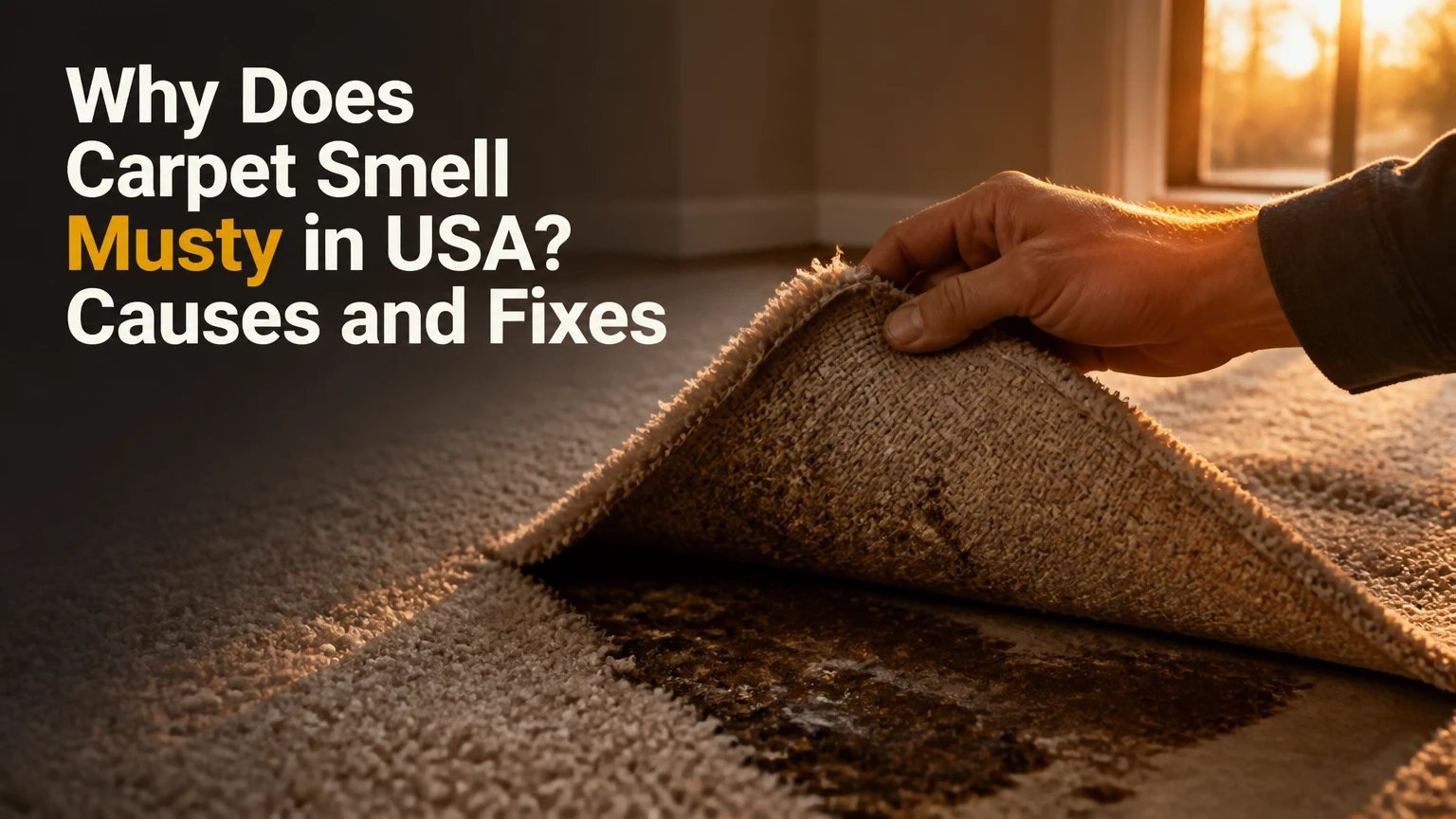
Why Does Carpet Smell Musty in USA? Causes and Fixes
A musty carpet smell in the USA usually comes from moisture that allows mold, mildew, bacteria, or contaminated carpet backing to release odor compounds into indoor air. Common sources include wet padding, basement slab moisture, high indoor humidity, HVAC leaks, plumbing failures, slow drying after cleaning, and old pet urine deposits.
Key Facts at a Glance
- A musty odor indicates a moisture or contamination problem, but the smell alone cannot identify a specific mold species.
- Carpet padding can retain substantially more water than the visible carpet surface, allowing odor to persist after the pile feels dry.
- Indoor relative humidity above 60% increases condensation and microbial-growth risk; a practical target for most homes is 30-50% RH.
- Carpet affected by sewage, floodwater, or prolonged saturation often requires removal rather than repeated deodorizing.
- Baking soda can adsorb some surface odor, but it cannot dry wet padding or remove contamination below the carpet.
- The EPA states, “The key to mold control is moisture control,” which applies directly to recurring carpet odor.
What causes a musty carpet smell?
A musty carpet smell develops when moisture reaches carpet fibers, padding, dust, or the subfloor and microorganisms produce volatile odor compounds. Mold and bacteria can contribute, but damp materials can also smell sour or stale before visible growth appears.
Carpet is a layered system. The face fibers are attached to a primary backing, adhesive, secondary backing, and pad, which may sit over plywood, concrete, or another floor assembly. Water entering any layer can migrate sideways, remain under furniture, or evaporate slowly into the room.
Microbial volatile organic compounds, commonly called mVOCs, include compounds associated with earthy or mold-like odors. A smell does not prove that dangerous mold is present, and smell intensity does not reliably measure contamination size. EPA and CDC guidance focuses on finding and correcting moisture rather than identifying mold by odor alone.
Why does moisture create the odor?
Moisture activates the problem by extending the time that organic material remains wet. Dust, skin flakes, food residue, pet dander, paper fibers, wool, jute, and adhesives can provide nutrients, while carpet pile restricts ventilation near the floor.
The often-repeated claim that mold always begins growing within exactly 24-48 hours is too precise. Growth speed depends on temperature, water activity, material, species, and ventilation. After a clean-water spill, rapid extraction and drying within roughly 24-48 hours is a sensible restoration goal, not a guaranteed biological deadline.
Where does carpet moisture come from in US homes?
The most likely moisture source depends on climate, floor level, construction, and recent events. Basement carpets commonly face slab or foundation moisture, while upper-level carpets more often develop odor from plumbing, roof, window, or HVAC problems.
| Location or condition | Common moisture source | Typical clue | First inspection |
|---|---|---|---|
| Finished basement | Concrete slab vapor, foundation seepage, sump failure | Odor follows exterior walls or rainy periods | Moisture meter at carpet edge and slab |
| Southeast or Gulf Coast | Indoor RH above 60%, condensation | Smell returns during humid weather | Hygrometer, supply vents, return airflow |
| Northeast or Midwest | Snowmelt, freeze-thaw seepage, high water table | Seasonal basement odor | Foundation wall, floor drain, sump pump |
| Pacific Northwest | Rain intrusion, crawlspace humidity | Odor follows storms | Window wells, crawlspace vapor barrier |
| Upper-level bedroom | Plumbing, roof, window, or condensation leak | One isolated patch | Ceiling below, exterior wall, window casing |
| Near HVAC equipment | Condensate pan, drain, coil, or duct leakage | Odor changes when system runs | Air handler, drain line, adjacent flooring |
Can high humidity cause carpet odor without a leak?
Yes. High indoor humidity can make carpet smell musty even when no pipe or roof leak exists. Warm, humid air can condense on cooler concrete, exterior walls, or carpet surfaces, while hygroscopic dust and pet urine residues absorb water directly from the air.
Measure RH with a digital hygrometer placed near the affected carpet and another placed in the room’s center. A recurring reading above 60% deserves correction; 30-50% is a practical operating range for many homes. A dehumidifier may reduce symptoms, but it cannot repair a foundation leak or wet insulation.
Why does basement carpet smell musty after rain?
Basement carpet often smells musty after rain because water enters through foundation cracks, porous masonry, floor joints, window wells, or the concrete slab. Hydrostatic pressure and vapor transmission can wet the underside of carpet padding without leaving obvious surface puddles.
Do not assume a dry-looking basement is dry beneath the carpet. Lift a corner near an exterior wall, inspect the pad and tack strip, and compare moisture readings across affected and unaffected areas. A musty odor concentrated along one wall points toward localized infiltration, while room-wide odor points more strongly toward humidity or a saturated pad.
How can you identify the source before treating carpet?
Source identification should come before deodorizing because surface treatment fails when moisture, padding, or subfloor contamination remains. Inspect the smell pattern, carpet layers, adjacent building materials, and indoor humidity in that order.
- Map the odor. Close interior doors for several hours, then compare corners, closets, edges, and areas beneath furniture. Mark the strongest zones.
- Check recent events. Record leaks, storms, cleaning, appliance overflow, basement flooding, and pet accidents.
- Measure humidity. Log room RH morning and evening for two days. Record outdoor weather and HVAC operation.
- Inspect the perimeter. Look for damp tack strips, swollen baseboards, staining, lifted edges, and wet drywall.
- Lift a carpet corner safely. Check the pad, backing, tack strip, and floor. Avoid cutting or disturbing suspected mold unnecessarily.
- Test the floor assembly. Use an appropriate moisture meter for wood or concrete, recognizing that meters provide comparative readings rather than universal proof.
- Trace adjacent sources. Inspect toilets, sinks, washing machines, refrigerators, water heaters, air handlers, windows, crawlspaces, and floor drains.
A useful practitioner rule is to compare the affected area with a control area. If both areas have similar moisture readings but only one smells, pet contamination, detergent residue, or localized backing damage becomes more likely.
| Odor pattern | More likely cause | Confirming clue | Treatment direction |
|---|---|---|---|
| Earthy, damp, room-wide | Humidity or wet pad | RH above 60%, broad odor field | Dehumidify, inspect pad and subfloor |
| Sour, strongest after cleaning | Over-wetting or residue | Odor began within 1-3 days of cleaning | Extract residue, accelerate drying |
| Ammonia-like or sharp | Pet urine | UV fluorescence or repeated pet area | Enzyme treatment or pad removal |
| Rotten-egg or sewage-like | Drain, sewer, or contaminated water | Odor near drain or flood boundary | Plumbing repair and professional sanitation |
| Sweet chemical smell | Adhesive, backing, or cleaning product | New installation or chemical exposure | Ventilate, identify product, consult installer |
| Earthy odor with visible staining | Possible microbial contamination | Damp backing or wall material | Moisture correction and containment |
Why does carpet smell worse after cleaning?
Carpet can smell worse after cleaning because water and detergent reach the backing or pad, dissolve old residues, and dry too slowly. The process can also move soil toward the fiber tips, a phenomenon called wicking, making previously hidden contamination more noticeable.
A properly performed hot-water extraction should leave carpet only lightly damp, with strong airflow and ventilation used immediately afterward. Odor that appears briefly while carpet dries is different from odor that persists after 48-72 hours. Persistent odor suggests trapped moisture, residue, urine contamination, or a pre-existing problem revealed by wetting.
Do not automatically apply vinegar, rubbing alcohol, or bleach. Household chemistry, dye stability, backing type, and ventilation vary, and these substances are not reliable substitutes for extraction or mold remediation. Never mix bleach with ammonia, acids, or other cleaners.
How long should damp carpet take to dry?
Lightly damp, professionally extracted carpet commonly dries within 6-24 hours under favorable conditions, while saturated padding may require 24-72 hours or removal. Drying time depends on water volume, pad thickness, airflow, temperature, RH, carpet density, and the floor beneath.
| Drying condition | Typical drying time | Recommended action | Failure risk |
|---|---|---|---|
| Light surface dampness, RH 40-50% | 6-12 hours | Run fans and HVAC | Low |
| Moderate extraction, standard pad | 12-24 hours | Use air movers and dehumidifier | Moderate |
| Saturated pad, RH above 60% | 24-72 hours | Extract, lift carpet, assess removal | High |
| Floodwater or sewage exposure | Immediate removal decision | Stop occupancy in affected zone | Very high |
| Concrete slab with vapor issue | Repeated or indefinite dampness | Correct slab or foundation source | Persistent |
Can baking soda remove a musty carpet smell?
Baking soda can reduce mild surface odor for a short period, but it cannot remove moisture, contaminated padding, active microbial growth, or urine below the carpet. Use it only when the carpet and pad are completely dry, and vacuum thoroughly rather than layering repeated powder applications.
A HEPA vacuum can reduce settled particulate matter, but vacuuming does not sterilize carpet or solve a wet-floor problem. Fragranced carpet powders can leave residue and may irritate sensitive occupants. Test any product in an inconspicuous area, follow the carpet manufacturer’s instructions, and avoid saturating carpet with homemade solutions.
Is bleach safe for moldy carpet?
Bleach is generally unsuitable for moldy carpet because carpet and pad are porous, bleach can damage dyes and backing, and surface disinfection does not remove contaminated material underneath. The EPA does not recommend bleach as a routine mold-remediation solution for porous materials.
For a small, recent, clean-water area, drying and professional extraction may save the carpet. For sewage, floodwater, widespread visible growth, or a persistently wet pad, removal is usually safer than repeated chemical treatment. People with asthma, severe allergies, immune suppression, or respiratory symptoms should avoid disturbing contaminated carpet and seek medical advice about symptoms.
Which remediation option fits the damage?
The correct remediation option depends on contamination type, wet-area size, drying success, pad condition, and whether the moisture source has been repaired. Cleaning the visible fibers is appropriate only when the backing and pad are dry, structurally sound, and free from significant contamination.
| Remediation option | Typical USA cost | Typical duration | Best fit | Main limitation |
|---|---|---|---|---|
| Dry vacuum and odor reduction | $5-$40 | 1 day | Dry, mild surface odor | Cannot treat pad or subfloor |
| Professional extraction | $150-$600 per area | 6-24 hours drying | Clean-water spill and sound pad | Fails if moisture source remains |
| Pad removal and replacement | $300-$1,500 | 1-2 days | Odor concentrated in pad | Carpet may need restretching |
| Subfloor cleaning and sealing | $500-$2,000 | 1-3 days | Concrete or wood contamination | Does not solve exterior water alone |
| Partial carpet replacement | $500-$2,500 | 1-3 days | Isolated damaged section | Color and dye-lot mismatch |
| Full carpet replacement | $3-$10 per square foot installed | 1-4 days | Widespread damage or old carpet | Highest cost and disruption |
Costs are typical US planning ranges, not quotes. Region, access, emergency timing, furniture, demolition, disposal, pad thickness, and testing can change the total substantially.
Should you replace the carpet pad?
Replace the carpet pad when it remains odorous after drying, has visible growth, absorbed sewage or floodwater, feels compressed or crumbly, or has extensive pet urine contamination. Padding is inexpensive compared with carpet, but it is difficult to clean reliably because its open structure retains contaminated water.
Carpet may be salvageable after pad replacement if the face fibers and backing are clean, dry, and undamaged. A contractor should clean the subfloor before installing new pad and should correct moisture transmission first. Installing new pad over a wet slab simply hides the reservoir.
How do USA climate zones change the diagnosis?
US climate affects the probability of each moisture pathway, but regional assumptions never replace inspection. A humid home in Arizona can still have a plumbing leak, and a dry Midwestern winter can still produce basement condensation.
| US region | Frequent carpet risk | Seasonal trigger | Preventive control |
|---|---|---|---|
| Gulf Coast and Southeast | High RH, HVAC condensate, storms | May-October humidity | Maintain 30-50% RH and service drains |
| Northeast and Midwest | Basements, snowmelt, slab vapor | Spring thaw and heavy rain | Grade soil away, inspect sump and foundation |
| Pacific Northwest | Rain intrusion and crawlspace moisture | Fall through spring rain | Repair flashing and control crawlspace RH |
| Southwest | Evaporative cooling, plumbing leaks | Monsoon periods or cooled surfaces | Inspect condensate and monitor dew point |
| Mountain West | Snowmelt and closed homes | Spring thaw, temperature swings | Check foundation drainage and ventilation |
| Florida coastal areas | Flooding, salt air, persistent humidity | Storm season | Elevate vulnerable contents and dehumidify |
What should renters do about musty carpet?
Renters should document the odor, moisture, visible staining, dates, affected rooms, and property damage before applying a wet cleaner or removing carpet. Notify the landlord or property manager in writing, because the source may involve building envelope, plumbing, HVAC, or slab defects outside a tenant’s control.
Use a hygrometer, take date-stamped photographs, and keep copies of maintenance requests. Do not cut carpet, remove baseboards, or apply strong chemicals without permission unless an immediate emergency requires temporary action. State and local housing rules differ, so renters should contact a local tenant-help organization or public health department for jurisdiction-specific guidance.
When should you call a professional?
Call a water-mitigation or qualified remediation professional when carpet has remained wet for more than 24-48 hours, sewage or floodwater is involved, odor covers a large area, drywall or insulation is damp, the source is unknown, or symptoms occur when occupants enter the room.
Ask the contractor to identify the moisture source, document moisture readings, explain whether pad removal is necessary, and provide a written scope. For mold-related work, look for technicians trained under IICRC standards and ask how they will contain dust and protect unaffected rooms. Mold testing is not always necessary for a small visible problem, and a laboratory result does not replace moisture correction.
An honest limitation matters: no odor-removal spray can guarantee success when carpet backing, pad, concrete, or wood remains wet. The most expensive mistake is paying for repeated deodorizing while the building continues supplying moisture.
How can you prevent musty carpet odor?
Prevent musty carpet odor by controlling humidity, fixing water entry quickly, drying spills through the full carpet assembly, and keeping soil and pet residues from accumulating. Prevention works best when the floor, pad, and room air are treated as one moisture system.
- Keep indoor RH between 30% and 50% when practical.
- Repair HVAC condensate leaks and keep drain pans clear.
- Maintain gutters, downspouts, grading, window wells, and foundation drainage.
- Respond to clean-water spills immediately with extraction and air movement.
- Lift wet furniture and block furniture legs from transferring dye or moisture.
- Keep carpet several inches away from damp basement walls when possible.
- Use manufacturer-approved cleaning methods and avoid over-wetting.
- Treat pet accidents promptly, because dried urine salts can reactivate during humid weather.
- Inspect crawlspaces and basements at least twice yearly in wet climates.
A practitioner rule of thumb is simple: if a room repeatedly smells musty during the same season, measure humidity and inspect the floor assembly before buying another deodorizer.
Frequently Asked Questions
Does musty carpet always mean mold?
No. Musty carpet can result from mold, mildew, bacteria, wet padding, detergent residue, old pet urine, damp concrete, or contaminated floodwater. Mold becomes more likely when odor coincides with elevated moisture, visible growth, damp backing, or water damage, but odor alone cannot confirm the cause or identify a species.
Why does carpet smell musty only in summer?
Summer odor often reflects high indoor humidity, air-conditioning condensate, or condensation on cool slabs and exterior walls. Hygroscopic residues such as pet urine salts also absorb moisture during humid weather. Measure RH near the floor, inspect HVAC drainage, and check whether the odor declines after dehumidification.
Can a dehumidifier permanently fix musty carpet?
A dehumidifier can permanently prevent humidity-driven odor only when high RH is the sole cause. It cannot repair a leaking pipe, wet foundation, failed drain, saturated pad, or contaminated subfloor. Maintain approximately 30-50% RH, then confirm that carpet and underlying materials are dry before judging the result.
How do you tell mold odor from pet urine odor?
Mold odor is commonly earthy or damp and may spread across a broad wet area, while pet urine often smells sharp, ammonia-like, or strongest in repeated accident zones. Neither description is definitive. UV inspection, moisture readings, carpet lifting, and professional assessment provide better evidence than smell alone.
Does replacing carpet eliminate the smell?
Replacing carpet eliminates the smell only when the moisture source, pad, subfloor, tack strips, and adjacent building materials are also clean and dry. New carpet installed over a damp slab or contaminated wood can develop the same odor. Correct the source first, then replace affected porous materials when cleaning cannot restore them.
The Bottom Line
Why does carpet smell musty in USA? Moisture is the central cause, whether it comes from humidity, a basement slab, a leak, slow post-cleaning drying, or hygroscopic pet residue. Find the moisture source, measure RH, inspect the pad and subfloor, and dry or remove contaminated materials before using deodorizer. For sewage, prolonged saturation, widespread growth, or recurring odor, professional assessment is more reliable than repeated DIY treatments.