How to Get Musty Smell Out of Room: A Safe, Lasting Fix
To get musty smell out of room air, remove the moisture source, dry the space to 30%-50% relative humidity, clean or discard contaminated porous materials, and ventilate only when outdoor air is drier. Fragrance, baking soda, and air purifiers can reduce odor temporarily, but they cannot resolve a wet wall, carpet pad, leak, or hidden mold source.
Key facts at a glance
The U.S. Environmental Protection Agency recommends keeping indoor relative humidity between 30% and 50% to help control mold.
A musty smell can come from mold, mildew, wet carpet padding, damp wood, stagnant air, dirty HVAC components, or a plumbing problem.
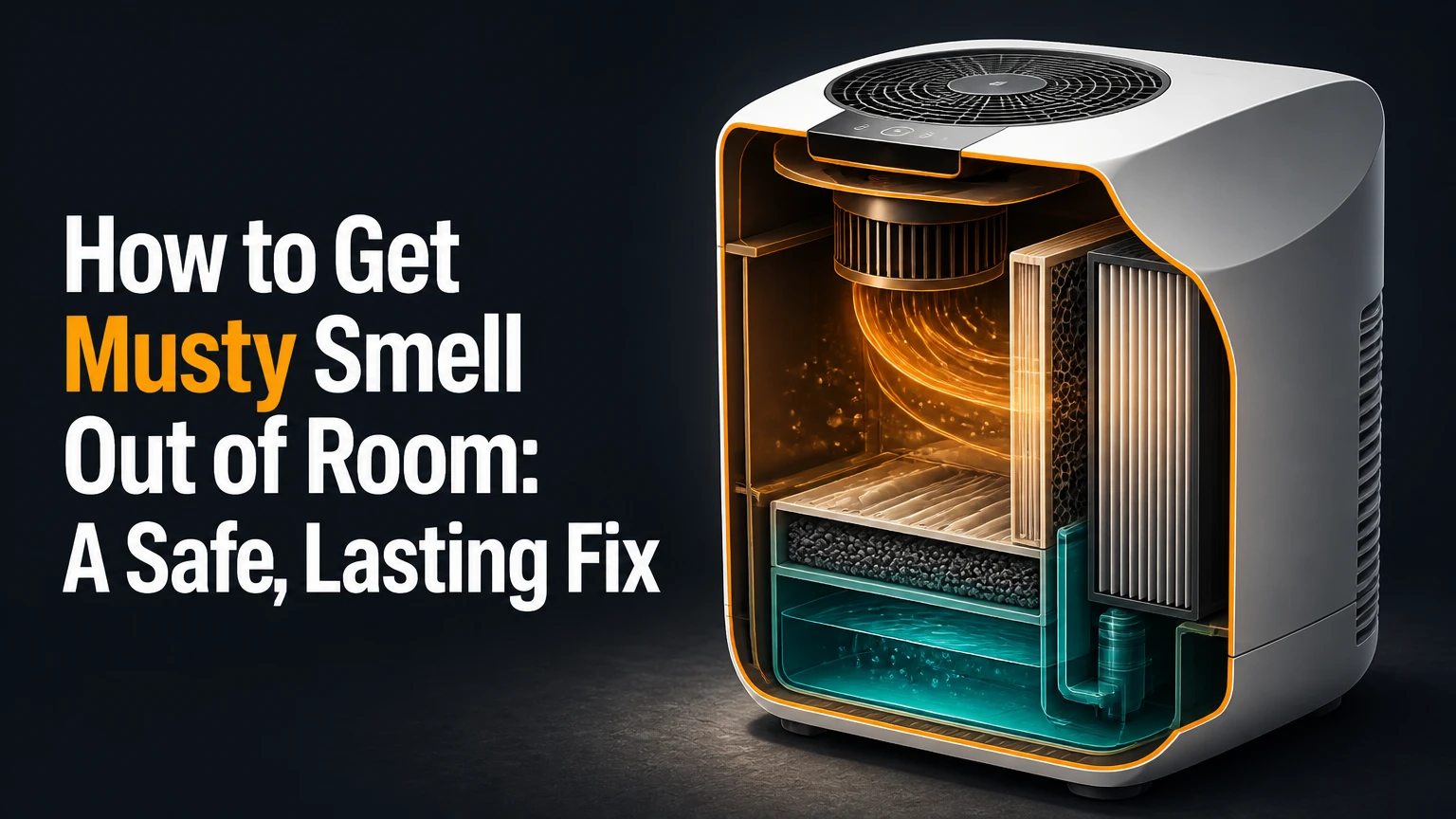
A dehumidifier removes moisture; an activated-carbon air purifier removes some airborne odor compounds. Neither repairs a leak.
Do not mix bleach with vinegar, ammonia, hydrogen peroxide, or other cleaners.
Porous drywall, insulation, ceiling tile, and saturated carpet padding often require removal rather than surface cleaning.
Visible mold covering more than about 10 square feet warrants professional guidance under EPA remediation guidance, especially after flooding.
Why Does a Room Smell Musty?
A musty room smells that way because damp materials, microbial growth, poor air exchange, or contaminated HVAC components release odor compounds into the air. Mold and mildew are common causes, but odor alone cannot identify the species, quantity, or health risk of any growth.
The smell often becomes noticeable before visible mold appears. Microbial volatile organic compounds, or mVOCs, can come from fungal growth on paper, wood, fabric, dust, or drywall facing. Damp carpet padding is especially deceptive because the surface may look clean while polyurethane foam below retains moisture and odor.
EPA describes moisture control as the central mold-control measure: “The key to mold control is moisture control.” That principle matters more than the choice between vinegar, baking soda, or a scented product.
| Possible source | Where to inspect | Useful clue | First response |
|---|---|---|---|
| Condensation | Windows, exterior walls, closets | Odor worsens after cold nights | Reduce RH and improve air circulation |
| Water leak | Ceiling, baseboard, plumbing cabinet | Staining, bubbling paint, swollen trim | Stop the leak and dry materials |
| Carpet padding | Under rugs, room perimeter, tack strips | Smell returns after vacuuming | Lift a corner and check the pad |
| HVAC contamination | Return grille, filter, coil cabinet | Odor appears when fan starts | Replace filter and arrange HVAC inspection |
| Stagnant storage | Closets, boxes, upholstered furniture | Strongest behind stored items | Empty, dry, wash, or discard affected goods |
A sulfur, rotten-egg, sewage, or fuel-like odor deserves a different response. Leave the area for strong gas odors, avoid switches and flames, and contact the gas utility or emergency services. A musty odor should not be used as a diagnosis for every unpleasant room smell.
How Do You Get Musty Smell Out of Room?
The reliable method takes five actions: find and stop moisture, measure humidity, isolate affected materials, clean only surfaces that can be safely restored, and dry the room completely. A small, isolated odor may improve within 24-72 hours; odor from wet building materials can persist until those materials are removed.
Before You Start
Prepare the room before moving contaminated items through the house. Typical DIY supply costs are $35-$180, excluding a dehumidifier, and the first inspection and cleaning session usually takes 2-6 hours.
| Item | Typical quantity or specification | Typical USA cost | Purpose |
|---|---|---|---|
| Digital hygrometer | 1 unit, 30%-90% RH range | $8-$25 | Measures room humidity |
| Nitrile gloves | 1 box, 50-100 gloves | $8-$18 | Protects hands during cleaning |
| N95 respirator | 1 per person, NIOSH-approved | $2-$8 each | Reduces inhalation of particles |
| Microfiber cloths | 6-12 cloths | $8-$20 | Removes residue from hard surfaces |
| HEPA vacuum | Sealed unit with replaceable filter | $120-$500 purchase | Captures fine dust during cleanup |
| EPA-registered cleaner | 1 quart or spray bottle | $6-$20 | Surface-specific cleaning |
| Dehumidifier | 30-50 pint/day for a room | $170-$350 | Lowers sustained RH |
People with asthma, severe allergies, chronic lung disease, or immune suppression should avoid disturbing suspected mold and ask a qualified professional for advice. Children and pets should stay outside the work area. Never rely on an N95 mask to make extensive mold removal safe.
Step 1: Find and Stop the Moisture
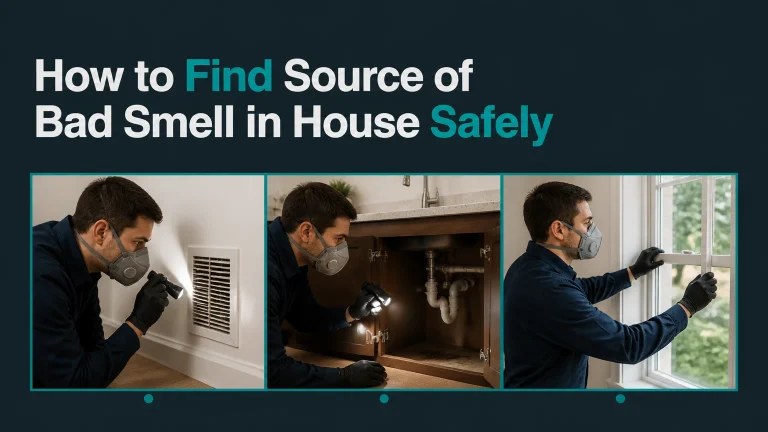
Inspect the room systematically, beginning at the odor’s strongest point and then checking adjacent spaces. Look behind furniture, under rugs, inside closets, around windows, along exterior walls, beneath sinks, near HVAC equipment, and above stained ceilings.
Use a hygrometer in the center of the room, away from a supply vent and exterior wall. Record RH in the morning and evening for two days. A reading above 60% indicates poor moisture control, while condensation on windows or cold walls shows that local surface conditions may be wetter than the room average.
Check for:
- Plumbing leaks under sinks, behind toilets, and near washing machines.
- Roof, siding, foundation, or window leaks after rain.
- Condensation around uninsulated ducts, cold-water pipes, and exterior corners.
- Wet carpet padding, stored cardboard, mattresses, or upholstered furniture.
- Air-conditioning drain pans, condensate lines, and dirty return-air compartments.
Stop the water before deodorizing. A cleaned surface will smell again if the leak, condensation, or damp padding remains.
You will know this step worked when: no active leak is present, the affected material is drying, and RH falls toward 30%-50%.
Common mistake: Measuring only room humidity and ignoring a wet wall cavity or carpet pad. A room can read 48% RH while one concealed material remains saturated.
What if the room has no visible water?
A room with no visible leak may still have hidden moisture, especially after a past flood or slow plumbing failure. Compare the odor at baseboards, carpet edges, wall penetrations, closets, and HVAC registers; a pinless moisture meter can identify suspicious patterns but cannot prove mold or locate every leak.
Typical meter readings vary by material and device, so compare suspicious areas with a dry reference area of the same material. Do not cut into walls based on one unexplained reading. A building inspector, leak-detection specialist, or qualified remediation professional can investigate concealed moisture with thermal imaging, targeted openings, or other methods.
Step 2: Lower Humidity and Exchange Air
Run a correctly sized dehumidifier with windows closed when outdoor air is humid. Set the unit around 45%-50% RH, keep its intake and exhaust unobstructed, and empty the reservoir or connect a continuous drain according to the manufacturer’s instructions.
Open windows only when outdoor air is genuinely drier than indoor air. In a hot, humid summer climate, ventilation can add water vapor and make the odor source grow faster. A bathroom exhaust fan should vent outdoors, not into an attic, crawl space, or wall cavity.
| Equipment | Removes moisture | Removes airborne odor | Best use | Main limitation |
|---|---|---|---|---|
| 30-pint dehumidifier | Yes, typical small-room capacity | Indirectly, after drying | Bedroom or office | Does not fix leaks |
| 50-pint dehumidifier | Yes, higher extraction rate | Indirectly, after drying | Basement or damp suite | Uses more electricity |
| HEPA purifier | No | Limited, unless carbon is included | Airborne particles | Cannot dry materials |
| Activated-carbon purifier | No | Yes, variable by carbon mass | Residual odor after drying | Carbon saturates |
| Box fan | No | Moves odor only | Dry-air exhaust | Can spread particles |
| HVAC exhaust fan | Sometimes | Exchanges air | Bathrooms and kitchens | Must discharge outdoors |
EPA guidance recommends indoor RH between 30% and 50%. Avoid driving humidity below roughly 30% for long periods because excessively dry air can irritate skin and airways and damage some wood products.
You will know this step worked when: the hygrometer remains below 50% for at least 24 hours and condensation stops.
Common mistake: Running a fan directly across visible mold. Air movement can spread particles to clean areas. Drying should be controlled, and extensive growth should be handled professionally.
Step 3: Clean Hard, Nonporous Surfaces
Wear gloves, eye protection, and a properly fitted N95 respirator when cleaning a small, localized area. Use detergent and water on sealed tile, metal, glass, vinyl, and finished plastic, then dry the surface completely.
Vinegar can remove some odor and surface residue, but a 1:1 vinegar-water mixture is not a universal mold treatment. Its performance varies by organism, surface, concentration, and contact time, and household vinegar should not be presented as a guaranteed fungicide.
For an EPA-registered antimicrobial product, read the label for the exact material, required wet contact time, ventilation instructions, and personal protective equipment. Never combine products. In particular, mixing vinegar with bleach can release chlorine gas.
| Surface | Safer first treatment | Drying requirement | When replacement is more appropriate |
|---|---|---|---|
| Glazed tile | Detergent, water, dry cloth | 1-2 hours | Grout remains damp or crumbles |
| Painted trim | Detergent on damp cloth | 2-6 hours | Wood is swollen or soft |
| Finished wood | Manufacturer-approved cleaner | 6-24 hours | Finish is lifting or wood stays wet |
| Drywall face | Light surface cleaning only | 24-48 hours | Paper is swollen, stained, or moldy |
| Metal register | Detergent, rinse, dry | 1-2 hours | Internal insulation is contaminated |
Do not saturate drywall, raw wood, insulation, or plaster merely to increase cleaner contact time. Extra water can carry contamination deeper into a porous assembly and extend drying.
You will know this step worked when: the cleaned surface is dry, has no visible residue, and the odor does not intensify after the room is closed for several hours.
Common mistake: Treating dark staining as proof that bleach has solved the problem. Bleach may change color while leaving moisture and damaged porous material behind.
Step 4: Launder and Restore Soft Materials
Remove washable fabrics from the room and place them in sealed bags or containers if they are visibly moldy. Wash according to the care label with detergent and the warmest safe water, then dry thoroughly; a fixed 140°F setting is not safe for every textile and is unnecessary for many washable items.
Curtains, bedding, clothing, and washable rugs can retain odor after a single wash. Repeat laundering only after identifying the moisture source. Do not return fabric to a room that remains above 50%-60% RH because it can absorb moisture again.
For upholstered furniture and mattresses, vacuuming and baking soda may reduce surface odor but cannot reliably clean deep contamination. Avoid soaking foam. Professional upholstery extraction may help when contamination is limited, while heavily wet or moldy foam often needs replacement.
Can baking soda remove musty carpet odor?
Baking soda can absorb some surface moisture and odor, but it does not remove mold growing beneath carpet fibers or inside padding. Use it only after the carpet is dry, leave a thin layer for 12-24 hours, and remove it with a sealed HEPA vacuum if the manufacturer permits.
Carpet affected by clean-water wetting may sometimes be professionally dried within 24-48 hours. Sewage, floodwater, long-standing dampness, or mold growth changes the decision because padding and subfloor materials may be contaminated. Do not use a household vacuum on visibly moldy or wet carpet.
Step 5: Clean or Remove Carpet and Porous Materials
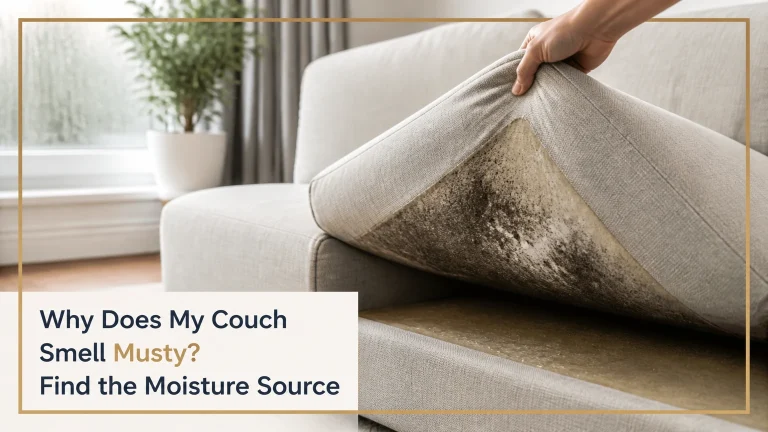
Lift a carpet corner near the strongest odor and inspect the pad, tack strip, subfloor, and baseboard. A musty smell that returns after surface extraction strongly suggests retained moisture or contamination beneath the visible fibers.
Discard or arrange professional assessment for porous items that are visibly moldy, swollen, delaminated, or impossible to dry completely. Common examples include saturated carpet pad, ceiling tile, fiberglass insulation, cardboard boxes, particleboard furniture, and moldy drywall.
| Material | Typical decision | Typical drying window | Odor-removal outlook |
|---|---|---|---|
| Washable cotton | Launder and dry | 4-24 hours | Usually favorable |
| Synthetic area rug | Professional extraction if sound | 24-48 hours | Variable |
| Carpet pad | Remove if saturated or moldy | 24-48 hours after removal | Poor if retained |
| Painted drywall | Clean only if superficial and dry | 24-48 hours | Poor if paper is damaged |
| Solid wood | Clean, dry, refinish if needed | 2-7 days | Often favorable |
| Particleboard | Replace after swelling or mold | 2-7 days for surrounding area | Poor |
Professional drying equipment can shorten the timeline, but drying equipment does not make contaminated material reusable automatically. The material’s porosity, water category, duration of wetness, and structural condition determine the outcome.
You will know this step worked when: the carpet pad and subfloor are dry, the room remains below 50% RH, and the odor does not return after 24 hours with the door closed.
Common mistake: Replacing only the carpet while leaving the old pad. Odor compounds can continue migrating from the retained foam.
Which Removes Musty Odor Best, a Dehumidifier or an Air Purifier?
A dehumidifier is the better first purchase when room RH exceeds 50%-60% or damp materials are present. An air purifier with substantial activated carbon is useful after moisture is controlled, while a HEPA filter primarily captures particles and does not remove the water source or all gaseous odor compounds.
| Option | Typical USA price | Main function | Best condition | Limitation |
|---|---|---|---|---|
| Hygrometer | $8-$25 | Measures RH | Every musty room | Does not change conditions |
| Portable dehumidifier | $170-$350 | Extracts water | Damp bedroom or basement | Noise and electricity use |
| HEPA purifier | $100-$400 | Captures airborne particles | Dust or suspected spores | Little odor removal without carbon |
| Carbon purifier | $150-$600 | Adsorbs some gases | Residual odor after drying | Carbon requires replacement |
| Professional air scrubber | $300-$1,000 weekly rental | Filters during remediation | Contained cleanup | Not a substitute for source repair |
A purifier can make the air smell better while the wall, floor, or furniture remains wet. That apparent success is temporary. Use the hygrometer as the deciding instrument, not your nose alone.
Vinegar, Bleach, or Commercial Cleaner: Which Is Safer?
For small growth on hard, washable surfaces, detergent and water are often a reasonable first cleaning method, while an EPA-registered product can be selected when its label covers the material. Vinegar is not a guaranteed mold killer, and bleach is a poor choice for porous drywall, raw wood, carpet, and insulation.
Use bleach only when the product label permits it and the surface is compatible. Never mix bleach with acids, ammonia, or other cleaners, and provide ventilation without blowing contaminated air into occupied areas.
The practical hierarchy is:
- Repair the moisture source.
- Remove unsalvageable porous material.
- Clean salvageable hard surfaces.
- Dry the assembly.
- Use filtration for residual airborne particles or odor.
That sequence prevents a common failure: applying a stronger chemical to a material that should have been removed or dried.
How Long Does Musty Smell Take to Disappear?
A minor stale-air odor may improve in 2-24 hours after ventilation and humidity control, while odor from carpet padding, drywall, or wall cavities commonly takes 2-7 days after correct drying and source removal. If the smell returns within 24-48 hours, the source is probably still present or a porous material remains contaminated.
| Situation | Typical improvement time | Likely next action | Typical DIY cost |
|---|---|---|---|
| Stagnant closed room | 2-12 hours | Ventilate when outdoor air is dry | $0-$25 |
| Condensation problem | 1-3 days | Dehumidify and improve airflow | $20-$350 |
| Damp washable textiles | 1-3 days | Launder and dry fully | $10-$40 |
| Wet carpet pad | 2-7 days after removal | Replace or professionally dry | $150-$1,500 |
| Hidden wall moisture | 1-4 weeks | Leak repair and targeted opening | $300-$5,000 |
| HVAC odor source | 1-7 days after service | Coil, drain-pan, or liner inspection | $150-$1,500 |
Costs are typical USA household ranges, not fixed quotes. Regional labor, access, water damage category, room size, and reconstruction requirements can change the total substantially.
When Should You Stop DIY Cleaning?
Stop DIY work when visible mold covers more than approximately 10 square feet, contamination involves HVAC systems, sewage or floodwater, extensive drywall, insulation, or multiple rooms. EPA mold remediation guidance uses 10 square feet as a planning threshold, but sensitive occupants and complex building conditions justify earlier professional involvement.
Professional help is also appropriate when:
- The odor returns after two complete drying and cleaning cycles.
- A wall, ceiling, floor, or crawl space remains wet.
- The HVAC system distributes the smell through multiple rooms.
- You cannot identify the moisture source.
- Occupants develop breathing symptoms or worsening asthma.
- The property has extensive water damage or suspected sewage contamination.
Do not cut open walls, remove insulation, or run an unsealed vacuum in a contaminated area without a containment plan. Ask contractors for the moisture diagnosis, work scope, containment method, disposal procedure, and post-remediation moisture verification. Mold testing is not always necessary for a basic visible-growth cleanup, and a laboratory result does not repair a leak.
Situation-Specific Fixes for Bedrooms, Basements, and Closets
How do you remove musty smell from a bedroom?
Remove bedding and upholstered items, inspect the bed base and exterior wall, measure RH near the floor and closet, and run a dehumidifier until readings remain below 50%. Wash fabrics, clean sealed surfaces, and leave several inches between furniture and cold exterior walls.
Bedrooms often develop odor from condensation behind headboards, damp mattresses, storage boxes, or a portable air conditioner’s drain system. Do not sleep in the room during active cleaning of visible mold or while strong chemical vapors remain.
How do you deodorize a basement?
A basement requires source control before deodorizing because foundations, slab edges, sump pits, drains, and ductwork can continuously introduce moisture. Check after rainfall, operate a correctly sized dehumidifier, keep RH at 40%-50%, and inspect stored cardboard and carpet.
Never cover a damp basement smell with a fragrance diffuser. Remove wet materials, verify drainage and sump-pump operation, and obtain a professional inspection when seepage affects walls or flooring.
How do you fix a musty closet?
Empty the closet, wash or dry-clean clothing according to labels, discard damp cardboard, clean shelves, and leave the door open while RH is controlled. Maintain air circulation with clearance around exterior walls and avoid packing clothing tightly against cold surfaces.
Passive desiccant bags can help in a small wardrobe, but they have limited capacity. Replace them according to the package instructions and use a hygrometer elsewhere in the room to confirm that the wider moisture problem is controlled.
What should renters do?
Renters should photograph stains, condensation, damaged materials, and hygrometer readings, then report the moisture source to the property manager in writing. Use reversible steps such as laundering fabrics and running a properly drained dehumidifier, but do not remove drywall or apply aggressive chemicals without permission.
Document dates, room locations, odors, and maintenance responses. Local housing requirements differ across the USA, so tenants should contact a city or county housing department, tenant union, or legal-aid organization when a landlord does not address persistent water intrusion.
Common Mistakes and How to Fix Them
Masking the odor with fragrance: Candles, plug-ins, essential-oil diffusers, and aerosol deodorizers add volatile compounds without drying the room. Stop masking, measure RH, and isolate the strongest odor source.
Using a box fan on visible mold: Airflow can spread particles. Turn off uncontrolled fans, close nearby doors, and seek professional advice for extensive growth.
Cleaning moldy drywall repeatedly: Surface wiping cannot restore swollen or moldy paper facing. Remove affected drywall under an appropriate containment plan.
Vacuuming with an unsealed machine: A conventional bagless vacuum can redistribute fine particles. Use a sealed HEPA vacuum for suitable dry materials, or leave extensive contamination to a remediation contractor.
Opening windows during humid weather: Outdoor air can increase indoor moisture. Compare outdoor and indoor RH before ventilating.
Replacing only the visible finish: New paint, carpet, or trim will not stop odor from a wet cavity or pad. Confirm moisture control before reconstruction.
Mixing cleaning chemicals: Bleach and vinegar can produce dangerous chlorine gas. Use one product at a time, follow its label, and rinse or dry as directed.
Frequently Asked Questions
Can a musty smell exist without visible mold?
Yes. Musty odor can come from hidden mold, damp carpet padding, wet wood, dirty HVAC insulation, stagnant air, or moisture behind furniture. Visible inspection cannot rule out concealed moisture, so compare RH readings, inspect edges and cavities safely, and investigate any odor that returns after cleaning.
Will a dehumidifier remove a musty smell?
A dehumidifier can remove musty smell indirectly by lowering moisture and stopping continued microbial growth, but it does not remove odor already trapped in carpet, drywall, furniture, or clothing. Use a hygrometer and continue source removal and cleaning after RH reaches 30%-50%.
Is a musty room dangerous?
A musty room is not automatically dangerous, and odor does not identify a specific mold species or toxin. Persistent dampness can support mold and worsen symptoms for some occupants, particularly people with asthma or allergies. Address water promptly and seek medical advice for breathing symptoms.
Should I get a mold test?
A mold test is not always needed when visible growth and a moisture source are obvious. Testing cannot replace leak repair or material removal. Consider an independent assessor when the source is hidden, occupants have persistent concerns, multiple rooms are involved, or a professional remediation decision requires documentation.
How much does professional mold remediation cost?
Typical USA remediation for a limited room may range from about $500-$3,000, while extensive water damage, HVAC contamination, demolition, or reconstruction can exceed $5,000. Obtain written scopes from qualified contractors because square footage, material type, containment, disposal, and rebuilding drive the final price.
Can I paint over a musty wall?
No. Paint can hide staining temporarily but cannot dry a wall cavity or remove contaminated drywall. Repair the moisture source, assess the wall assembly, remove damaged material when required, and repaint only after the substrate is dry and suitable for coating.
The Bottom Line
To get musty smell out of room air permanently, treat the odor as a moisture investigation rather than a fragrance problem. Measure humidity, repair leaks, dry the room to 30%-50% RH, launder recoverable fabrics, clean compatible hard surfaces, and remove porous materials that remain wet or moldy.
A dehumidifier controls moisture, a carbon purifier manages some residual gases, and HEPA filtration captures airborne particles. None replaces source repair. If the smell returns within 24-48 hours, visible growth exceeds approximately 10 square feet, or contamination involves HVAC systems, flooding, or wall cavities, professional assessment is the safer next step.