
Why Are My Windows Sweating? Find the Real Cause
Window sweating is surface condensation: water vapor in indoor or outdoor air turns into liquid when it touches glass colder than the air’s dew point. Interior droplets usually mean excessive indoor moisture or insufficient warm-air circulation; exterior droplets often indicate efficient Low-E glass, while moisture between panes usually means an insulating-glass seal has failed.
Key facts at a glance
Interior window condensation forms when the glass surface temperature falls below the room air’s dew point.
A digital hygrometer costing about $10-$25 can confirm whether indoor relative humidity is contributing to the problem.
Winter indoor relative humidity often needs to stay below 35%-40% in cold U.S. climates to prevent wet glass.
Moisture between sealed panes cannot be wiped away because the insulated glass unit, or IGU, has lost airtightness.
Exterior condensation on high-performance windows is commonly harmless and can indicate that the glazing is insulating effectively.
Persistent water on frames or sills can damage wood, drywall, paint, and finishes even when the original cause is ordinary condensation.
What Does Window Sweating Mean?
Window sweating means condensation has collected on a window surface. The water is not leaking through the glass when it appears as droplets on one face; the air next to that face has cooled enough to reach saturation.
The U.S. Geological Survey defines the underlying process simply: “Condensation is the process by which water vapor turns into liquid water.” Warm air can contain more water vapor than cold air, but cooling does not remove moisture from the air. Instead, the relative humidity rises until the air reaches its dew point.
A cold window is often the first place condensation appears because glass transfers heat more readily than insulated walls. Aluminum frames, metal spacers around double-pane glass, poorly insulated trim, and air leaks can create even colder areas.
How Does Dew Point Create Water?
Dew point is the temperature at which air becomes saturated with its existing water vapor. For example, indoor air at 70°F and 50% relative humidity has a dew point near 50°F. If the interior glass surface falls to 50°F or below, condensation can develop.
Relative humidity is therefore only part of the diagnosis. A room at 70°F and 40% RH has a dew point near 46°F, while a room at 70°F and 60% RH has a dew point near 55°F. The second room can produce wet windows even when the room feels comfortably warm.
Why Are My Windows Sweating in Winter?
Interior window sweating in winter usually results from indoor humidity meeting cold glazing, although restricted airflow and installation defects can make one window worse than the rest. Showers, cooking, drying laundry, houseplants, occupants, and combustion appliances add water vapor to the home.
Cold outdoor temperatures lower the inside glass temperature. The colder the glass, the less indoor moisture the room can tolerate before condensation begins. A tight, modern home can also retain more water vapor because air leakage no longer removes moisture as quickly.
| Indoor air at 70°F | Approximate dew point | Condensation risk in winter |
|---|---|---|
| 30% RH | 37°F | Low on quality double-pane glass |
| 40% RH | 46°F | Moderate near frames and edges |
| 50% RH | 50°F | High on cold or older glazing |
| 60% RH | 55°F | Very high, with possible wall and sill condensation |
| 70% RH | 60°F | Severe, including frost on cold glass |
The 30%-50% indoor humidity range is a broad comfort guideline, not a universal winter target. In Minneapolis, Buffalo, or Denver during a cold snap, 30%-35% RH may be more realistic. In Seattle, Atlanta, or Miami, outdoor humidity, air conditioning, and building ventilation change the balance.
What Household Activities Add Moisture?
The Environmental Protection Agency recommends controlling moisture at its source and keeping indoor humidity below 60%, ideally between 30% and 50%. That upper limit is intended for general mold prevention; windows in cold weather may require a lower setting.
| Moisture source | Typical water released | Best control |
|---|---|---|
| 20-minute shower | 0.2-0.5 gallons | Bathroom exhaust during and 20 minutes after showering |
| Simmering uncovered food | 0.5-2 gallons per day of cooking | Range hood vented outdoors, lids on pots |
| Clothes drying indoors | 1-2 gallons per load | Outdoor vented dryer or separate drying room |
| Two sleeping adults | About 1-2 pints overnight | Bedroom ventilation and lower nighttime humidity |
| Unvented gas heater | Variable, often substantial | Stop using indoors and install vented equipment |
The figures are typical household ranges, not fixed outputs. A long shower, wet laundry load, or unvented propane heater can release substantially more water than a short cooking task.
How Do You Diagnose the Wet Location?
The wet location identifies the likely failure mode. Touch the moisture with a clean, dry cloth or inspect the surface at an angle: room-side water is a humidity or temperature problem, exterior water is usually weather-related, and fog trapped inside an IGU indicates seal failure.
Interior Surface
Room-side droplets appear on the inside face of the glass, frame, or sill. They are most common during winter mornings, after showers, during cooking, or in bedrooms with closed doors and limited air movement.
Interior condensation becomes more concerning when water pools on wood, reaches drywall, freezes repeatedly, or returns after indoor RH falls below the appropriate seasonal target. A wet lower edge can also indicate a cold spacer or a missing perimeter seal between the frame and wall.
Exterior Surface
Exterior condensation appears on the outdoor face of the pane. It frequently occurs during humid summer mornings or clear nights when the glass radiates heat toward the sky and becomes cooler than the surrounding outdoor air.
Low-E double-pane and triple-pane windows can show more exterior dew than older single-pane windows because the interior heat stays inside instead of warming the outer glass. Exterior droplets usually do not indicate a failed seal.
Between the Panes
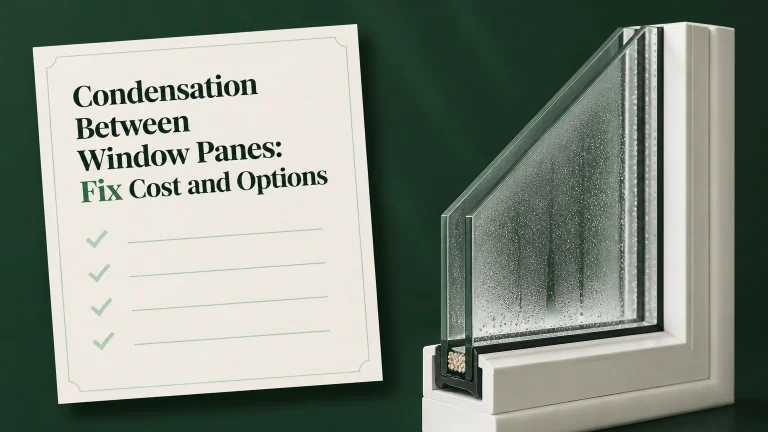
Moisture between panes appears as fog, haze, or droplets inside a sealed double-pane or triple-pane unit. The space cannot be reached by wiping either side, and the appearance may change with temperature or sunlight.
A failed edge seal allows humid air to enter the IGU. The desiccant in the spacer initially absorbs that moisture, but once saturated, the unit remains cloudy and loses some insulating performance. The frame may still be sound, so replacing the glass unit is often possible without replacing the entire window.
| Moisture location | Common season | Likely cause | Typical urgency |
|---|---|---|---|
| Room-side glass | November-March | High RH or cold surface | Same week if water pools |
| Room-side frame | Winter | Thermal bridge or air leak | Same week |
| Outdoor glass | May-September mornings | Outdoor dew point above glass temperature | Usually low |
| Between panes | Any season | Failed IGU perimeter seal | Schedule repair |
| Wall or trim beside window | Any season | Installation air leak or water intrusion | Prompt inspection |
What Humidity Should a House Have?
A house should generally stay at 30%-50% RH, but cold-weather homes often need a lower indoor target to keep window surfaces above their dew point. Use outdoor temperature, not a single year-round humidity number, to set a practical winter limit.
| Outdoor temperature | Suggested maximum indoor RH | Reason |
|---|---|---|
| 40°F | 40%-50% | Most modern double-pane windows tolerate this range |
| 20°F | 30%-40% | Glass edges become significantly colder |
| 0°F | 25%-35% | Frost risk rises on older or metal-framed windows |
| -20°F | 15%-25% | Very cold surfaces require aggressive moisture control |
These are operating ranges, not guarantees. Window design, glazing type, frame material, wind exposure, curtains, and indoor air circulation can shift the result by several percentage points.
Place a hygrometer in the affected room, away from a humidifier, supply register, kitchen, bathroom, or exterior wall. Record RH in the morning and evening for three days. A reading of 35% in the living room does not prove that a bedroom or basement has the same humidity.
How Do You Stop Interior Condensation?
To stop interior condensation, reduce indoor moisture, increase warm airflow across the glass, and raise the interior surface temperature where practical. Start with a hygrometer and exhaust fans before buying replacement windows.
- Measure indoor relative humidity. Record room temperature and RH near the affected window.
Success checkpoint: You have three readings taken at different times.
Common mistake: Measuring beside a running shower or dehumidifier. - Exhaust moisture at the source. Run the bathroom fan during bathing and for 20 minutes afterward. Use a range hood vented outdoors while cooking.
Success checkpoint: Steam clears from the bathroom mirror within about 15 minutes.
Common mistake: Using a recirculating hood that filters grease but does not remove vapor. - Lower the humidity target. Set a portable dehumidifier to 35%-45% RH in winter, or reduce a whole-house humidifier.
Success checkpoint: Morning RH stays below the seasonal limit for several days.
Common mistake: Adding humidity because dry skin feels uncomfortable without checking the windows. - Restore airflow at the window. Open curtains several inches, keep supply registers unobstructed, and maintain roughly 2-4 inches between furniture and exterior walls.
Success checkpoint: The glass dries faster after heating cycles begin.
Common mistake: Closing blackout curtains tightly overnight. - Dry the sill every day. Wipe standing water and inspect paint, caulk, wood joints, and drywall.
Success checkpoint: No pooled water or darkening material remains after 24 hours.
Common mistake: Painting over damp wood before correcting the moisture source.
A temporary interior shrink-film kit can improve the temperature of the room-side plastic surface during winter. Film does not repair a failed IGU seal, stop exterior condensation, or correct water entering around the window frame.
Why Is One Window Worse Than the Others?
One window can sweat while nearby windows remain dry because its glass is colder, its airflow is restricted, or its installation has a localized defect. A north-facing window, basement window, corner room, window behind furniture, or opening exposed to prevailing wind commonly shows the first symptoms.
Compare the affected window with another of the same size and orientation. Check for a cold draft around the trim using a smoke pencil or incense, inspect exterior caulk, and look for missing insulation behind interior casing.
A thermal camera can reveal a cold perimeter, but readings require consistent indoor conditions and a known emissivity setting. A surface thermometer is less expensive and often sufficient. Measure the center glass, lower corner, frame, and adjacent wall, then compare them with a dry window.
Practitioner rule: If indoor RH is controlled but one window still develops water at the same frame location, investigate air leakage or a thermal bridge before replacing all the windows.
Can Sweating Windows Cause Damage?
Persistent interior condensation can damage wood, paint, drywall, flooring, and insulation, while repeated dampness supports mold growth. Water on the glass is not automatically dangerous, but water that remains on porous materials requires prompt correction.
Look for swelling at wood joints, peeling paint, dark sill corners, soft drywall, musty odor, and mold on caulk. The Centers for Disease Control and Prevention recommends fixing moisture problems and cleaning hard surfaces, but porous materials with extensive mold contamination may need removal.
Do not rely on bleach as a universal remedy. Porous wood, drywall, carpet, and insulation can retain contamination behind the visible surface. For an area larger than about 10 square feet, extensive water damage, or occupants with significant respiratory sensitivity, consult a qualified remediation professional.
Unvented fuel-burning heaters require special caution. They release combustion water and may also produce carbon monoxide, so replacing them with properly vented equipment and maintaining working carbon monoxide alarms is safer than simply running a larger dehumidifier.
Is Exterior Condensation a Problem?
Exterior condensation is usually harmless when water is on the outdoor face of the glass and disappears after the sun or wind dries it. High-performance Low-E windows often show exterior dew because their insulating layers prevent indoor heat from warming the outside pane.
Exterior condensation becomes worth investigating when water appears between panes, enters the wall, remains unusually long because of a roof overhang, or occurs with damaged exterior glazing seals. Exterior dew itself does not prove that the window is defective.
| Window condition | Exterior condensation likelihood | Interpretation |
|---|---|---|
| Single-pane glass | Low | Indoor heat warms the outdoor surface |
| Older clear double-pane glass | Low to moderate | Moderate insulating value |
| Double-pane Low-E glass | Moderate | Outer pane stays cooler |
| Triple-pane Low-E glass | Moderate to high | Stronger thermal separation |
| Shaded glass on a clear night | High | Radiative cooling lowers surface temperature |
Which Fix Should You Choose?
The right fix depends on whether the problem is airborne moisture, restricted airflow, a cold bridge, or a failed IGU. A $15 hygrometer and source-control changes should come before a $1,000-per-window replacement decision.
| Fix | Typical USA cost | Setup or installation time | Best use | Important limitation |
|---|---|---|---|---|
| Digital hygrometer | $10-$25 | 5 minutes | Confirming RH | Does not measure glass temperature |
| Portable dehumidifier | $150-$300 | 15-30 minutes | High indoor moisture | Uses electricity and needs drainage |
| Interior shrink film | $10-$40 per window | 30-60 minutes | Renters and drafty winter windows | Temporary appearance and access limits |
| IGU glass replacement | $250-$600 per window | 2-4 hours | Failed sealed unit | Requires accurate measurement |
| Whole-window replacement | $600-$1,500 per window | 1-3 days for a house | Damaged frame or repeated defects | Highest cost and installation disruption |
| ERV or HRV system | $2,000-$5,000 | 1-3 days | Tight homes with persistent ventilation needs | Requires design, controls, and maintenance |
Prices are typical U.S. planning ranges and vary by region, window size, access, frame condition, labor, and warranty coverage. Glass-only replacement usually costs less than full-frame replacement when the existing frame is square, dry, structurally sound, and properly flashed.
When Is Glass Replacement Better Than Full Replacement?
Glass-only replacement is usually the better economic choice when the frame remains intact and the only fault is fogging between panes. Full replacement becomes more defensible when wood is rotten, the frame leaks, the opening is poorly flashed, the window is severely drafty, or multiple components have failed.
Check the original manufacturer’s warranty before authorizing work. Many IGU warranties cover seal failure for a defined period, but labor, glass appearance, transferability, and installation errors may be treated separately.
Is IGU Defogging Worth Paying For?
IGU defogging can improve visibility at a lower upfront price, often around $100-$200 per window, but drilling and venting the unit does not restore the original insulating gas or factory seal. It is a cosmetic or temporary intervention, not equivalent to replacing the failed sealed unit.
A defogging service may make sense for a large, expensive, historically significant, or difficult-to-remove window when full replacement is impractical. It is a weak choice when the window is under warranty or when long-term energy performance matters.
What Should Renters Do First?
Renters should document the moisture, control room humidity, improve exhaust ventilation, and use removable interior film without altering the window frame. Photograph wet sills and record hygrometer readings before requesting building maintenance.
Do not drill a frame, remove sealed glass, apply permanent caulk, or disconnect a landlord-provided humidifier without permission. Report failed seals, rotted sills, leaks around trim, and condensation that persists below roughly 35%-40% RH.
A renter’s practical sequence is simple:
- Buy a hygrometer and record the affected room’s RH.
- Run bathroom and kitchen exhaust fans during moisture-producing activities.
- Keep curtains open enough for warm air to reach the glass.
- Dry the sill daily.
- Request inspection when moisture is between panes or the frame is deteriorating.
When Should You Call a Professional?
Call a window or building-envelope professional when condensation persists after humidity control, when moisture is trapped between panes, or when the wall around the window is wet. A professional can separate IGU failure from flashing, drainage, air-sealing, and insulation problems.
Request a written diagnosis that identifies the moisture location, measured indoor RH, suspected dew point, frame condition, and recommended scope. Ask whether the proposed work replaces the glass unit only or the full frame, and ask how the installer will verify dimensions and exterior water management.
Professional evaluation is especially appropriate when:
- Frost forms on interior glass despite controlled RH.
- Water appears beneath trim or inside the wall.
- Several windows fail in the same elevation.
- The window frame is soft, swollen, or structurally damaged.
- A new replacement window sweats immediately after installation.
- Occupants have asthma or other conditions affected by dampness.
A replacement window cannot solve a roof leak, missing flashing, or high whole-house humidity. Correct diagnosis comes first.
Frequently Asked Questions
Do single-pane windows sweat more than double-pane windows?
Yes. Single-pane glass usually has a colder interior surface because there is no insulating air or gas space. Double-pane and triple-pane windows keep the room-side surface warmer, although high indoor humidity can still produce condensation, especially along metal frames, spacers, and edges.
Should I open windows in winter to stop condensation?
Brief ventilation can reduce indoor moisture, but opening windows is inefficient during very cold or humid weather and may not solve a whole-house source. Use exhaust fans first, then ventilate for roughly 5-10 minutes when outdoor conditions are suitable. Mechanical ventilation is more consistent in a tight home.
Does window condensation mean my windows are bad?
No. Interior condensation usually reflects the relationship between indoor humidity and glass temperature, not automatic window failure. Condensation between sealed panes indicates IGU seal failure, while exterior dew commonly occurs because efficient glazing keeps the outdoor pane cold.
Can houseplants cause window sweating?
Houseplants contribute moisture through soil evaporation and transpiration, but a few plants rarely explain severe condensation by themselves. Large plant collections, wet potting soil, aquariums, indoor laundry, and poor ventilation can combine to raise RH enough to affect cold glass.
Why do my windows sweat only at night?
Nighttime condensation often occurs because outdoor temperatures fall, curtains restrict warm airflow, and bedrooms gain moisture from occupants while doors remain closed. Check bedroom RH before sleep and on waking. If the room exceeds its seasonal target, ventilation or dehumidification is usually more effective than replacing the window.
How long does window condensation take to dry?
Light condensation may dry within 30-90 minutes after heating, sunlight, airflow, or ventilation removes the moisture. Pooling water can remain much longer on porous sills. If a sill is still wet after several hours of normal heating, inspect airflow, humidity, frame temperature, and possible water intrusion.
The Bottom Line
Why are my windows sweating? Interior droplets form when humid air reaches glass colder than its dew point, so measure indoor RH, improve exhaust ventilation, and keep warm air moving across the pane before considering replacement. Exterior dew is usually harmless, while moisture between panes signals a failed IGU seal. Correct the moisture source first, then repair the specific window component that has actually failed.