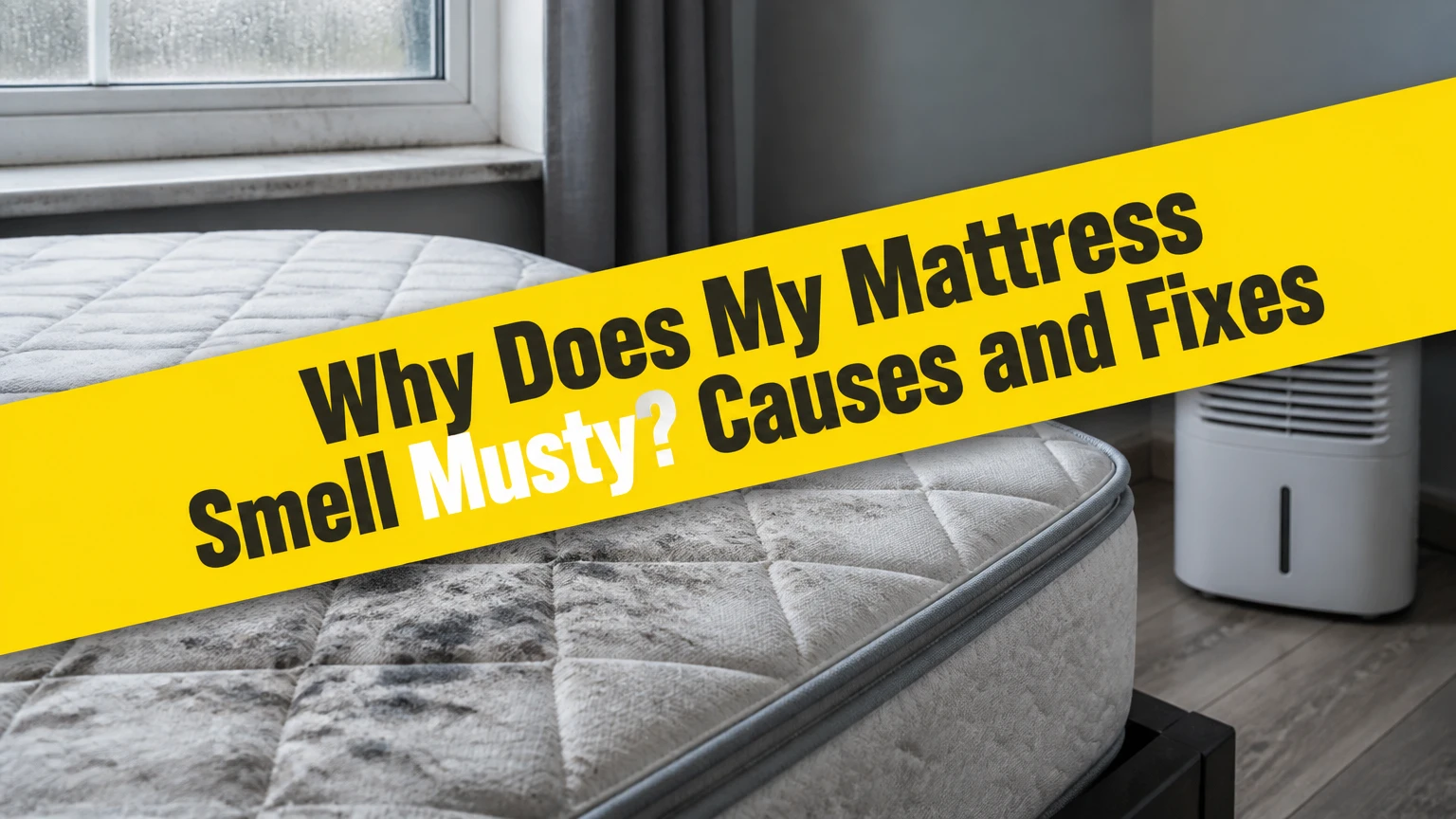
Why Does My Mattress Smell Musty? Causes and Fixes
A musty mattress smell usually means moisture has combined with sweat, skin oils, dust, or a spill inside poorly ventilated materials. That environment can support mildew, mold, or odor-producing bacteria. A persistent earthy or sour odor is different from normal new-mattress off-gassing and deserves inspection before deodorizing or continued use.
Key Facts at a Glance
- A musty odor most often indicates retained moisture, inadequate airflow, fungal growth, or biological residue.
- New-mattress off-gassing usually smells chemical or plasticky and commonly declines during the first several days.
- Baking soda can reduce a light surface odor, but it cannot remove mold growing inside foam or fabric.
- The U.S. Environmental Protection Agency recommends keeping indoor relative humidity below 60%, ideally between 30% and 50%.
- Never soak memory foam, latex, or a spring mattress because trapped water can worsen odor and delay drying.
- A mattress exposed to sewage, floodwater, or extensive visible mold is generally safer to replace than clean.
Why Does My Mattress Smell Musty?
A mattress smells musty when moisture remains in its cover, padding, foam, or foundation long enough for microorganisms and decomposing organic residue to produce volatile odor compounds. Nightly perspiration, body oils, dead skin, spills, pet accidents, condensation, and humid room air can all supply moisture or nutrients.
Mattresses dry slowly because dense polyurethane foam, memory foam, and quilted batting have limited internal airflow. A mattress placed directly on the floor, against a cold exterior wall, or on a solid platform can retain even more moisture underneath. The odor may become strongest in the morning because overnight heat and perspiration have warmed the damp layers.
The EPA states, “The key to mold control is moisture control.” That principle matters more than fragrance, sunlight, or a surface deodorizer. If the moisture source remains, the smell commonly returns after a short improvement.
What does a musty smell usually indicate?
A persistent earthy, damp-basement, sour, or stale-cloth odor indicates one of four conditions: moisture retention, surface mildew, deeper fungal contamination, or biological buildup. Odor alone cannot prove that mold is present, but a smell that returns after airing strongly suggests an unresolved source.
Check the mattress underside, seams, handles, bed slats, box spring, wall behind the bed, and floor beneath it. A musty mattress may be reacting to mold elsewhere in the sleep system rather than containing the original problem.
How does moisture get inside a mattress?
Moisture enters a mattress through perspiration, liquid spills, urine, pet accidents, humid air, condensation, and incomplete drying after cleaning. Memory foam and other closed-cell or dense materials can hold moisture near the cover or in seams, while an absorbent inner layer can retain liquid below the surface.
| Moisture source | Typical exposure | Likely location | First inspection |
|---|---|---|---|
| Adult perspiration | 200-700 mL per night, highly variable | Top quilting and protector | Damp bedding and yellowing |
| Drink or water spill | 250-1,000 mL per event | Localized foam zone | Ring-shaped stain and cool patch |
| Pet urine | 50-500 mL per event | Cover, foam, underside | Sharp ammonia odor |
| High room humidity | 60-90% RH periods | Underside and foundation | Condensation and wall dampness |
| Wet cleaning | 0.5-3.0 L applied | Cover and upper foam | Odor after 24-72 hours |
These quantities are practical ranges, not universal measurements. Body size, climate, bedding, and ventilation change the actual exposure. A waterproof protector reduces liquid entry, but it does not prevent moisture from perspiration accumulating above the protector if bedding is rarely washed or dried.
A mattress on a solid board has less underside ventilation than one on spaced slats. Leave at least several inches of clearance around the foundation where possible, and inspect the underside after humid weather or a spill.
Is the smell mold, mildew, bacteria, or off-gassing?
Chemical off-gassing usually smells like plastic, paint, rubber, or adhesive and is strongest when a mattress is new. Mustiness smells earthy, damp, sour, or like a basement and usually becomes stronger after sleeping, humid weather, or a spill.
| Odor pattern | Most likely source | Usual timing | Recommended response |
|---|---|---|---|
| Plastic or chemical | VOC release from new foam | 1-7 days after opening | Ventilate and follow manufacturer guidance |
| Damp earth or basement | Moisture, mildew, or mold | Persistent or humidity-related | Inspect both mattress sides and room |
| Sour body odor | Sweat, oils, and bacteria | Strongest after sleeping | Wash bedding and dry mattress surface |
| Ammonia | Urine residue | Immediate or humidity-activated | Use an enzyme product only if label permits |
| Smoke or solvent | Cigarette smoke or chemical contamination | Persistent after moving | Professional assessment or replacement |
Mildew commonly describes superficial fungal growth or odor on a damp surface. Mold can also grow below a mattress cover, where it may not be visible. Bacteria can create stale odors without any visible mold, so a clean-looking mattress is not automatically free of odor sources.
Do not identify a mold species by color. Black, green, white, or orange coloration cannot reliably determine toxicity, species, or health risk without laboratory analysis.
Can mold grow inside memory foam?
Mold can grow on organic residue and moisture retained within or around memory foam, although the foam polymer itself is not a food source in the same way as fabric, dust, skin, or spilled liquid. Dense foam also makes internal drying difficult, so surface cleaning may leave a contaminated or wet layer underneath.
| Mattress construction | Drying difficulty | Moisture behavior | Cleaning limitation |
|---|---|---|---|
| Memory foam | High, 24-72 hours after light dampness | Holds moisture in dense cells and seams | Avoid saturation and aggressive scrubbing |
| Latex foam | Medium, 12-48 hours | More resilient but still moisture-sensitive | Check manufacturer washing limits |
| Innerspring | Low to medium, 12-36 hours | Air moves through spring spaces | Padding and border can remain damp |
| Hybrid mattress | Medium to high, 24-72 hours | Foam layers slow internal evaporation | Professional extraction may be incomplete |
| Cotton or wool futon | Medium, 24-72 hours | Absorbs humidity and liquid readily | Needs thorough airing and low moisture |
The mattress type changes the remedy. A lightly stale innerspring mattress may respond to ventilation and vacuuming, while a memory foam mattress with odor throughout the core often has a poor cleaning prognosis.
Is it safe to keep sleeping on a musty mattress?
A faint odor without visible growth, water damage, or symptoms is usually a cleaning and moisture-control problem rather than an immediate emergency. Stop using the mattress and seek professional advice when visible mold is widespread, floodwater contaminated it, the odor causes respiratory symptoms, or the mattress remains damp.
Mold exposure can irritate the nose, throat, skin, and eyes, especially for people with asthma, allergies, chronic lung disease, or immune suppression. The Centers for Disease Control and Prevention advises people with mold-sensitive conditions to avoid cleaning mold themselves and to reduce exposure.
| Condition | Short-term decision | Longer-term decision | Risk level |
|---|---|---|---|
| Light odor, no stains, dry surface | Air and clean bedding | Control humidity | Lower |
| Small surface spot under 10 cm | Isolate and inspect | Follow manufacturer guidance | Moderate |
| Growth on top and underside | Stop sleeping on it | Replace or obtain assessment | High |
| Floodwater or sewage contact | Discard from use | Replace mattress and inspect room | High |
| Odor with asthma symptoms | Leave the room or bed | Medical advice and source removal | High |
A mattress cannot be treated like a washable sheet. Repeated exposure to an irritating odor can also make it difficult to determine whether symptoms come from mold, dust mites, fragrance products, or another indoor-air source.
How can you remove a light musty odor safely?
Remove a light surface odor with a dry, low-moisture process that takes roughly 2-24 hours. Strip the bed, vacuum carefully, apply a thin layer of plain baking soda, ventilate the room, and dry the mattress completely before replacing bedding.
Before you start
| Requirement | Typical value | Practical specification |
|---|---|---|
| Total time | 2-24 hours | Longer in humid rooms |
| Baking soda | 1-2 cups | Plain, unscented powder |
| Vacuuming | 10-20 minutes | Upholstery attachment preferred |
| Room humidity | 30-50% RH | Measure with a hygrometer |
| Cost | $0-$25 | Existing vacuum plus baking soda |
Step 1: Remove bedding and inspect the sleep system
Take off sheets, blankets, pillows, and the mattress protector. Wash bedding according to its care label, then inspect the top, bottom, seams, handles, slats, box spring, wall, and floor.
You will know this step worked when you can identify whether the odor is strongest on the mattress, foundation, bedding, or surrounding room. The common mistake is treating the mattress while leaving a moldy box spring or damp rug underneath it.
Step 2: Vacuum the mattress surface
Use an upholstery attachment and slow passes over the top, sides, seams, and underside. Vacuuming removes dust, skin particles, and loose debris that can hold odor.
Do not use high suction against delicate quilting or pull hard on the fabric. Vacuuming cannot remove deep mold, and a vacuum without appropriate filtration may redistribute fine particles.
Step 3: Apply plain baking soda
Spread approximately 1-2 cups over a queen mattress in a thin, even layer. Leave it for at least 4 hours, or up to 12 hours when the room is dry and ventilated.
Baking soda absorbs some surface moisture and volatile odor compounds. It does not disinfect foam or penetrate deeply enough to remediate established mold. Skip essential oils because fragrance can irritate sensitive airways and can conceal rather than solve the source.
Step 4: Vacuum again and ventilate
Remove all powder with slow upholstery-attachment passes. Stand the mattress on its side only if the construction and manufacturer instructions permit it, then use a fan to move air across both sides.
Sunlight can help warm and dry a mattress, but ultraviolet exposure does not reliably kill or remove mold throughout foam. Avoid leaving foam in strong heat for extended periods because heat can damage adhesives and deform materials.
Step 5: Confirm complete dryness
Press a clean, dry towel against several seams and corners. The mattress should feel uniform in temperature and texture, show no damp transfer, and have no odor increase after several hours in a closed room.
The main failure is putting sheets back on while the mattress is still damp. Wait until the cover and accessible seams are completely dry, then use a clean breathable protector.
Which cleaning method fits the problem?
Dry deodorizing is appropriate for mild surface odor, professional low-moisture cleaning suits some localized contamination, and replacement is safer after sewage, extensive mold, or deep recurring odor. No cleaning method reliably restores every water-damaged foam mattress.
| Method | Typical U.S. cost | Typical time | Best use |
|---|---|---|---|
| Baking soda and vacuum | $5-$25 | 2-24 hours | Mild surface stale odor |
| Enzyme spot treatment | $10-$30 | 12-48 hours | Small recent urine area, label-approved cover |
| Professional cleaning | $80-$250 | 4-48 hours | Localized odor on cleanable materials |
| Mattress replacement | $300-$2,000+ | Same day to 2 weeks | Deep mold, sewage, persistent contamination |
Professional mattress cleaning commonly costs about $80-$250 in the United States, with larger, thicker, or specialty mattresses often costing more. Ask whether the provider uses extraction, how much water remains after treatment, and what drying equipment is supplied.
Steam is not automatically safer or more effective. Excess heat can damage adhesives, and residual water can worsen microbial growth. A provider who cannot explain drying time, extraction, and manufacturer compatibility is a poor choice.
What should you avoid when cleaning a musty mattress?
Avoid bleach, soaking, mixing chemicals, and sealing a damp mattress inside plastic. These actions can damage fabric, trap moisture, create fumes, or drive liquid deeper into foam.
- Do not pour bleach onto foam. Bleach may discolor fabric and does not reliably reach hidden contamination.
- Do not mix vinegar, bleach, ammonia, peroxide, or other cleaners.
- Do not use a carpet cleaner unless the mattress manufacturer explicitly permits it.
- Do not scrub visible mold aggressively because disturbance can spread particles.
- Do not sleep on a mattress with a wet interior.
- Do not cover odor with perfume, essential oil, or room spray.
- Do not discard the law label or original purchase information before checking warranty terms.
Manufacturer warranties typically cover defects in materials and workmanship, not mold, stains, odor, misuse, or liquid damage. Cleaning does not automatically void every warranty, but an unapproved chemical, saturation, altered cover, or missing law label can complicate a claim. Check the warranty before treatment and photograph the condition.
How much humidity prevents mattress odor?
Keep bedroom relative humidity between 30% and 50% when practical, and prevent sustained levels above 60%. Measure humidity with a small hygrometer rather than estimating by comfort because a room can feel cool while still holding enough moisture to support condensation.
| Control measure | Target or specification | Typical cost | Use case |
|---|---|---|---|
| Digital hygrometer | 30-50% RH | $8-$25 | Confirm bedroom conditions |
| Portable dehumidifier | 20-50 pint/day | $150-$350 | Humid bedroom or basement |
| Ventilation fan | 50-100 CFM | $20-$150 | Bathroom and bedroom moisture |
| Breathable protector | Full zippered fit | $30-$150 | Reduce spills and dust entry |
| Slatted platform | 2-4 inch spacing | $100-$500 | Improve underside airflow |
Run bathroom exhaust during showers and for about 20-30 minutes afterward. Open windows only when outdoor air is drier than indoor air. In a humid U.S. coastal or basement bedroom, a dehumidifier may work better than open-window ventilation.
A waterproof protector limits liquid spills but can reduce evaporation if its surface is nonbreathable. Wash and dry the protector regularly, and inspect underneath it for condensation.
What if the mattress was soaked?
A soaked mattress should be removed from use immediately, and a mattress exposed to floodwater, sewage, or contaminated water should generally be discarded. Clean water from a small spill may be recoverable if the mattress is dried rapidly, fully, and according to the manufacturer’s instructions.
For a clean-water spill, blot rather than rub, remove wet bedding, elevate the mattress for airflow, run fans and a dehumidifier, and check the underside every few hours. Drying may take 24-72 hours for foam, depending on volume, temperature, and humidity.
Do not place a wet mattress in direct high heat, use a hair dryer close to foam, or wrap it in plastic. If odor develops after drying, the liquid likely reached an absorbent layer that surface deodorizing cannot reliably correct.
When should you replace a musty mattress?
Replace a mattress when mold is widespread, contamination reached the interior, floodwater or sewage entered it, the odor returns immediately after proper drying, or a vulnerable household member develops symptoms around the bed. A universal 30-centimeter mold threshold is not an established safety rule; material depth and contamination type matter more than one spot’s diameter.
Consider replacement when any of these conditions apply:
- Visible growth appears on multiple surfaces, seams, or the foundation.
- The mattress stayed wet for more than 24-48 hours.
- The source was sewage, floodwater, or unknown contaminated water.
- The odor persists after a complete dry-out and low-moisture cleaning.
- Mold is inside foam, batting, or an inaccessible quilted layer.
- A person with asthma, allergy, immune suppression, or lung disease reacts in bed.
- The mattress cover cannot be removed and washed according to its label.
A new mattress does not solve the room’s moisture problem. Inspect the platform, wall, carpet, windows, HVAC condensate, and foundation first, or the replacement may develop the same odor.
How can you prevent a musty mattress from returning?
Prevent recurrence by controlling humidity, washing bedding, improving underside airflow, protecting against liquid, and drying spills immediately. Prevention works only when the environmental moisture source is corrected.
Wash sheets weekly or more often after heavy sweating, and wash protectors according to their labels. Let bedding dry completely before making the bed. Leave the bed uncovered for a short period after waking when practical, especially in humid rooms.
Keep mattresses off bare floors, maintain clearance under platforms, and rotate only when the manufacturer allows it. Inspect the underside every few months in basements, coastal homes, and rooms with condensation.
Expert rules of thumb
- If the smell is strongest below the mattress, inspect the platform before buying cleaning products.
- If the odor disappears outdoors but returns indoors, measure room humidity and inspect the wall or floor.
- If the smell remains after 12 hours of dry ventilation, assume the source is deeper than surface dust.
- If a product requires saturating foam, it is the wrong first treatment for a musty mattress.
- If the odor began after a spill, the spill location matters more than the mattress age.
Frequently Asked Questions
Can a mattress smell musty without visible mold?
Yes. A mattress can smell musty because of bacteria, sweat residue, damp foam, mildew hidden under the cover, or mold on the foundation. Visible spots are not required. Inspect seams, the underside, slats, carpet, and wall, then measure bedroom humidity before assuming the mattress itself is the only source.
Does baking soda kill mold on a mattress?
No. Baking soda can absorb some surface moisture and reduce mild odor, but it does not reliably kill or remove mold inside foam, batting, or seams. Use it only for a dry, lightly stale mattress. Stop DIY treatment when visible growth, persistent dampness, or recurring odor indicates deeper contamination.
Can I use vinegar on a musty mattress?
Vinegar is not a dependable mattress mold-remediation treatment, and liquid can move contamination deeper into foam. If a manufacturer permits a specific diluted cleaner for a localized stain, follow that label exactly and dry the area completely. Never mix vinegar with bleach or ammonia.
Why does my guest-room mattress smell musty?
Guest-room mattresses often remain covered, unused, and poorly ventilated for long periods, allowing humidity to collect against walls, floors, or plastic covers. Remove bedding, inspect the underside and foundation, measure relative humidity, and ventilate the room before treating the mattress.
Will a mattress protector stop a musty smell?
A protector can reduce spills, skin residue, and dust reaching the mattress, but it cannot correct high room humidity or dry a damp mattress. Choose a properly fitted, washable protector, allow the mattress to dry before covering it, and inspect beneath the protector for condensation.
How long does a musty mattress take to air out?
A light surface odor may improve within 2-24 hours of dry ventilation. Damp foam can require 24-72 hours or longer, depending on humidity and the amount of liquid. If the smell returns immediately after the mattress is dry, airing has not removed the underlying source.
The Bottom Line
Why does my mattress smell musty? Moisture is the central explanation, whether it came from perspiration, a spill, humid air, condensation, or an inadequately dried cleaning treatment. Start with inspection and humidity control, use only low-moisture deodorizing for mild surface odor, and replace mattresses affected by sewage, extensive mold, or recurring deep contamination.