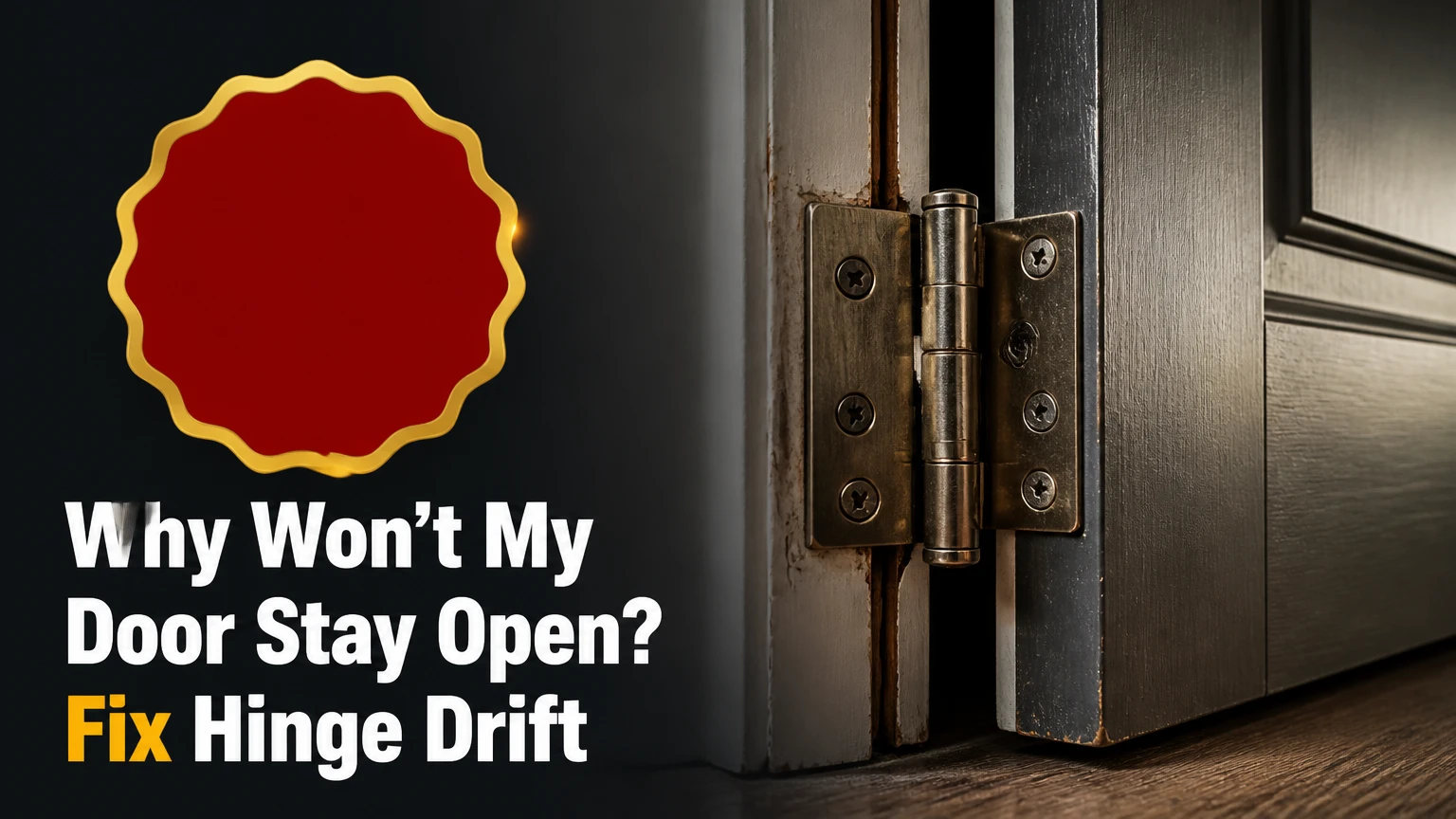
Why Won’t My Door Stay Open? Fix Hinge Drift
A hinged door will not stay open when its hinge axis is out of plumb, the slab is sagging, or friction and airflow are forcing movement. Most residential cases involve loose hinge screws or a slightly tilted frame, but rubbing, a door closer, pressure differences, and warped components can produce the same symptom.
Key Facts at a Glance
- A door that swings by itself usually has a hinge axis that is not vertical.
- A loose top hinge can lower the latch side and change the door’s swing path.
- A 4-foot level, screwdriver, wedge, and replacement screws diagnose most interior doors.
- A slightly bent hinge pin adds friction, but it does not correct sag or a distorted jamb.
- A 3-inch screw can pull a loose top hinge toward the wall framing when the stud is correctly located.
- A fire-rated or commercial door should not receive an improvised hold-open modification.
Why Won’t My Door Stay Open?
A door that drifts closed usually has its hinge axis tilted toward the latch side or has a door slab that has sagged out of alignment. A door that swings open usually tilts in the opposite direction, although air pressure can reverse the apparent result in rooms with HVAC airflow or open windows.
The hinge barrels determine the door’s rotational axis. When the top and bottom hinge centers do not line up vertically, gravity moves the door toward the lowest point of its arc. A difference of only a few millimeters can make a lightweight hollow-core door move noticeably.
What door creep means mechanically
“Door creep” describes a hinged door that moves after being placed at an angle. The door is not finding a deliberate locking position. Its mass is responding to a tilted axis, friction imbalance, or an external force.
A plumb hinge axis does not guarantee that a door will remain still in every installation. Slight differences in hinge wear, seal compression, latch contact, and air movement can still create motion. However, persistent movement at several open angles strongly indicates alignment rather than random hardware behavior.
The most reliable repair restores the hinge geometry first. Friction devices and doorstops are appropriate when alignment cannot be corrected economically or when the user needs a fixed hold-open function.
What should you check before repairing the door?
Check the direction of movement, the door gaps, hinge screws, frame plumb, and possible airflow before changing hardware. A 10-minute inspection prevents the common mistake of bending a hinge pin when a loose screw or door closer is the actual cause.
Open the door to approximately 30, 60, and 90 degrees. Release it at each position and record whether it moves toward the jamb or away from it. Then inspect the perimeter gap, which should remain reasonably consistent from the top corner to the bottom corner.
Diagnostic sequence
- Remove airflow from the test. Close nearby windows, disable a room fan, and temporarily adjust a strong HVAC register. Repeat the test. If movement changes substantially, pressure is contributing to the problem.
- Check rubbing. Look for fresh paint marks, polished wood, crushed weatherstripping, or scrape lines on the latch edge, hinge edge, and threshold.
- Test the hinge screws. Tighten loose screws by hand with a screwdriver. A power driver can strip the hole or pull the hinge leaf too far into the jamb.
- Measure the frame. Put a 4-foot spirit level against the hinge jamb and latch jamb. Check the door face separately because a plumb jamb does not prove that the slab is straight.
- Inspect the top hinge. Sag commonly appears as a narrowing gap at the top latch corner and a widening gap near the bottom latch corner.
- Check for a closer. Hydraulic closers, spring hinges, magnetic locks, and concealed closers can intentionally move the door. Adjustments may be restricted by the manufacturer or fire-safety requirements.
- Repeat at 90 degrees. A fast return indicates a larger alignment or force problem. A slow movement usually needs a small adjustment or modest friction.
| Observation during test | Likely cause | First check | Typical repair |
|---|---|---|---|
| Door drifts closed at 30, 60, and 90 degrees | Tilted hinge axis | Hinge jamb level | Tighten screws or shim hinge |
| Door swings open only with HVAC running | Room pressure | Register and window airflow | Balance airflow or use a stop |
| Top latch corner rubs jamb | Sagging slab | Top hinge screws | Replace one screw with 3-inch screw |
| Door moves only near closed position | Weatherstrip or latch friction | Edge gap and strike | Adjust strike or weatherstrip |
| Door returns firmly from every angle | Spring hinge or closer | Hinge barrel and closer arm | Adjust or replace approved hardware |
| Door binds at the threshold | Settled frame or swollen slab | Bottom gap and threshold | Correct frame, plane slab, or adjust threshold |
How to tell alignment from airflow
Hold a narrow strip of tissue near the latch edge while the door is stationary. If the tissue pulls consistently through the gap, pressure is present. Test again with the room’s supply and return vents in their normal operating state.
Airflow is often misdiagnosed as a bad hinge because the door behaves correctly when the HVAC system is off. Alignment work will not eliminate pressure-driven movement. A door can require both a minor hinge correction and a magnetic catch in a room with strong pressure differences.
How do you fix a drifting door?
Fix a drifting door by correcting loose or misplaced hinge geometry before adding a stop. Start with screw repair, then use a hinge shim for controlled alignment, and use a lightly bent hinge pin only when the door is structurally sound and a small amount of friction is acceptable.
Step 1: Tighten and reinforce the hinge screws
Support the door with a wooden wedge under the latch-side corner before removing screws. Tighten every hinge screw, then test the door at 30, 60, and 90 degrees.
If a screw spins without tightening, the hole may be stripped. Pack the hole with hardwood slivers and wood glue, or install a purpose-made hinge repair screw where appropriate. Do not rely on a longer screw unless you have confirmed that it enters solid framing without contacting wiring or plumbing.
For a sagging interior door, replace one jamb-side screw in the upper hinge with a 3-inch screw, commonly a No. 9 or No. 10 construction or structural wood screw. Drive it slowly through the jamb and into the framing stud. The screw should pull the hinge leaf firmly against the jamb rather than bowing the jamb inward.
You will know the step worked when the top latch gap improves, the latch enters the strike without lifting the door, and the door remains in place at two or more test angles. The common mistake is driving the screw too hard and distorting the jamb.
Step 2: Shim the hinge leaf
Use a thin, rigid shim behind the jamb-side hinge leaf when the hinge jamb is misaligned. Plastic hinge shims are preferable on exterior doors because cardboard absorbs moisture and changes thickness.
Remove the screws from one jamb-side hinge leaf while the door remains supported. Insert a shim covering the hinge pocket without protruding into the hinge knuckles, reinstall the screws, and test the door. Start with approximately 0.5-1 millimeter of material rather than stacking a thick pack immediately.
Shim direction requires testing because door swing, hinge placement, and the direction of the plumb error vary. If the first adjustment makes the drift faster, remove it and reverse the correction. A shim should improve the gap and swing while preserving latch alignment.
You will know the step worked when the door holds at 30, 60, and 90 degrees without scraping. The common mistake is shimming the wrong hinge or leaving a gap under the hinge leaf that allows the screws to loosen again.
Step 3: Add controlled hinge friction
A slightly bent removable hinge pin can stop a light interior door from moving. This is a convenience repair, not a structural correction.
Support the door, remove the center hinge pin with a nail set and hammer, and place the pin on a solid wood block. Make one very slight bend near the middle, often less than 1-2 degrees, then reinstall it. The pin should enter the knuckles with light hammer taps and should not require force.
Test the door before bending the pin further. Excessive bending can prevent full insertion, damage hinge knuckles, create squeaking, or make the door difficult to operate. Avoid this method on heavy solid-core, exterior, fire-rated, or frequently used commercial doors because the added friction may not hold and can accelerate wear.
You will know the step worked when the door stays at the selected angle but still opens smoothly with one hand. The common mistake is using a sharply kinked pin to compensate for a sagging hinge.
Step 4: Correct a warped or rubbing door
A rubbing door needs clearance correction, not simply more hinge friction. Identify the contact point with a thin piece of paper or removable marking compound, then inspect whether the slab, jamb, weatherstrip, or threshold is creating the resistance.
Minor wood swelling can respond to humidity control and careful hinge adjustment. Larger contact areas may require planing or routing, followed by sealing the exposed wood. Exterior doors need particular care because removing too much material can compromise weather resistance and security.
A door that rubs only after rain may have moisture-related swelling, foundation movement, or a deteriorated threshold. A door that rubs year-round may have a dropped hinge, loose frame fastener, or incorrect original installation.
| Repair method | Materials | Typical time | Appropriate door |
|---|---|---|---|
| Tighten existing screws | Screwdriver, wedge | 5-10 minutes | Hollow-core or solid interior |
| Replace upper hinge screw | 3-inch structural wood screw, drill | 10-20 minutes | Sagging wood jamb |
| Shim hinge leaf | Plastic shim, screwdriver, wedge | 15-30 minutes | Misaligned interior or exterior |
| Bend hinge pin | Nail set, hammer, wood block | 5-10 minutes | Lightweight interior door |
| Plane rubbing edge | Plane, sandpaper, finish | 30-90 minutes | Swollen or distorted wood slab |
| Replace hinge | Matching hinge, screws, drill | 30-60 minutes | Worn, bent, or undersized hinge |
Which door hold-open solution should you choose?
Choose hinge alignment for a door that should operate normally, a magnetic catch for a residential door that must hold fully open, a kickdown stop for a heavy utility door, and a wedge for a temporary renter-friendly solution. A hold-open device is not a substitute for correcting a door that rubs, fails to latch, or threatens a fire-rated assembly.
| Hardware option | Hold-open position | Typical USA cost | Installation and limitation |
|---|---|---|---|
| Rubber floor wedge | Any angle from 10-90 degrees | $5-$15 | No drilling; creates a floor trip hazard |
| Magnetic door catch | Usually 90-180 degrees | $10-$30 | 20-40 minutes; requires aligned magnet |
| Adhesive catch | Usually 90-180 degrees | $12-$25 | 10-20 minutes; adhesive dislikes dusty surfaces |
| Kickdown door stop | Approximately 0-120 degrees | $12-$35 | 30-45 minutes; visible on door face |
| Spring hold-open hinge | Preset 90 or 180 degrees | $15-$45 per hinge | 30-60 minutes; changes closing force |
| Overhead hold-open closer | Commonly 90 degrees | $100-$400 installed | Commercial use; code and accessibility review |
Magnetic catches
A magnetic catch is the cleanest residential hardware solution when the door must remain fully open. Install the jamb or baseboard plate so the magnet meets the door plate squarely with the door at its intended open angle.
Magnetic catches do not solve a door that needs to remain open at arbitrary angles. They also can pull trim loose if the magnet is stronger than the fasteners. Adhesive models avoid drilling, but painted, dusty, damp, or textured surfaces reduce bond strength.
Kickdown stops
A kickdown stop attaches to the lower face or edge of the door and uses a rubber foot against the floor. It holds at selected angles and works better than a bent pin on many heavy utility doors.
The trade-off is visibility and floor loading. A stop can damage resilient flooring, catch footwear, or interfere with a threshold. Verify that the folded stop does not strike the frame or reduce the door’s clear opening.
Door closers and fire doors
Do not wedge open a fire door, modify a rated closer, or install hold-open hardware without checking the label and local requirements. The National Fire Protection Association’s NFPA 80 covers opening protectives, while the 2021 International Building Code generally requires fire doors to close and latch unless an approved release system is provided.
The Americans with Disabilities Act Standards for Accessible Design also limit opening force for many interior hinged doors to 5 pounds, excluding the force needed to release a latch. A strong spring hinge or friction pin can make a door harder to operate even if it stays open.
What does each repair cost in the USA?
Typical USA DIY costs range from $0 for tightening screws to $45 for a replacement hinge or stop, while a handyman service call commonly starts around $75-$150 before parts. Structural frame movement, exterior-door replacement, and commercial closer work can cost substantially more.
| Repair or service | Typical parts cost | DIY time | Typical professional total |
|---|---|---|---|
| Tighten loose screws | $0-$5 | 5-10 minutes | $75-$125 |
| Install 3-inch structural screw | $2-$8 | 10-20 minutes | $75-$150 |
| Shim one hinge | $2-$12 | 15-30 minutes | $90-$175 |
| Install magnetic catch | $10-$30 | 20-40 minutes | $100-$200 |
| Plane and refinish rubbing edge | $10-$35 | 30-90 minutes | $150-$350 |
| Replace three hinges | $15-$45 | 45-90 minutes | $175-$400 |
| Adjust commercial closer | $0-$25 | 20-45 minutes | $125-$300 |
These are typical planning ranges for the United States, not fixed price quotes. Urban labor rates, access problems, door weight, finish matching, and emergency scheduling can change the final bill.
Why does the door still move after a hinge repair?
A door can continue moving after hinge work when airflow, a spring hinge, a warped slab, a distorted frame, or uneven weatherstrip pressure remains. The repair should be reassessed by repeating the test with HVAC, windows, and the latch condition controlled.
Use this recovery sequence:
- Confirm the door is not being pulled by a closer or spring hinge.
- Check the hinge screws again after 24 hours of use.
- Inspect the gap with the door open and closed.
- Test the door with nearby windows and fans closed.
- Remove any shim that worsened the drift.
- Check whether the threshold or weatherstrip pushes the slab sideways.
- Replace a bent or worn hinge rather than increasing friction indefinitely.
Common failure modes and recovery
| Failure mode | Symptom | Recovery action | Preventive rule |
|---|---|---|---|
| Bent pin kinked too far | Pin will not seat | Replace pin or straighten gently | Bend in tiny increments |
| Long screw overdriven | Jamb bows, latch misses strike | Back screw out, reset jamb | Stop when hinge is snug |
| Shim too thick | Door scrapes or latch shifts | Remove half the shim | Start below 1 millimeter |
| Wrong hinge shim direction | Drift becomes faster | Reverse or remove shim | Test after every adjustment |
| Stripped hinge holes | Screw spins freely | Use hardwood repair or repair screws | Drive screws by hand |
| Doorstop misplaced | Stop misses plate or trim | Reposition both plates | Mark open angle first |
One practitioner rule is especially useful: correct the top hinge before touching the bottom hinge when the latch-side top gap is tight. The top hinge carries much of the visible sag, and changing several hinges at once makes the direction of improvement difficult to identify.
Another rule concerns hollow-core doors. A bent pin can be an efficient five-minute fix, but it is a poor choice when the door already drags, squeaks, or needs excessive force. Added friction hides the symptom while leaving the hinge axis wrong.
A final rule applies to exterior entries: preserve compression, drainage, and latch security. A door that stays open but no longer seals against wind-driven rain is not repaired.
Which situations need a different solution?
Interior bedroom doors, exterior entry doors, rental doors, bathroom doors, and commercial openings have different constraints. Door weight, weather exposure, fire rating, accessibility, and permission to modify the property determine the appropriate repair.
Lightweight interior door
Start with screw tightening and a hinge-pin friction repair if the slab is straight and the jamb is stable. A typical hollow-core door weighs approximately 25-40 pounds, so a small friction increase may be sufficient.
Heavy solid-core or exterior door
Use a supported hinge repair, correctly placed long screw, or professional alignment. Solid-core doors often weigh 60-120 pounds, and a bent pin may not provide enough holding force. Plastic or brass shims are safer than paper-based material where humidity or rain is present.
Rental property
Use a removable wedge or an adhesive magnetic catch after checking the lease. Do not drill the jamb, replace hinges, or drive structural screws without written permission. Photograph the rubbing or sagging condition before reporting it because frame movement may be a maintenance responsibility.
Bathroom or privacy door
A door that will not stay open may be intentionally affected by a spring hinge, exhaust fan, or pressure imbalance. Test with the exhaust fan off, then check whether the door closes when the fan runs. A magnetic catch can hold the door open, but it should not defeat a required privacy or accessibility function.
Commercial or fire-rated opening
Use listed hardware compatible with the door assembly and consult the facility manager or qualified door technician. Improvised wedges and bent hinge pins can prevent a fire door from closing, while an unapproved closer adjustment can alter closing speed and latch performance.
How can you prevent door drift from returning?
Prevent recurring door drift by checking hinge screws twice yearly, sealing exposed wood, avoiding door-hanger overload, and addressing frame movement before the latch begins to miss. Weather changes can reveal a marginal installation because wood moisture and building movement alter gaps over time.
Use a screwdriver rather than an impact driver for routine hinge maintenance. Keep the hinge leaves fully seated in their mortises, replace missing screws, and use corrosion-resistant fasteners on exterior openings. Do not lubricate a hinge pin heavily if the goal is to create holding friction, because lubricant can remove the very resistance stopping the movement.
Monitor these warning signs:
- The latch-side top corner drops below its original gap.
- The door scrapes the strike-side jamb.
- The hinge leaf pulls away from the wood.
- The closer slams or fails to latch.
- The gap changes noticeably between summer and winter.
- The door no longer meets the weatherstrip evenly.
FAQ
Can a door be out of plumb if the frame looks straight?
Yes. A door slab can be twisted, warped, or incorrectly positioned even when the visible jamb appears straight. Test the hinge axis, the slab face, and the perimeter gaps separately. A level on the jamb cannot diagnose a hinge barrel that is bent or a door that has absorbed moisture.
Why does my door stay open in one spot but close everywhere else?
A door may pause where hinge friction, latch pressure, weatherstrip compression, and gravity temporarily balance. That position is not proof that the frame is correctly aligned. Test at several angles and inspect whether the door changes direction near the strike or threshold.
Can humidity make a door stop staying open?
Humidity can swell a wood slab or jamb, alter the gap, and create rubbing that changes the door’s movement. Seasonal swelling commonly affects bathroom and exterior doors. Reduce moisture, identify the contact point, and correct the hinge or edge only after the wood reaches a normal moisture condition.
Should I use WD-40 to stop the door from moving?
No. WD-40 and similar penetrating products reduce hinge friction, so they can make a drifting door move more freely. Lubrication is appropriate for a squeaking hinge when smooth movement is wanted, but it is not a reliable hold-open repair.
How do I know whether to call a carpenter?
Call a carpenter or qualified door technician when the frame is moving, the door is heavy, hinge holes are damaged, the slab must be planed, or the opening is fire-rated or commercial. Professional help is also appropriate when a repair causes latch failure, security problems, or uneven exterior weather sealing.
Will a doorstop fix the underlying problem?
A doorstop controls the symptom but does not correct a tilted hinge axis, sagging jamb, warped slab, or pressure imbalance. Use a stop when the door must hold open at a defined angle or when structural repair is impractical. Choose alignment repair when normal, smooth door operation matters.
The Bottom Line
The answer to “why won’t my door stay open” is usually a tilted hinge axis caused by loose screws, sag, or a slightly out-of-plumb frame. Tighten and reinforce the upper hinge first, test airflow and rubbing, then shim the hinge or use a lightly bent pin only when appropriate. Choose a magnetic catch or kickdown stop when the door needs a deliberate hold-open function, and use listed hardware for commercial or fire-rated openings.