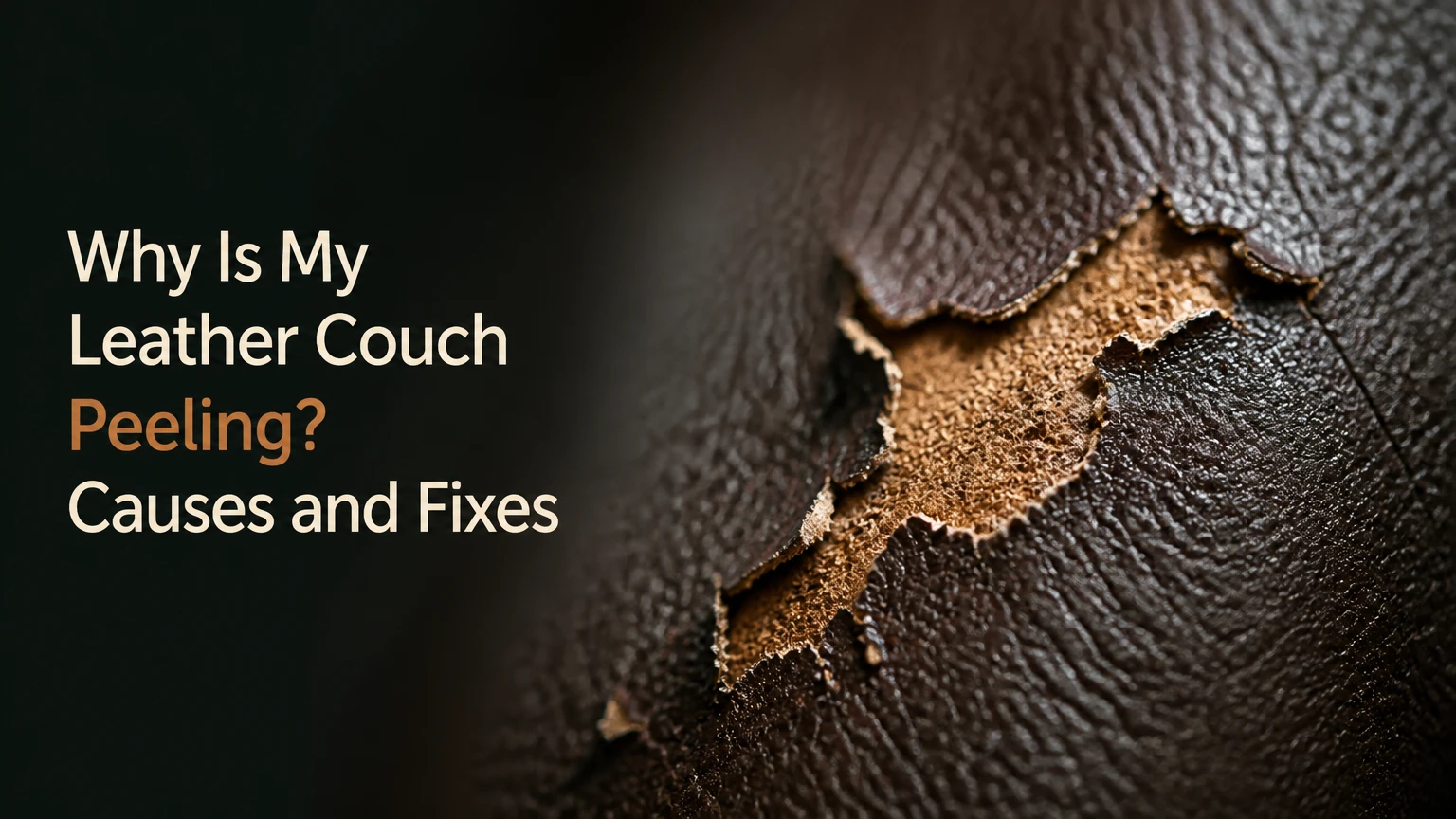
Why Is My Leather Couch Peeling? Causes and Fixes
A leather couch peels when its surface coating or synthetic upholstery layer separates from the backing beneath it. The problem usually affects bonded leather, polyurethane faux leather, vinyl, or leather-match panels, although coated genuine leather can also lose its finish. Natural hide more commonly cracks, dries, or scuffs rather than shedding in flakes.
Key Facts at a Glance
- Bonded leather peeling is usually delamination, which means the top polyurethane film is separating from its fabric or fiber backing.
- Genuine full-grain and aniline leather do not normally peel in sheets, but corrected-grain leather can lose a painted or pigmented surface coating.
- Direct sunlight, body oils, friction, heat, cleaners, and low humidity can accelerate surface failure.
- A water-drop test cannot reliably identify upholstery because finish, conditioner, and surface texture change absorption.
- Flexible filler and color can improve appearance, but they cannot restore a failing bonded-leather coating across an entire sofa.
- Typical USA DIY repair costs range from $15-$100, while professional restoration commonly starts near $150 for a small panel.
What Does Peeling Mean on a Leather Couch?
Peeling on a leather couch means the visible surface is separating from the material below it. The detached layer may be polyurethane, PVC, pigment, adhesive, or a thin bonded-leather film, so the word “leather” on a sales listing does not establish that the exposed surface is natural hide.
Peeling differs from cracking. Cracking creates lines or open splits within a surface, often because natural leather fibers lost lubrication and flexibility. Peeling creates flakes, chips, or broad sheets because a coating has lost adhesion to its backing.
A useful diagnosis begins with the shape of the damage. Powdery black or brown flakes usually indicate a failing synthetic coating, while pale, fuzzy fibers under a missing surface indicate a fabric-backed laminate. A shallow scratch that reveals the same fibrous material as an unstressed area may indicate bonded leather rather than full-grain hide.
Why does peeling usually happen after several years?
Bonded leather and faux leather often fail after repeated flexing, abrasion, heat exposure, and chemical contact weaken the bond between the top film and its backing. The calendar age is only a rough clue because a heavily used sofa can fail sooner than a lightly used sofa in the same room.
Manufacturing quality also matters. Coating thickness, binder chemistry, backing fabric, pigment, humidity, and the amount of flexing at seat edges all affect service life. Published furniture warranties and product specifications are more useful than a universal “one to three year” lifespan claim.
How Can You Identify the Upholstery Material?
You can identify most peeling couch upholstery by inspecting an inconspicuous area, the reverse side of a removable cushion, and the texture beneath a loose flake. Do not rely on a single water test, because a protective topcoat can make natural leather repel water just as synthetic upholstery does.
Look for a material label under the sofa, behind a zippered cushion, or on the original sales invoice. In the USA, terms such as “bonded leather,” “reconstituted leather,” “leather match,” “PU leather,” “vinyl,” and “faux leather” describe different constructions, but retailers have not always used these terms consistently.
| Upholstery type | Visible construction | Typical failure | Repair implication |
|---|---|---|---|
| Full-grain leather | Continuous natural grain, no fabric face | Dry cracks, scuffs, stains | Conditioning and recoloring may work |
| Top-grain leather | Sanded or corrected natural grain | Pigment wear, cracks, finish loss | Surface repair may be durable |
| Bonded leather | Leather fibers under PU film and backing | Flakes, sheets, exposed fibers | Cosmetic repair, panel replacement |
| PU faux leather | Polyurethane film over woven fabric | Cracks, tackiness, peeling | Replace damaged covering |
| PVC vinyl | Plasticized PVC over textile backing | Splits, hardening, flakes | Vinyl repair or reupholstery |
| Leather match | Leather on touch areas, synthetic sides | Uneven failure by panel | Replace synthetic panels first |
A water drop that beads on the surface does not prove that a couch is faux leather. Pigmented leather, polyurethane topcoats, wax, conditioner, and years of body oils can all block absorption. A material professional can make a more reliable identification by examining the cross-section and underside.
Can genuine leather peel?
Genuine leather can appear to peel when a painted, corrected, or polyurethane-coated surface layer fails, but the natural hide itself usually does not delaminate like bonded leather. Full-grain aniline leather has no thick plastic face to shed, whereas corrected-grain and heavily pigmented leather may lose color or finish.
The label “genuine leather” is not a durability grade. It is a broad material category that can include lower-grade hide with a substantial artificial finish. If the damage exposes a fibrous natural hide but the missing layer looks like paint, the repair may be possible without replacing the entire cover.
Why Does Bonded Leather Fail?
Bonded leather fails because a thin polyurethane surface is carrying the visual and abrasion burden of a composite material that has limited flexibility. The underlying leather fibers do not make the surface immune to coating fatigue, and the top film can separate after repeated bending at seat fronts, armrests, and back cushions.
Manufacturers commonly produce bonded leather by combining leather fibers with a binder and applying the mixture to a textile or paper-like backing. The exact leather percentage and coating process vary by product, so fixed composition ranges should not be treated as universal specifications.
Which materials peel most often?
Bonded leather and low-cost PU upholstery are the most common sources of sheet-like peeling. Vinyl may become brittle and split, while coated natural leather tends to show pigment wear, cracking, or localized finish loss before large flakes appear.
| Symptom | Probable material | Mechanism | Best first action |
|---|---|---|---|
| Large black flakes on seat | Bonded leather or PU | Film delamination | Inspect hidden seam |
| Sticky surface before peeling | Aged PU | Plasticizer or polymer breakdown | Stop using oily cleaners |
| Fine dry cracks with dark hide | Pigmented leather | Dehydration and flexing | Condition after testing |
| White or tan fuzzy backing | Bonded or faux leather | Surface loss | Photograph and assess coverage |
| Peeling only on side panels | Leather match | Synthetic panel failure | Compare touch areas |
| Linear split at seam | Any upholstery | Tension or thread failure | Check foam and seam stress |
Why do seat fronts and armrests peel first?
Seat fronts and armrests peel first because they receive concentrated friction, skin oils, sweat, clothing abrasion, and repeated flexing. The front edge also bends sharply when a person sits down, creating more movement between the surface layer and backing than a protected back panel experiences.
Armrests can fail even in an otherwise clean room because forearms transfer oil, hand lotion, sunscreen, and perspiration. A sofa placed beside a window may show a lighter or more brittle arm facing the glass, which points to combined UV and contact damage rather than a material-wide defect.
Which Environmental Conditions Accelerate Peeling?
Sunlight, elevated temperature, low humidity, and poor ventilation can accelerate surface deterioration, while friction and contaminated cleaners often determine where the damage first appears. A couch does not need to sit beside a radiator to suffer; repeated afternoon UV through a window can affect a nearby arm or seat.
The American Society of Heating, Refrigerating and Air-Conditioning Engineers generally places occupied indoor comfort humidity around 30%-60% relative humidity, although leather care should follow the manufacturer’s instructions. Extremely dry air can contribute to natural-leather stiffness, but humidity alone does not repair or prevent a failing synthetic film.
| Stress factor | Typical exposure | Observable result | Preventive measure |
|---|---|---|---|
| Direct window sun | 2-6 hours daily | Fading and brittle finish | Use UV shades or move sofa |
| Radiator or vent heat | Within 3 feet | Dryness and hardening | Maintain at least 12-36 inches |
| Body oils | Daily contact | Dark tacky zones | Wipe monthly with approved cleaner |
| Abrasive grit | Weekly accumulation | Polished or worn patches | Vacuum seams and cushions |
| Pet claws | Repeated contact | Punctures and lifted film | Use a throw and trim claws |
| Solvent cleaner | One or more applications | Color loss or sticky finish | Patch-test every product |
An expert rule of thumb is to treat a three-inch worn patch differently from a sofa-wide failure. A small isolated defect may respond to a flexible repair system, while widespread peeling means the surrounding coating is likely near the same stage of breakdown.
How Do You Repair a Peeling Leather Couch?
You can repair a small peeling area with a flexible filler, compatible colorant, and protective topcoat after removing every unstable flake. A typical USA DIY repair takes 2-4 active hours plus 12-24 hours of curing, but success depends more on sound surrounding material and product compatibility than on the brand of kit.
Before You Start
| Requirement | Typical specification | USA cost or time | Prerequisite |
|---|---|---|---|
| Active work | 2-4 hours | $15-$100 in supplies | Ventilated workspace |
| Curing period | 12-24 hours | No labor charge | Temperature near 65-80°F |
| Fine abrasive | 600-1,000 grit | $4-$10 | Use light pressure |
| Flexible filler | 2-4 ounces for a patch | $10-$25 | Compatible with substrate |
| Colorant | 1-2 ounces | $15-$45 | Match sheen and color |
| Sealer | 2-4 ounces | $10-$30 | Compatible with colorant |
Step 1: Remove unstable material
Lift loose flakes by hand and use a plastic scraper only where the edge will not damage firmly attached upholstery. Continue until the remaining edge resists gentle fingernail pressure, then feather a sharp boundary with 600-grit abrasive.
You will know the surface is ready when rubbing lightly with a clean fingertip produces no additional flakes. The common mistake is applying filler over loose film, which traps movement under the repair and causes early failure.
Step 2: Clean without stripping the finish
Vacuum dust first, then use a cleaner specifically labeled for the identified substrate. Apply the cleaner to a cloth rather than saturating the couch, and test a hidden section for color transfer, stickiness, or gloss change before treating the repair zone.
Avoid an automatic alcohol wipe recommendation. Isopropyl alcohol can remove pigment, soften some synthetic coatings, and create a larger damaged area, particularly on finished leather and vinyl. Use it only when the product manufacturer explicitly permits it.
Step 3: Fill the exposed depression
Apply flexible leather or vinyl filler in layers no thicker than approximately 1/16 inch per coat. Allow the product’s stated drying period, commonly 30-120 minutes, before adding another layer or sanding with 600-grit paper.
The filled area should finish level with the surrounding surface, not proud of it. A common mistake is one thick application, which skins over while remaining soft underneath and later cracks when the seat flexes.
Step 4: Restore color and sheen
Apply a compatible leather or vinyl colorant with a small sponge in two to four thin coats. Match the surrounding sheen as well as the hue, because a gloss mismatch can make a technically smooth patch remain visibly obvious under overhead lighting.
You will know the color is ready when the repair disappears at normal seated distance and does not transfer to a clean white cloth after the product’s specified cure. Do not use ordinary craft acrylic paint, which can form a rigid film on a flexing seat.
Step 5: Seal and cure
Apply the manufacturer’s compatible acrylic or polyurethane finisher in thin coats, then leave the couch unused for at least 12 hours, or longer in cool, humid conditions. Keep the repaired area free from blankets, pets, and body contact during curing.
A successful sealer restores some abrasion resistance but does not rebuild the original factory coating. If the surrounding upholstery continues to shed flakes, the finished patch will eventually fail at its edges.
What Should You Avoid During a DIY Repair?
Olive oil, baby oil, furniture polish, superglue, heat guns, and thick household paint can shorten the life of a repair or damage the upholstery further. Oils leave residues that interfere with adhesion, while cyanoacrylate glue forms a hard brittle spot that cannot flex with a seat cushion.
| Mistake | Immediate effect | Long-term problem | Safer alternative |
|---|---|---|---|
| Olive or baby oil | Surface looks darker | Adhesion failure and rancid residue | Approved leather conditioner |
| Superglue | Edge appears bonded | Brittle cracking under weight | Flexible repair adhesive |
| Heat gun | Faster apparent drying | Shrinkage and gloss damage | Room-temperature curing |
| Thick paint | Hides color quickly | Rigid cracking and transfer | Thin compatible colorant |
| Wet scrubbing | Removes loose dirt | Spreads delamination | Controlled damp cloth |
| No adhesion test | Faster preparation | Repair lifts within days | Test hidden section first |
The most counterintuitive repair rule is that aggressive cleaning can make a peeling couch worse. Surface oils are a problem, but removing the entire finish exposes weak material and enlarges the area that must be rebuilt.
How Much Does Repair Cost in the USA?
A small DIY peeling-couch repair typically costs $15-$100, while a professional localized repair commonly costs $150-$400. Extensive restoration can reach $600-$1,500 or more, and full reupholstery frequently exceeds the value of an inexpensive bonded-leather sofa.
Prices vary by city, access, color matching, cushion removal, travel fees, and whether the technician must repair foam or structural components. These are typical USA planning ranges, not fixed quotations.
| Repair route | Typical USA price | Typical time | Suitable damage |
|---|---|---|---|
| DIY spot repair | $15-$100 | 2-4 hours plus curing | Under 1 square foot |
| Mobile technician | $150-$400 | 1-3 hours on site | One or two panels |
| Extensive color restoration | $600-$1,500 | 1-3 days | Multiple worn areas |
| Panel replacement | $300-$900 | 1-3 days | Limited synthetic panels |
| Full reupholstery | $1,500-$4,500+ | 1-3 weeks | Valuable frame or broad failure |
| Replacement sofa | $700-$4,000+ | Same day to weeks | Low-value widespread failure |
Should You Repair, Reupholster, or Replace It?
Repair a peeling couch when damage is small, the frame and foam are sound, and the surrounding coating remains firmly attached. Choose reupholstery for a structurally valuable sofa with widespread surface failure, and choose replacement when the upholstery, cushions, frame, and repair estimate all point to declining value.
A technician should inspect suspension, frame joints, foam compression, seam tension, and the underside before quoting a full restoration. Replacing a cover on a sagging frame can produce an attractive but uncomfortable sofa.
| Condition | Repair | Reupholster | Replace |
|---|---|---|---|
| Peeling area | Under 1 square foot | More than 30% of surfaces | More than 60% |
| Frame condition | Solid | Solid and valuable | Loose or cracked |
| Cushion condition | Firm | Replace foam possible | Flattened and costly |
| Estimated cost | $15-$400 | $1,500-$4,500+ | $700-$4,000+ |
| Expected result | Cosmetic improvement | New surface | New complete system |
| Best financial case | Low-cost fix | Quality heirloom frame | Budget bonded sofa |
Is bonded-leather peeling a permanent failure?
Bonded-leather peeling is a permanent failure of the original surface in the affected region, although a repair can hide the damage temporarily. Filler and color restore appearance, but they do not recreate the factory laminate, so untreated nearby panels may begin peeling later.
For extensive delamination, the durable options are replacing the affected upholstery panels or covering the sofa with a new material. A fabric slipcover can be a practical low-cost alternative when the frame remains comfortable and stable.
How Can You Slow Further Damage?
You can slow further damage by reducing UV exposure, removing abrasive grit, keeping oils off high-contact areas, and avoiding unapproved cleaners. Prevention cannot reverse delamination, but it can preserve intact panels long enough to plan repair or replacement.
Vacuum seams weekly with a soft upholstery attachment and wipe high-contact surfaces approximately every two to four weeks with the manufacturer-approved cleaner. Keep the sofa away from direct heat, use window shades during strong sun, and avoid placing sharp-edged tables against the arms.
What if pets or sharp objects caused the damage?
Pet claws and sharp objects usually create punctures, linear cuts, or lifted edges rather than uniform chemical peeling. Trim loose threads without pulling them, protect the area from repeat contact, and use a flexible patch or professional panel repair when the backing is exposed.
Do not stretch a loose synthetic flap back into place while someone is sitting on the cushion. Weight and movement can enlarge the tear and distort the backing, making a later patch harder to align.
Does a Warranty Cover Peeling?
A warranty may cover premature peeling when the upholstery construction, use conditions, and claim period meet the manufacturer’s terms, but ordinary wear, chemical damage, pets, sunlight, and commercial use are often excluded. Check the invoice, warranty booklet, material description, and purchase date before attempting repair.
Photograph the entire couch, close-ups of the peeling, the product label, and the room placement. Do not apply dye, glue, or filler before a warranty inspection because an alteration can complicate the claim.
| Warranty evidence | Why it matters | Action |
|---|---|---|
| Purchase receipt | Establishes claim date | Save digital and paper copies |
| Material specification | Identifies bonded or PU construction | Compare with sales listing |
| Close-up photos | Shows failure pattern | Photograph before cleaning |
| Room-placement photo | Shows heat or sun exposure | Document normal use |
| Care records | Supports maintenance compliance | List products and dates |
| Warranty exclusions | Defines denied causes | Request written interpretation |
FAQ
Can leather conditioner stop a peeling couch?
Leather conditioner can soften and protect suitable natural leather, but it cannot stop a polyurethane film from delaminating. Test conditioner on a hidden area first, especially on pigmented or coated upholstery, because excess product can leave a greasy film and interfere with later color or adhesive work.
Is it safe to use Magic Eraser on peeling leather?
A melamine foam eraser is abrasive and can remove pigment, topcoat, or the already weakened synthetic film. Do not use it on a peeling couch. Use a soft cloth and an approved upholstery cleaner, followed by a hidden-area color-transfer test.
Why is only one couch cushion peeling?
One cushion may receive more sunlight, body contact, friction, or cleaner exposure than the others. A removable cushion can also have a different upholstery batch or replacement cover. Compare its underside and seams with another cushion before assuming the entire sofa uses the same material.
Can a slipcover hide peeling leather?
A slipcover can hide peeling and contain flakes, but it will not stop the underlying coating from failing. Use a breathable cover with a smooth underside, remove loose debris first, and inspect monthly so trapped moisture or continued abrasion does not damage the foam or fabric.
How long will a DIY repair last?
A small DIY repair may last several months to a few years under moderate use, but no universal lifespan is reliable. Durability depends on remaining adhesion, seat flexing, cleaner compatibility, and whether the surrounding bonded material is also deteriorating.
Should I buy a couch labeled genuine leather?
A “genuine leather” label alone is insufficient for a purchase decision because it does not identify grain quality, coating thickness, leather location, or synthetic side panels. Request the upholstery specification, warranty terms, and a description of which surfaces use natural hide before buying.
The Bottom Line
The answer to “why is my leather couch peeling” is usually a failing synthetic or coated surface, not ordinary dryness in natural hide. Identify the upholstery before cleaning, repair only small areas with firmly attached edges, and treat widespread bonded-leather delamination as a reupholstery or replacement decision. Protect intact surfaces from UV, friction, oils, heat, and unsuitable solvents.