
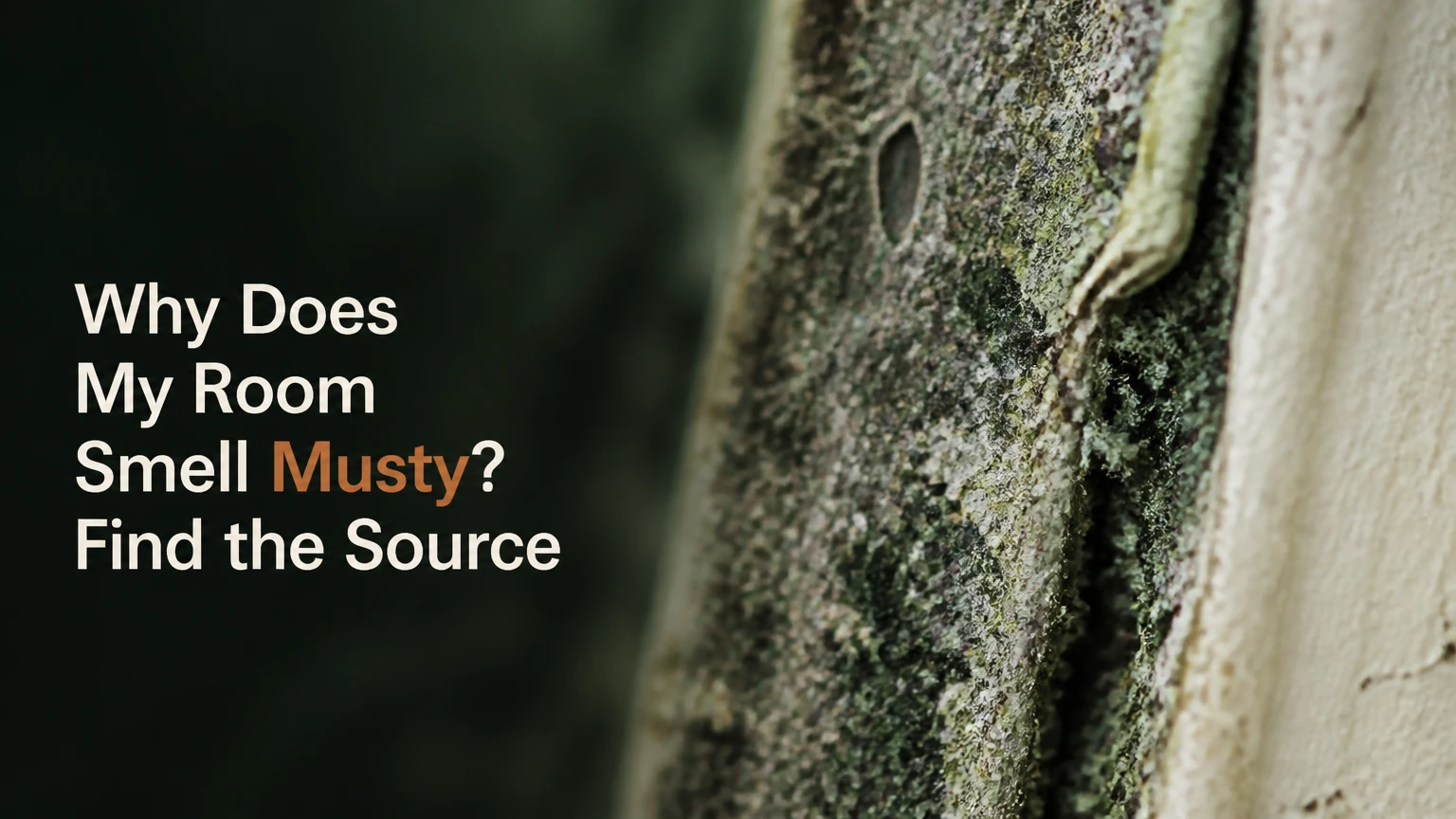
Why Does My Room Smell Musty? Find the Source
A musty room smell usually comes from excess moisture that has dampened building materials, carpeting, fabrics, or dust and enabled microbial activity. Mold and bacteria can release odor compounds before visible growth appears, but a musty odor alone cannot prove mold; wet carpet, poor ventilation, HVAC components, sewer gas, and decaying organic debris can create similar smells.
Key Facts at a Glance
- Indoor relative humidity of 30%-50% generally supports comfort and reduces condensation risk.
- A musty smell identifies an odor problem, not the exact source or type of microorganism.
- Mold growth requires moisture, a food source, and suitable conditions; temperature alone does not establish a reliable growth timeline.
- EPA’s commonly cited DIY reference is about 10 square feet of visible mold, not a guarantee that every smaller problem is safe to handle.
- Cleaning cannot permanently remove a musty odor when a leak, wet wall cavity, damp carpet pad, or HVAC problem remains active.
- Bleach, fragrance sprays, ozone generators, and painting over damp materials can worsen diagnosis or leave the moisture source untreated.
Why Does My Room Smell Musty?
A room smells musty when moisture and limited air movement allow odor-producing microorganisms or damp organic materials to accumulate. The highest-probability sources are a wet carpet pad, condensation on a cold wall or window, hidden plumbing leakage, damp stored textiles, or a contaminated HVAC component.
The odor may come from microbial volatile organic compounds, commonly called MVOCs, released by fungi and some bacteria as they grow on materials such as paper-faced drywall, wood, dust, fabric, cardboard, and carpet backing. Human odor detection can occur before a colony becomes obvious, but smell intensity does not measure contamination size or health risk.
The U.S. Environmental Protection Agency states, “The key to mold control is moisture control.” That principle is more useful than treating the smell itself. Find and correct the water source, dry the affected material, then clean or remove materials that cannot be dried completely.
Is a musty smell always mold?
No. Mold is a leading possibility, but a musty odor can also come from wet padding, stagnant closet air, a dirty condensate pan, a blocked drain, old books, rodent nesting, or sewer-gas intrusion. A source-specific inspection is more reliable than assuming the smell identifies mold.
What Creates a Musty Odor?
Moisture activates microbial growth when a usable food source is present, while poor ventilation allows odor compounds to accumulate. Mold spores are widespread indoors and outdoors, so the practical question is not whether spores exist, but where building conditions allow growth.
The supplied overview presents fixed 0-12-hour, 12-24-hour, and 24-48-hour mold milestones. Those exact intervals are not dependable for every home. Growth speed changes with material, water activity, temperature, airflow, species, and whether the surface is repeatedly wetted. After a flood, prompt drying still matters: the Federal Emergency Management Agency recommends drying wet contents and building materials as quickly as possible, generally within 24-48 hours when feasible, to reduce mold risk.
Relative humidity also has limits as a diagnostic tool. A room can read 45% RH while a cold exterior corner reaches a surface condition that supports condensation. Conversely, a room at 60% RH does not prove that mold is growing. RH is a screening measurement, not a mold detector.
What Are the Most Common Sources?
The most common sources are damp porous materials, condensation, plumbing or exterior leaks, and stagnant air around furniture or stored belongings. The strongest clue is location: odor concentrated near one surface usually points toward that surface or the cavity behind it.
| Source | Typical location | Diagnostic clue | Likely material |
|---|---|---|---|
| Condensation | Exterior wall, window sill, closet corner | Worse in cold weather or behind furniture | Drywall paper, wallpaper, wood |
| Plumbing leak | Shared wall, ceiling, baseboard | Staining, swelling, soft drywall, recurring odor | Insulation, gypsum, subfloor |
| Wet carpet | Carpet edge, closet, under bed | Odor strongest near floor; padding feels cool or damp | Carpet backing, pad, tack strip |
| High humidity | Whole room, wardrobes, textiles | Hygrometer repeatedly reads above 55%-60% RH | Dust, clothing, curtains, mattress |
| HVAC contamination | Supply or return vent | Smell intensifies when system starts | Coil, drain pan, filter, duct liner |
| Crawlspace or basement dampness | First-floor bedroom, floor perimeter | Odor rises from vents, floor, or baseboards | Subfloor, joists, insulation |
| Stored organic material | Boxes, books, laundry, furniture | Odor follows one container or item | Cardboard, leather, paper, fabric |
Why does one room smell musty?
One room smells musty when its moisture load or air circulation differs from the rest of the home. An exterior-facing bedroom may have colder wall surfaces, a closet may trap humid air, and a closed room may receive less heating or cooling than adjacent spaces.
Room-specific causes include a bed or wardrobe pushed against an exterior wall, wet clothing dried indoors, an unvented bathroom nearby, a window leak, or a carpet spill that reached the pad. In a basement bedroom, inspect the slab perimeter, sill plate, dehumidifier discharge, and foundation walls before blaming the ventilation system.
What Humidity Level Causes Musty Odors?
Indoor RH between 30% and 50% is a practical target for most U.S. homes, while repeated readings above 55%-60% increase condensation and mold risk. No single RH percentage guarantees mold growth because surface temperature, dust, material, and duration also control the outcome.
| Hygrometer reading | Interpretation | Recommended response | Verification period |
|---|---|---|---|
| Below 30% RH | Dry air; irritation and static may increase | Avoid aggressive dehumidification | Recheck after 24 hours |
| 30%-50% RH | Common comfort and moisture-control range | Maintain ventilation and normal heating | Log morning and evening |
| 51%-55% RH | Watch zone, especially near cold surfaces | Inspect windows, corners, and closets | Log for 3-7 days |
| 56%-60% RH | Elevated risk during persistent conditions | Use dehumidification and find moisture | Recheck after 24-48 hours |
| Above 60% RH | High moisture burden | Dehumidify, ventilate, and investigate leaks | Measure continuously if possible |
Place the hygrometer in the occupied part of the room, away from a window, vent, exterior wall, radiator, humidifier, and direct sunlight. Take readings at waking, mid-afternoon, and evening for several days. A single center-room reading can miss a cold, damp microclimate behind a wardrobe.
How Can You Locate the Source?
Locate a musty odor by mapping its intensity, measuring room humidity, and inspecting the nearest materials for moisture, staining, swelling, or microbial growth. Do not begin with destructive wall opening or chemical spraying, because both can obscure the original evidence.
- Close the room for four hours. Keep windows and doors closed, but do not run a portable fragrance device. Enter and note whether the odor is strongest at the floor, wall, closet, window, or vent.
- Measure RH in the center. Record the percentage and room temperature. Repeat the test near the suspected area because local conditions can differ substantially.
- Inspect windows and exterior walls. Look for condensation, peeling paint, dark caulk, bubbling wallpaper, tide marks, and staining below a sill.
- Move furniture 2-4 inches from cold walls. Check rear panels, wall corners, and the floor beneath storage. Compressed dust can hold moisture against the wall.
- Check carpet edges and padding. Lift an accessible edge only if you can replace it securely. A moisture meter reading at the carpet surface may miss a wet pad underneath.
- Inspect vents and HVAC access points. Look for a dirty filter, water around the indoor unit, a full drain pan, or odor that appears only when the blower operates.
- Check adjacent rooms and the opposite side of walls. A bathroom, laundry area, attic, crawlspace, or plumbing chase may reveal the cause more clearly.
- Document before cleaning. Photograph stains, record RH, note dates, and mark the odor location on a simple floor plan.
A pin-type moisture meter can compare one area with a nearby dry reference, but consumer meters do not identify mold species and can misread metal, salts, foil-backed insulation, or dense materials. Use readings comparatively, not as a laboratory diagnosis.
Can Carpet or Furniture Cause the Odor?
Yes. Carpet padding, upholstered furniture, mattresses, and wood furniture can retain spilled water long after the visible surface feels dry. Carpet is especially deceptive because the backing and pad can remain damp while the exposed fibers appear normal.
| Material | Why it retains odor | Cleanability | Typical decision |
|---|---|---|---|
| Washable cotton | Holds sweat, skin oils, and humidity | Usually washable if fully dried | Launder and dry completely |
| Carpet face fiber | Traps dust and surface moisture | Often cleanable after drying | Extract, dry, then reassess |
| Carpet pad | Absorbs spills and supports hidden growth | Difficult to dry in place | Replace after prolonged wetting |
| Upholstery foam | Porous and slow to dry | Limited deep cleaning | Professional evaluation or replacement |
| Mattress | Absorbs body moisture and spills | Surface cleaning is limited | Replace if persistently damp or contaminated |
| Cardboard boxes | Retains moisture and spores | Poorly cleanable | Discard damp boxes |
| Solid wood | Surface contamination may be removable | Usually cleanable if structurally sound | Dry, clean, and seal only after drying |
A dehumidifier may lower room RH while a wet pad continues releasing odor. Remove or dry the reservoir material first. If carpet became saturated with sewage, floodwater, or contaminated water, avoid ordinary household cleaning and arrange professional assessment.
Which Cleaning Method Is Safest?
The safest cleaning method depends on the material and affected area, but physical removal, detergent cleaning, and complete drying are more dependable than relying on bleach or vinegar. Never mix bleach with ammonia, acids, vinegar, or other cleaners, because dangerous gases can form.
| Method | Suitable use | Main limitation | U.S. household rule |
|---|---|---|---|
| Detergent and water | Small, cleanable hard surfaces | Cannot fix hidden moisture | Dry the surface completely |
| EPA-registered disinfectant | Selected nonporous surfaces | Follow label contact time | Never improvise concentration |
| White vinegar | Limited household surface cleaning | Does not remove porous material or fix leaks | Do not mix with bleach |
| Chlorine bleach | Limited nonporous disinfection | Poor fit for drywall, wood, and carpet | Follow label and ventilate |
| HEPA vacuum | Dry settled debris after drying | Not a substitute for removal | Avoid ordinary vacuuming on moldy debris |
| Air purifier | Captures some airborne particles | Does not dry materials or remove source | Use HEPA filtration as a supplement |
The EPA does not recommend bleach as a routine practice for mold cleanup. On porous drywall, insulation, carpet, and unfinished wood, the priority is often removal of the affected material rather than surface whitening. Vinegar can reduce odor on some hard, washable surfaces, but it is not a universal mold treatment and has limited penetration into porous assemblies.
Wear gloves and eye protection for small cleanup jobs. People with asthma, severe allergies, immune suppression, or chronic lung disease should avoid direct mold cleanup and ask another adult or a qualified professional to perform it.
Can an Air Purifier Remove Musty Smells?
An air purifier can reduce some airborne particles and may lessen odor temporarily, but it cannot correct a wet wall, contaminated carpet pad, or active HVAC reservoir. A true HEPA filter targets particles; odor reduction requires an activated-carbon stage, whose effectiveness depends on carbon quantity and airflow.
Air purification is useful after the moisture source is corrected, especially during cleanup or when outdoor conditions prevent window ventilation. It is not a substitute for extraction, material removal, plumbing repair, or dehumidification. Ozone generators are a poor household solution because ozone can irritate lungs and does not reliably solve hidden moisture.
How Long Should a Musty Smell Last?
A minor odor from washable fabrics may improve within 24-72 hours after cleaning and complete drying, while an odor from a wall cavity, carpet pad, or HVAC component can persist for weeks until the affected material is repaired or removed. The smell should steadily decline after the source is corrected.
| Cause | Typical first action | Typical odor improvement | Escalation point |
|---|---|---|---|
| Damp clothing or curtains | Wash and machine-dry | 1-2 days | Odor returns after laundering |
| High room humidity | Dehumidify and ventilate | 2-7 days | RH remains above 55% |
| Small surface spot | Clean and dry | 1-3 days | Growth returns or spreads |
| Wet carpet pad | Extract or replace pad | 2-5 days after drying | Odor remains at floor |
| Hidden leak | Repair and dry cavity | Several days to weeks | Stain or odor persists |
| HVAC source | Service drain pan, coil, or filter | 1-7 days after service | Smell follows every cycle |
Do not judge success by fragrance. Remove the deodorizer, close the room for several hours, and compare odor intensity, RH, and moisture readings. A returning odor indicates an unresolved source, even when the room smells clean immediately after spraying.
How Much Does Professional Help Cost?
Typical U.S. costs range from about $150-$500 for localized inspection or cleaning, $500-$3,750 for moderate remediation and drying, and $5,000 or more for structural or whole-home work. Prices vary with water damage, demolition, containment, laboratory testing, regional labor rates, and reconstruction.
| Service or problem | Typical U.S. cost | Typical duration | What the price may include |
|---|---|---|---|
| Moisture inspection | $150-$500 | 1-3 hours | Moisture mapping and source assessment |
| Carpet cleaning and drying | $150-$600 | 1-2 days | Extraction, fans, and deodorizing |
| Small mold cleanup | $300-$1,500 | 1-3 days | Local containment and cleanable surfaces |
| Moderate remediation | $500-$3,750 | 1-4 days | Removal, drying, HEPA cleaning |
| HVAC moisture repair | $300-$2,000 | 1-2 days | Drain, coil, filter, or duct-related work |
| Major structural remediation | $5,000-$30,000+ | 1-3 weeks | Demolition, drying, repair, reconstruction |
These are typical planning ranges, not quotes. Ask whether the estimate separates source repair, containment, disposal, cleaning, post-drying verification, and rebuilding. Air testing alone cannot replace moisture tracing, and a low-cost test that produces a species list may not tell you what to remove.
Can You Clean the Problem Yourself?
DIY cleanup is generally reasonable for a small, visible area on a hard, washable surface when the water source is fixed and no vulnerable person is exposed. EPA’s 10-square-foot reference is a screening boundary, not a universal safety guarantee; hidden growth, sewage contamination, HVAC contamination, or extensive porous damage can require professional work even below that size.
Stop DIY work and seek qualified help when:
- Visible growth covers more than roughly 10 square feet.
- The smell comes from inside walls, ceilings, ducts, insulation, or crawlspaces.
- The water involved sewage, floodwater, or a long-standing plumbing leak.
- Drywall, insulation, carpet pad, or upholstery remains wet or swollen.
- Anyone in the home has asthma, immune suppression, or serious respiratory disease.
- The source cannot be found after humidity, plumbing, flooring, and HVAC checks.
- Odor returns within days after cleaning and drying.
Mold inspection, remediation, and indoor-air testing are different services. A remediation contractor should explain containment, removal, drying, and verification rather than promising that an air test alone will certify a home as safe.
What Should Renters Document?
Renters should photograph visible staining, condensation, damaged materials, and meter readings before moving or cleaning anything significant. Send the landlord a dated written notice describing the location, onset, suspected water source, RH readings, and any health-related concern without claiming a diagnosis.
Keep a log with these fields:
| Record | Example |
|---|---|
| Date and time | January 14, 8:00 a.m. |
| Room condition | Window closed overnight |
| RH and temperature | 62% RH, 68°F |
| Odor location | Strongest behind wardrobe |
| Visible condition | Brown mark below sill |
| Action taken | Furniture moved 3 inches |
| Follow-up result | Odor unchanged after 24 hours |
Do not conceal the smell with paint, fragrance, or unauthorized demolition. A landlord may need to repair an exterior defect, plumbing leak, roof issue, ventilation fault, or building-envelope problem. Local housing rules differ, so renters should consult their city, county, or state housing agency for notice and habitability procedures.
What If the Smell Comes From a Vent?
A musty odor that intensifies when the HVAC system starts points toward the filter, evaporator coil, condensate pan, drain line, duct insulation, or nearby building materials. The HVAC odor may also be coming from a wet wall or carpet near the return, so the vent is a clue rather than proof of contaminated ductwork.
Turn off the system if water is pooling near electrical components, replace an overdue filter with the manufacturer’s specified size, and inspect accessible areas without opening sealed equipment. A qualified HVAC technician can check condensate drainage, coil cleanliness, microbial growth, and duct insulation. Do not fog or spray household chemicals into ducts without a product label and professional assessment.
If only one supply vent smells, compare that register with other vents and inspect the boot, nearby drywall, and subfloor. If every vent smells when the blower operates, investigate the air handler and return path first.
Common Mistakes and How to Fix Them
| Mistake | Why it fails | Better correction | Recovery timeframe |
|---|---|---|---|
| Spraying air freshener | Masks MVOCs temporarily | Trace moisture and remove source | Recheck after 4 hours |
| Painting over stains | Traps moisture and hides recurrence | Dry, repair, then prime | Several days to weeks |
| Using bleach on drywall | Does not remove porous material | Remove damaged drywall safely | After source repair |
| Running an ozone machine | Irritates lungs and leaves moisture | Use source control and HEPA filtration | Same day to discontinue |
| Replacing carpet without checking subfloor | Leaves wet wood or wall damage | Inspect pad, tack strip, and subfloor | Before new flooring |
| Opening walls prematurely | Spreads dust and destroys evidence | Photograph and assess first | Before demolition |
One practitioner rule is especially useful: if the odor is strongest at the baseboard, inspect the floor assembly before cleaning the wall. Carpet pad, sill plates, and subfloor edges often retain water that a wall-surface inspection misses.
Another counterintuitive point is that opening windows can increase indoor moisture in humid U.S. climates. Ventilate when outdoor air is cooler and drier than indoor air, but use mechanical dehumidification when outdoor dew point is high.
How Can You Prevent Recurrence?
Prevent recurrence by keeping indoor RH near 30%-50%, exhausting bathroom moisture outdoors, drying spills quickly, maintaining HVAC drainage, and leaving airflow around cold surfaces. Prevention succeeds when the building materials stay dry, not when the room receives stronger fragrance.
Use this maintenance schedule:
- Daily: Dry wet clothing outside the room and wipe window condensation.
- Weekly: Check closets, exterior corners, carpet edges, and under-bed storage.
- Monthly: Clean or replace the HVAC filter according to system requirements and inspect condensate drainage.
- Seasonally: Check roof, gutters, exterior caulking, foundation drainage, and crawlspace conditions.
- After a leak: Remove standing water immediately, document damage, run appropriate drying equipment, and verify moisture before closing walls.
Keep wardrobes and bookcases 2-4 inches from exterior walls where condensation is common. Avoid filling closets tightly because restricted airflow creates a cooler, damper microclimate around clothing and wall surfaces.
FAQ
Can a clean room still smell musty?
Yes. A clean room can smell musty when the odor source is hidden inside a wall, floor, carpet pad, HVAC component, or furniture cavity. Surface dust removal does not dry wet materials. Compare odor intensity near boundaries, measure RH, and inspect for water staining, swelling, condensation, or recurring dampness.
Does opening a window remove a musty smell?
Opening a window can dilute indoor odor when outdoor air is cooler and less humid, but it will not remove a hidden moisture source. In humid summer weather, open-window ventilation may raise indoor dew point and worsen condensation. Use a hygrometer and compare indoor and outdoor conditions before relying on ventilation.
Is musty odor dangerous to breathe?
A musty odor can indicate dampness or microbial growth, and damp buildings can aggravate asthma and respiratory symptoms in sensitive people. Odor intensity does not establish toxicity or contamination level. People with asthma, immune suppression, chronic lung disease, or severe allergies should avoid cleanup and seek medical guidance for symptoms.
Why does the smell disappear when the heat turns on?
Heating lowers relative humidity temporarily and increases air mixing, so the odor may become less noticeable without the source disappearing. Warm air can also release trapped odor compounds from carpet, wood, or wall cavities. Recheck the room after it cools and measure RH near the suspected material.
Should you replace a mattress that smells musty?
Replace a mattress when it has persistent internal dampness, visible mold, sewage or flood contamination, or an odor that remains after complete surface drying. A mattress is highly porous, so household sprays rarely reach the interior. If the odor comes only from removable bedding, launder and dry those items first.
When should you call a mold professional?
Call a qualified professional for growth beyond roughly 10 square feet, hidden or recurring odor, HVAC contamination, sewage water, extensive porous-material damage, or a household member with significant respiratory vulnerability. Choose a provider that explains moisture correction, containment, removal, drying, and repair rather than selling air testing alone.
The Bottom Line
Why does my room smell musty? In most cases, moisture has accumulated in a porous material, poorly ventilated space, or hidden building assembly, allowing microbial odor compounds to build up. Measure RH, map the strongest odor location, inspect carpet and exterior walls, check HVAC and adjacent spaces, and correct the water source before using any deodorizer. A room that still smells musty after drying and cleaning needs further moisture tracing, not stronger fragrance.