Condensation Between Window Panes: Fix Cost and Options
Condensation between window panes usually means the sealed Insulated Glass Unit (IGU) has lost its airtight edge seal. Moisture inside the cavity cannot be wiped away from either surface, and the practical repair is usually replacement of the IGU or sash, not adding household dehumidification. Surface condensation on the room or outdoor side has a different cause.
Key Facts at a Glance
- Trapped fog between panes is a common symptom of a failed double-pane or triple-pane IGU seal.
- An IGU contains glass, a perimeter spacer, primary and secondary sealants, and air or insulating gas.
- Typical USA IGU-only replacement costs about $150-$500 per window, depending on size, glass specification, and labor.
- Defogging can improve appearance, but drilling the unit does not recreate a factory-sealed insulating cavity.
- A warranty may provide replacement glass or a sash for little or no product cost, although labor can remain chargeable.
- A sound frame usually makes glass-only replacement more economical than full-window replacement.
What Does Condensation Between Window Panes Mean?
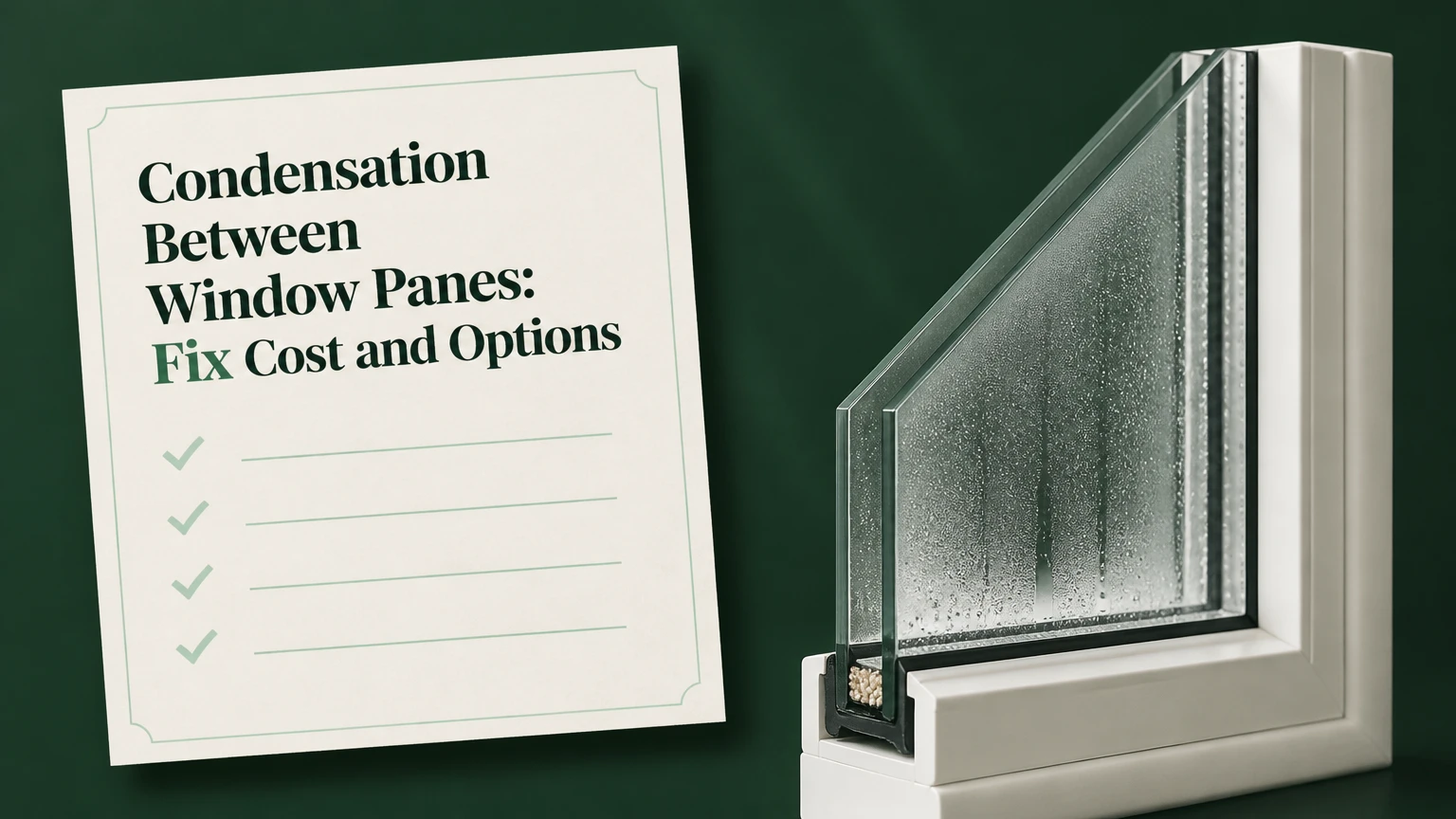
Condensation between window panes means water vapor has entered the sealed cavity of an IGU and reached its dew point. The moisture appears on the inward-facing surfaces of the glass, where it creates fog, droplets, streaks, or mineral residue that remains inaccessible from inside the room.
A double-pane window has two sheets of glass; a triple-pane unit has three. A spacer separates the panes around the perimeter, while sealants close the edge. Manufacturers normally fill the cavity with dry air, argon, or, less often, krypton. Desiccant inside the spacer absorbs residual moisture during manufacturing and early service life.
A failed edge seal allows humid ambient air into that cavity. The insulating gas may also diffuse out, although gas loss and visible condensation do not always occur at the same time. The unit can therefore lose thermal performance before a homeowner notices fogging.
How can you confirm the moisture is internal?
Run a clean, dry finger or microfiber cloth across the affected area on the room side and then inspect the outdoor side. If the haze remains in the same location after both accessible surfaces are dry, the moisture is inside the IGU.
| Observation | Likely location | Immediate interpretation |
|---|---|---|
| Wipes away from room side | Interior surface | Indoor humidity or a cold interior glass surface |
| Wipes away from exterior side | Outdoor surface | Cold outdoor glass, shade, rain, or dew |
| Remains after both sides are cleaned | IGU cavity | Probable failed edge seal |
| Appears only as rain streaks | Exterior surface or frame | Drainage, wind-driven rain, or gasket issue |
| Water collects in the bottom track | Sill or drainage channel | Blocked weep holes or frame leakage |
Condensation between window panes is not the same as condensation on the room-facing glass. Interior surface condensation can often improve when indoor relative humidity falls, air circulation increases, or a window covering moves away from the glass.
How Does a Sealed IGU Fail?
An IGU fails when its perimeter seal no longer limits moisture and gas movement. Daily temperature changes expand and contract the cavity gas, while frame movement, ultraviolet exposure, manufacturing defects, chemical incompatibility, and water exposure gradually stress the edge seal.
The common sequence is straightforward:
- The IGU experiences repeated heating and cooling.
- The edge seal develops leakage paths or loses adhesion.
- Drying desiccant absorbs infiltrating vapor.
- The desiccant capacity decreases.
- Cold glass surfaces inside the cavity reach the dew point.
- Liquid water or persistent fog becomes visible.
Solar pumping contributes to pressure cycling, but it is not the only failure mechanism. Improper setting blocks can load the glass unevenly, a distorted sash can twist the unit, and standing water at the lower edge can accelerate seal deterioration. Impact damage and frame settlement also create localized failures.
Building scientist Joseph Lstiburek has summarized the design reality with the phrase, “Windows are holes in walls.” The edge connection, drainage path, and installation tolerances matter as much as the glass specification.
Which window components matter?
| Component | Typical material or value | Function | Failure symptom |
|---|---|---|---|
| Glass panes | 2 or 3 lites, often 3-6 mm each | Separates interior and exterior environments | Cracks, haze, poor insulation |
| Spacer bar | Aluminum, stainless steel, or warm-edge composite | Maintains cavity width | Cold edge, seal stress, perimeter fog |
| Primary seal | Polyisobutylene, often called PIB | Limits gas and vapor movement | Gas loss or moisture entry |
| Secondary seal | Silicone or polyurethane | Adds structural and weather resistance | Edge separation or leakage |
| Desiccant | Molecular sieve in spacer | Absorbs residual cavity moisture | Persistent internal condensation |
| Low-E coating | Microscopically thin metallic oxide layer | Reduces radiant heat transfer | Lower comfort and higher U-factor if specification changes |
Argon is common because it improves insulation at a moderate cost and is easier to source than krypton. The replacement unit must match the original cavity thickness, glass thickness, coating orientation, safety rating, and spacer geometry. A visually similar pane can still perform differently.
Is the Condensation Dangerous or Merely Cosmetic?
Internal window condensation is usually not an immediate health emergency, but it is more than a cosmetic defect. A failed IGU can reduce insulation, obscure visibility, stain the glass, and conceal water-related damage at the sash or frame.
The moisture inside the cavity is generally isolated from indoor air, so it does not automatically create indoor mold. Mold risk becomes more relevant when water also reaches wood, drywall, interior trim, or a concealed sill. Laminated or tempered glass can create a separate safety concern if cracking or edge damage is present.
What damage should you inspect?
- Soft, swollen, or darkened wood around the sill and lower corners.
- Peeling paint, bubbling veneer, or rust on steel reinforcement.
- Drafts that persist when the sash is locked.
- Water in the track after ordinary rainfall.
- Broken balances, warped rails, or difficulty locking the window.
- A sharp crack, impact mark, or exposed glass edge.
A fogged IGU does not prove that the frame has failed. Conversely, replacing the glass will not correct frame rot, major distortion, or a leaking installation joint.
What Are the Repair Options and Costs?
For a structurally sound frame, IGU-only replacement is usually the best-value repair, with a typical USA price of $150-$500 per window. Full-window replacement becomes more appropriate when the frame, sash, drainage, hardware, or surrounding opening also has a significant defect.
Prices vary by region, access, glass size, coating, safety requirements, and labor minimums. Large picture windows, custom shapes, laminated glass, historic profiles, and triple-pane units cost more than standard residential units.
| Option | Typical USA cost | On-site time | Restores sealed insulation? |
|---|---|---|---|
| IGU-only replacement | $150-$500 | 20-60 minutes | Yes, if specified and installed correctly |
| Sash replacement | $200-$600 | 15-45 minutes | Yes, with a correct factory sash |
| Defogging service | $100-$250 | 45-90 minutes | No, not to factory condition |
| Full replacement window | $400-$2,500+ | 2-4 hours | Yes, if the opening is sound |
| Full replacement with trim repair | $800-$3,500+ | 4 hours to several days | Yes, with additional finish work |
These are typical planning ranges, not a contractor bid. Labor markets in New York, California, Seattle, and other high-cost areas can exceed them, while warranty parts may reduce material costs substantially.
What is the difference between IGU and sash replacement?
An IGU replacement removes only the glass sandwich. A sash replacement replaces the movable frame that holds the glass, including its factory-installed IGU, balances, weather seals, or hardware where applicable.
| Repair type | Best condition | Main measurement | Primary limitation |
|---|---|---|---|
| IGU-only | Sound vinyl, wood, or aluminum sash | Glass width, height, and thickness | Does not fix a warped sash |
| Sash replacement | Identifiable modern manufacturer | Model, series, and sash size | Matching parts may be discontinued |
| Full insert window | Existing frame opening is usable | Rough opening and frame dimensions | Reduces visible glass area |
| Full-frame replacement | Rot, leakage, or major distortion | Rough opening and exterior finish | Disturbs trim, siding, and interior finishes |
Sash replacement is especially efficient for many modern double-hung windows. It is less practical when the manufacturer is unknown, the product line is discontinued, or the surrounding frame has deteriorated.
How Do You Order the Correct Replacement IGU?
Order a replacement IGU through the manufacturer, a glass fabricator, or a qualified glazier after documenting the existing unit. The essential information includes visible glass dimensions, overall IGU thickness, pane count, coating, spacer, gas specification, and any tempered or laminated safety requirement.
Do not measure only the exposed glass if the unit sits inside a deep frame. A professional may remove a glazing bead or use frame dimensions to calculate the original unit size, because a few millimeters of error can prevent proper seating and drainage.
What should you document before requesting quotes?
- Photograph the fogging in daylight.
- Photograph the corner etching, manufacturer label, or spacer stamp.
- Record the window location, such as bedroom north wall.
- Measure visible width and height to the nearest 1/16 inch.
- Note whether the glass is double or triple pane.
- Identify cracks, tint, Low-E appearance, and safety markings.
- Record frame material and sash operation.
- Ask whether the quote includes setting blocks, glazing beads, disposal, and labor.
| Specification | Common residential example | Why it affects the order |
|---|---|---|
| IGU size | 28 x 48 inches | Determines glass area, weight, and price |
| Overall thickness | 7/8, 1, or 1-1/4 inches | Must fit the sash rebate |
| Glass thickness | 3 or 4 mm per lite | Affects weight and acoustic performance |
| Cavity width | 1/2 or 5/8 inch | Controls gas volume and insulation |
| Safety type | Tempered or laminated | Required near doors, floors, or hazardous locations |
| Coating | Low-E 366, Low-E 270, or equivalent | Changes solar gain and U-factor |
The replacement should match the climate and orientation. A south-facing window may need different solar-control glass from a shaded north-facing window. The lowest U-factor is not automatically the best choice if unwanted solar heat gain is a major problem.
Can You Fix a Failed Window Seal Yourself?
Homeowners can diagnose the location, clean drainage paths, check a warranty, and replace some removable sashes, but resealing a failed IGU in place is rarely a durable DIY repair. The glass sandwich must be fabricated in controlled conditions, and the edge seal requires compatible materials, correct cavity geometry, and clean assembly.
Drilling small holes and flushing the cavity can reduce visible fogging temporarily. It does not restore the original gas fill, desiccant capacity, edge seal, or tested thermal rating. Defogging is therefore an appearance repair, not equivalent to IGU replacement.
A heat gun does not normally cause an IGU to “explode” simply because it warms nearby paint, but concentrated heat can crack glass, damage coatings, soften sealants, and create thermal stress. Scraping tools, solvents, and pressure washers can also damage gaskets or seals. Keep high-pressure spray away from window edges.
Which maintenance actions actually help?
| Action | Frequency | Useful result | Limitation |
|---|---|---|---|
| Clear exterior weep holes | Every 6-12 months | Drains sill water | Cannot repair a failed IGU seal |
| Inspect sealant joints | Annually | Finds frame-to-wall leakage | Requires safe exterior access |
| Maintain indoor humidity | Daily in cold weather | Reduces room-side fogging | Does not dry cavity moisture |
| Wash with mild detergent | As needed | Removes surface residue | Abrasive pads can scratch glass |
| Check locks and weatherstripping | Annually | Reduces drafts | Does not restore lost gas fill |
A dehumidifier can reduce interior-surface condensation when indoor humidity is excessive. It cannot remove moisture trapped between panes, because the sealed cavity is separated from the room air.
What Is the Replacement Process?
A professional glazier typically removes the retaining beads, extracts the failed IGU, cleans the rebate, installs setting blocks, places the new unit, and reinstalls the glazing system. A standard accessible window takes about 20-60 minutes on site, while fabrication commonly adds 1-3 weeks.
The work sequence matters because setting blocks support the glass without blocking drainage, and the replacement must sit squarely without point loads. The installer should verify operation, lock engagement, weather seals, and water management before leaving.
Step 1: Confirm the failed cavity
Clean both accessible glass surfaces and photograph the unchanged fogging. Check for cracks, edge chips, water in the track, and frame deterioration.
Success checkpoint: The haze remains between the panes after both surfaces are dry.
Common mistake: Calling room-side humidity a failed IGU without testing both surfaces.
Step 2: Check the warranty
Find the manufacturer name, date code, corner etching, purchase documents, or builder records. Many residential thermal-glass warranties cover sealed-unit failure for periods ranging from 10 years to limited lifetime, but labor and transfer rules differ.
Success checkpoint: You have written confirmation of covered parts, labor, shipping, and transfer eligibility.
Common mistake: Assuming a lifetime glass warranty covers installation labor.
Step 3: Obtain an IGU-only quote
Ask a local glass company for the cost of a replacement sealed unit, not merely “window repair.” Request the glass build, Low-E specification, spacer, gas fill, safety glass, lead time, removal, installation, and disposal in writing.
Success checkpoint: Two quotes describe comparable specifications.
Common mistake: Comparing a bare glass price with a full-service installed price.
Step 4: Inspect the frame and sash
Open and lock the window if safe. Look for rot, warping, failed balances, cracked vinyl, corrosion, and water intrusion around the rough opening.
Success checkpoint: The frame can hold setting blocks and glazing beads without movement or decay.
Common mistake: Installing new glass into a sash that cannot remain square.
Step 5: Install and verify the new unit
The technician removes the old glazing materials, cleans the rebate, places compatible setting blocks, installs the IGU, and secures the beads or stops. The sash should then operate smoothly and lock without excessive force.
Success checkpoint: No visible gap exists, the glass is centered, the sash closes evenly, and drainage remains open.
Common mistake: Caulking over exterior weep holes or forcing an oversized IGU into the frame.
Which Repair Should You Choose?
Choose IGU-only replacement when the frame is sound, the window operates correctly, and the failure is limited to internal fogging. Choose a sash replacement when the manufacturer still supplies a matching movable unit. Choose full-window replacement when rot, distortion, repeated leakage, or obsolete hardware makes the existing assembly unreliable.
| Home situation | Recommended first option | Typical budget | Reason |
|---|---|---|---|
| Five-year-old vinyl window with one fogged pane | Warranty IGU or sash | $0-$600 | Product may still be covered |
| Twenty-year-old wood window with sound sash | Custom IGU or sash repair | $250-$900 | Preserves trim and historic fabric |
| Rotting lower wood rail and leaking sill | Full-frame restoration or replacement | $800-$3,500+ | Glass alone cannot stop structural damage |
| Several fogged units in a 30-year-old system | Compare IGU batch and full replacement | $1,000-$12,000+ | Quantity changes labor and performance economics |
| Rental unit with a single failed IGU | Written maintenance request | Tenant cost often $0 | Owner or manager controls the repair |
Age is a screening factor, not an automatic replacement rule. A 25-year-old wood window with repairable joinery may outlast a newer low-quality unit, while widespread frame failure justifies a larger project.
When does full replacement make financial sense?
Full replacement becomes more defensible when at least two major conditions are present: structural frame damage, repeated IGU failures, severe air leakage, obsolete hardware, poor operation, or a planned siding and trim renovation. Replacing one sound IGU does not improve unrelated windows elsewhere in the home.
For energy decisions, compare the proposed U-factor, solar heat gain coefficient, visible transmittance, air leakage rating, and installation scope. The National Fenestration Rating Council labels these performance values so buyers can compare unlike products more accurately.
How Can You Prevent Future Fogging?
You cannot guarantee that a sealed IGU will never fail, but you can reduce avoidable stress by preserving drainage, preventing frame movement, and selecting a properly installed replacement. Indoor humidity control helps surface condensation, while edge-seal quality and water management determine cavity durability.
Use a hygrometer during cold weather. A commonly practical target is approximately 30%-40% indoor relative humidity in winter, with lower levels sometimes needed in very cold climates to prevent room-side glass condensation. That target does not repair an internal seal, but it reduces moisture load on the building.
Do not block weep holes, direct pressure washing at the perimeter, or apply incompatible solvents near gaskets. During remodeling, protect glass from welding sparks, abrasive dust, paint stripping, and impact.
Frequently Asked Questions
Can condensation between window panes disappear on its own?
Condensation between window panes may temporarily disappear when the cavity warms, but recurring fogging usually indicates a compromised IGU edge seal. A warm afternoon can evaporate visible droplets without removing the moisture source. If the haze returns during cold weather, the sealed unit remains defective.
Does condensation between panes mean the window needs replacing?
Condensation between window panes usually means the IGU needs replacing, not necessarily the entire window. Glass-only replacement is appropriate when the sash and frame are square, dry, structurally sound, and compatible with a replacement unit. Full replacement is warranted when the surrounding assembly also leaks, rots, or no longer operates correctly.
Will insurance pay for a failed double-pane seal?
Homeowners insurance often excludes gradual deterioration and ordinary seal failure, although coverage may apply when a covered event such as accidental impact or a storm breaks the glass. Review the policy’s glass, wind, and wear exclusions before filing a claim, because a small repair may fall below the deductible.
Does argon gas escaping make a window unsafe?
Argon loss from an IGU does not usually create a safety hazard because argon is inert and present in low quantities. The concern is reduced insulation, not poisoning or combustion. A replacement unit can restore the specified cavity gas, but only a properly manufactured and sealed IGU can maintain that performance.
Can interior humidity cause moisture inside the glass unit?
Normal interior humidity cannot reach the sealed IGU cavity unless the edge seal or glass assembly has a leakage path. High indoor humidity can condense on the room-facing pane, especially when indoor air is above roughly 40% relative humidity during cold weather. Testing both surfaces separates the two conditions.
How long does a replacement IGU last?
A replacement IGU commonly carries a manufacturer thermal warranty ranging from 10 years to limited lifetime, while actual service life depends on glass quality, seal design, installation, drainage, and climate. A warranty period is not a guaranteed lifespan. Inspecting the frame and preserving weep paths improves the odds of long service.
The Bottom Line
Condensation between window panes is usually evidence of a failed sealed IGU, not a household humidity problem. Confirm the fogging remains after cleaning both glass surfaces, document the manufacturer and dimensions, check the warranty, and request an IGU-only quote when the frame is sound. Choose full-window replacement only when the frame, sash, drainage, or performance needs justify its higher USA cost.