Why Does My House Smell When It Rains? Find the Source
Your house smells when it rains because wet soil odors can enter from outdoors, while rain also exposes moisture, plumbing, drainage, or wildlife problems inside the building. An earthy smell may be normal petrichor, but musty, sewage, sulfur, or chemical odors usually point to a specific source that requires inspection.
Key Facts at a Glance
- Petrichor is an outdoor earthy scent produced partly by geosmin and plant oils when rain disturbs dry soil.
- Rain does not create mold in minutes, but it can wet building materials, raise humidity, and intensify an existing musty odor.
- A rotten-egg smell near a drain commonly indicates a dry trap, plumbing-vent problem, septic issue, or sewer intrusion.
- Radon has no smell; an earthy odor cannot identify radon exposure.
- The U.S. Environmental Protection Agency recommends keeping indoor relative humidity between 30% and 50%.
- Air fresheners and carbon filters can reduce perceived odor, but neither repairs a leak, failed trap, blocked vent, or wet crawlspace.
Why does rain trigger a smell inside the house?
Rain changes the air around and beneath a house, and the resulting airflow can carry outdoor odors or expose damp materials. The dominant cause is usually location-specific: open windows can admit petrichor, while basements and crawlspaces often reveal water intrusion, wet insulation, soil odor, or microbial growth.
The weather sequence matters. A storm can bring higher relative humidity, wind-driven rain, splashback against foundation walls, roof leaks, and changes in how bathroom and kitchen exhaust systems move air. A house with a leaky foundation may smell after rain even when no standing water is visible.
Barometric pressure is part of the context, but the common “straw effect” explanation is too broad. A falling pressure system does not automatically make gases trapped in soil, drains, and walls expand into a home. Wind pressure, openings in the building envelope, exhaust fans, drain-trap condition, and plumbing vent design usually have a larger practical effect.
What is petrichor, and can it enter indoors?
Petrichor is the earthy scent released when rain contacts dry soil, rock, and vegetation. Geosmin, a compound associated with soil microorganisms including certain actinomycetes, contributes strongly to that smell; plant oils and ozone can contribute as well.
Research published in Nature Communications in 2015 described how raindrops striking porous surfaces can create airborne droplets and aerosols. An open window, door, bathroom exhaust pathway, or outdoor-air intake can carry those compounds indoors. Petrichor is generally strongest immediately after rain begins and usually fades as the air exchanges.
Normal petrichor has a useful diagnostic feature: the smell is strongest near an open window, screened porch, or fresh-air intake and does not remain concentrated in one enclosed wall, cabinet, drain, or floor area. If closing windows removes the odor within 30-60 minutes, an indoor repair may not be necessary.
Which rain-related house odors indicate a problem?
Odor character, location, and timing narrow the source more reliably than weather alone. Musty odors favor moisture, sewage odors favor plumbing or wastewater, sulfur odors may indicate decay or hydrogen sulfide, and chemical odors often come from roofing, sealants, or stored products.
| Odor profile | Strongest location | Likely source | First inspection |
|---|---|---|---|
| Earthy, wet soil | Open windows, basement floor | Petrichor, damp concrete, wet soil | Close windows, then check floor and walls |
| Musty, wet cardboard | Crawlspace, basement, closet | Damp materials, mold, condensation | Measure humidity and inspect porous materials |
| Rotten egg, sewage | Bathroom, laundry, floor drain | Dry P-trap, vent defect, sewer backup | Refill traps and isolate individual drains |
| Sulfur, decay | Attic, wall, sump pit | Dead animal, saturated debris, wastewater | Inspect accessible areas without opening walls |
| Tar, asphalt, creosote | Attic, upper floor | Wet roof products, chimney residue | Check roof leaks and chimney flashing |
| Solvent, plastic, chemical | Utility room, garage | Adhesive, fuel, cleaner, sealant | Remove products and ventilate safely |
Why does rain trigger a musty smell?
Rain triggers a musty smell when water reaches a basement, crawlspace, roof assembly, wall cavity, or stored material that was previously dry enough to suppress odor. Mold may be present, but wet wood, insulation, paper, carpet backing, dust, and soil can also produce a musty smell without visible mold.
Measure relative humidity with a digital hygrometer in the affected room and crawlspace. EPA guidance places the preferred indoor range at 30-50%; sustained readings above 60% increase condensation and microbial-growth risk. Humidity is a screening measurement, not a mold diagnosis.
Look for damp staining, peeling paint, efflorescence, swollen trim, rusty fasteners, wet insulation, and condensation on cold pipes. Check after the rain stops because water often travels horizontally before appearing far from the entry point.
How can I tell whether moisture activated mold?
Mold becomes more likely when a persistent odor remains after surfaces dry, the odor is concentrated near porous materials, or staining and repeated water exposure are present. A single humid afternoon does not prove a mold colony, and mold testing cannot replace finding the moisture source.
The timeline depends on material, temperature, and water availability. Wet drywall, carpet, paper, and insulation can support growth faster than sealed metal or clean, quickly dried concrete. The often-repeated “24-48 hour” rule is a practical drying target after water damage, not a universal biological deadline.
The EPA states, “The key to mold control is moisture control.” Remove or dry wet materials, repair the leak, and improve drainage before paying for air sampling. A qualified assessor becomes more useful when the odor persists, the affected area is extensive, HVAC components are involved, or occupants report respiratory irritation.
Why does rain trigger a sewer smell?
Rain can expose a sewer smell when a drain trap has evaporated, a plumbing vent is blocked or damaged, wastewater backs up, or a septic system is hydraulically stressed. The odor often becomes noticeable in bathrooms, laundry rooms, basements, or rooms containing floor drains.
A P-trap holds water that blocks sewer gases from entering the room. Unused sinks, showers, tubs, and floor drains can lose that water over weeks or months, especially in heated spaces. Pour water into each unused drain, then add a small amount of mineral oil only where the fixture manufacturer and local plumber permit it; oil is not appropriate for every drain or septic setup.
A blocked roof vent can disrupt drain pressure and pull trap water out during discharge, while a damaged cleanout or ejector-pit cover can leak odor at floor level. Do not climb onto a wet roof during a storm. A licensed plumber can inspect the vent, traps, cleanouts, sewer lateral, and backwater conditions.
| Plumbing location | Typical symptom after rain | Likely failure | Safe first action |
|---|---|---|---|
| Guest bathroom sink | Odor at faucet cabinet | Evaporated trap | Run water for 30-60 seconds |
| Basement floor drain | Odor strongest at floor | Dry trap or failed primer | Add water, then monitor 24 hours |
| Laundry standpipe | Sewer odor during washer discharge | Trap, vent, or standpipe defect | Stop use if wastewater rises |
| Toilet base | Odor at floor joint | Failed wax or gasket seal | Arrange plumbing inspection |
| Sump or ejector pit | Odor from sealed basin | Missing or loose cover | Keep cover closed and inspect seal |
| Whole lower floor | Odor with backup or rain | Sewer surcharge or lateral issue | Stop discharging water and call utility |
What does barometric pressure actually change?
A pressure drop can change air movement through cracks, vents, chimneys, and exhaust pathways, but it is not a standalone explanation for sewer gas or soil odor. Wind direction, stack effect, mechanical ventilation, and pressure differences across the building envelope determine whether outside or subsurface air enters.
A house may become slightly negative relative to outdoors when kitchen, bathroom, or clothes-dryer exhaust removes air without adequate replacement air. Wind can pressurize one side of the building and depressurize another. Those forces can draw odor through a crawlspace hatch, sump lid, plumbing penetration, foundation crack, or poorly sealed duct.
This explains why an odor can appear before rain, during strong wind, or when exhaust fans run. It does not justify assuming that every storm-related odor is a hidden gas leak. Source tracing remains more reliable than weather correlation.
Can rain cause an earthy smell through a concrete slab?
Rain can increase soil moisture and indoor humidity near a slab, but intact concrete does not normally transmit a strong indoor petrichor odor simply because soil gases diffuse through microscopic pores. A smell near a slab more often involves an unsealed joint, floor drain, sump basin, crack, vapor pathway, wet finish, or contaminated material.
Concrete is porous and can transmit water vapor by diffusion and capillary movement. However, claims that rain pulls “gallons” of soil odor through ordinary concrete or that geosmin routinely passes through slabs should not be treated as standard building-science conclusions.
If the odor is strongest at a crack or utility penetration, use smoke pencils or pressure diagnostics through a qualified contractor rather than sealing blindly. A sealant may reduce airflow while trapping moisture or hiding a structural drainage problem.
Is an earthy smell evidence of radon?
An earthy smell is not evidence of radon because radon is a colorless, odorless radioactive gas. EPA recommends testing homes for radon, especially in areas with elevated screening results, regardless of whether the house smells after rain.
Short-term radon tests typically run for 2-90 days, while long-term tests run more than 90 days. Follow the test device instructions, place it in the lowest lived-in level, and do not put it beside windows, drains, exterior walls, or HVAC outlets.
A sub-slab depressurization system can reduce soil-gas entry when testing identifies elevated radon or a qualified specialist finds a soil-gas pathway. Sealing cracks alone is not a dependable substitute for testing or active mitigation.
How can I diagnose the odor safely?
Use odor profile, exact location, weather timing, and controlled ventilation changes to narrow the source before purchasing equipment. A basic inspection takes about 30-60 minutes and requires a hygrometer, flashlight, disposable gloves, paper towels, and a notebook or phone camera.
- Map the strongest location. Check each room, drain, cabinet, floor penetration, crawlspace access, and HVAC return. Record whether the odor is strongest at floor, ceiling, wall, or fixture level.
- Close exterior openings. Shut windows and doors for 30-60 minutes, then compare the affected room with the rest of the house. A major reduction points toward outdoor petrichor.
- Check humidity. Record relative humidity at floor level and at breathing height. Readings above 60% after repeated rain justify moisture investigation, not automatic mold treatment.
- Refill unused traps. Run each sink, shower, tub, and floor drain for 30-60 seconds. If the odor returns quickly, stop using the fixture and arrange a plumbing inspection.
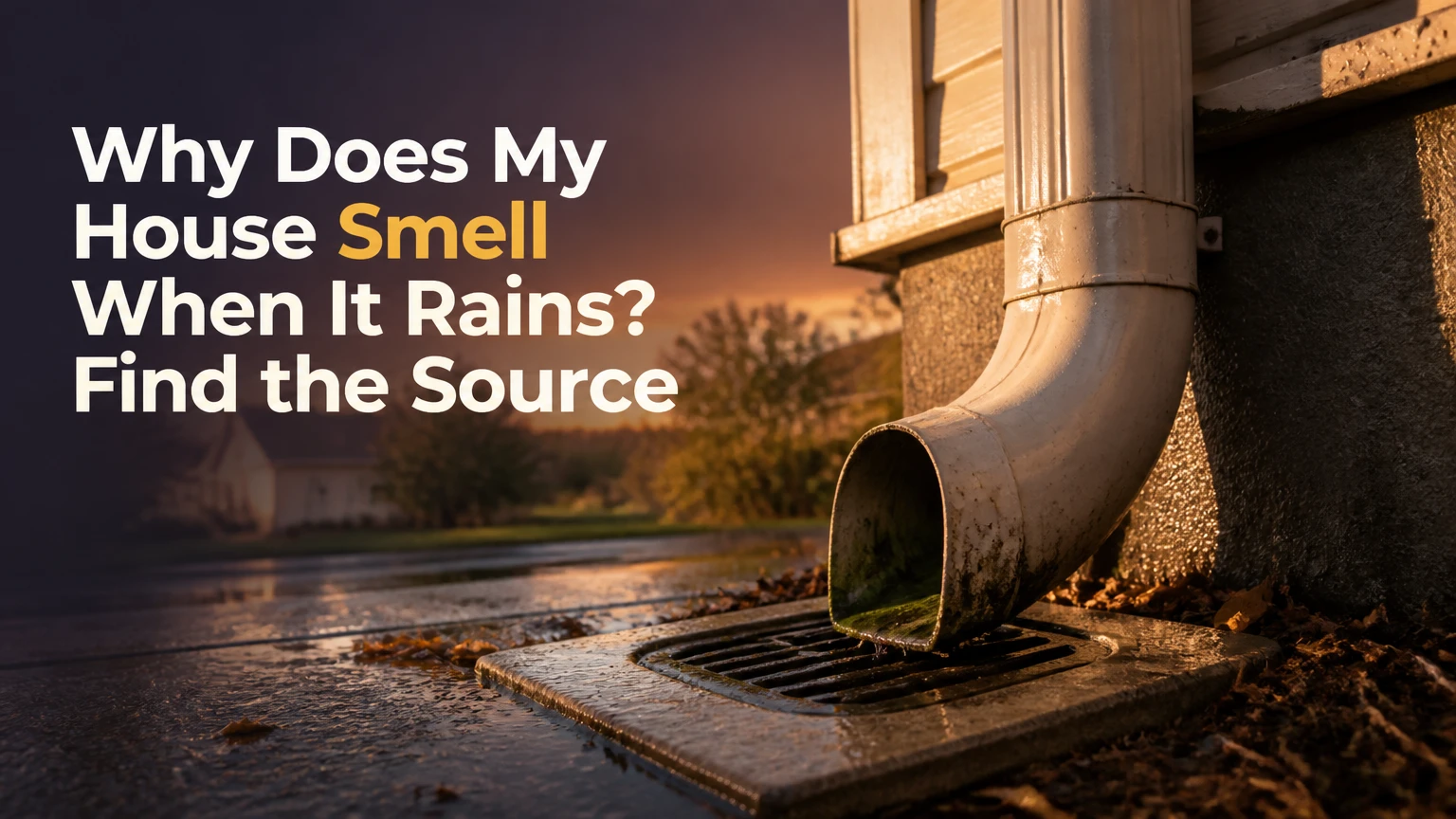
- Inspect rain pathways. Check gutters, downspouts, grading, window wells, foundation walls, roof penetrations, sump covers, and crawlspace vapor barriers.
- Check HVAC routes. Replace a dirty filter, inspect condensate pans, and determine whether a return grille is near a damp wall or crawlspace opening.
- Document recurrence. Photograph stains and record rainfall, wind, humidity, location, and duration for at least two storm events.
You will know the first test was informative when one controlled change alters the odor. A drain that still smells after refilling, or a basement that remains musty after humidity falls, needs a deeper inspection.
When should I leave the house or call for help?
Leave the affected area and seek urgent help when a strong sewer or sulfur odor causes headache, dizziness, nausea, eye irritation, breathing difficulty, or confusion. Hydrogen sulfide can be hazardous, and smell is an unreliable warning because olfactory fatigue can reduce detection.
Never use a flame to find a gas leak. If the odor resembles natural gas rather than damp soil or sewage, leave immediately, avoid switches and phones inside, and call the gas utility or 911 from outside. Carbon monoxide is also odorless, so every home should have working carbon-monoxide alarms near sleeping areas.
Call a professional when wastewater backs up, a plumbing odor affects multiple fixtures, visible mold covers a large area, insulation or drywall is wet, a crawlspace floods, or the smell returns after basic checks. Roof, electrical, confined-space, and sewage work carry risks that make improvised repairs unsafe.
Which fix matches the odor?
The correct remedy depends on the source, not on how strong the smell seems. A dehumidifier helps excess humidity, an activated-carbon purifier reduces airborne odor, and sealing helps only after the pathway and moisture cause are understood.
| Remedy | Typical USA cost | Useful timeframe | Best source match | Main limitation |
|---|---|---|---|---|
| Digital hygrometer | $10-$30 | Immediate reading | Humidity screening | Does not locate water |
| Portable dehumidifier | $180-$400 | 1-4 hours to lower RH | Damp basement air | Does not repair leaks |
| Plumber trap or vent repair | $150-$600 | 1-4 hours | Sewer or drain odor | Scope varies by access |
| Roof vent clearing | $150-$500 | 1-3 hours | Blocked plumbing vent | Roof access risk |
| Sump pump installation | $800-$2,500 | 4-8 hours | Recurring groundwater | Requires discharge planning |
| Crawlspace encapsulation | $5,000-$15,000 | 1-4 days | Persistent crawlspace moisture | Needs dehumidifier maintenance |
| Mold remediation | $1,500-$6,000 typical | 1-5 days | Confirmed contaminated materials | Must follow moisture repair |
| Radon mitigation | $1,200-$2,500 | 1 day | Elevated radon test | Requires post-install testing |
Typical USA prices vary with region, access, permits, contamination, and finish restoration. A dehumidifier is poor value when water enters through a foundation wall, while a carbon purifier is poor value when a dry trap is admitting sewer gas.
Is an air purifier better than a dehumidifier?
A dehumidifier is better for high indoor humidity, while an activated-carbon purifier is better for reducing some airborne odor after the source is controlled. HEPA filtration captures particles, including many airborne particles, but ordinary HEPA media does not remove sewer gases or most odor molecules without an adsorbent such as activated carbon.
Choose a unit by measured room size, pint-per-day rating, automatic humidity control, drainage option, and carbon quantity. Many small consumer purifiers contain only a thin carbon sheet, which may have limited capacity for persistent chemical or sewer odors.
Neither appliance fixes wet drywall, a plumbing leak, saturated soil, or a failed sump. The odor returning after the appliance is turned off is evidence that source control remains incomplete.
How can homeowners prevent rain-related odors?
Prevent rain-related odors by controlling water at the roof, site, foundation, crawlspace, and plumbing system. Keep gutters clear, discharge downspouts at least 6 feet from the foundation where site conditions allow, maintain a continuous ground slope away from the house, and keep traps filled.
| Prevention action | Target specification | Inspection interval | Failure sign |
|---|---|---|---|
| Indoor humidity control | 30%-50% RH | Weekly during wet season | Persistent readings above 60% |
| Downspout discharge | About 6 feet from foundation | After major storms | Splashing beside wall |
| Crawlspace ground cover | Continuous sealed vapor barrier | Every 6-12 months | Exposed soil or standing water |
| Floor drains | Water seal maintained | Monthly in unused areas | Dry trap or odor |
| Gutters | No blockage or overflow | Spring and fall | Water marks below eaves |
| Sump system | Pump and alarm operational | Quarterly | Cycling, silence, or wet pit |
| Bathroom exhaust | Vents outdoors, not attic | Annual | Condensation or attic staining |
Three practitioner rules prevent many repeat problems. First, test the odor at the source rather than at the room center, because air mixing can make a drain smell like a wall. Second, inspect during or immediately after rain, when pathways are active. Third, do not seal a crack until you know whether it carries water, soil gas, or structural movement.
What should renters do?
Renters should document the odor, location, weather conditions, visible moisture, and health symptoms, then notify the landlord in writing. Do not cut drywall, remove suspected mold, climb onto the roof, or disconnect plumbing fixtures without permission.
A renter can safely refill unused drain traps, use a hygrometer, ventilate when outdoor air is clean and dry, and report a malfunctioning exhaust fan or HVAC condensate problem. Photographs taken during rain are more useful than a general complaint that the home smells damp.
Landlords should investigate recurring odors involving sewage, water intrusion, visible mold, flooding, or HVAC contamination. Local housing and landlord-tenant requirements differ across the USA, so renters should contact the local health department or housing agency when a documented hazard is not addressed.
What common mistakes make diagnosis harder?
Masking the odor with fragrance delays source identification and can add volatile compounds to already irritating indoor air. Mixing bleach with ammonia, acids, or drain cleaners can create dangerous gases, so never combine cleaning chemicals.
Running exhaust fans continuously during a storm can increase negative indoor pressure in a tightly sealed house, although fan operation is not proof of a sewer-gas pathway. Turn fans off temporarily for a controlled comparison, but restore required ventilation after testing.
Testing every surface for mold before checking gutters, traps, and leaks wastes money. Mold sampling can identify airborne or surface conditions at one moment, but it cannot determine why a basement becomes wet after rain.
Ignoring a sump pit is another frequent error. A loose cover, missing gasket, or failed check valve can release odor even when the pump appears to operate normally.
Frequently Asked Questions
Why does my house smell like wet dirt but only during storms?
A wet-dirt smell that occurs only while windows or outdoor-air intakes are open is usually petrichor entering from outside. If the smell remains after openings are closed, inspect the basement, crawlspace, slab penetrations, sump basin, and damp stored materials for an indoor soil or moisture pathway.
Can heavy rain make a septic system smell inside?
Heavy rain can make septic odors more noticeable when the tank, drain field, cleanout, vent, or plumbing system has a defect or hydraulic limitation. Rain alone should not routinely send septic gas indoors. A septic professional should inspect the system when odors recur, wastewater drains slowly, or fixtures gurgle.
Why does the smell appear before rain starts?
Odors can appear before rainfall because wind and changing atmospheric pressure alter airflow through vents, cracks, chimneys, and exhaust pathways. A pre-storm odor is especially informative when it occurs near a floor drain, crawlspace hatch, sump pit, or plumbing fixture.
Does vinegar remove a rain-related musty smell?
Vinegar may reduce some surface odors temporarily, but it does not remove moisture from drywall, insulation, wood framing, or carpet padding. Source repair, drying, and removal of unsalvageable porous material are more reliable than household deodorizing treatments.
How long should a house smell after rain?
Outdoor petrichor typically fades within minutes to several hours after windows close and indoor air exchanges. A musty or sewer odor that persists for more than 24 hours, returns after several storms, or concentrates in one location warrants moisture or plumbing inspection.
Should I test for mold or radon first?
Test for radon independently if the home has not been tested, because radon is odorless and cannot be diagnosed by smell. Investigate moisture and plumbing first when the immediate complaint is an odor, since source control often identifies the cause more efficiently than mold sampling.
The Bottom Line
Why does my house smell when it rains? Rain can carry normal petrichor indoors, but persistent musty, sewage, sulfur, or chemical odors usually reveal moisture, drainage, plumbing, wildlife, or building-envelope problems. Close windows, map the strongest location, measure humidity, refill unused traps, and inspect rain pathways before buying an air purifier or commissioning mold treatment. A recurring odor with visible water, wastewater, symptoms, or a gas-like character requires qualified help.