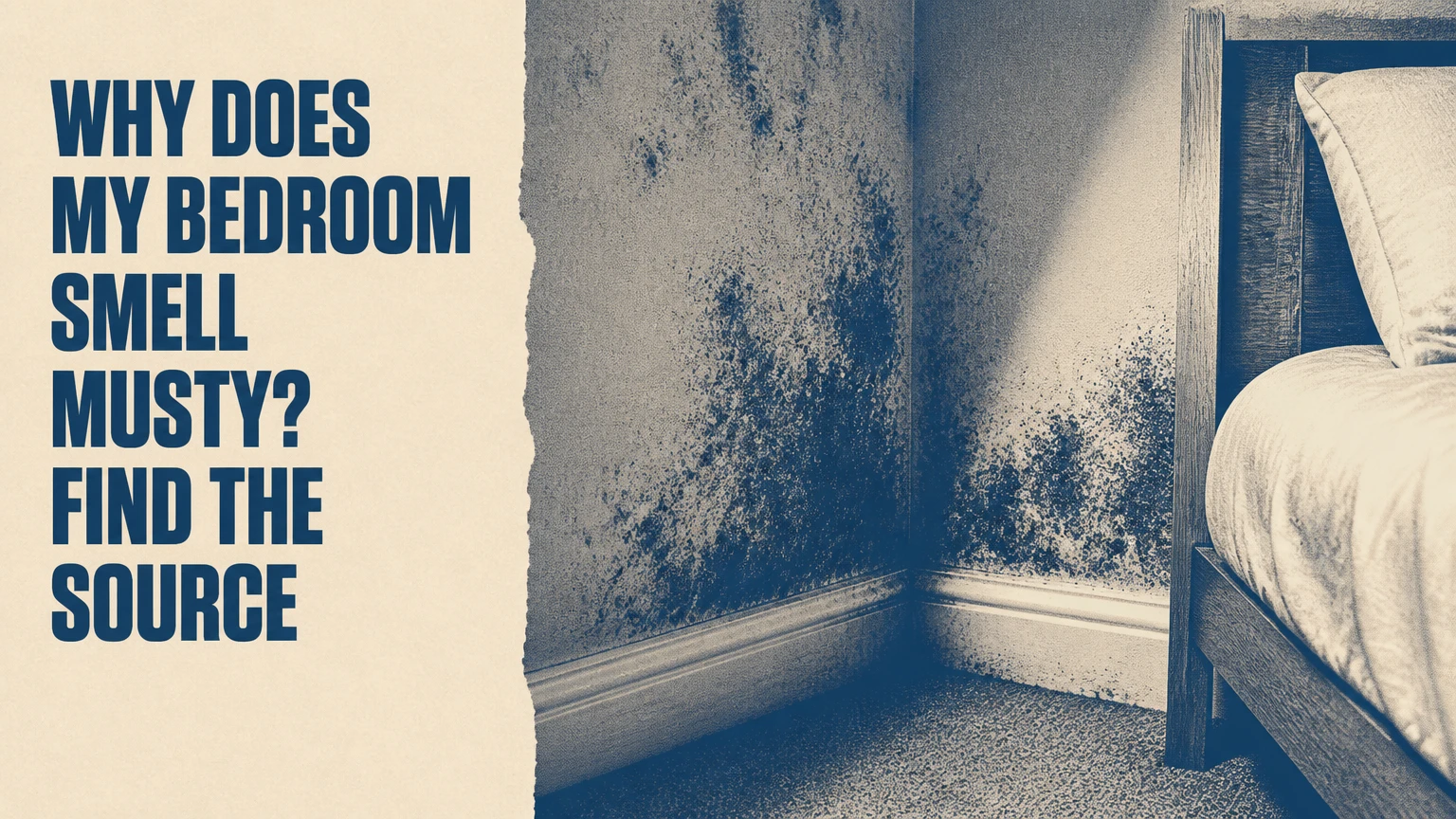
Why Does My Bedroom Smell Musty? Find the Source
A musty bedroom smell usually comes from moisture that allows mold, mildew, bacteria, or damp materials to release odor compounds into the air. Common sources include high humidity, condensation, hidden leaks, wet carpet padding, mattresses, closets, and HVAC components. Finding and drying the moisture source matters more than covering the odor.
Key Facts at a Glance
Indoor relative humidity around 30-50% generally limits condensation and moisture-related growth.
A musty odor indicates dampness or microbial activity, but it does not prove that visible mold exists.
EPA guidance generally treats moldy areas smaller than about 10 square feet as potential DIY projects for suitable occupants.
Bleach is not a reliable treatment for porous drywall, wood, carpet padding, or upholstered furniture.
A dehumidifier reduces moisture in room air, but it cannot dry a wet wall cavity or repair a plumbing leak.
An HVAC odor that appears only when cooling starts points toward the coil, drain pan, filter, or nearby ductwork.
Why Does My Bedroom Smell Musty?
Mold, mildew, bacteria, damp fabrics, and trapped stale air are the main causes of a musty bedroom smell. Microbial volatile organic compounds, or mVOCs, can create earthy, stale, or mold-like odors as microorganisms grow on materials such as cellulose, wood, dust, carpet, and fabric.
The odor is a warning signal, not a complete diagnosis. A bedroom can smell musty without visible mold because growth may sit behind furniture, below carpet, inside a wall, around a window, or in an HVAC component. Conversely, a small visible patch may produce little odor if the room has strong air exchange.
The U.S. Environmental Protection Agency states, “The key to mold control is moisture control.” That principle is more useful than trying to identify a mold species by smell. Most household odor investigations should begin with water, humidity, temperature, and material condition.
How Does a Musty Odor Develop?
Moisture first raises the water content of air or building materials. Microorganisms then use available organic material, including dust, paper backing, wood fibers, drywall facing, skin residue, and textile fibers. Odor compounds accumulate when growth, dampness, and poor air exchange persist together.
The often-repeated claim that mold always germinates within exactly 24-48 hours is too precise. Drying speed depends on temperature, relative humidity, material porosity, nutrient availability, and how long the surface stays wet. Water-damaged materials should still be dried promptly because extended dampness increases the chance of microbial growth.
| Condition | What it indicates | Typical bedroom clue | First response |
|---|---|---|---|
| 30-50% RH | Usually manageable indoor moisture | Dry bedding, no window pools | Maintain ventilation and monitor |
| 51-60% RH | Elevated moisture risk | Damp corners or morning condensation | Increase extraction and inspect |
| Above 60% RH | Persistent humidity problem | Sticky air, odor after sleep | Run a dehumidifier and find source |
| Wet material | Local water source | Stain, swollen trim, soft carpet | Stop the leak and dry promptly |
| Cold surface below dew point | Condensation risk | Wet window sill or exterior wall | Improve air circulation and insulation |
Is a Musty Smell Always Mold?
No. A musty smell can come from mold or bacteria, but damp carpet, old spills, pet urine, dirty laundry, a clogged drain, or a poorly ventilated closet can produce a similar odor. Odor alone cannot establish the presence, species, quantity, or health risk of mold.
A reliable diagnosis combines smell location with moisture evidence. Use a digital hygrometer in the bedroom and inspect materials that touch exterior walls or floors. If the odor is strongest inside a closet, behind a headboard, or around a window, the source is probably localized. If the smell fills the room when the air conditioner starts, investigate the HVAC system.
Home mold test kits rarely answer the practical question, which is where moisture exists and what must be removed. The Centers for Disease Control and Prevention emphasizes visual inspection and moisture control rather than routine air sampling for ordinary household decisions.
Which Bedroom Materials Hold Musty Odors?
Porous materials hold odor because moisture and microbial residue can penetrate below the surface. Carpet pad, particleboard furniture, foam, mattresses, pillows, curtains, and upholstered chairs usually require more scrutiny than sealed tile, glass, or metal.
| Material | Common odor source | Inspect for | Typical decision |
|---|---|---|---|
| Carpet and pad | Spill, condensation, pet urine | Damp underside, brown stain, sour odor | Clean shallow contamination; replace wet pad |
| Mattress and pillows | Sweat, body oils, humidity | Persistent odor at close range | Dry fully; replace if moldy or persistently damp |
| Drywall | Wall leak or condensation | Staining, bubbling paint, soft paper | Cut out damaged sections when needed |
| Wood or particleboard | Window leak or high humidity | Swelling, dark edges, delamination | Dry sealed wood; replace swollen board |
| Curtains and bedding | Incomplete drying, closet dampness | Odor after washing | Launder and dry completely |
| Leather or vinyl | Surface moisture and dust | Sticky film, seam discoloration | Clean and dry; inspect backing |
Could the Mattress or Carpet Be the Source?
Yes. A mattress can accumulate moisture from overnight perspiration, humid air, spills, and poor ventilation beneath the bed. Exact sweat quantities vary widely by person, bedding, temperature, and health, so the frequently quoted figure of 10-12 ounces every night should not be treated as a universal measurement.
Test soft goods by isolating them. Remove bedding, stand the mattress on its side in a dry ventilated area, and smell the carpet corners, pad edges, pillows, and curtains separately. Do not place a damp mattress back on a solid platform, because restricted airflow keeps the underside wet.
Pet urine has a different pattern. A musty urine odor often becomes stronger in humid weather because moisture reactivates odor compounds in carpet backing or subflooring. An ultraviolet flashlight can help locate some urine residues, but it cannot diagnose mold and may miss older or chemically altered stains.
Where Should You Inspect First?
Inspect the places where water enters, condenses, collects, or cannot evaporate. Start with the strongest odor location, then move outward to the nearest window, exterior wall, ceiling, floor edge, closet, and HVAC register.
Pull beds, dressers, and bookcases at least 6 inches from exterior walls. Look for spotting, peeling paint, swollen baseboards, damp dust, discoloration, and a temperature difference between the wall and the rest of the room. Do not rely on color alone, because mold can be white, gray, green, brown, or nearly invisible.
| Inspection location | Evidence to check | Useful tool | Escalation clue |
|---|---|---|---|
| Window sill and track | Condensation, failed seal, wet trim | Flashlight and tissue | Water returns after drying |
| Exterior wall | Cold patch, bubbling paint, staining | Hygrometer and moisture meter | Elevated reading persists |
| Ceiling | Ring stain, soft drywall, peeling paint | Flashlight | Pattern expands after rain |
| Floor perimeter | Damp carpet edge, swollen baseboard | Flat screwdriver and moisture meter | Subfloor feels soft |
| Closet | Packed contents, wet back wall, odor in clothing | Hygrometer | Odor remains after emptying |
| Under or behind furniture | Dark spotting, trapped dust, damp wall | Flashlight and tissue | Growth covers a broad area |
A pin or pinless moisture meter can identify suspicious areas, but readings are comparative rather than absolute. Compare a questionable wall with a dry interior wall made from the same material, and follow the manufacturer’s scale. A single reading cannot prove mold or locate a leak path.
What Does the Odor Pattern Reveal?
Odor timing often identifies the source faster than a broad visual search. Record whether the smell changes after rain, overnight occupancy, opening windows, running heat, starting cooling, or closing the bedroom door.
| Odor pattern | More likely source | Confirmation test | Typical repair |
|---|---|---|---|
| Stronger after rain | Roof, window, masonry, foundation leak | Inspect within 24 hours of rain | Seal and dry affected assembly |
| Stronger each morning | Bedding, carpet, high overnight humidity | Measure RH on waking | Wash textiles and reduce humidity |
| Stronger with AC | Coil, pan, filter, condensate line | Compare first 10 minutes of cooling | Service coil, drain, or filter |
| Stronger when room stays closed | Stagnant air, closet, damp furniture | Ventilate for 30 minutes | Clean source and improve exchange |
| Localized behind bed | Cold exterior wall or hidden growth | Move bed and inspect wall | Dry, repair, or remove material |
| Present throughout house | HVAC, basement, crawlspace | Compare multiple rooms | Inspect central moisture source |
Is the HVAC System Causing the Smell?
An HVAC system is a likely source when the odor appears within minutes of starting air conditioning or heating and then spreads through several rooms. Cooling coils, condensate pans, drain lines, filters, insulation, and nearby duct surfaces can collect moisture and dust.
A dirty filter alone usually causes dust or stale airflow rather than a strong mold odor, but a clogged filter can reduce airflow and keep the evaporator coil wet. Do not spray household disinfectants, bleach, or fragrance into supply ducts. Turn off the system before inspecting the accessible filter and registers, and arrange qualified service for the coil, drain pan, and condensate line.
| HVAC component | Odor mechanism | Homeowner check | Service need |
|---|---|---|---|
| Return filter | Dust retention and restricted airflow | Check replacement date | Replace with compatible filter |
| Evaporator coil | Wet dust and microbial residue | Usually not visible safely | HVAC technician cleaning |
| Condensate pan | Standing water or sludge | Inspect accessible pan | Clear drain and repair slope |
| Supply duct | Damp insulation or residue | Smell at register | Duct evaluation, not automatic cleaning |
| Return plenum | Moist dust near air handler | Odor at return grille | Professional inspection |
| Furnace heat exchanger area | Combustion or electrical concern | Do not disassemble | Immediate technician assessment |
A musty odor from a register does not prove that the entire duct system requires cleaning. The National Air Duct Cleaners Association recommends source-specific assessment, while EPA guidance warns that duct cleaning has limited value when no contamination or moisture problem is present.
How Can You Remove the Musty Smell Safely?
Remove the moisture source, dry the room and materials, clean salvageable surfaces, and replace porous items that remain contaminated or wet. Odor removal commonly takes 4 hours to several days, depending on whether the source is bedding, surface condensation, carpet padding, or a concealed building leak.
Step 1: Measure and Document the Room
Place a digital hygrometer away from windows, vents, bathrooms, and direct sunlight. Record bedroom RH and temperature when the odor is weak, strong, and strongest after sleeping. Typical hygrometers cost $10-$30 in U.S. stores.
For renters, photograph stains, record dates, and send a written maintenance request. Do not remove wall materials or discard major property without landlord instructions and documentation.
Step 2: Remove Soft Items
Take laundry, bedding, curtains, rugs, and storage boxes out of the room. Wash machine-safe fabrics according to their care labels and dry them completely, because folded fabric that feels cool may still retain moisture.
Do not use fragrance beads, candles, or aerosol fresheners as the main treatment. Fragrance can hide the source and may irritate occupants with asthma or chemical sensitivity.
Step 3: Dry the Room
Use a dehumidifier sized for the room and aim for approximately 40-50% RH. Keep doors and windows configured for the weather: opening windows helps when outdoor air is drier, but increases indoor moisture during humid summer conditions.
A fan can speed drying when there is no suspected active mold contamination. Avoid directing high-speed airflow across visible mold or heavily contaminated debris, because disturbance can spread particles. Drying is the goal, not indiscriminate air movement.
Step 4: Clean Appropriate Surfaces
For hard, nonporous surfaces, use detergent and water, then dry fully. For washable fabrics, launder and dry thoroughly. Vinegar may reduce some surface odors, and products such as Concrobium are marketed for hard-surface mold treatment, but neither repairs a leak or reliably restores deeply contaminated porous material.
Bleach requires careful correction. Household bleach is a dilute sodium hypochlorite solution in water, but the exact water percentage depends on the product formulation, so the claim that bleach universally contains 94% water is not reliable. Bleach also does not penetrate porous drywall, wood, or carpet pad consistently. Never mix bleach with vinegar, ammonia, or other cleaners.
Step 5: Recheck After Drying
A successful cleanup produces lower RH, dry materials, and no odor after the room remains closed for several hours. If the smell returns within a day or two, the moisture source remains active or a porous reservoir was not addressed.
Which Cleaning Method Fits the Material?
Detergent and water are suitable for many hard surfaces, while porous materials require drying, specialized cleaning, or replacement. No household chemical can make a water-damaged wall safe if the wall cavity remains wet.
| Treatment | Suitable use | Typical cost | Main limitation |
|---|---|---|---|
| Detergent and water | Painted trim, tile, glass, metal | $5-$15 | Does not remove deep porous growth |
| Diluted vinegar | Some hard surfaces and odor residue | $3-$8 | Can damage stone; never mix with bleach |
| Commercial fungicidal product | Labeled hard surfaces | $10-$30 | Follow label; not a leak repair |
| HEPA vacuum | Dried settled particles on suitable surfaces | $150-$600 purchase | Does not remove embedded moisture |
| Carpet extraction | Cleanable carpet after drying source | $40-$90 rental | Wet pad can retain odor |
| Material replacement | Moldy drywall, soaked pad, swollen board | $100-$2,000 typical room work | Requires disposal and reconstruction |
EPA guidance generally allows suitable occupants to handle limited areas under about 10 square feet, provided the material and contamination are manageable. People with asthma, severe allergies, immune suppression, or respiratory disease should avoid disturbing mold and ask a qualified professional for guidance.
Are Dehumidifiers and Air Purifiers Enough?
A dehumidifier controls airborne moisture, while a HEPA purifier captures many airborne particles and activated carbon can reduce some odors. Neither appliance removes mold growing inside a wall, dries wet carpet padding, stops a roof leak, or repairs condensation caused by poor insulation.
Choose equipment based on the problem. A compressor dehumidifier is efficient in warm rooms, while a desiccant unit performs better in cooler spaces but usually consumes more electricity. Portable air cleaners should be sized by clean air delivery rate, not by vague claims such as “medical grade.”
| Option | Primary function | Typical USA cost | Best use |
|---|---|---|---|
| Digital hygrometer | Measures RH and temperature | $10-$30 | Diagnosis and monitoring |
| Portable dehumidifier | Removes room moisture | $150-$350 | RH above 60% |
| HEPA air purifier | Captures airborne particles | $100-$500 | Temporary particle reduction |
| Activated carbon filter | Adsorbs some odor compounds | $20-$150 replacement | Odor support, not source removal |
| Bathroom exhaust fan | Removes moisture at source | $150-$600 installed | Nearby bathroom humidity |
| Moisture meter | Compares building-material dampness | $25-$150 | Leak investigation |
Air cleaning is supportive, not curative. If the odor disappears only while the purifier runs, the purifier is masking airborne residue while the source continues.
DIY or Professional Remediation?
DIY treatment is reasonable for a small, visible area on a cleanable surface when the moisture source is fixed. Professional assessment is preferable for recurring odor, hidden water damage, extensive growth, sewage contamination, HVAC contamination, or occupants with significant respiratory vulnerability.
Typical U.S. costs vary by region, access, materials, and whether reconstruction is required. The ranges below are planning figures, not quotes.
| Service or remedy | Typical USA price | Typical duration | Best decision condition |
|---|---|---|---|
| Hygrometer and basic inspection | $10-$150 | 30-90 minutes | Initial source tracing |
| Dehumidifier operation | $150-$350 equipment | 1-3 days initially | Elevated room RH |
| Carpet cleaning | $100-$300 | 4-24 hours drying | Surface odor, dry pad |
| HVAC service | $150-$600 | 2-5 hours | Odor follows cooling |
| Moisture or mold inspection | $300-$800 | 2-4 hours | Hidden source suspected |
| Limited remediation | $500-$3,000 | 1-3 days | Small contaminated assembly |
| Extensive remediation | $3,000-$10,000 or more | 3-10 days | Multiple rooms or reconstruction |
Professional remediation does not automatically mean chemical fogging or vacating the entire home. A competent contractor should identify the moisture source, define the affected area, isolate work when needed, remove damaged material, control dust, and explain drying and verification procedures.
What Are the Main DIY Failure Modes?
The most common failure is treating odor instead of water. Air freshener, ozone, incense, and fragrance products can change the smell while leaving wet drywall, carpet pad, or wood untouched.
A second failure is cleaning the visible side of a material while ignoring its reverse side. Carpet, furniture backs, mattresses, and wall cavities can retain moisture after the room surface feels dry.
A third failure is using fans without a drying plan. Fans help evaporate water only when the moisture has somewhere to go; in a humid closed room, they can move damp air around without lowering material moisture.
A fourth failure is assuming a negative home test kit rules out hidden mold. Sampling is a snapshot of airborne conditions and does not replace inspection, moisture measurement, or repair.
What Should Renters and Apartment Residents Do?
Renters should document the odor, humidity, visible damage, and dates before moving or discarding property. A written request should identify the room, suspected water source, measured RH, odor timing, and any health symptoms, while avoiding unsupported claims about mold species or toxicity.
Ask property management to inspect windows, plumbing, roof assemblies, exterior walls, HVAC equipment, and adjacent units. Apartment odors can travel through shared ductwork, pipe chases, ceiling cavities, and wall penetrations, so the source may not be inside the bedroom.
Do not open walls, remove carpet, or apply chemicals to a rental without permission unless an immediate safety emergency requires action. Check the lease and local housing rules because repair duties and inspection standards differ across U.S. states and municipalities.
When Is a Musty Bedroom Smell a Health Concern?
A musty odor deserves faster action when occupants develop wheezing, coughing, eye irritation, worsening asthma, or persistent nasal symptoms, although odor alone cannot establish a specific illness. The CDC advises people with asthma or other lung conditions to avoid buildings with visible mold or mold growth when possible.
Leave the area and seek medical care for severe breathing difficulty, chest tightness, confusion, or rapidly worsening symptoms. People with weakened immune systems should not perform mold cleanup because exposure risk and infection consequences can be higher.
Health symptoms can have many causes, including dust mites, pollen, cleaning chemicals, carbon monoxide, and respiratory infections. Carbon monoxide is odorless, so a musty smell does not detect it. Maintain working carbon monoxide alarms near sleeping areas and fuel-burning equipment.
How Long Will the Smell Take to Disappear?
A surface or laundry odor may improve within 4-24 hours after washing and complete drying. A humid room often needs 1-3 days of dehumidification, while a leak inside drywall, flooring, or insulation can require several days to weeks after repair and material removal.
| Source type | Odor improvement after correction | Reason it may persist |
|---|---|---|
| Damp bedding | 4-24 hours | Incomplete drying or mattress underside |
| Room humidity | 1-3 days | Ongoing outdoor or plumbing moisture |
| Wet carpet pad | 24-72 hours after extraction | Pad or subfloor contamination |
| Window condensation | 2-7 days after control | Cold surface or failed seal |
| HVAC coil or pan | 1-5 days after service | Residue, drain issue, or duct source |
| Wall cavity leak | 3-14 days or longer | Wet insulation, drywall, or framing |
The odor should gradually decline after the source is corrected. A sharp return after rain, cooling, or overnight occupancy is evidence that the investigation is incomplete.
The Bottom Line
A musty bedroom smell usually points to excess moisture, damp porous material, microbial growth, or stale air rather than a simple need for fragrance. Measure humidity, isolate the strongest odor source, inspect windows and perimeter walls, check bedding and carpet, and note whether HVAC operation changes the smell.
Keep room RH near 30-50% when practical, repair leaks, dry materials completely, and replace porous building materials that remain damaged. Use bleach cautiously and never as a substitute for source removal. If the odor recurs, affects several rooms, involves HVAC equipment, or accompanies significant respiratory symptoms, obtain professional help.
The fastest way to answer “why does my bedroom smell musty” is to connect the odor to a measurable moisture pattern and a specific material. Odor control succeeds when the moisture source and contaminated reservoir are both addressed.
Frequently Asked Questions
Can a bedroom smell musty in winter?
Yes. Winter humidity can be low outdoors while indoor moisture condenses on cold windows, exterior walls, and poorly insulated corners. Sleeping, drying clothes, and closed doors add moisture. Check morning RH, window tracks, wall temperature, and furniture clearance before assuming the heating system is the source.
Why does my bedroom smell musty after it rains?
Rain can expose roof leaks, failed window seals, masonry cracks, foundation seepage, and crawlspace moisture. Inspect the ceiling, window trim, exterior-wall corners, floor edges, and closet backs within 24 hours of rainfall. A recurring post-rain odor requires building-envelope repair rather than deodorizing.
Can dirty sheets cause a mold smell?
Dirty sheets can produce a stale or sour odor from sweat, skin oils, bacteria, and incomplete drying, but they do not automatically indicate mold. Wash bedding according to its care label, dry it fully, and inspect the mattress, bed platform, and carpet beneath the bed if the smell remains.
Should I sleep in a room that smells musty?
A mild odor does not by itself determine whether a room is safe, but visible growth, wet materials, repeated respiratory symptoms, or extensive water damage justify avoiding the room until it is assessed. People with asthma, lung disease, or immune suppression should be especially cautious about disturbing damp materials.
Will baking soda remove a musty bedroom smell?
Baking soda may absorb or reduce a small amount of surface odor in dry fabrics, but it cannot remove moisture or growth inside carpet padding, drywall, wood, or a mattress. Use it only as a minor supplement after cleaning and drying, not as the main remediation method.
Do I need a mold test for a musty room?
Usually, no. A mold test may identify airborne or surface organisms, but it does not show where water is entering or which material needs repair. Visual inspection, RH measurement, moisture comparisons, and professional assessment provide more useful information for most household decisions.