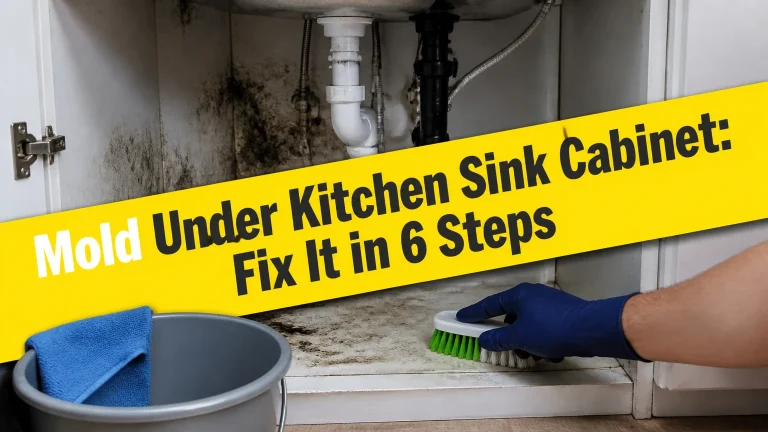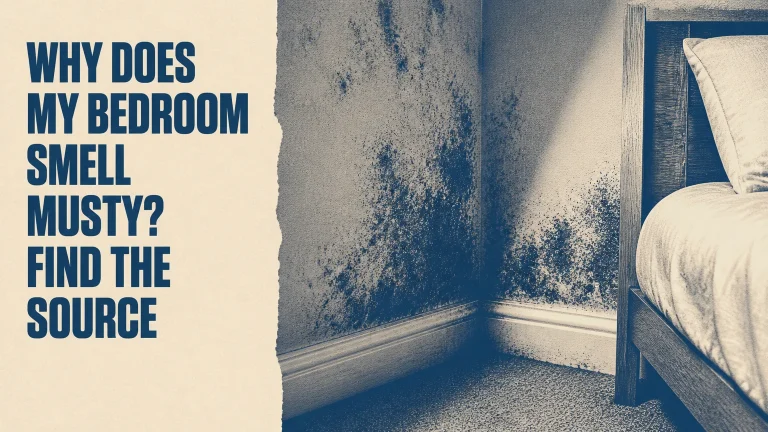
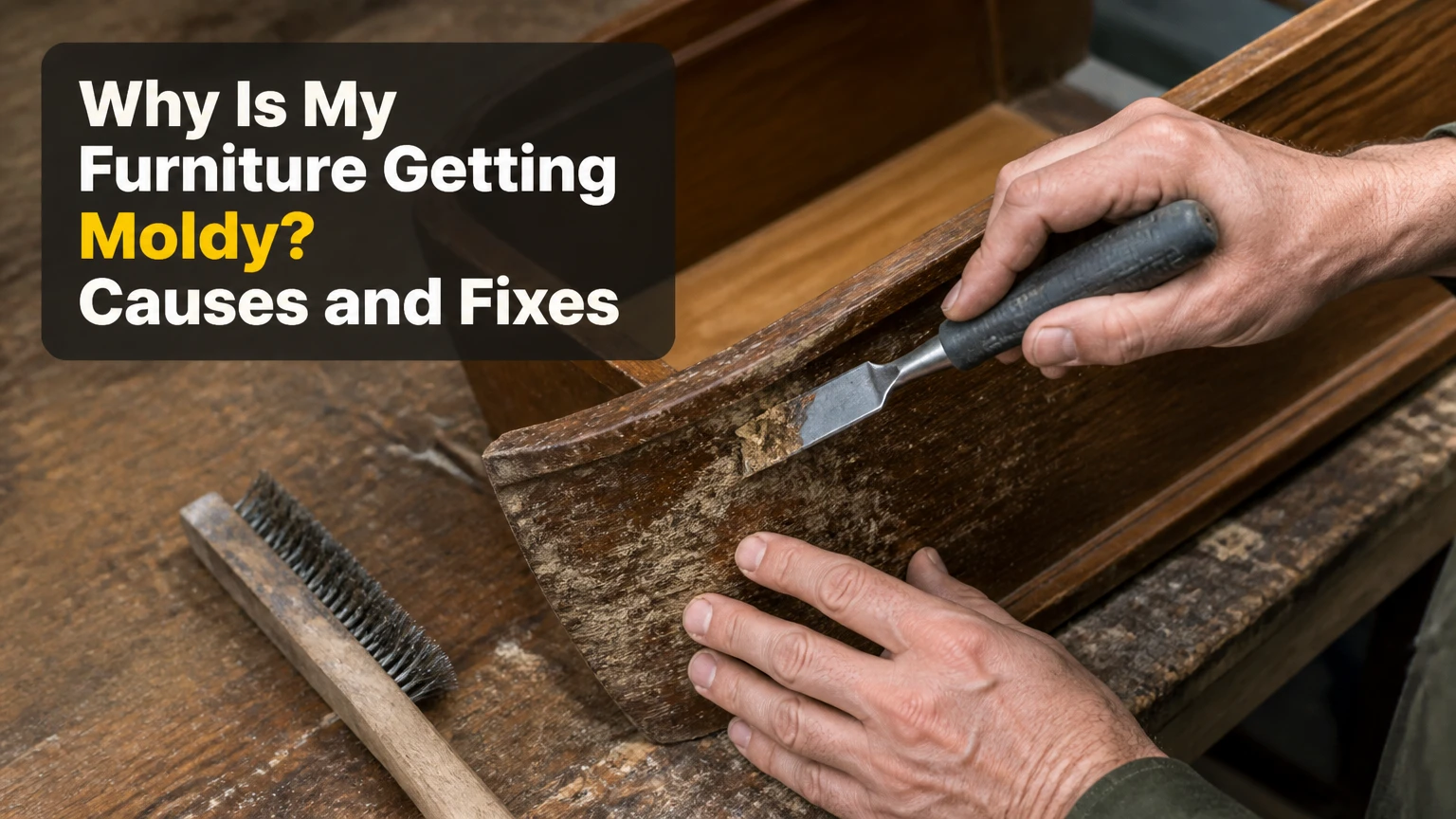
Why Is My Furniture Getting Moldy? Causes and Fixes
Furniture gets moldy when airborne fungal spores encounter persistent moisture, suitable indoor temperatures, oxygen, and organic material such as wood fiber, leather, fabric dust, or skin oils. The most common cause is excessive humidity or trapped condensation, especially behind furniture against cold exterior walls, inside closets, basements, and poorly ventilated rooms.
Key Facts at a Glance
- Indoor relative humidity should generally remain between 30% and 50% to reduce condensation and mold risk.
- A room reading below 60% does not guarantee dry furniture because fabric, walls, floors, and enclosed cabinets can retain moisture.
- Mold color cannot reliably identify a species, toxicity, or health risk; laboratory identification is required for species-level claims.
- Porous MDF, particleboard, foam, unfinished wood, leather, and upholstery can retain mold below the visible surface.
- Cleaning mold without repairing a leak, condensation problem, or humidity source usually leads to recurrence.
- EPA guidance states, “The key to mold control is moisture control.”
Why Is My Furniture Getting Moldy?
Furniture becomes moldy because moisture remains on or inside the material long enough for ordinary indoor spores to germinate. High humidity, condensation behind a sofa, a plumbing leak, wet cleaning, damp storage, and water trapped in cushions are common triggers; temperature usually matters less because normal homes already fall within mold-friendly conditions.
Mold does not require visibly dripping water. A cold wall can create a narrow, damp air pocket behind a bookcase while the center of the room feels comfortable. Upholstery can also absorb sweat, spills, and humid air, then dry slowly beneath cushions or against a floor.
The four-part mechanism is straightforward:
- Spores: Mold spores enter through windows, doors, clothing, HVAC systems, and outdoor air.
- Food: Cellulose, lignin, leather proteins, cotton fibers, dust, and skin residue supply nutrients.
- Temperature: Typical indoor temperatures, approximately 60°F-90°F, support many household molds.
- Moisture: Elevated relative humidity, condensation, wet materials, or leaks activate growth.
Oxygen is normally available on every exposed furniture surface. Removing spores from the air is therefore less effective than controlling moisture at the furniture and building level.
How fast can mold grow on furniture?
Mold can become visible within several days after wetting, but no universal germination clock applies to every species or material. Temperature, surface moisture, dust, porosity, airflow, and the type of spore determine the timeline, so claims that all mold germinates in exactly 24-48 hours are overprecise.
A wet cushion left in a warm room may smell musty before visible colonies appear. A damp particleboard cabinet can swell internally and develop concealed growth while its exterior looks clean. Drying within 24-48 hours is a practical water-damage target, not a guarantee that mold has been prevented.
What Humidity Prevents Mold?
A hygrometer reading between 30% and 50% relative humidity is the most useful household prevention target. Mold risk rises substantially as humidity approaches and exceeds 60%, but localized condensation can support growth even when the room average appears acceptable.
Measure humidity in the room where mold occurs, not only beside a thermostat. Place a digital hygrometer near the affected furniture, inside a closet, and in a basement or bathroom if those areas are involved. Take readings morning and evening for at least seven days.
| Reading near furniture | Interpretation | Recommended action |
|---|---|---|
| 30%-45% RH | Low routine mold risk | Maintain ventilation and inspect leaks |
| 46%-55% RH | Acceptable but monitor | Improve airflow behind furniture |
| 56%-60% RH | Increasing condensation risk | Run dehumidification and inspect cold surfaces |
| Above 60% RH | Mold-supporting environment | Reduce humidity promptly and find the source |
| Above 70% RH | High moisture load | Check HVAC, plumbing, foundation, and storage conditions |
Humidity can rise after showers, cooking, drying clothes indoors, or air-conditioning failure. In winter, indoor air at 45% RH may still condense on a cold exterior wall because the wall surface is much colder than the room air.
Why does mold grow behind furniture?
Mold grows behind furniture because restricted airflow allows a cold wall, trapped moisture, and dust to create a localized microclimate. A wardrobe or sofa placed directly against an exterior wall blocks warm room air from reaching the wall, increasing condensation and slowing evaporation.
Keep large furniture several inches from exterior walls where space permits. A 2-4 inch gap improves inspection and circulation, but it will not correct a leaking wall, foundation seepage, or severe indoor humidity. White or gray growth concentrated on the rear panel strongly suggests a wall or ventilation problem rather than a random furniture defect.
Where Is the Moisture Coming From?
The moisture source is usually identified by the mold’s location, distribution, and recurrence pattern. Mold on one rear corner suggests condensation, a spill, or a leak near that piece; mold on several unrelated items indicates a room-wide humidity, drainage, HVAC, or storage problem.
| Mold pattern | Most likely source | Confirmation test |
|---|---|---|
| Rear panel only | Cold exterior wall or condensation | Move furniture 2-4 inches and inspect wall |
| Bottom edges and legs | Wet floor, slab moisture, or flooding | Check flooring moisture and nearby plumbing |
| Inside drawers or cabinets | Closed humid air and poor circulation | Measure RH inside cabinet for 24 hours |
| Under sofa cushions | Spill, sweat, or slow drying | Inspect foam, webbing, and underside |
| Near windows | Condensation or failed seal | Check glass, frame, sill, and curtains |
| Several rooms affected | Whole-home humidity or HVAC issue | Compare hygrometer readings in each room |
| Musty furniture after storage | Damp basement, garage, or shipping wrap | Inspect storage walls and packaging |
Common hidden causes include a slow pipe leak, a refrigerator water line, a roof or window leak, a damp crawl space, a basement slab, blocked dryer ventilation, and an oversized air conditioner that cools without removing enough moisture. Furniture stored tightly in plastic can also trap water vapor.
A moisture meter can help locate wet wood, but readings vary by species, finish, and meter calibration. Use it as a comparison tool, not as proof that a surface is mold-free.
What Does Furniture Mold Look Like?
Furniture mold may appear as white, gray, green, brown, or black spots, patches, fuzz, powder, or a thin film, but appearance alone cannot identify the mold species or determine toxicity. Dust, textile lint, efflorescence, degraded foam, and finish damage can resemble mold.
“Black mold” is a visual description in ordinary household conversation, not a reliable diagnosis of Stachybotrys chartarum. The species is associated with chronically wet, cellulose-rich materials, yet black-colored growth can belong to many other fungi. Treat all substantial visible growth as a moisture and exposure-control problem rather than trying to identify it by color.
| Appearance or odor | Possible explanation | Practical implication |
|---|---|---|
| White powder or fine fuzz | Surface mold, dust, or salt residue | Test carefully and inspect moisture |
| Green or blue spots | Common surface fungi on damp materials | Clean only if the item is salvageable |
| Black patches | Several fungi, soot, or finish staining | Do not infer species from color |
| Flat gray film | Mildew or embedded textile growth | Examine seams and underside |
| Musty odor without spots | Hidden cushion, wall, or cabinet growth | Inspect concealed cavities |
| Raised bubbling finish | Moisture damage beneath coating | Drying alone may not restore finish |
People with asthma, mold allergies, chronic lung disease, or immune suppression may be more sensitive to indoor mold exposure. The CDC and EPA recommend reducing exposure and correcting dampness; neither recommends relying on a color-based “toxic mold” test.
Which Furniture Materials Mold Fastest?
MDF and particleboard generally mold and deteriorate faster than sealed solid wood because compressed wood fibers absorb water and dry slowly. Leather, suede, foam, cotton, linen, wool, and unfinished wood also retain moisture or organic residue, while intact nonporous metal and glass are easier to clean.
| Material | Moisture behavior | Salvage outlook | Main failure mode |
|---|---|---|---|
| MDF or particleboard | Absorbs water into fibers | Poor after swelling or deep growth | Edge swelling and hidden colonies |
| Unfinished solid wood | Porous, dries unevenly | Moderate with prompt drying | Growth in end grain and joints |
| Finished wood | Coating slows absorption | Good for light surface growth | Mold on dust or damaged finish |
| Leather or suede | Retains humidity and oils | Moderate, delicate cleaning | Staining, odor, finish loss |
| Cotton or linen upholstery | Absorbs spills and dust | Moderate if promptly dried | Growth in seams and backing |
| Foam cushions | Holds water internally | Poor when odor persists | Hidden mold inside foam |
| Metal or glass | Low absorption | High after proper disinfection | Mold on dust, fabric, or joints |
A finished table can still grow mold. Polyurethane, lacquer, or paint protects the substrate only while the coating remains intact; dust on top of the finish can feed surface colonies, and cracks, screw holes, unfinished undersides, and damaged edges remain vulnerable.
Can moldy particleboard furniture be saved?
Moldy particleboard can sometimes be cleaned when growth is small, superficial, and the board remains flat and structurally sound. Discard or replace particleboard when it is swollen, crumbly, delaminated, deeply odorous, or visibly colonized inside edges, because porous core material is difficult to dry and clean completely.
Do not save a low-cost cabinet if remediation costs approach replacement cost. Seal contaminated furniture in plastic before moving it through the home, and avoid breaking or shaking panels because that releases spores and debris.
How Do You Clean Moldy Furniture?
Clean a small, limited furniture area only after isolating the item, protecting yourself, and correcting the moisture source. Wear gloves, eye protection, and at least a well-fitting N95 respirator, ventilate directly outdoors, avoid dry brushing, and keep children and sensitive occupants away from the work area.
EPA guidance generally supports cleaning small areas while using containment and moisture control; large contamination, extensive water damage, or HVAC involvement requires professional assessment. The following process suits a small surface colony on a potentially salvageable item.
Step 1: Isolate the furniture
Move the piece outdoors only when weather is dry and the route will not spread contamination through living areas. Otherwise, close the room, cover nearby clean items, and place disposable plastic beneath the furniture.
Do not run a box fan across visible mold indoors. Air movement can distribute spores into adjacent rooms.
Step 2: Identify the material and damage
Inspect the underside, back, drawer joints, cushion seams, foam, and wall behind the item. Photograph the condition before cleaning if a landlord, insurer, or restoration contractor may need documentation.
Test any cleaner on a hidden 1-inch area. Stop if dye transfers, finish turns cloudy, leather darkens, or the surface becomes tacky.
Step 3: Remove loose contamination safely
Use a damp disposable cloth for smooth, finished surfaces. A HEPA vacuum can capture settled particles when used carefully, but a standard household vacuum may exhaust fine spores back into the room.
Do not sand, scrape, or dry-brush mold indoors. Those actions increase airborne contamination and can drive growth deeper into porous fibers.
Step 4: Apply a material-compatible cleaner
Choose the least aggressive product that can remove the colony without saturating the furniture. Vinegar, alcohol, peroxide, and commercial fungicidal products have different finish and flammability risks.
| Cleaning option | Suitable material | Typical contact or drying detail | Key limitation |
|---|---|---|---|
| Mild detergent solution | Sealed wood, plastic, metal | Wipe, then dry within 30 minutes | Does not penetrate porous cores |
| 70% isopropyl alcohol | Some unfinished hard surfaces | Fast evaporation, 10-15 minutes | Flammable; damages shellac and leather |
| White vinegar | Limited durable hard surfaces | Light application, dry 1-2 hours | Odor, staining, finish incompatibility |
| EPA-registered product | Label-specified materials | Follow product label exactly | Label may exclude upholstery or leather |
| Professional treatment | Antiques, extensive growth | Often 1-3 days for setup and work | Typical USA cost starts near $500 |
Never mix bleach with vinegar, ammonia, or other cleaners. Chlorine bleach is not a dependable solution for porous wood or upholstered furniture because it may not reach embedded growth and can add water to the material.
Step 5: Dry completely and reassess
Use indirect airflow, a dehumidifier, and space around the item. Wood should feel dry, upholstery should have no cool damp areas, and the musty odor should not intensify after 24-48 hours.
A clean-looking surface is not proof of successful remediation. Recurring odor, swelling, staining that returns, or new growth indicates concealed moisture or material that cannot be adequately cleaned.
Which Cleaning Method Fits the Material?
Finished wood usually tolerates controlled wiping better than unfinished wood, while leather and upholstery require conservative treatment and rapid drying. No household chemical safely guarantees removal of mold roots from every porous item, so the material, contamination area, finish, and replacement value determine the correct method.
| Furniture type | First-line approach | Avoid | Professional threshold |
|---|---|---|---|
| Sealed wood table | Damp wipe, compatible cleaner, dry | Flooding joints or finish | Growth over broad surface |
| Unfinished wood chair | HEPA capture, light cleaner, rapid drying | Heavy saturation and sanding indoors | Persistent odor or deep staining |
| Leather sofa | Isolate, specialist leather cleaner | Alcohol, bleach, soaking | Mold in seams or backing |
| Fabric cushion | Remove cover, launder if label permits, dry fully | Reinstalling damp foam | Odor or growth inside foam |
| MDF cabinet | Clean only superficial spots | Soaking swollen board | Swelling, crumbling, internal growth |
| Antique furniture | Photograph and consult conservator | Vinegar, alcohol, abrasive scrubbing | Any valuable finish or veneer damage |
Vinegar is not universally safe, and “natural” does not mean compatible with finishes. Commercial products are not automatically better either; the label must specify the surface and required ventilation.
When Should Furniture Be Discarded?
Furniture should usually be discarded when porous material has extensive growth, remains musty after complete drying, has swollen or deteriorated, or cannot be cleaned without exposing occupants. Replacement is especially appropriate for moldy foam, heavily contaminated particleboard, saturated mattresses, and upholstered items with growth in the padding.
Consider salvage when the item is valuable, structurally sound, and contamination is limited to a cleanable surface. A furniture conservator is preferable for antiques, veneer, marquetry, painted finishes, and heirloom leather because aggressive household cleaning can destroy more value than the mold itself.
EPA commonly uses a roughly 10-square-foot visible mold area as a point at which occupants should consider professional guidance, although the exact response depends on material, water damage, occupants, and HVAC contamination. The threshold is not a safety guarantee.
What Does Moldy Furniture Treatment Cost?
Typical USA costs range from $10-$30 for basic cleaning supplies, $150-$300 for a portable dehumidifier, and $500-$3,000 or more for professional remediation. Replacement costs can exceed treatment for inexpensive particleboard, while antiques and structural moisture problems may justify specialist work.
| Intervention | Typical USA cost | Typical timeframe | Best use |
|---|---|---|---|
| Hygrometer | $10-$25 | 10 minutes to install | Confirm room humidity |
| Cleaning supplies | $10-$30 | 1-3 hours plus drying | Small surface colony |
| Portable dehumidifier | $150-$300 | 24-72 hours to stabilize | One humid room |
| Upholstery cleaning | $100-$400 | 1-3 days including drying | Limited fabric contamination |
| Furniture conservator | $300-$1,500+ | Several days to weeks | Valuable wood or leather |
| Mold remediation company | $500-$3,000+ | 1-3 days for small projects | Broad contamination or leaks |
These are typical planning ranges, not guaranteed quotes. A contractor may charge more when wall removal, containment, air-handler cleaning, crawl-space work, or post-flood drying is required.
Common Mistakes That Make Mold Return
Furniture mold returns when cleaning removes visible staining but leaves moisture, contaminated padding, or a cold condensation surface. The most frequent failures involve drying, airflow, chemical choice, and moving contaminated items.
- Pushing furniture directly against an exterior wall: Leave a 2-4 inch inspection gap and correct wall dampness.
- Using a non-HEPA vacuum: Use damp wiping or a true HEPA machine; do not distribute spores indoors.
- Saturating wood or upholstery: Apply only enough product to contact the surface, then dry immediately.
- Trusting one humidity reading: Measure near the item, inside cabinets, and during humid weather.
- Cleaning before fixing a leak: Repair plumbing, roofing, window seals, slabs, or HVAC drainage first.
- Wrapping damp furniture in plastic: Plastic traps vapor; dry the item before storage.
- Using bleach on porous materials: Bleach can damage finishes and does not reliably treat embedded growth.
- Assuming black means toxic: Color does not establish species, toxin production, or exposure risk.
A practitioner rule is simple: if mold returns in the same location within two weeks, stop repeating surface cleaning and investigate the building assembly or concealed material.
Situational Advice for USA Homes
Renters should photograph the furniture, wall, floor, and hygrometer readings before moving or cleaning extensive mold. Notify the landlord in writing when leaks, window condensation, HVAC failures, or damp walls are involved, because treating personal property cannot correct a building defect.
Basement owners should inspect foundation walls, floor drains, sump pumps, stored cardboard, and dehumidifier operation. Keep furniture off concrete floors and avoid tight plastic covers unless the item is fully dry and the enclosure is designed for climate-controlled storage.
People moving homes should not place musty furniture directly into a clean residence. Isolate the item, inspect hidden surfaces, and resolve the cause before transport, because spores and contaminated dust can travel on fabric, cardboard, and unfinished wood.
Antique owners should avoid vinegar, alcohol, bleach, and abrasive methods until a conservator assesses the finish. A small amount of surface mold can permanently stain veneer or lacquer, while rapid uncontrolled drying can crack old wood and loosen joints.
The Bottom Line
Why is my furniture getting moldy? In most homes, the immediate cause is moisture, not an unusual type of furniture or a mysterious airborne contamination event. Measure humidity near the item, inspect walls and concealed surfaces, separate furniture from cold walls, and dry affected materials before choosing a cleaner.
Small surface growth on sound, nonporous or finished furniture may be manageable with controlled cleaning. Mold in foam, swollen MDF, damp upholstery backing, or structurally damaged wood often warrants disposal or professional treatment. If mold repeatedly returns, fix the moisture source rather than applying stronger chemicals.
Frequently Asked Questions
Can furniture cause mold in a room?
Furniture can spread mold spores and retain moisture, but furniture alone rarely creates the original room-wide problem. Upholstery, cardboard, unfinished wood, and contaminated dust can release spores after disturbance, while a damp wall, basement, leak, or high humidity usually supplies the moisture that allows growth.
Why does my furniture smell moldy but look clean?
A musty smell without visible mold can indicate growth inside foam, under upholstery, behind a cabinet, beneath a finish, or on the wall behind furniture. Remove cushions and drawers, inspect seams and backs, measure local humidity, and investigate leaks before using fragrance or surface cleaners.
Can I put moldy furniture outside in the sun?
Outdoor drying can help when weather is dry, warm, and low-humidity, but sunlight alone does not remove embedded mold from porous furniture. Do not place contaminated upholstery where wind can spread spores toward doors, windows, neighbors, or HVAC intake vents.
Does renters insurance cover moldy furniture?
Renters insurance may cover furniture damaged by a covered sudden event, such as a burst pipe, but policies often exclude gradual humidity, neglect, flooding, and maintenance-related mold. Document the cause and damage, review exclusions, and contact the insurer before discarding expensive property.
Should I test the mold before cleaning furniture?
Routine species testing is usually unnecessary for a small visible area because color cannot guide safe cleaning or establish toxicity. Testing becomes more useful when the source is disputed, a large area is involved, a health professional requests documentation, or insurance and legal decisions depend on evidence.
How do I stop mold from returning after cleaning?
Stop recurrence by keeping local relative humidity near 30%-50%, repairing leaks, improving airflow, separating furniture from exterior walls, and drying upholstery completely. Reinspect after 48 hours, then again after two weeks; recurring odor or growth means concealed moisture remains unresolved.