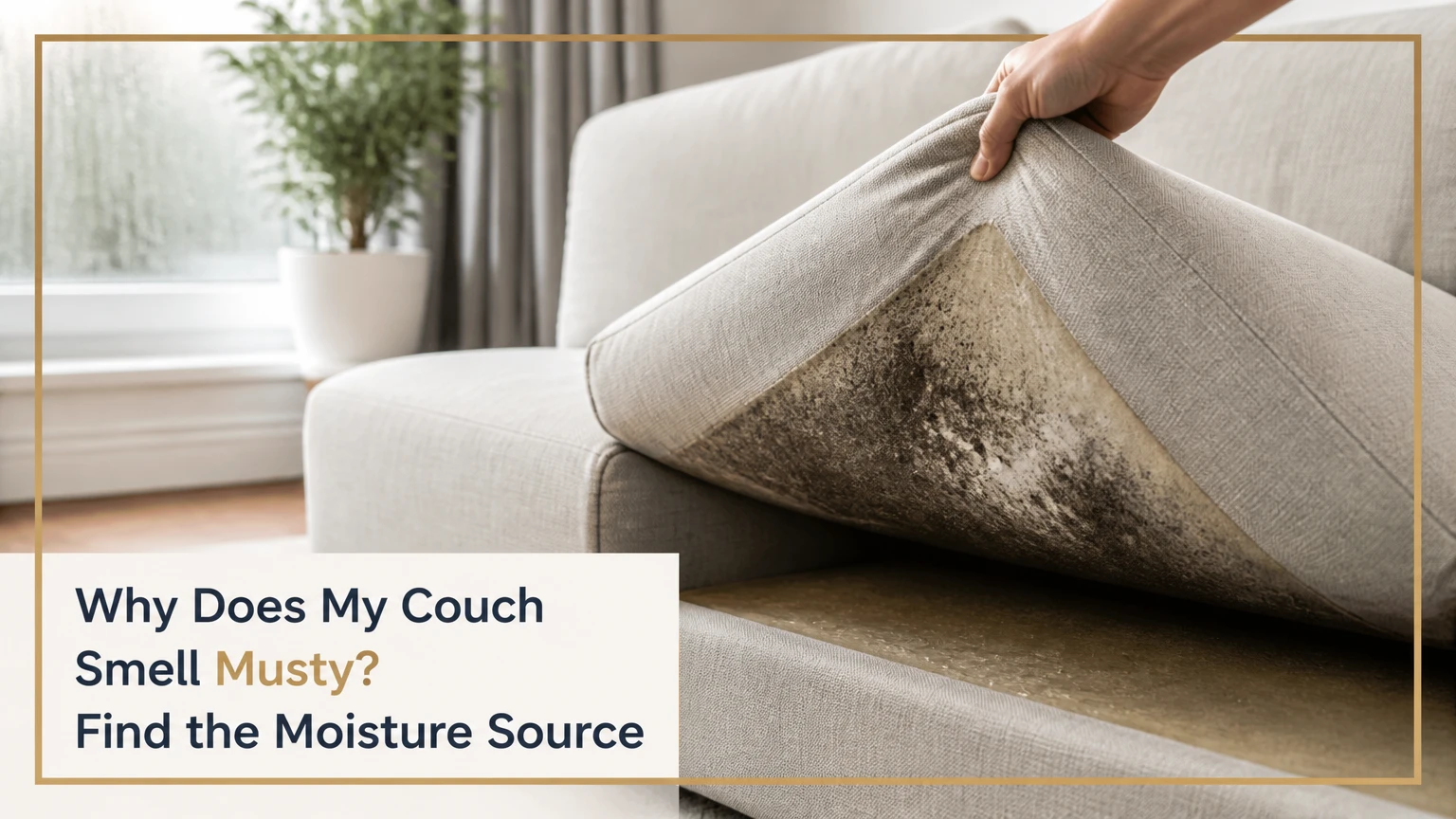
Why Does My Couch Smell Musty? Find the Moisture Source
A musty couch smell usually means moisture has remained in the upholstery, cushion foam, underside, or nearby room, allowing microbial growth or odor compounds to accumulate. The hidden source may be an old spill, damp cleaning water, high indoor humidity, basement air, pet contamination, or mold behind the couch rather than visible mildew on the fabric.
Key Facts at a Glance
- Cushion foam can retain liquid for 24-48 hours after upholstery appears dry.
- Indoor relative humidity above 60% increases the likelihood of persistent damp odors and mold growth.
- Upholstery care code W permits water-based cleaning, while code X permits vacuuming only.
- Baking soda can reduce surface odor, but it cannot remove mold inside foam or upholstery backing.
- Sealed wet cushions in plastic can stay damp longer and worsen microbial odor.
- Typical USA professional upholstery cleaning costs $100-$300 per couch, with extra charges for severe odor or mold remediation.
Why Does My Couch Smell Musty?
A musty couch smells because moisture and organic residue have created conditions for fungi, bacteria, or chemical odor compounds inside the upholstery system. The most common reservoirs are cushion foam, batting, fabric backing, the wood frame, and the floor or wall behind the couch. Surface fragrance rarely solves the source.
Microorganisms can release microbial volatile organic compounds, often called mVOCs. These compounds produce earthy, sour, damp-basement, or mushroom-like odors. A couch can smell musty without showing green or black spots because growth may be hidden beneath fabric, inside foam, or on the underside.
The U.S. Environmental Protection Agency states, “The key to mold control is moisture control.” That principle matters more than the choice between vinegar, baking soda, or a scented spray. If moisture remains, odor commonly returns after the cleaning product evaporates.
What usually causes the odor?
| Suspected source | Typical location | Diagnostic clue | Likely response |
|---|---|---|---|
| Old liquid spill | Seat foam, 1-3 inches below fabric | Smell strongest on one cushion | Remove cover and inspect foam |
| Damp cleaning water | Foam, batting, underside | Odor began within 1-7 days after cleaning | Increase airflow and extract moisture |
| High humidity | Entire couch and room-facing surfaces | Multiple textiles smell earthy | Measure humidity and run dehumidifier |
| Pet urine | Cushion seam or foam core | Sharp ammonia or sour odor | Use a labeled enzyme cleaner |
| Basement or wall moisture | Back panel, legs, floor edge | Smell strongest behind couch | Inspect wall, floor, and baseboard |
| Smoke and soil residue | Fabric surface and arm interiors | Odor persists in dry conditions | Use upholstery-safe cleaning and extraction |
Is a musty couch always moldy?
A musty couch is not automatically moldy, but persistent damp odor should be treated as a moisture problem until inspection rules out hidden contamination. Sweat, cooking residue, tobacco smoke, pet urine, and decomposing food can produce similar odors without visible mold.
Odor alone cannot identify a species, toxin level, or health risk. A mold test kit also cannot determine whether a couch is safe to keep. Physical inspection, moisture history, visible growth, and the condition of the cushion interior provide more useful evidence.
Where Is the Musty Smell Hiding?
The strongest odor location usually identifies the contaminated component. Smell each cushion separately, then check the zipper edge, underside, rear dust cover, arm seams, and floor beneath the couch. A couch that smells normal on top but strong underneath may have absorbed moisture from a damp floor or wall.
How do you inspect a couch without spreading contamination?
Inspect outdoors or in a well-ventilated area when practical, and avoid vigorous brushing that can release contaminated dust. Wear gloves while handling visibly moldy material, keep children and pets away, and place heavily affected removable covers in a sealed bag until they can be laundered or discarded according to the material label.
| Inspection area | What to check | Odor intensity clue | Next action |
|---|---|---|---|
| Removable cushion cover | Damp seams, stains, zipper edge | Strong at zipper | Inspect foam core |
| Foam insert | Yellowing, dampness, crumbling cells | Strong from foam | Dry only if contamination is minor |
| Couch underside | Dark spots, wet dust cover | Strong below frame | Inspect floor and frame |
| Back wall | Condensation, staining, peeling paint | Strong at wall gap | Correct building moisture |
| Floor beneath legs | Damp carpet, warped wood, odor | Strong at feet | Move couch and dry flooring |
| Arm and back batting | Compressed, stained filling | Strong when pressed | Consider professional extraction |
Why does the smell return after cleaning?
Odor returns when cleaning removes surface residue but leaves contaminated foam, backing, frame wood, or moisture behind. A second common cause is slow drying: the fabric feels dry while the interior remains wet, particularly in thick cushions with dense polyurethane foam.
Press a dry white towel firmly against the cushion for 10 seconds. If the towel feels cool or shows moisture, the interior has not dried. A moisture meter designed for building materials can provide a useful screening reading, but upholstery readings vary by fabric, foam density, and meter design.
Which Couch Materials Need Different Treatment?
Fabric, microfiber, leather, faux leather, and cushion foam do not tolerate the same products or moisture levels. The manufacturer’s care label takes priority over general home remedies, and an inconspicuous spot test should precede every cleaner.
| Material or code | Water tolerance | Suitable first action | Main risk |
|---|---|---|---|
| W upholstery | Water-based cleaner allowed | Vacuum, low-moisture upholstery cleaner | Water rings and slow drying |
| S upholstery | Solvent cleaner only | Vacuum, labeled upholstery solvent | Shrinkage or dye transfer |
| W/S upholstery | Water or solvent allowed | Use the least-wet approved method | Residue from overapplication |
| X upholstery | Vacuum only | HEPA vacuum and professional advice | Permanent water damage |
| Finished leather | Minimal damp wiping | Vacuum, leather cleaner, conditioner | Finish cracking or clouding |
| Aniline leather | Almost no water | Dry cloth and leather specialist | Permanent dark water marks |
| Faux leather | Limited damp wiping | Mild soap solution on cloth | Peeling polyurethane coating |
Can you use vinegar on a leather couch?
Do not assume that a 50/50 vinegar-water mixture is safe for leather. Acidic solutions can dull, dry, stain, or damage leather finishes, especially on aniline and unfinished hides. Use a manufacturer-approved leather cleaner, apply it to a cloth rather than directly to the couch, and contact a leather professional when odor comes from the interior.
For finished leather, vacuum seams and crevices first, wipe with a barely damp cloth, and dry immediately. Never saturate perforated leather because liquid can pass into the foam. Leather conditioner may protect a clean, dry surface, but it will not remove mold inside padding.
How Can You Remove the Odor Safely?
The safest home process is low-moisture cleaning followed by rapid drying. Plan on 2-4 hours of active work and 24-48 hours of drying for removable fabric cushions, although dense foam, cool weather, and indoor humidity can extend drying beyond 48 hours.
Before you start
- Time: 2-4 hours of work, plus 24-48 hours of drying
- Typical cost: $10-$30 for household supplies
- Tools: HEPA vacuum, white towels, soft brush, gloves, fan, hygrometer
- Materials: 1 cup baking soda, 1 quart approved upholstery solution, clean water
- Prerequisite: Confirm the care code and test a hidden 2-inch area
- Stop condition: Visible widespread mold, water damage, or strong odor inside foam
Step 1: Identify the care code
Find the manufacturer’s tag beneath a cushion, under the couch, or along the platform. Code W supports water-based products, S requires solvent products, W/S permits both, and X means do not wet-clean at home.
Success checkpoint: The proposed product matches the code and the test area shows no color transfer after drying.
Common mistake: Treating every fabric couch as water-safe.
Step 2: Remove cushions and vacuum thoroughly
Vacuum both sides of removable cushions, the deck beneath them, seams, piping, and the underside using an upholstery attachment. Move slowly, making two passes over each section so the vacuum can remove skin flakes, dust, crumbs, and dry residue.
Success checkpoint: No visible debris remains in seams, and the odor is not stronger after vacuuming.
Common mistake: Using a spinning brush that pulls loops or damages delicate upholstery.
Step 3: Apply baking soda to dry upholstery
Use about 1 cup of baking soda for a standard three-seat couch, distributing a thin layer rather than a heavy mound. Leave it for 8-12 hours, then vacuum slowly with a clean filter.
Baking soda can absorb some moisture and acidic odor compounds. It cannot disinfect a moldy cushion, penetrate all foam cells, or correct a wet frame.
Success checkpoint: Surface odor decreases after complete removal of the powder.
Common mistake: Leaving powder in the fabric, where residue can attract moisture and irritate sensitive airways.
Step 4: Clean with the approved low-moisture product
For W or W/S fabric, use a labeled upholstery cleaner and apply the smallest amount that removes soil. Work in sections of approximately 12 by 12 inches, blot with white towels, and avoid soaking seams or cushion edges.
For S fabric, use only the specified solvent and ventilate according to the label. Do not mix vinegar, bleach, ammonia, peroxide, or commercial cleaners because incompatible chemicals can create hazardous vapors or damage dyes.
Success checkpoint: The towel lifts soil without dye transfer, and the fabric is damp rather than wet.
Common mistake: Drenching the couch because the odor seems deep.
Step 5: Extract and dry the interior
Use an upholstery extractor only when the care code permits water and the machine can remove more liquid than it applies. Stand cushions on their long edge, separate them from the couch, and aim a fan across both sides while a dehumidifier maintains indoor humidity below 50%.
Success checkpoint: Cushions feel room-temperature and dry at the seams, zipper, and center after 24 hours.
Common mistake: Reassembling cushions while the foam remains cool or clammy.
Step 6: Recheck the odor after 48 hours
Smell the couch only after it has fully dried and the room has aired out. If the odor is gone, correct the moisture source and maintain airflow. If it returns within hours, the source is probably inside the foam, frame, floor, wall, or HVAC system.
Success checkpoint: The couch remains neutral after an overnight period with windows closed.
Common mistake: Applying fragrance before confirming that drying succeeded.
Which Odor Treatment Works Best?
The best treatment depends on the contaminant, material, and location. Baking soda suits dry surface odor, enzyme cleaner suits fresh organic contamination such as pet urine, and professional extraction suits deep soil that a household vacuum cannot remove.
| Method | Best target | Typical amount or setting | Limitation |
|---|---|---|---|
| Baking soda | Dry surface odor | 1 cup per standard couch, 8-12 hours | Does not remove embedded mold |
| Enzyme cleaner | Pet urine or food protein | Label dilution, 10-30 minute dwell | Requires material compatibility |
| Upholstery extractor | Water-safe fabric soil | 1-2 slow passes per section | Overwetting can worsen odor |
| Steam cleaning | Select durable W fabric | Manufacturer-approved heat setting | Heat does not remove mold debris |
| Activated charcoal | Residual room odor | 1-2 bags near couch for 7-14 days | Does not clean upholstery |
| Professional low-moisture cleaning | Deep soil and odor | $100-$300, usually 4-8 hours drying | Cannot guarantee mold removal |
Steam cleaning deserves special caution. Heat may reduce some surface microbes, but steam cannot reliably sanitize the full thickness of couch foam, and the added water can create a second moisture problem. Steam is a method for compatible surfaces, not a mold-remediation guarantee.
Should You Clean the Couch or Replace It?
Clean a couch when the odor is localized, the foam remains structurally sound, and the moisture event was minor. Replacement becomes more sensible when foam is visibly moldy, crumbling, repeatedly wet, or contaminated by sewage, floodwater, or extensive pet urine.
| Situation | DIY cleaning suitability | Typical USA cost | Recommended decision |
|---|---|---|---|
| One dry food spill | High | $10-$20 | Clean promptly |
| Small pet accident on cover | Moderate | $15-$35 | Wash cover and treat foam carefully |
| Odor after a wet cleaning | Moderate | $20-$60 | Extract and dry rapidly |
| Visible mold under one cushion | Low | $100-$300 inspection or cleaning | Seek professional evaluation |
| Floodwater contamination | Very low | $300-$1,500 remediation | Replace porous components |
| Recurrent odor after two cleanings | Low | $150-$500 diagnosis | Inspect foam, wall, floor, and HVAC |
A professional cleaner can provide stronger extraction, but professional service is not the same as mold remediation. Ask whether the technician handles upholstered mold, what drying equipment is included, whether the company inspects foam, and whether the quote covers deodorization or only surface cleaning.
The EPA recommends professional help when mold contamination is extensive, when HVAC systems may be involved, or when occupants have significant health concerns. A couch with widespread porous-material contamination may not be economically recoverable.
What Changes the Diagnosis in Common Situations?
What if the couch is in a basement?
A basement couch often absorbs ambient humidity rather than one isolated spill. Measure relative humidity beside the couch with a hygrometer; a sustained reading above 60% indicates a room-level moisture problem that cleaning alone will not solve.
Move the couch at least 2-4 inches from exterior walls, operate a dehumidifier with a target near 45%-50%, and inspect baseboards, carpet, concrete, and foundation walls. Do not place cushions outdoors during humid or rainy weather because outdoor air can add moisture.
What if a used couch arrived already smelling musty?
A used couch with a pre-existing musty odor should be inspected before entering the main living area. Check removable covers, foam, rear fabric, staples, and the wooden frame, then ask the seller whether the couch experienced basement storage, flooding, or professional cleaning.
Do not rely on a fragrance spray or a sealed plastic treatment. If the odor is strong throughout the foam, the couch has visible mold, or the seller cannot explain its moisture history, returning it is usually safer and cheaper than repeated cleaning.
What if the smell follows a pet accident?
Pet urine can travel through fabric into foam and remain detectable after the surface dries. Use an enzyme product labeled for upholstery, follow its dilution and dwell-time instructions, and avoid steam or ammonia-based cleaners because heat can set odor and ammonia resembles urine chemically.
A cover may be washable while the foam is not. If urine has saturated the cushion core repeatedly, replacement foam or professional treatment may provide a more reliable result than repeated surface applications.
What if someone in the home has asthma or fragrance sensitivity?
Use unscented products, ventilate during cleaning, and keep sensitive occupants away until the couch and room are fully dry. Fragrance compounds can mask odor while adding another airborne irritant, and baking soda dust can aggravate some respiratory conditions during application.
Visible mold, persistent dampness, or respiratory symptoms warrant professional advice. Cleaning should not expose occupants to disturbed contaminated dust.
Common Mistakes and How to Fix Them
- Saturating the cushions: Extract as much liquid as possible, separate cushions, and use moving air plus dehumidification. If odor persists after 48 hours, stop adding cleaner.
- Using vinegar on every material: Follow the care code and material manufacturer’s instructions. Use a leather-specific cleaner on leather.
- Sealing wet foam in a garbage bag: Remove the plastic immediately, separate the cushion, and dry all sides. Vacuum bagging can trap humidity instead of forcing a neutralizer safely into foam.
- Mixing cleaning chemicals: Rinse only according to the product label, ventilate, and never combine bleach with vinegar or ammonia.
- Cleaning without correcting the room: Measure humidity, inspect the wall and floor, and maintain clearance behind the couch.
- Masking odor with perfume: Remove the contaminant and dry the upholstery first; deodorizer belongs after source control.
How Do You Prevent the Smell From Returning?
Prevention requires keeping upholstery dry, reducing residue, and finding room-level moisture. Vacuum high-use cushions weekly, clean spills immediately with blotting rather than rubbing, and leave space behind furniture for air circulation.
| Prevention action | Frequency or target | Equipment | Expected benefit |
|---|---|---|---|
| Vacuum seats and seams | Every 7 days | HEPA vacuum | Removes dust and skin residue |
| Check indoor humidity | Daily for 7 days, then weekly | Hygrometer | Keeps RH near 45%-50% |
| Rotate cushions | Every 2-4 weeks | Manual rotation | Reduces compressed damp zones |
| Air behind couch | Maintain 2-4 inches | Furniture clearance | Improves wall-side airflow |
| Treat spills | Within 15 minutes | White towels, approved cleaner | Limits foam absorption |
| Inspect basement or wall | Every 3-6 months | Flashlight, moisture meter | Finds recurring moisture |
A couch should not be pushed flush against a cold exterior wall, especially in a basement or humid climate. Condensation can form behind the furniture while the visible front remains dry.
How Much Does Professional Couch Cleaning Cost?
Typical USA professional upholstery cleaning costs $100-$300 for one standard couch, with sectional size, fabric type, access, severe pet odor, and mold-related work raising the price. Drying commonly takes 4-8 hours after low-moisture service and 12-24 hours after wetter extraction.
| Service type | Typical USA price | Typical drying time | Appropriate use |
|---|---|---|---|
| Standard sofa cleaning | $100-$180 | 4-8 hours | Soil and ordinary odor |
| Large sectional cleaning | $180-$350 | 6-12 hours | Multiple cushions and sections |
| Pet odor treatment | $150-$400 | 8-24 hours | Localized urine contamination |
| Cushion foam replacement | $150-$600 | 0-4 hours after installation | Saturated or crumbling foam |
| Mold assessment | $150-$500 | 1-3 days for report | Visible or recurrent contamination |
| Mold remediation | $500-$2,000+ | 2-7 days | Extensive porous-material damage |
Request a written quote that names the cleaning method, estimated moisture level, drying equipment, deodorization treatment, and exclusions. A low price that covers only a quick surface spray may not address a musty smell inside foam.
When Should You Stop Cleaning and Dispose of the Couch?
Dispose of or replace porous couch components when visible mold covers a broad area, floodwater has penetrated the frame, foam remains contaminated after professional treatment, or the smell returns repeatedly despite corrected humidity. Moldy porous materials can be difficult to clean completely because growth and residue extend into irregular internal spaces.
Small, isolated contamination on a removable washable cover may be recoverable. Widespread contamination inside foam, batting, or particleboard is a different situation. The EPA and CDC both emphasize moisture removal and caution around mold exposure, but neither organization provides a universal “safe odor” threshold for upholstered furniture.
FAQ
Can baking soda remove a musty couch smell overnight?
Baking soda can reduce dry, surface-level odor after an 8-12 hour application, but it cannot remove mold or moisture inside cushion foam. Vacuum the powder completely, then inspect and dry the cushion. If the odor returns within the next day, the source is deeper than the fabric surface.
How long should couch cushions dry after cleaning?
Couch cushions typically need 24-48 hours to dry after careful water-based cleaning, although dense foam, cool rooms, and humidity above 60% can extend the period. Stand cushions on edge, use a fan across both sides, and verify that seams and the center feel dry before reassembly.
Can a dehumidifier fix a musty sofa?
A dehumidifier can help when room humidity causes or prolongs the odor, but it cannot remove contamination already inside foam. Set indoor relative humidity near 45%-50%, improve airflow, and inspect the couch after drying. Persistent odor requires inspection of the cushion, underside, wall, and floor.
Is it safe to sleep on a couch that smells musty?
Avoid sleeping on a couch with persistent musty odor until the moisture source is identified and the upholstery is dry. Odor does not prove hazardous mold, but disturbed fibers may release contaminated dust, and people with asthma or allergies may be more sensitive to damp environments.
Will fabric spray permanently remove mildew odor?
Fabric spray usually masks mildew odor rather than removing the moisture, residue, or contaminated foam producing it. Use fragrance only after source control and complete drying. A recurring smell after spraying indicates that the couch, nearby building materials, or HVAC system still needs investigation.
The Bottom Line
Why does my couch smell musty? The most likely answer is trapped moisture in fabric, foam, batting, the frame, or the surrounding room, with microbial growth or organic residue producing the odor. Check the care code, locate the strongest-smelling component, vacuum dry surfaces, use only compatible low-moisture cleaning, and dry cushions for 24-48 hours. If the smell returns, visible mold appears, or floodwater reached the couch, stop masking the odor and arrange professional evaluation or replacement.