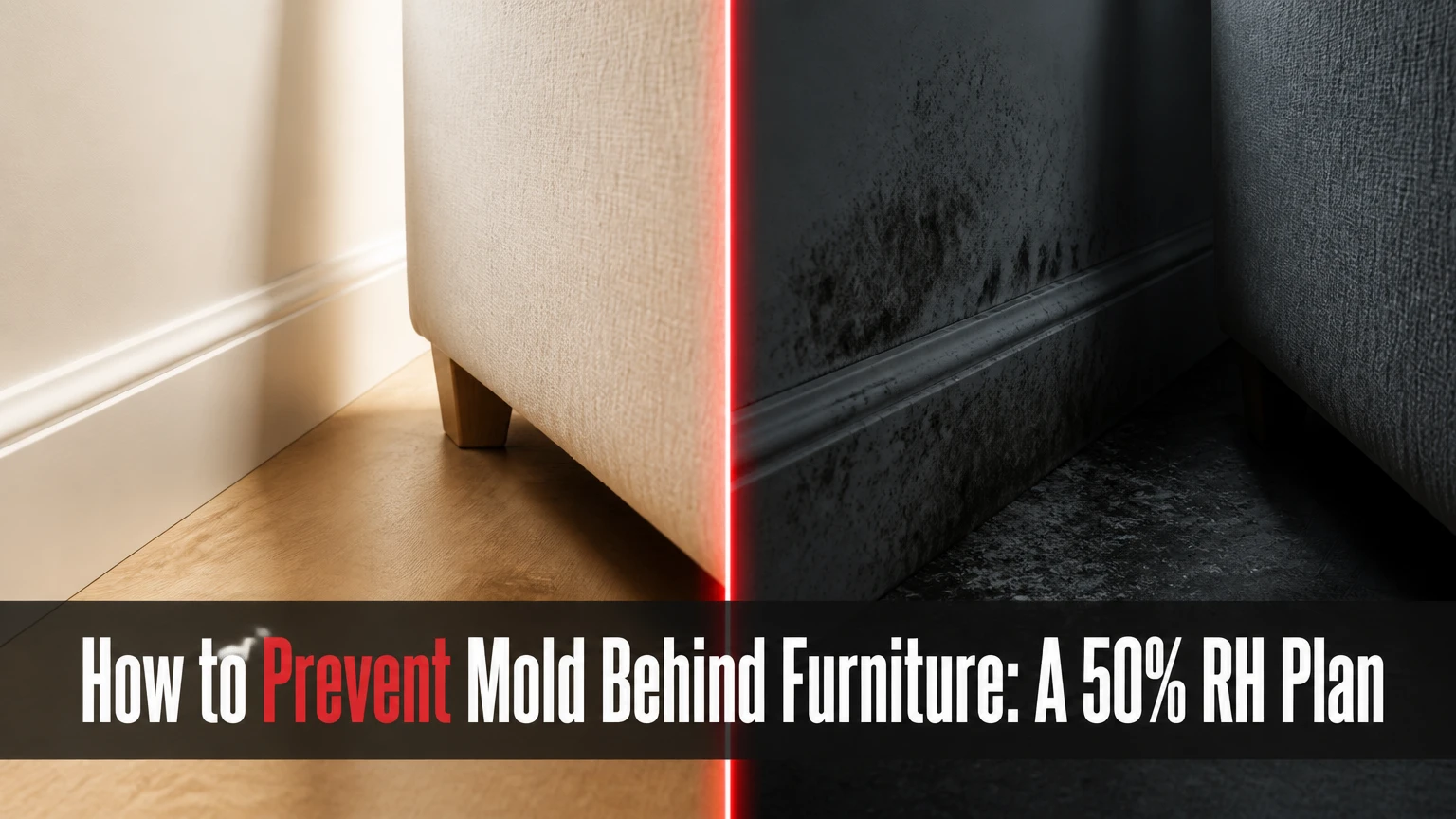
How to Prevent Mold Behind Furniture: A 50% RH Plan
To prevent mold behind furniture, control indoor humidity, maintain a 2-4 inch air gap, keep exterior walls warm, and investigate leaks before cleaning. Use a hygrometer to keep room humidity at 30-50%, ventilate moisture-producing rooms, and inspect hidden wall surfaces monthly during humid or cold seasons.
Key facts
Indoor relative humidity of 30-50% generally limits condensation and mold risk in occupied rooms.
Furniture should sit at least 2 inches from exterior walls, with 4-6 inches preferred in cold, poorly insulated corners.
A bathroom exhaust fan should run during showering and for about 20 minutes afterward.
A dehumidifier removes moisture from an entire room; passive absorbers work mainly in closets and small enclosed spaces.
Mold that returns after cleaning usually indicates continuing condensation, a plumbing leak, roof seepage, or foundation moisture.
Mold covering more than about 10 square feet, spreading through porous materials, or involving HVAC equipment warrants professional assessment.
Why Mold Grows Behind Furniture
Mold behind furniture develops when moisture remains on a cool wall or trapped material long enough for fungal growth to establish. Warm indoor air carries water vapor toward exterior walls, and a wardrobe, sofa, or bed can prevent that damp air from mixing with drier room air.
The physical mechanism is condensation. When a wall surface falls below the room air’s dew point, invisible vapor changes into liquid water. The wall may feel dry at the center while the narrow space behind furniture remains damp for days.
The risk increases in winter, in humid coastal regions, and around thermal bridges such as concrete columns, window reveals, outside corners, and uninsulated masonry. A furniture panel can also absorb moisture, especially when it is made from particleboard, MDF, cardboard backing, fabric, or unfinished wood.
The U.S. Environmental Protection Agency states, “The key to mold control is moisture control.” That principle matters more than mold-resistant paint, fragrance products, or repeated surface wiping because those measures do not remove the water source.
What Humidity Level Prevents Mold?
A home should generally maintain 30-50% relative humidity, with action taken when readings remain above 55-60% and urgent moisture control when readings approach 70%. Relative humidity describes air saturation at a specific temperature, so the same reading can create different condensation risks on a warm wall and a cold wall.
| Hygrometer reading | Mold risk | Recommended response | Typical timeframe |
|---|---|---|---|
| 30-40% RH | Low in most rooms | Maintain normal ventilation | Continuous |
| 41-50% RH | Low to moderate | Monitor exterior walls in winter | Weekly |
| 51-60% RH | Increasing | Ventilate, reduce moisture, inspect corners | Within 24 hours |
| 61-70% RH | High | Run dehumidifier and find the source | Same day |
| 71-80% RH | Very high | Remove furniture from wall and investigate dampness | Immediately |
| Above 80% RH | Severe | Treat as an active moisture problem | Professional review if persistent |
Place a digital hygrometer at breathing height, roughly 3-5 feet above the floor, away from a vent, window, kitchen, bathroom, or dehumidifier outlet. Put a second sensor behind or beside high-risk furniture for 48 hours if the room reading looks normal but mold keeps appearing.
A room can read 50% RH while a cold wall surface reaches the dew point. That is why humidity control and an air gap must be used together.
Before You Start
The basic prevention process takes 30-90 minutes for one room, excluding repairs and drying time. The difficulty is low for furniture repositioning and monitoring, but it becomes moderate when wall damage, plumbing, insulation, or ventilation requires investigation.
| Item | Typical quantity | Typical USD cost | Purpose |
|---|---|---|---|
| Digital hygrometer | 1-2 units | $10-$30 each | Measures room and hidden-space RH |
| Moisture meter | 1 unit | $25-$80 | Screens drywall, wood, and trim |
| Furniture spacers | 2-6 pieces | $8-$25 | Maintains a repeatable wall gap |
| HEPA vacuum | 1 unit | $100-$350 | Captures settled spores during cleanup |
| Box fan with filter | 1 unit | $25-$60 | Improves drying with filtered airflow |
| Electric dehumidifier | 1 unit | $150-$350 | Removes room moisture |
| Nitrile gloves and N95 respirator | 1 set | $15-$35 | Reduces exposure during small cleanup |
Before moving a heavy item, protect flooring, identify electrical cords, and ask for help with wardrobes or beds. Do not disturb large visible growth until you have decided whether the area requires professional remediation.
How to Prevent Mold Behind Furniture Step by Step
The most reliable method uses five actions: inspect the space, create airflow, measure humidity, exhaust moisture, and keep cold surfaces warmer. The full routine takes about one hour to establish, but moisture readings should continue for at least seven days because short-term improvement can conceal a recurring problem.
Step 1: Inspect the Wall and Furniture
Move the furniture far enough to see the entire wall, baseboard, floor edge, and back panel. Use a bright flashlight and look for black, green, white, or yellow spotting, bubbling paint, swollen MDF, peeling wallpaper, damp cardboard, rusted fasteners, and water staining.
Smell the wall and the furniture separately. A persistent earthy odor with no visible growth can indicate hidden mold inside a wall cavity, under carpet, or within upholstered backing. A moisture meter reading above the surrounding dry wall is a useful screening signal, but consumer meters do not identify the moisture source.
Record the room humidity and take dated photographs. Check monthly in normal conditions, weekly during winter or humid weather, and after any plumbing, roofing, or window leak.
You will know the inspection worked when: the entire hidden surface has been viewed, photographed, and compared with a dry nearby wall.
Common mistake: checking only the furniture back. Mold often begins at the baseboard, floor-wall joint, corner, or cold exterior-wall section.
Step 2: Create a Continuous Air Gap
Move beds, sofas, bookcases, and wardrobes at least 2 inches from the wall. Use a 4-6 inch gap where the wall is exterior-facing, visibly cold, poorly insulated, or located in a basement.
Air needs an entry and exit path. A narrow gap blocked by a solid plinth, storage boxes, curtains, or furniture packed edge-to-edge may still trap moisture. Leave the top and bottom of the space open when possible, and avoid storing clothing, paper, or plastic bins directly against the wall.
| Furniture or location | Minimum gap | Preferred gap | Extra measure |
|---|---|---|---|
| Interior wall sofa | 1-2 inches | 2 inches | Keep cushions 1 inch from wall |
| Exterior wall bed | 2 inches | 4-6 inches | Use slatted headboard |
| Full-height wardrobe | 2 inches | 4 inches | Ventilate top and bottom |
| Basement bookcase | 4 inches | 6 inches | Use metal or sealed shelving |
| Closet cabinet | 1 inch | 2-3 inches | Leave doors open periodically |
| Cold masonry corner | 4 inches | 6 inches | Inspect wall insulation |
Use furniture legs or wall spacers that do not puncture plumbing or electrical wiring. Do not permanently seal the gap with caulk, foam, or adhesive panels unless a building professional has designed the assembly, because trapped moisture may become harder to detect.
You will know the spacing worked when: air can move behind the complete item and the wall remains dry during the next cold or humid period.
Common mistake: creating a gap at the sides while the back is still pressed tightly against the wall.
Step 3: Measure and Reduce Indoor Humidity
Place a hygrometer in the room and check it morning and evening for seven days. Keep the average between 30% and 50% RH, and respond when readings stay above 55% for several hours.
Reduce moisture at its source. Cover boiling pots, repair dripping faucets, run the range hood outdoors when possible, use a bathroom exhaust fan during showers, and dry wet towels outside the room. Air conditioning lowers humidity while cooling, but an oversized system may shut off before removing enough moisture.
A typical 30-pint dehumidifier suits a moderately damp bedroom or living room, while a 50-pint model is more appropriate for a basement or persistently humid large space. Manufacturer capacity ratings are measured under test conditions and can fall substantially in cooler rooms.
You will know humidity control worked when: the seven-day log stays between 30% and 50%, including after showers, cooking, and overnight occupancy.
Common mistake: relying on a small disposable absorber to lower humidity throughout an occupied bedroom. Its moisture removal is too limited for that job.
Step 4: Ventilate Moisture-Producing Rooms
Run a bathroom exhaust fan while showering and for approximately 20 minutes afterward. Keep the bathroom door closed during the shower so moisture does not migrate into bedrooms, closets, and cooler hallways.
Use a kitchen exhaust hood that vents outdoors for cooking. Recirculating hoods remove grease but return much of the water vapor to the room. In mild weather, open windows on opposite sides of the home for 10-15 minutes to create cross-ventilation.
Cold-weather ventilation requires shorter bursts rather than a window left open all day. In the United States, homes with balanced mechanical ventilation, bathroom exhaust, or heat-recovery ventilation can exchange air while limiting heat loss, but fans must discharge outdoors rather than into an attic or wall cavity.
You will know ventilation worked when: bathroom mirrors clear faster, humidity falls within 30 minutes, and the room does not develop a damp odor.
Common mistake: opening a bathroom window in a hot, humid climate and assuming outdoor air will dry the room. Check outdoor dew point and use mechanical dehumidification when outside air is wetter.
Step 5: Keep Cold Walls and Furniture Dry
Maintain steady heating during cold weather instead of allowing rooms to become cold for long periods. Warmer wall surfaces reduce condensation risk, but heating alone cannot remove water vapor from the home.
Keep supply-air vents unobstructed and avoid placing tall furniture over radiators or baseboard heaters. Improve insulation around persistent cold spots, window reveals, exterior corners, and exposed foundation walls after ruling out leaks.
A surface infrared thermometer can identify a cold bridge, although it does not measure moisture. If a wall is much colder than adjacent surfaces under the same conditions, an energy auditor or building professional can assess insulation and air leakage.
You will know heating and insulation worked when: the wall temperature stays above the room’s dew-point temperature and no condensation appears during cold mornings.
Common mistake: turning the thermostat higher while leaving indoor RH at 70%. Heat may temporarily hide condensation, but moisture remains available for mold growth.
Which Moisture-Control Option Works Best?
An electric dehumidifier is the best whole-room option, while a passive moisture absorber is appropriate for a small closet, cabinet, or enclosed storage space. Ventilation works best at the moisture source, and heating helps cold walls but cannot substitute for humidity removal.
| Option | Typical capacity or coverage | Typical USD cost | Best use | Main limitation |
|---|---|---|---|---|
| 30-pint dehumidifier | 300-1,000 square feet | $150-$250 | Bedroom or living room | Uses electricity and makes noise |
| 50-pint dehumidifier | 500-2,500 square feet | $220-$350 | Damp basement | Needs drainage and floor space |
| Calcium-chloride absorber | 0.5-1.5 pounds per refill | $5-$15 | Closet or cabinet | Low room-scale performance |
| Bathroom exhaust fan | 50-110 CFM | $100-$400 installed | Shower moisture | Requires correct outdoor ducting |
| Outdoor-vented range hood | 200-600 CFM | $200-$1,000 installed | Cooking moisture | Recirculating models lack full removal |
| Portable air conditioner | 8,000-14,000 BTU | $300-$700 | Hot, humid single room | Can be inefficient and noisy |
A dehumidifier should sit with at least 12 inches of clearance around its air intake and outlet. Connect a drain hose where possible, because a full tank stops moisture removal. Clean the filter according to the manufacturer’s schedule, commonly every two weeks during heavy use.
Passive absorbers are quiet and useful behind a wardrobe only when the surrounding room already has acceptable humidity. They do not correct a wet wall, a plumbing leak, or high whole-home RH.
Can Anti-Mold Paint Prevent Recurrence?
Anti-mold paint can protect a clean, dry, nonporous surface, but it cannot prevent mold caused by active leaks, wet drywall, high humidity, or a cold wall behind tightly packed furniture. Paint is a finishing measure, not a moisture-control system.
Remove loose paint, allow the substrate to dry, and follow the product label before repainting. Do not coat visible mold, damp drywall, or swollen particleboard and expect the growth to disappear underneath.
For a recurring cold spot, insulation, air sealing, improved heating, or ventilation may provide a durable solution. A paint film may fail within months if water continues moving through the wall.
How Should You Clean Small Mold Growth?
Small areas on hard, nonporous surfaces can often be cleaned with detergent and water, followed by complete drying. Porous materials such as drywall, insulation, ceiling tile, carpet pad, and heavily contaminated upholstery may need removal because mold hyphae penetrate below the visible surface.
The EPA commonly uses about 10 square feet as a threshold for considering professional guidance, although the correct response also depends on material, occupants, and moisture source. People with asthma, severe allergies, immune suppression, or chronic lung disease should avoid mold cleanup.
Never mix bleach with ammonia, acids, or other cleaners. Bleach is not a dependable solution for porous building materials, and its fumes can harm occupants without correcting hidden moisture.
| Material | Small-area response | Drying requirement | Replacement trigger |
|---|---|---|---|
| Sealed wood | Detergent, wipe, dry | 24-48 hours | Swelling or deep staining |
| Bare wood | HEPA vacuum, detergent, dry | 48-72 hours | Softness or structural damage |
| Painted drywall | Clean only if surface growth is minor | 24-48 hours | Damp core or recurring growth |
| Upholstery | Isolate and professional clean | 48-72 hours | Persistent odor or deep growth |
| Carpet pad | Remove contaminated section | Complete subfloor drying | Any saturated moldy pad |
| Wallpaper | Remove affected section | Wall dry before replacement | Blistering or hidden growth |
Use gloves, eye protection, and at least an N95 respirator for small cleanup. Do not use a household fan that blows unfiltered air across heavy mold before containment, because it can spread spores into the room.
Why Does Mold Return Behind Furniture?
Recurring mold usually means the original moisture source remains active. Condensation, plumbing leaks, roof seepage, foundation infiltration, window leaks, and wet building materials can produce similar stains but require different repairs.
Use the pattern to guide diagnosis. Uniform spotting across a cold exterior wall suggests condensation; a localized vertical stain near a pipe suggests plumbing; dampness after rain points toward roof, window, gutter, or foundation intrusion.
| Visible pattern | Likely source | Confirmation check | Typical repair |
|---|---|---|---|
| Speckles across cold wall | Condensation | RH log and surface temperature | Air gap, dehumidification, insulation |
| Vertical stain near bathroom | Plumbing leak | Plumbing pressure and access check | Pipe or valve repair |
| Damp baseboard after rain | Foundation seepage | Exterior inspection and moisture meter | Drainage or waterproofing |
| Ceiling mark above wardrobe | Roof or upstairs leak | Attic or upper-floor inspection | Roof or supply-line repair |
| Mold around window edge | Air leakage or flashing | Smoke pencil and rain check | Recaulking, flashing, insulation |
| Odor with clean visible wall | Hidden cavity growth | Professional moisture and borescope check | Controlled remediation |
Clean only after the wall and furniture have dried. If mold returns within days or weeks, stop repeating cosmetic treatments and investigate the assembly behind the furniture.
What Changes in Different Homes?
Bedrooms, basements, closets, rentals, and humid climates require different prevention priorities. The universal rule remains the same: keep moisture below the level at which cold surfaces stay wet, then preserve airflow around furniture.
Bedrooms and Beds
Keep a bed at least 4 inches from an exterior wall, particularly when the headboard is solid. Human occupants release moisture overnight, and bedding can block airflow precisely where a cold wall needs it most.
Use a slatted headboard or leave the lower wall exposed. Avoid storing boxes beneath the bed against an exterior wall, and check the wall monthly during winter.
Wardrobes and Closets
Keep clothing, shoes, and cardboard at least 2-3 inches from the closet’s exterior wall. Open wardrobe doors for several hours each week, especially after placing damp coats or shoes inside.
A passive absorber can help inside a compact closet, but a hygrometer remains necessary. Replace saturated crystals before liquid reaches wood flooring or the cabinet base.
Basements
Use a 50-pint dehumidifier with continuous drainage where practical, and keep furniture 4-6 inches from foundation walls. Do not place fabric sofas, mattresses, or untreated wood directly on a concrete floor.
Inspect gutters, downspouts, grading, sump pumps, and foundation cracks. Basement humidity above 60% often indicates a building-envelope issue rather than a furniture-placement issue alone.
Renters and Apartments
Photograph mold, record humidity, and notify the landlord in writing before applying paint or removing wall material. Renters can reposition furniture, ventilate, use a hygrometer, and run a portable dehumidifier, but concealed leaks and inadequate building ventilation require property-owner action.
Do not conceal mold with new wallpaper or furniture. Local housing rules differ across the United States, so consult the city or county housing department when the landlord does not respond.
Hot and Humid Regions
Use air conditioning or dehumidification consistently, and keep indoor RH near 40-50%. Short window opening can increase moisture when outdoor dew point is high, even if the outdoor air feels cooler.
Keep furniture away from air-conditioning condensate lines and exterior walls that receive humid outdoor air. Check closets and rooms with closed doors because they often receive less conditioned air.
Common Mistakes and How to Fix Them
Several prevention attempts fail because they address visible mold rather than moisture movement. The following corrections target the failure mechanism.
- Pushing furniture tightly against an exterior wall: Move it 2-6 inches away and remove items blocking the lower gap.
- Using a passive absorber for a damp bedroom: Replace it with a properly sized electric dehumidifier and measure RH.
- Drying clothes on radiators: Use an outdoor line, vented dryer, or a ventilated drying room with a dehumidifier.
- Leaving a bathroom fan running without outdoor ducting: Verify the duct terminates outdoors, not in an attic or ceiling cavity.
- Painting over visible mold: Clean or remove affected material only after correcting moisture and confirming dryness.
- Ignoring a musty odor after cleaning: Inspect carpet backing, wall cavities, furniture panels, and HVAC pathways.
A practitioner rule of thumb is to treat a repeat appearance within 30 days as diagnostic evidence, not as a cleaning failure. Mold should not repeatedly return in the same location when the moisture condition has truly been corrected.
How Much Does Prevention Cost?
Furniture spacing and humidity monitoring can cost less than $30, while whole-room dehumidification typically costs $150-$350 for equipment plus electricity. Building repairs range from minor caulking to several thousand dollars for foundation waterproofing or wall reconstruction.
| Prevention or repair | Typical USD range | Typical duration | Best financial use |
|---|---|---|---|
| Furniture spacers and hygrometer | $20-$60 | 1 hour | First response |
| Portable dehumidifier | $150-$350 | Same day setup | Persistent high RH |
| Bathroom fan replacement | $250-$700 installed | 2-6 hours | Weak shower ventilation |
| Window air sealing | $100-$600 | 1 day | Local cold drafts |
| Attic or wall insulation repair | $500-$3,000 | 1-3 days | Persistent cold surfaces |
| Professional mold assessment | $300-$800 | 1-3 hours | Recurring or hidden growth |
| Professional remediation | $1,000-$6,000+ | 1-7 days | Extensive contamination |
Prices vary by region, access, material, and the extent of demolition. A low-cost hygrometer can prevent wasted spending by showing whether the room remains humid after furniture is moved.
When Should You Call a Professional?
Call a qualified mold or water-damage professional when visible growth exceeds approximately 10 square feet, returns after moisture correction, involves HVAC equipment, affects porous structural materials, or follows sewage or contaminated water. Professional help is also appropriate when occupants have significant respiratory vulnerability.
A professional assessment should identify the moisture source, map affected materials, define containment, and specify drying or removal. Air sampling alone does not prove that a home is safe, and a negative sample does not rule out hidden growth behind a wall.
Leave the area undisturbed when demolition could spread contamination. Keep children, pets, and medically vulnerable occupants away until the source and cleanup plan are established.
FAQ
Can I Put Furniture Against an Interior Wall?
Furniture can sit closer to an interior wall, but a 1-2 inch gap still improves inspection and airflow. Interior walls are usually warmer than exterior walls, yet plumbing leaks, humid closets, and poorly ventilated corners can still create mold. Maintain extra space when the wall borders a bathroom, kitchen, laundry room, or unconditioned space.
Does Mold Behind a Wardrobe Mean the Wall Is Leaking?
Mold behind a wardrobe does not automatically mean the wall is leaking. Condensation is common when indoor RH is high and the wardrobe blocks a cold exterior surface. Check the growth pattern, moisture readings, weather correlation, plumbing locations, gutters, and window seals before choosing between dehumidification and building repair.
Can a Fan Alone Prevent Mold Behind Furniture?
A fan alone rarely prevents mold behind furniture because moving humid air does not remove its water vapor. A fan can accelerate drying after moisture is removed, but the durable combination is lower RH, an open air gap, and a wall that stays above the dew point.
Should I Leave My Wardrobe Doors Open?
Leave wardrobe doors open periodically when the room air is drier than the closet air. Open doors cannot solve a leaking wall or high household humidity, and they may spread musty odors temporarily. Keep clothing off exterior walls, use a hygrometer, and confirm that closet RH stays below about 55%.
How Often Should I Check Behind Furniture?
Check behind high-risk furniture monthly and inspect weekly during cold snaps, rainy periods, or humid summers. A seven-day humidity log is more useful than a single reading because overnight occupancy, showers, cooking, and weather can raise RH after a daytime check.
Is Mold Behind a Bed Dangerous?
Mold behind a bed can aggravate allergies, asthma, and respiratory irritation, particularly when spores or fragments enter the room air. Risk depends on the extent of growth and the occupant’s health. Avoid disturbing extensive contamination, correct the moisture source, and seek professional guidance when vulnerable people occupy the room.
The Bottom Line
To prevent mold behind furniture, keep furniture 2-4 inches from ordinary walls and 4-6 inches from cold exterior or basement walls, maintain 30-50% indoor RH, exhaust moisture outdoors, and keep wall surfaces warm enough to avoid condensation. The exact keyword, how to prevent mold behind furniture, describes a moisture-management problem, not a paint-selection problem.
Inspect hidden surfaces monthly, measure humidity rather than guessing, and treat recurring growth as evidence of an unresolved source. Use passive absorbers only for small enclosed spaces, choose a dehumidifier for room-scale moisture, and obtain professional assessment for extensive, porous, recurring, or HVAC-related contamination.