Condensation on Bedroom Windows in Morning: Causes and Fixes
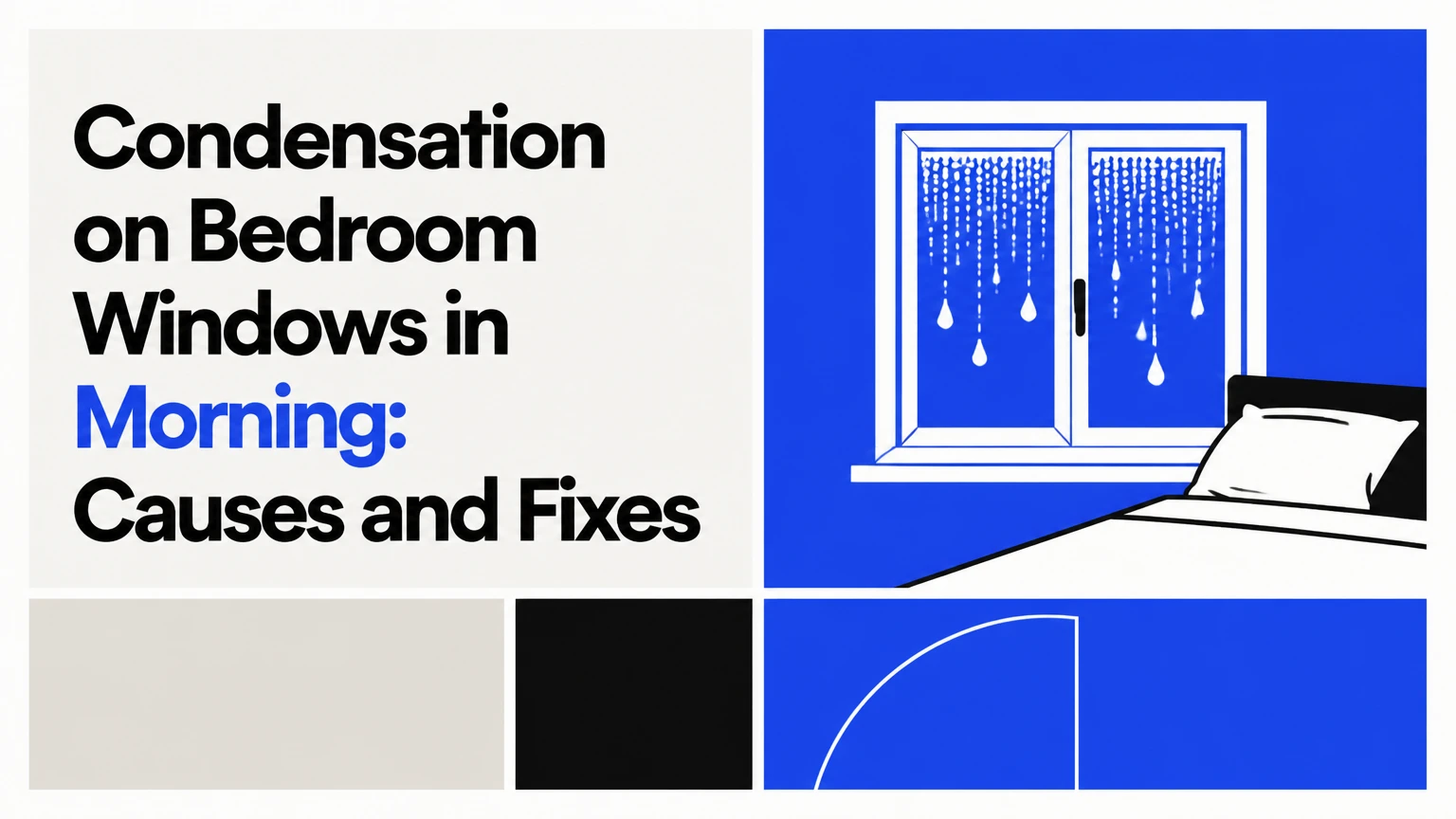
Condensation on bedroom windows in morning hours forms when humid indoor air reaches glass that has cooled below the air’s dew point. Overnight breathing commonly raises bedroom moisture, while outdoor cold lowers the glass temperature. The solution is to reduce indoor humidity, improve air circulation, warm the glass, or repair a failed window seal.
Key Facts at a Glance
Interior window condensation means the glass surface is colder than the room air’s dew point.
A bedroom relative humidity reading of 30%-50% is a practical general target, although colder weather may require a lower setting.
One sleeping adult typically adds about 0.25-0.5 liters of water vapor during an eight-hour night, depending on body size, breathing, and room ventilation.
Water between double-pane or triple-pane glass usually indicates a failed insulating seal, not excessive bedroom humidity.
Outdoor condensation on modern low-emissivity windows is usually harmless and can indicate a well-insulated glass unit.
Daily wet sills, peeling paint, musty odors, or visible mold require action because porous materials can retain moisture after the glass dries.
Why Does Morning Condensation Happen?
Morning condensation happens because bedroom air gains moisture during sleep while the window glass loses heat overnight. Air near the glass cools first; when that air reaches 100% relative humidity at the glass surface, water vapor changes into liquid droplets.
The process has four connected parts:
- Moisture generation: Sleeping, breathing, humidifiers, attached bathrooms, wet towels, and indoor laundry add water vapor.
- Thermal loss: Clear glass loses heat to the outdoors, especially during cloudless nights.
- Dew-point contact: The thin layer of air beside the glass cools below its dew point.
- Liquid formation: Excess vapor deposits as beads, haze, or a continuous wet film.
Relative humidity is temperature-dependent. Air can show 45% RH in the center of a room while reaching 100% RH beside a much colder pane. That difference explains why a hygrometer can report a seemingly acceptable reading while the lower window corners remain wet.
The bedroom creates a predictable morning pattern. A closed room with one sleeper, thick curtains, limited supply air, and a cold exterior wall can accumulate enough vapor to condense before sunrise. Two occupants, a pet, or a bathroom without a working exhaust fan increase the moisture load.
What is the dew point?
The dew point is the temperature at which air becomes saturated and begins releasing water. At 68°F and 50% RH, the dew point is approximately 49°F. If the interior glass surface falls to 49°F or lower, condensation can begin.
| Room air temperature | Relative humidity | Approximate dew point | Condensation implication |
|---|---|---|---|
| 65°F | 40% | 41°F | Glass below 41°F can collect water |
| 68°F | 50% | 49°F | Common winter condensation threshold |
| 70°F | 60% | 55°F | Many cold panes will become wet |
| 68°F | 70% | 58°F | High condensation risk on ordinary windows |
| 62°F | 50% | 44°F | Cooler bedrooms reach saturation sooner at the pane |
These figures are approximate and assume ordinary sea-level conditions. A $10-$25 digital hygrometer cannot measure glass temperature, so persistent condensation with normal RH requires a surface-temperature check using an infrared thermometer.
What Indoor Humidity Should a Bedroom Have?
A bedroom should generally remain between 30% and 50% relative humidity, with the lower end often more practical during freezing weather. The U.S. Environmental Protection Agency recommends keeping indoor humidity below 60%, ideally between 30% and 50%, to limit moisture-related mold conditions.
The 30%-50% range is not a guarantee that windows will stay dry. Single-pane glass, poorly insulated frames, aluminum spacers, air leaks, and cold corners can remain below the dew point even at 35%-40% RH. Humidity is one control variable, not the entire diagnosis.
Use a hygrometer at head height, away from the window, supply registers, radiators, humidifiers, and exterior walls. Check it at bedtime and again in the morning for three consecutive days. A single reading taken after opening the door can miss the overnight peak.
The EPA’s mold guidance gives a useful operating principle: “The key to mold control is moisture control.” That advice applies directly to bedroom windows, because wiping water removes the symptom while humidity, cold glass, or hidden leakage continues producing it.
How much water does sleeping add to bedroom air?
One sleeping adult typically releases approximately 0.25-0.5 liters of water vapor over eight hours, although the amount changes with body size, metabolic rate, room temperature, and breathing. The fixed claim that every sleeper releases exactly one pint is too precise for household diagnosis.
The moisture does not necessarily remain in the air. Ventilation may exhaust part of it, while bedding, carpet, walls, and clothing absorb the rest. A closed small bedroom therefore reaches a higher morning humidity than a larger room with continuous outdoor-air exchange.
Where Is the Water Located?
The location of window moisture identifies the likely fault. Water on the room-facing surface usually involves indoor humidity or a cold interior pane, water outside often reflects efficient glazing, and water between sealed panes indicates insulating-unit failure.
| Water location | Most likely meaning | Immediate response | Typical urgency |
|---|---|---|---|
| Room-facing glass | Dew point exceeds interior glass temperature | Measure RH, ventilate, dry sill | Same day if daily |
| Exterior glass | Exterior surface reached its dew point | Usually leave undisturbed | Low |
| Between sealed panes | Failed insulating glass seal | Request glass-unit inspection | Repair when practical |
| Frame, drywall, or trim | Condensation, air leakage, or water intrusion | Dry, inspect, and test source | High if recurring |
Is condensation inside a double-pane window serious?
Condensation on the room side of a double-pane window is usually a humidity or temperature problem, not proof that the sealed unit has failed. Condensation between the panes is different: it commonly indicates loss of the airtight seal, allowing moisture into the insulating cavity.
A failed seal reduces insulating performance and creates permanent fogging, mineral marks, or droplets that cannot be wiped from either surface. Replacing only the insulated glass unit is often less expensive than replacing the complete frame, provided the frame remains sound and the replacement matches its dimensions.
Is condensation outside a window a problem?
Exterior condensation on the outside face of a window is usually harmless. Modern low-E double-pane and triple-pane units keep indoor heat from reaching the exterior pane, so the outer surface can cool below the outdoor dew point during humid mornings.
Exterior fogging can occur on clear nights, after rain, or during a humid summer morning. It becomes a concern only when it blocks visibility for safety, reveals damaged weather seals, or appears with water entering the wall assembly.
How Can You Stop Condensation on Bedroom Windows?
Stop interior window condensation by lowering bedroom humidity, exhausting moisture at its source, keeping air moving across the glass, and raising the interior glass temperature. Begin with a hygrometer and ventilation changes before purchasing replacement windows.
What should you do each morning?
Use this five-minute morning routine:
- Wipe the glass and sill: Remove standing water with a microfiber cloth or squeegee. Do not push water into the frame joints.
- Vent the room: Open the bedroom door and, where outdoor conditions permit, use a short period of cross-ventilation.
- Run exhaust equipment: Operate the bathroom fan during showers and for about 20 minutes afterward. Use a kitchen hood that vents outdoors during cooking.
- Check the RH reading: Record the bedroom value before ventilation changes alter it.
- Inspect the perimeter: Look for darkened caulk, peeling paint, soft wood, or damp drywall.
You will know the first intervention is working when morning RH falls over several days and the wet area becomes smaller or disappears. If RH stays below 40% but the same pane remains wet, focus on glass temperature, curtains, air leakage, and window construction.
Do not rely on wiping alone. Wiping prevents water from pooling, but it does not prevent mold behind trim or repeated wetting of a wood sill.
Which fix works best?
The best first fix is source ventilation when bedroom RH exceeds 50%. A dehumidifier is more controllable when outdoor air is already humid, window film helps a cold pane, and glass replacement addresses a failed seal rather than indoor moisture.
| Fix | Typical USA cost | Typical result time | Best use | Main limitation |
|---|---|---|---|---|
| Hygrometer and behavior changes | $10-$40 | 1-3 mornings | RH diagnosis and free moisture reduction | Does not warm defective glass |
| Portable dehumidifier | $150-$350 | 2-6 hours | RH above 50% without suitable ventilation | Adds noise, heat, and electricity use |
| Interior shrink-film kit | $8-$25 per window | 15-30 minutes | Drafty or single-pane bedroom windows | Temporary appearance and access limits |
| Heat-recovery ventilator | $1,500-$4,500 installed | 1-3 days installation | Persistent whole-home moisture | Higher upfront cost |
| Replacement insulated glass | $250-$900 per opening | 2-6 weeks typical | Failed pane seal or damaged glass | Does not cure high indoor RH |
| Full window replacement | $600-$2,000 per window | 1-2 installation days | Poor frame, glazing, and air leakage | Highest cost and disruption |
Costs are typical USA residential ranges and vary by region, opening size, frame material, labor, permits, and product specification. A dehumidifier cannot repair a failed seal, while replacement glass cannot remove moisture generated by an unvented bathroom.
Should curtains or blinds stay open?
Curtains and blinds should remain open enough to let warm room air reach the glass. Heavy fabric pressed against a cold pane creates a stagnant pocket, lowers the local surface temperature, and can increase condensation even when average bedroom RH is acceptable.
Keep curtains 2-4 inches from the glass where possible, leave a lower gap for convection, and avoid sealing the top and sides of the recess. Cellular shades can improve comfort, but tightly fitted coverings may trap cold air unless the manufacturer’s installation allows controlled airflow.
Which Window Type Is Most Susceptible?
Single-pane windows are most susceptible because one thin layer of glass provides little resistance to outdoor cooling. Older double-pane units, metal frames, and windows with damaged weatherstripping can also develop cold interior surfaces.
| Window condition | Approximate interior surface behavior | Morning condensation risk | Practical response |
|---|---|---|---|
| Single-pane clear glass | Often near outdoor temperature | High below 45%-50% RH in winter | Film, storm window, or replacement |
| Older double-pane glass | Moderate insulation, cold edge | Medium to high | Check seal, spacer, and perimeter |
| Modern low-E double-pane | Warmer center glass | Low to medium | Control RH and inspect edges |
| Modern triple-pane low-E | Warmest interior surface | Low at normal RH | Investigate leaks or excessive moisture |
| Aluminum frame with metal spacer | Cold perimeter and corners | High at edges | Improve frame insulation or replace unit |
| Wood or vinyl frame with warm-edge spacer | Warmer edge zone | Lower than metal-framed equivalent | Maintain seals and humidity control |
The center of a pane can remain dry while its lower corners collect water. That pattern points toward edge heat loss, spacer design, frame geometry, or blocked airflow rather than a whole-room humidity problem.
Why does condensation persist below 50% humidity?
Condensation can persist below 50% RH when the interior glass surface is colder than the room’s dew point. Cold-climate nights, uninsulated window headers, failed weatherstripping, recessed windows, and tightly closed curtains can all create a locally cold surface.
Measure three points with an infrared thermometer: the center of the glass, the lower corner, and the frame. A difference of 8°F-15°F between the center and edge suggests an edge thermal bridge or spacer problem. A sharp cold line around the entire perimeter may indicate air leakage or missing insulation.
Window film can raise the temperature of the interior surface by adding a still air layer, but it cannot correct wet framing, a leaking wall, or a failed insulating seal. It is a seasonal mitigation, not a structural repair.
How Do You Tell Condensation From a Leak?
Condensation usually appears broadly on the room-facing glass after cold nights and dries as the room warms. A leak often produces localized staining, water after rain, moisture inside the wall, or dampness around the exterior trim regardless of indoor humidity.
Use a simple pattern test:
- Cold morning, dry weather, broad glass haze: condensation is likely.
- Rain or snowmelt, one corner or header: investigate flashing, roof drainage, and exterior sealant.
- Water between panes: failed insulated-glass seal is likely.
- Damp drywall below or beside the window: inspect both condensation and water intrusion.
- Mold only behind furniture or curtains: restricted airflow may be concentrating surface moisture.
Do not seal exterior drainage holes or caulk over weep paths. Those openings allow water inside the window track to escape. Blocking them can redirect water into the wall.
When should you call a professional?
Call a window or building-envelope professional when water damages drywall, the sill feels soft, mold covers more than about 10 square feet, condensation persists below 35%-40% RH, or moisture appears after rain. Renters should document photographs, dates, RH readings, and damage before notifying the property manager.
The EPA advises professional evaluation for larger mold areas, extensive water damage, contaminated materials, or occupants with significant respiratory sensitivity. Small areas on cleanable, nonporous surfaces may be handled with appropriate protective measures, but porous drywall, insulation, and carpet commonly require removal rather than surface cleaning.
What Common Mistakes Make Condensation Worse?
Several well-intended fixes fail because they remove visible water without changing humidity or surface temperature. Drying laundry indoors, blocking vents, overheating one room while leaving the window zone cold, and keeping curtains tightly shut are frequent examples.
- Closing trickle vents or supply registers: This reduces air exchange and traps vapor. Keep designed ventilation paths open unless a qualified professional identifies a safety issue.
- Drying clothes in the bedroom: A typical indoor drying load can release roughly 1-2 liters of water, depending on spin speed and fabric weight. Use a vented dryer or ventilate the drying room.
- Running a humidifier automatically: Winter heating can make skin feel dry, but a humidifier raises dew-point risk. Use it only with a hygrometer and a defined RH limit.
- Turning up the thermostat only: Warmer air lowers RH temporarily, but it does not remove water. Heat the room while also exhausting or dehumidifying moisture.
- Pushing furniture against an exterior wall: A 2-4 inch air gap improves circulation and reduces cold, hidden surfaces behind beds and wardrobes.
- Replacing windows before testing humidity: New glazing may reduce condensation, but high moisture can still wet the new frame, exterior wall, or another cold window.
An expert rule of thumb is to correct moisture generation before upgrading glass. If a home has 60% RH after sleeping, the window is reporting a ventilation problem as much as a glazing problem.
Which Remedy Fits Your Situation?
Renters usually benefit from a hygrometer, open airflow paths, a portable dehumidifier, and removable shrink film. Homeowners should first establish whether the issue is whole-room humidity, one defective window, or a building-envelope leak before selecting a permanent upgrade.
| Situation | First action | Second action | Avoid first |
|---|---|---|---|
| Renter, RH 55%-65% | Ventilate and use portable dehumidifier | Removable interior film | Permanent window alteration |
| Owner, single-pane window | Reduce RH to 35%-45% | Add storm panel or film | Assuming replacement is the only fix |
| Owner, moisture between panes | Photograph and inspect seal | Replace insulated glass unit | Buying a dehumidifier for the seal |
| Bedroom beside bathroom | Run exhaust fan 20 minutes after shower | Keep door open after vapor clears | Leaving wet towels in bedroom |
| RH below 40%, one cold corner | Check surface temperature and air leaks | Improve insulation or glazing | Lowering RH below comfortable levels |
| Mold or damaged drywall | Stop moisture and document damage | Arrange qualified inspection | Painting over damp material |
How long should prevention take?
Ventilation can lower bedroom humidity within 30-90 minutes, while a portable dehumidifier commonly needs 2-6 hours to change a small bedroom. Shrink film takes 15-30 minutes to install, but glass-unit replacement commonly takes 2-6 weeks because measurement, fabrication, and scheduling occur separately.
A lasting result should appear across several cold mornings, not after one wiped pane. Record outdoor temperature, bedtime RH, morning RH, and the affected window for a week. That log helps separate weather-driven condensation from a constant defect.
Is window replacement worth the cost?
Window replacement is worthwhile when the insulating glass seal has failed, the frame leaks air, or the existing window remains dangerously cold after humidity control. Replacement is poor value when the true source is an unvented bathroom, indoor laundry, a humidifier, or excessive whole-home RH.
Ask for the window’s U-factor, visible transmittance, low-E coating location, spacer type, and installation air-sealing details. ENERGY STAR labels identify efficiency performance, but a high-efficiency window cannot compensate for a wall leak or sustained indoor humidity above the recommended range.
FAQ
Can opening a bedroom window stop morning condensation?
Opening a bedroom window can reduce condensation when outdoor air contains less moisture than indoor air, especially during cold, dry weather. It can worsen the problem during humid summer conditions or rain. Use a hygrometer and short controlled ventilation rather than leaving the window open indefinitely.
Should I sleep with the bedroom door open?
Leaving the bedroom door open usually helps distribute moisture into the rest of the home, provided the rest of the home has adequate ventilation. A closed door can trap vapor around the window. Do not use an open door as a substitute for a bathroom exhaust fan or whole-home ventilation.
Does condensation mean my house has mold?
Condensation does not automatically mean mold is present. Mold becomes more likely when water repeatedly wets wood, drywall, insulation, carpet, or dust for extended periods. Dry the sill promptly, inspect hidden surfaces, and arrange an assessment if staining, odor, or visible growth continues.
Can a fan prevent condensation on windows?
A fan can reduce condensation by moving warmer room air across the glass, but a fan does not remove moisture unless it exhausts air outdoors. A small circulating fan may help a cold corner, while a bathroom exhaust fan or dehumidifier changes the moisture balance more directly.
Why do only one or two bedroom windows get wet?
Only one or two windows may get wet because they face prevailing winter winds, have less solar exposure, use single-pane glass, contain a cold metal spacer, or sit behind closed curtains. Compare their RH exposure, surface temperature, frame condition, and airflow with a dry window.
Is morning condensation worse in winter?
Morning condensation is usually worse in winter because outdoor temperatures cool glass below the indoor dew point. Winter heating also dries outdoor air, but moisture from sleeping, bathing, cooking, and laundry can still raise indoor RH enough to wet cold panes.
The Bottom Line
Condensation on bedroom windows in morning hours is usually a dew-point mismatch, not a mysterious window failure. Measure bedroom humidity, remove moisture at its source, keep curtains and doors from blocking airflow, wipe water from the sill, and test the glass temperature when RH is already low. Repair failed seals or water-damaged construction separately, because a dehumidifier cannot fix a leaking window and replacement glass cannot fix excessive indoor moisture.