Why Is There Condensation on My Walls? Find the Cause
Condensation appears on walls when humid indoor air reaches a wall surface colder than the air’s dew point. The air cools at the surface, releases excess water vapor as liquid droplets, and can eventually create peeling paint, musty odors, or mold. Cold exterior walls, high indoor humidity, poor airflow, and thermal bridges are the usual causes.
Key Facts at a Glance
- Wall condensation requires both moisture in the air and a sufficiently cold surface.
- The Environmental Protection Agency recommends keeping indoor relative humidity below 60%, ideally between 30% and 50%, to limit mold risk.
- A room can have an acceptable average humidity reading while a colder wall corner still reaches its dew point.
- Condensation usually appears on exterior walls, corners, window reveals, behind furniture, and areas above showers or sinks.
- Wetness that follows a pipe, ceiling stain, foundation joint, or rain event may indicate a leak rather than condensation.
- Lowering humidity is the fastest short-term control; insulation and air sealing raise cold surface temperatures for a longer-term repair.
Why Is There Condensation on My Walls?
Wall condensation forms because warm indoor air carries water vapor to a colder surface. When the wall cools the adjacent air below its dew-point temperature, the vapor changes into liquid water. The wall does not need to be leaking for this process to occur.
A winter example makes the mechanism clear. If indoor air is 70°F with 60% relative humidity, its dew point is approximately 55°F. An exterior wall surface at 55°F or lower can therefore become wet, even though the room feels warm.
The three variables are linked:
- Air temperature: Warmer air can contain more vapor before saturation.
- Relative humidity: RH measures how close air is to saturation at its current temperature.
- Surface temperature: The wall, not the room thermostat, determines whether condensation begins at that location.
A thermostat measures air temperature near the center of a room. It does not measure the temperature behind a bookcase, at a concrete beam, or inside a wall corner. That difference explains why one wall can be wet while another wall in the same room remains dry.
How Does Wall Condensation Form?
Wall condensation develops in six connected stages:
- Showers, cooking, laundry, plants, occupants, or combustion add water vapor.
- Humid air moves through the room by convection, drafts, or the HVAC system.
- Outdoor cold lowers the temperature of an exterior wall or thermal bridge.
- The thin air layer touching the wall loses heat.
- That air reaches its dew point.
- Water vapor becomes liquid on the paint, plaster, drywall, or wallpaper.
The approximate dew-point relationship is more useful than the often-repeated claim that moisture capacity halves after every 11°C drop. That rule is a rough approximation across ordinary temperatures, not a universal constant. A dew-point calculator or psychrometric chart gives better results when a wall is close to the condensation threshold.
What Humidity Level Causes Condensation?
Condensation risk rises sharply when indoor RH exceeds 60%, but no single RH value guarantees safety because the wall temperature matters. At 70°F, air at 50% RH has a dew point near 50°F, while air at 70% RH has a dew point near 60°F. The second condition wets many more wall surfaces.
The EPA’s mold guidance uses below 60% RH as a practical upper limit and identifies 30-50% as the preferred indoor range. In cold climates, keeping winter RH near 30-40% may be necessary if walls, windows, or frames are poorly insulated. In humid summer climates, air conditioning and dehumidification may be needed to prevent moisture on cooled surfaces.
| Indoor air condition at 70°F | Approximate dew point | Cold surface at risk |
|---|---|---|
| 40% RH | 46°F | Walls below 46°F |
| 50% RH | 50°F | Walls at or below 50°F |
| 60% RH | 55°F | Walls at or below 55°F |
| 70% RH | 60°F | Walls at or below 60°F |
| 80% RH | 64°F | Walls at or below 64°F |
Place a hygrometer in the affected room, about 3-5 feet above the floor and away from a supply vent, window, bathroom door, or humidifier. Check it morning and evening for several days. A single reading cannot capture shower peaks or overnight cooling.
Where Does the Moisture Come From?
Common indoor sources include showers, boiling water, dishwashers, damp laundry, basement evaporation, unvented combustion, and normal breathing. A family can add several pounds of water vapor to indoor air each day through routine occupancy and bathing.
| Moisture source | Typical water released | Highest-risk location |
|---|---|---|
| One 10-minute shower | 0.2-0.5 gallon | Bathroom walls and ceiling |
| One indoor-dried laundry load | 0.5-1.2 gallons | Laundry room and adjacent rooms |
| Simmering uncovered cooking pot | 0.1-0.3 gallon per hour | Kitchen wall and cabinets |
| Portable unvented propane heater | Approximately 0.8 gallon per gallon of propane burned | Any poorly ventilated room |
| Basement or crawl-space evaporation | 1-5 gallons per day in severe cases | Lower walls and flooring |
These are typical ranges, not laboratory measurements for every household. The amount depends on water temperature, duration, appliance efficiency, ventilation, room volume, and outdoor conditions.
The priority is source control. Run a range hood that exhausts outdoors during cooking, use a bathroom fan during showers and for 15-20 minutes afterward, and dry laundry in a vented room or outdoors when possible.
What Does Condensation on a Wall Look Like?
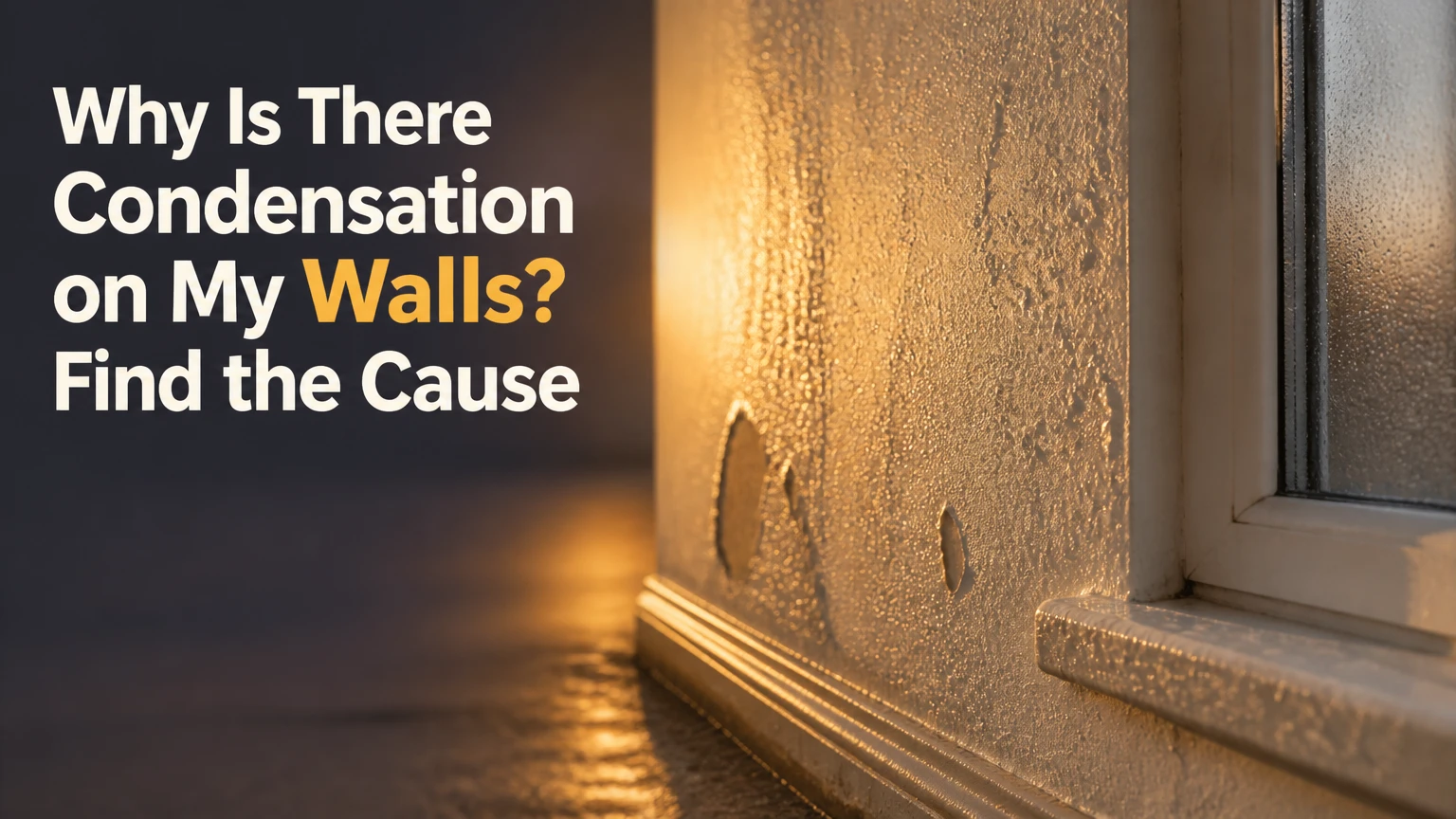
Surface condensation usually produces scattered droplets, a damp film, darkened paint, softened wallpaper seams, or mold concentrated where air movement is poor. Condensation often becomes worse overnight, after showers, during cooking, or during cold weather, then improves when heating and ventilation dry the room.
| Pattern on wall | Likely mechanism | Useful check |
|---|---|---|
| Broad damp area on cold exterior wall | High RH plus low surface temperature | Measure RH and wall temperature |
| Black specks behind wardrobe | Stagnant air and trapped cold surface | Move furniture 2-4 inches away |
| Vertical dark lines matching studs | Thermal bridging through framing | Compare with infrared scan |
| Damp upper bathroom wall | Shower vapor and weak exhaust | Test fan airflow and duct termination |
| Stain below window or ceiling | Leak, failed flashing, or condensation | Inspect after rain and check framing |
| Wet strip beside a pipe | Plumbing leak or pipe sweating | Shut off water and inspect access panel |
A clean surface does not prove a wall is dry. Paint, vinyl wallpaper, and vapor-resistant finishes can conceal moisture behind the visible surface. Conversely, dark discoloration alone does not prove active condensation, because old staining and mold can remain after the moisture source is removed.
Why Does Condensation Form in Spots or Lines?
Condensation forms in spots or lines when a thermal bridge creates a colder path through an otherwise warmer wall. Common bridges include metal framing, concrete columns, balcony slabs, wall-floor junctions, window lintels, fasteners, and corners where insulation is incomplete.
Thermal bridging is especially likely when the pattern repeats at regular intervals. Vertical stripes that match wall studs, dark dots at fasteners, or a continuous band around a slab edge point toward heat flow through the building assembly rather than a random plumbing leak.
Furniture creates a smaller, local version of the same problem. A large wardrobe against an exterior wall blocks room air, allowing the surface behind it to cool. The trapped air can reach its dew point even when the open part of the room appears dry.
Keep furniture at least 2 inches from exterior walls, and use larger gaps near visibly cold corners. Do not solve a severe recurring pattern with paint alone. Paint changes appearance, not the temperature or vapor flow causing the wetness.
How Can You Tell Condensation From a Leak?
Condensation is usually widespread, surface-level, weather-sensitive, and associated with high RH or poor airflow. A leak is more likely when moisture follows a defined path, appears after rain or plumbing use, remains wet despite controlled humidity, or causes localized staining from above, below, or behind a fixture.
| Diagnostic clue | Condensation indication | Leak or dampness indication |
|---|---|---|
| Timing | Morning, after showering, cold nights | After rain, plumbing use, or snowmelt |
| Shape | Broad film, droplets, corner pattern | Ring, stripe, tide mark, or isolated patch |
| Location | Exterior wall, window, cold corner | Below roof, pipe, gutter, bathroom, foundation |
| RH reading | Often above 55-60% | Can remain below 50% |
| Surface temperature | Near or below dew point | May be any temperature |
| Drying response | Improves with ventilation and heat | Returns until source is repaired |
The foil test can provide a clue but cannot prove the diagnosis. Tape a square of aluminum foil tightly to the wall for 24-48 hours. Moisture on the room-facing side suggests indoor condensation; moisture behind the foil suggests moisture moving through the wall. Gaps, temperature changes, and vapor trapped beneath the foil can produce misleading results.
Use a moisture meter, borescope, infrared camera, or professional building-envelope inspection when the stakes are high. Infrared imaging identifies temperature differences, not moisture by itself, so an operator must confirm findings with RH, moisture, or construction evidence.
When Is Wetness Probably Not Condensation?
Wetness is probably not condensation when it is concentrated around plumbing, expands after rain, rises from the floor, or produces a persistent stain in a room with RH below 50%. Possible causes include a leaking supply pipe, drain leak, roof or flashing failure, failed window seal, foundation seepage, gutter overflow, or rising damp.
Stop using a nearby fixture if a plumbing leak is possible. Check the attic, roof penetrations, gutters, exterior grading, basement walls, and HVAC condensate lines before repainting. A concealed leak can damage framing and insulation far faster than occasional surface condensation.
What Can You Do Today?
The fastest way to reduce wall condensation is to lower indoor humidity, increase air circulation, and keep the affected room warmer. These measures can reduce droplets within hours, but they will not repair a roof leak, replace missing insulation, or dry saturated wall cavities.
- Measure RH and temperature. Record both values in the affected room, especially when the wall is wet.
- Vent moisture at its source. Run bathroom and kitchen exhaust fans during use and for 15-20 minutes afterward.
- Increase air movement. Open interior doors, run a circulating fan, and move furniture 2-4 inches from the wall.
- Dry visible water. Use a clean absorbent cloth or squeegee, then wash and dry the tool.
- Reduce moisture production. Cover cooking pots, shorten showers, and stop using unvented fuel heaters indoors.
- Maintain steady heat. Avoid allowing the affected room to fall below approximately 60°F during cold weather.
- Recheck after 48-72 hours. Compare RH, wall temperature, odor, and the size of the damp area.
The success checkpoint is simple: the wall remains dry through the coldest overnight period at RH below 50-55%. If droplets return despite those conditions, investigate a cold bridge, missing insulation, air leakage, or a non-condensation moisture source.
Which Fix Works Best?
Lowering humidity is usually the least expensive first intervention, while insulation or air sealing provides the more durable solution when the wall itself is too cold. Bathroom exhaust is more effective than a dehumidifier for shower moisture because it removes vapor before that vapor spreads through the house.
| Remedy | Typical USA cost | Capacity or specification | Best use |
|---|---|---|---|
| Digital hygrometer | $10-$30 | RH accuracy approximately ±3-5% | Diagnosis and monitoring |
| Portable dehumidifier | $150-$350 | 20-50 pints per day | Persistent room humidity |
| Bathroom exhaust fan | $200-$600 installed | 50-110 CFM typical residential range | Shower vapor at source |
| Air-sealing repair | $150-$1,500 | Caulk, foam, gaskets, flashing repairs | Drafts and localized cold paths |
| Exterior insulation retrofit | $5,000-$25,000 or more | Project-specific continuous insulation | Whole-wall temperature improvement |
| Interior insulated wall system | $40-$100 per square meter, typical | 1-2 inch insulation plus compatible vapor control | Selected cold exterior walls |
Costs vary by region, access, electrical work, wall finish, and contractor rates. A portable dehumidifier is not a substitute for fixing bulk water entry, and interior insulation can create hidden moisture if the assembly is designed incorrectly.
| User situation | First action | Second action | Avoid |
|---|---|---|---|
| Renter with droplets | Buy hygrometer and ventilate | Request exhaust, leak, and insulation inspection | Drilling or insulating without approval |
| Homeowner with RH above 60% | Add source exhaust or dehumidification | Improve air sealing and heating balance | Painting over damp surfaces |
| Homeowner with RH below 50% | Measure wall temperature | Inspect thermal bridge and insulation | Assuming low RH rules out a cold wall |
| Basement owner | Test humidity and slab or wall moisture | Improve drainage, grading, or dehumidification | Relying on a foil test alone |
| New construction with cavity concern | Review wall assembly and vapor control layer | Obtain envelope or moisture inspection | Adding an interior vapor barrier randomly |
Should You Use a Dehumidifier or Exhaust Fan?
Choose a dehumidifier when moisture is distributed across a room or basement and outdoor air is already humid. Choose an exhaust fan when a predictable source, such as a shower or cooking appliance, generates the moisture. Many homes need both because source removal and background humidity control solve different problems.
A dehumidifier’s rated pint capacity is measured under specified test conditions. Actual removal falls in cooler rooms or when the air is already relatively dry. Select a model with an automatic humidistat, continuous drain option, and a capacity appropriate to the room rather than relying only on the advertised maximum.
A fan must exhaust outdoors, not into an attic, crawl space, or wall cavity. ENERGY STAR-qualified ventilation products can reduce energy use, but correct duct routing and adequate makeup air matter more than the label alone.
When Is Insulation the Right Repair?
Insulation is the right repair when the indoor RH remains near 30-50% but the wall surface still falls near the dew point. Raising the wall surface temperature reduces condensation risk, particularly at exterior corners, window reveals, slab edges, and regularly repeating stud patterns.
A thermal camera can locate cold areas during a temperature difference of roughly 18°F or more between indoors and outdoors. The camera does not identify the wall’s exact moisture content. Confirm the suspected cold bridge with surface-temperature readings, construction plans, or selective inspection.
Interior wall insulation requires care. The new assembly must account for air leakage, vapor diffusion, condensation potential, electrical boxes, windows, and drying direction. A misplaced vapor-impermeable layer can trap moisture inside a wall, especially in mixed or hot-humid U.S. climates.
For major work, consult a building-science professional familiar with the International Residential Code, local climate zone, and the existing wall assembly. Exterior continuous insulation often reduces thermal bridging more reliably, but it costs more and may require siding, trim, flashing, and permit changes.
Can Moisture Be Inside the Wall?
Moisture can condense inside a wall cavity when humid air or vapor reaches a cold layer within the assembly. Interstitial condensation may wet insulation, sheathing, framing, or fasteners without producing visible droplets on the room-side surface.
Warning signs include musty odor, recurring paint failure, swollen baseboards, mold that returns after cleaning, elevated moisture readings, and dampness near penetrations. A small inspection opening or borescope can reveal wet insulation, but avoid cutting near electrical wiring or plumbing without locating services first.
The wall assembly determines the risk. Air movement through gaps often transports far more moisture than vapor diffusion, so air sealing is frequently as important as choosing a vapor-control material. The appropriate vapor retarder varies by climate and construction; a generic plastic sheet is not a universal solution.
How Should Mold Be Cleaned?
Small areas of mold on washable, sound surfaces can often be cleaned after the moisture source is controlled, while porous materials with deep growth may require removal. The EPA advises controlling moisture first because cleaning without fixing the water source allows mold to return.
Wear gloves, eye protection, and at least an N95 respirator when disturbing a small contaminated area. Isolate the work area, avoid dry brushing or sanding, clean hard surfaces with detergent and water, and dry them completely. Do not mix bleach with ammonia, acids, or other cleaners.
Discard moldy drywall, insulation, ceiling tile, carpet padding, and other porous materials when growth penetrates the material. Hire a qualified remediation professional for extensive growth, HVAC contamination, sewage-related water, major hidden moisture, or occupants with significant respiratory vulnerability.
“The key to mold control is moisture control,” states the U.S. Environmental Protection Agency in its mold guidance. That principle also applies to condensation: surface treatment is secondary to humidity, temperature, airflow, and bulk-water diagnosis.
What Habits Make Condensation Worse?
Several ordinary habits raise indoor humidity or cool wall surfaces enough to trigger condensation. The largest avoidable errors are drying wet laundry without ventilation, shutting off heat in unused rooms, placing furniture tightly against exterior walls, and using unvented combustion heaters.
| Mistake | Immediate effect | Better replacement |
|---|---|---|
| Drying one load indoors without ventilation | Adds roughly 0.5-1.2 gallons of water | Use outdoor drying or vented dehumidification |
| Turning heat off in a cold room | Lowers wall temperature below the dew point | Maintain approximately 60°F or higher |
| Pushing furniture flush to exterior wall | Blocks convective airflow | Leave a 2-4 inch ventilation gap |
| Using portable propane or kerosene heater | Produces combustion moisture indoors | Use listed vented equipment |
| Closing bathroom fan immediately | Leaves vapor after the shower | Run fan 15-20 minutes afterward |
| Painting over damp or moldy drywall | Hides symptoms and traps moisture | Dry, diagnose, clean, and replace damaged material |
Do not use a dry cloth aggressively on visible mold because it can spread contaminated dust. Remove surface water carefully, ventilate the area, and address the cause before cosmetic repair.
How Long Does Wall Condensation Take to Stop?
Light surface condensation can improve within several hours after ventilation, steady heating, and dehumidification begin. Damp drywall, plaster, insulation, or framing may require several days to weeks to dry, depending on material, airflow, temperature, and whether the moisture source has been eliminated.
| Situation | Typical drying interval | Verification method |
|---|---|---|
| Water film on painted masonry | 2-12 hours | Dry surface and stable RH |
| Damp wallpaper or drywall face | 1-7 days | Moisture-meter trend |
| Wet insulation cavity | 1-4 weeks or replacement | Inspection and moisture readings |
| Framing after a leak | 1-6 weeks | Repeated readings below local target |
| Persistent cold bridge | Recurs during cold weather | Surface temperature and dew point |
Never seal, wallpaper, or repaint while the substrate is still damp. A dry-looking surface can conceal moisture beneath impermeable finishes.
The Bottom Line
Why is there condensation on my walls? In most cases, humid indoor air is meeting a wall surface colder than its dew point. Measure room RH, identify moisture sources, improve exhaust and airflow, and check whether the wall is unusually cold. If wetness follows a pipe, roofline, foundation, or rain event, investigate a leak instead.
Start with a $10-$30 hygrometer and several days of observations. Keep RH near 30-50% when practical, maintain steady heat, leave furniture 2-4 inches from exterior walls, and use exhaust fans at bathrooms and kitchens. Escalate to moisture testing or a building-envelope professional when the wall remains wet below 50% RH, mold returns, or the damp area is inside the assembly.
FAQ
Can condensation damage painted walls?
Yes. Repeated condensation can soften drywall paper, loosen wallpaper, blister paint, corrode fasteners, and support mold growth. Damage becomes more likely when water remains on the surface for extended periods or when the wall cannot dry between wetting events. Repair requires moisture control first, followed by cleaning and replacement of compromised finishes.
Why are my walls wet only in the morning?
Morning wetness usually results from overnight humidity accumulation and falling wall temperatures. People release moisture while sleeping, windows and exterior walls cool after heating cycles, and closed rooms receive less ventilation. Measure RH before bed and on waking. A morning RH above 60% strongly supports condensation, but localized stains still require leak checks.
Does opening windows always stop wall condensation?
Opening windows can reduce condensation during cold, dry weather because outdoor air often contains less absolute moisture. The method works poorly during humid summer weather, heavy rain, extreme cold, or where opening windows creates security or energy problems. Brief cross-ventilation, exhaust fans, and mechanical dehumidification provide more controlled alternatives.
Can air conditioning prevent condensation on walls?
Air conditioning can prevent condensation by lowering indoor moisture and maintaining stable temperatures, especially in humid U.S. regions. Oversized systems may cool the room quickly without running long enough to remove adequate moisture. A properly sized system, clean filter, sealed ducts, and a separate dehumidifier may be needed when RH remains above 55-60%.
Is condensation on basement walls normal?
Basement wall condensation is common but should not be treated as harmless. Cool masonry can reach the dew point even when the basement air feels comfortable. Measure basement RH, inspect exterior drainage and gutters, and test the wall for moisture. Persistent wetness below the dew point or after rain suggests seepage, not ordinary surface condensation.
Should I use anti-condensation paint?
Anti-condensation paint may slightly reduce surface cooling or improve appearance, but it cannot remove moisture, repair a leak, or replace missing insulation. Use it only after humidity, airflow, and wall-temperature problems are addressed. A coating that seals a damp wall can delay drying and make hidden damage harder to detect.