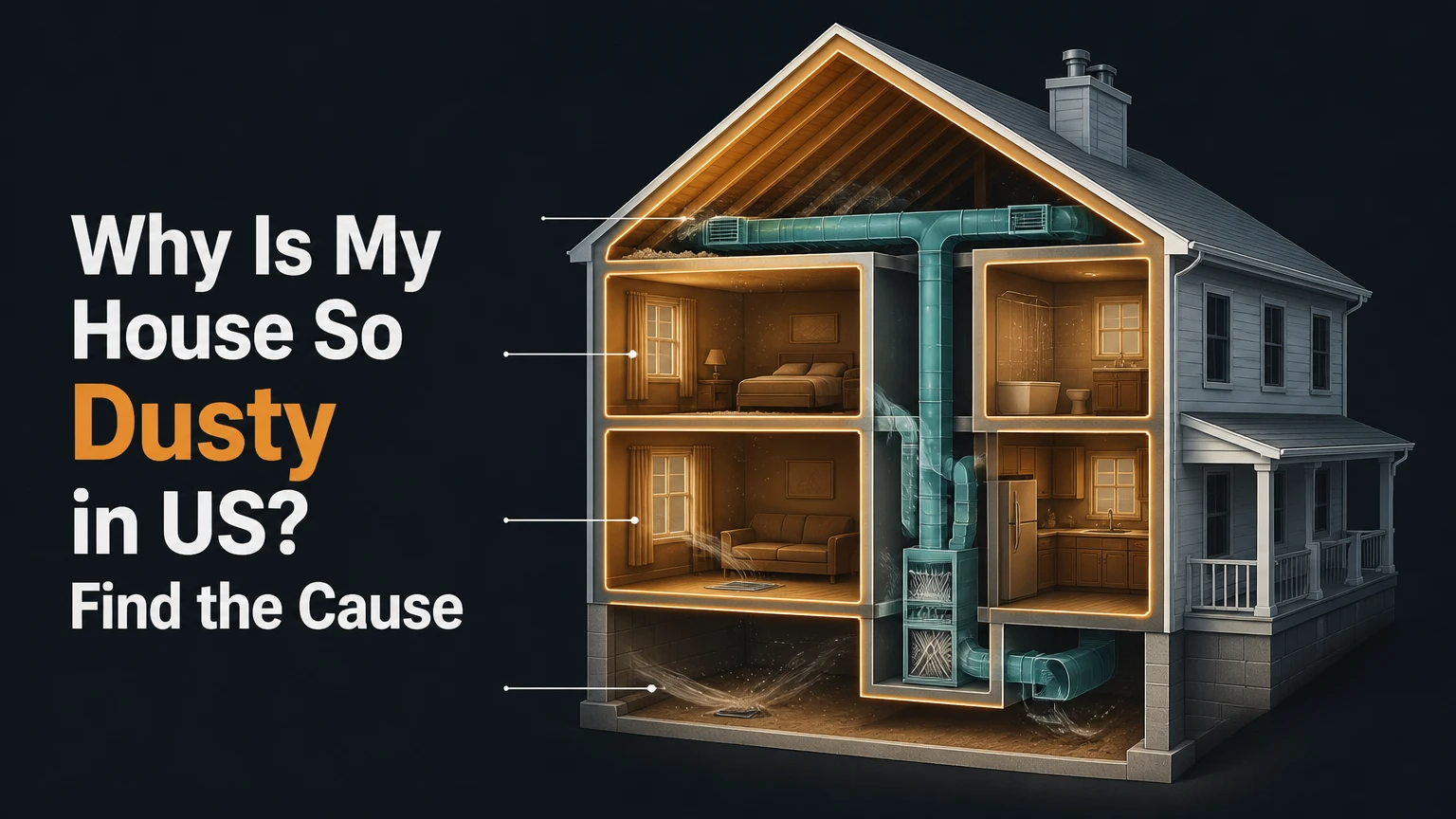
Why Is My House So Dusty in US? Find the Cause
Household dust is a mixture of outdoor soil, pollen, combustion particles, skin flakes, pet allergens, textile fibers, and insect or mold fragments. If dust returns within 24-48 hours, the leading causes are uncontrolled entry through doors or leaks, shedding from carpets and fabrics, HVAC filter bypass, and resuspension from foot traffic or fans.
Key Facts at a Glance
- The U.S. Environmental Protection Agency says duct cleaning is not routinely necessary, but cleaning can be appropriate when ducts contain substantial visible growth, vermin, or heavy dust deposits.
- A properly fitted pleated HVAC filter usually controls more whole-house airborne dust than a higher-rated filter that does not seal its frame.
- A portable air purifier removes airborne particles in its rated room, but it cannot remove dust already settled on floors, shelves, mattresses, or upholstery.
- Dust appearing around supply registers points toward duct leakage, dirty registers, wall damage, or filter bypass rather than ordinary skin shedding alone.
- Damp microfiber cleaning captures settled dust more reliably than dry dusting, which can resuspend fine particles.
- Indoor relative humidity near 40%-50% can reduce static-related dust attraction, but humidifiers must not push a home toward condensation or mold.
What Is Household Dust?
Household dust is a dynamic mixture of particles generated indoors and transported indoors from outside. The mixture changes by season, building type, occupancy, pets, ventilation, flooring, nearby traffic, and recent construction.
The common ingredients include mineral soil, sand, pollen, fungal spores, soot, textile fibers, human skin flakes, pet dander, hair, food residue, and insect fragments. Dust mites live mainly in mattresses, bedding, carpets, and upholstered furniture; their bodies and fecal particles can contribute allergens, although dust itself is not synonymous with dust mites.
A frequently repeated claim says 60% of household dust comes from outdoors and 40% comes from indoors. That split should not be treated as a universal U.S. measurement. Outdoor contribution varies with climate, shoes-off habits, ventilation, wildfire smoke, soil type, pets, and building leakage, so a home beside a busy road will not have the same dust profile as a tightly sealed apartment.
Why does dust stay in the air?
Fine particles remain airborne when heating, cooling, walking, fans, and pressure differences keep them moving. Larger particles settle faster, while small particles can travel through rooms and later deposit on horizontal surfaces.
A ceiling fan does not create dust, but it can repeatedly lift settled particles from bedding, carpet, shelves, and floors. HVAC startup has a similar effect when registers, return cavities, or duct interiors contain loose debris.
Where Does Dust Come From in a U.S. Home?
Dust enters through doors, windows, shoes, clothing, pets, crawlspaces, attics, and leaks around ducts or building assemblies. Indoor sources include fabrics, carpets, mattresses, upholstered furniture, paper, cardboard, skin flakes, cooking residue, and household activity.
The appearance and location of dust often identify its source faster than a laboratory test. Pale lint on bedroom furniture suggests textiles, dark powder near a fireplace or gas range suggests combustion residue, and gritty tan dust near entries suggests outdoor soil.
| Dust appearance or location | More likely source | Useful check | First response |
|---|---|---|---|
| Tan grit at entry doors | Soil, sand, road dust | Inspect shoes and door sweep | Use mats and remove shoes |
| Gray rings at supply registers | Duct leakage, wall leakage, dirty register | Watch register during blower startup | Photograph, then request HVAC testing |
| White or blue-gray lint on bedrooms | Bedding, clothing, carpet fibers | Check dryer lint and textile shedding | Wash bedding and use sealed vacuum |
| Black soot near kitchen or fireplace | Cooking, candles, fireplace, combustion | Inspect hood vent and appliance flame | Vent outdoors and stop indoor candle use |
| Fine ash after wildfire smoke | Outdoor smoke infiltration | Check AQI and window seals | Keep windows closed and filter recirculated air |
| Brown particles after remodeling | Drywall, sawdust, insulation | Inspect returns and unfinished cavities | Isolate work area and use HEPA cleanup |
Outdoor dust does not need a visible hole to enter. Door opening, window leakage, normal ventilation, and pressure changes can transport particles into a house, while poorly sealed return ducts can pull dusty attic or crawlspace air into the HVAC system.
Why Is My House So Dusty Again After Cleaning?
Dust returns quickly when cleaning removes deposited particles but leaves the source, airflow pathway, or resuspension mechanism unchanged. A home that looks dusty the next day often has carpet or textile shedding, a leaky return duct, an ill-fitting filter, renovation residue, or heavy activity in a small room.
The cleaning sequence matters. Vacuuming first can remove floor reservoirs, damp microfiber can capture shelf dust, and laundering bedding can reduce a major bedroom source. Dry wiping before vacuuming often moves particles from one surface into the breathing zone.
Rapid accumulation has four common patterns:
- Dust appears after HVAC startup: inspect the filter fit, return plenum, registers, and duct leakage.
- Dust appears after people walk: inspect carpet, rugs, entry mats, and vacuum performance.
- Dust appears overnight in bedrooms: inspect bedding, mattresses, upholstered furniture, and low air circulation.
- Dust appears after opening windows: check pollen, local construction, wildfire smoke, and damaged screens.
Expert insight: the return side matters most
A dirty supply register is visible, but a leaky return duct can be more consequential because negative pressure pulls surrounding air into the HVAC system. A return located in an attic, wall cavity, or dusty closet can distribute contaminants throughout the house without leaving obvious debris inside every supply duct.
How Can You Find the Source of Excessive Dust?
Find excessive dust by comparing its timing, location, appearance, and response to airflow. The most useful homeowner checks are the supply-register test, filter-frame inspection, return-air inspection, humidity measurement, and room-by-room dust mapping.
Step 1: Check registers during HVAC startup
Turn on the blower and hold a dark sheet of paper several inches from each supply register without blocking airflow. Do not place your hand inside the duct. Look for visible particles, fluttering debris, or a gray outline around the register.
Dust blowing from a register indicates a potential duct contamination problem, damaged insulation, wall cavity leakage, or register dirt. A gray outline can also result from normal air movement depositing particles on a wall, so the pattern is a clue, not proof of a failed duct.
Step 2: Inspect the filter and its frame
Turn off the HVAC system before removing the filter. Confirm the printed size, airflow arrow, installation date, and whether the filter bows, collapses, or leaves gaps around its edges.
Run a flashlight along the filter frame. Dirt lines outside the filter media indicate bypass, which means unfiltered air is entering the return path. A filter that is too small, backward, wet, or poorly supported cannot perform at its rated efficiency.
Step 3: Measure humidity and map dust
Use a digital hygrometer in the main living area and bedroom for several days. Record readings morning and evening, then mark where dust accumulates first.
Relative humidity below 35% can increase static attraction and make lint cling to screens and furniture. Humidity above 60% can support condensation and mold risk, especially on cool surfaces. A target near 40%-50% is practical for many U.S. homes, but the building envelope and climate determine the safe upper limit.
| Diagnostic result | Likely interpretation | Confirmation method | Appropriate next action |
|---|---|---|---|
| Dust blows at startup | HVAC or register pathway issue | Inspect filter and duct connections | HVAC leakage and airflow assessment |
| Dirt tracks around filter | Filter bypass | Compare filter size with slot | Install exact-size supported filter |
| Dust is worst near entry | Outdoor tracking | Examine mats and door sweep | Improve entry control |
| Dust is worst on carpet | Fiber and reservoir release | Vacuum one area thoroughly | Increase sealed HEPA vacuuming |
| Dust is worst after cooking | Grease and combustion particles | Check range hood discharge | Vent outdoors and clean hood filter |
| Dust is worst in winter | Dry air and closed-house activity | Measure relative humidity | Control humidity without condensation |
Which HVAC Filter Should You Use?
Use the highest MERV filter that the HVAC manufacturer or technician confirms the system can handle without excessive pressure loss. For many standard residential systems, a correctly fitted pleated MERV 8-11 filter is a sensible starting point; MERV 13 can provide stronger fine-particle control when the system and filter cabinet support it.
MERV means Minimum Efficiency Reporting Value, a performance scale defined by ASHRAE Standard 52.2. The rating describes particle capture under test conditions, not a guarantee that every home system will deliver the same result.
| Filter option | Typical particle-control role | Common residential use | Main limitation |
|---|---|---|---|
| MERV 1-4 fiberglass | Captures larger lint and debris | Basic equipment protection | Limited fine-particle capture |
| MERV 8 pleated | Controls common household dust | Older or moderate-airflow systems | Less fine-particle capture than MERV 11-13 |
| MERV 11 pleated | Stronger dust and allergen control | Many standard homes | Requires correct fit and airflow |
| MERV 13 pleated | Better fine-particle capture | Compatible newer systems | Higher resistance in restrictive cabinets |
| HEPA media | Very high particle removal | Dedicated bypass or separate purifier | Often unsuitable in ordinary 1-inch slots |
Replace filters based on loading, not a universal calendar alone. A typical 1-inch filter may need replacement every 30-90 days, while homes with pets, remodeling, smoke, or multiple occupants may need replacement every 30-60 days.
A common practitioner rule is simple: a MERV 13 filter in a leaky cabinet is often less useful than a MERV 8 filter that seals correctly. Never install a thicker or higher-MERV filter if the blower, furnace, air conditioner, or filter cabinet was not designed for it.
Do Air Purifiers Help With Dust?
Portable air purifiers with genuine HEPA filters help reduce airborne dust in the room they serve, especially when the purifier has adequate clean air delivery rate, or CADR, and runs for long periods. Portable purifiers do not remove settled dust and cannot correct a leaking duct or contaminated crawlspace.
The U.S. EPA describes HEPA filtration as capable of theoretically removing at least 99.97% of particles measuring 0.3 micrometers under test conditions. The 0.3-micrometer figure is a testing benchmark, not a cutoff where larger or smaller particles escape completely.
Choose a purifier by room volume and CADR rather than a marketing room-size claim. As a practical planning point, a 250-square-foot bedroom with an 8-foot ceiling contains about 2,000 cubic feet; a purifier rated around 200-300 cubic feet per minute can provide substantial air cleaning at a tolerable operating speed.
| Purifier choice | Typical purchase price | Best room or situation | Ongoing requirement |
|---|---|---|---|
| Compact HEPA unit | $80-$180 | Bedroom under 200 square feet | Filter commonly $20-$60 |
| Medium HEPA unit | $150-$350 | Living room around 200-400 square feet | Filter commonly $30-$90 |
| High-CADR HEPA unit | $300-$700 | Open-plan or smoke-prone areas | Higher energy and filter cost |
| Furnace bypass HEPA | $1,500-$4,000 installed | Whole-home central HVAC | Professional sizing and service |
Place the purifier away from curtains and furniture, with unrestricted intake and exhaust. Run it continuously on a lower setting when dust or allergies are persistent, then vacuum and damp-clean surfaces because airborne filtration cannot collect particles already deposited on the floor.
Should You Clean or Seal Your Air Ducts?
Seal or repair demonstrable duct leaks before paying for routine duct cleaning. The EPA says duct cleaning may be warranted when ducts contain substantial visible mold, vermin infestation, or excessive dust and debris that enters the living space, but the agency does not recommend routine cleaning as a normal home-maintenance measure.
Duct cleaning removes accumulated material from accessible duct surfaces using agitation and negative-pressure collection. Duct sealing repairs leaks at connections, plenums, boots, and inaccessible joints, which can prevent attic, crawlspace, or wall-cavity air from entering the return system.
| Service | Typical U.S. planning cost | Typical duration | Best indication | Does not fix |
|---|---|---|---|---|
| Supply and return cleaning | $300-$700 per system | 3-5 hours | Heavy visible debris or post-remodel residue | Leaky duct joints |
| Duct repair at accessible joints | $200-$1,500 | 2-8 hours | Disconnected or damaged sections | Hidden contamination everywhere |
| Aeroseal-style sealing | $1,500-$4,000 | 4-8 hours | Measured leakage in distributed ductwork | Settled surface dust |
| HVAC inspection and pressure testing | $150-$500 | 1-3 hours | Unknown airflow or leakage cause | Cleaning itself |
| Return-plenum cleaning | $150-$500 | 1-3 hours | Dust accumulation near blower | Building-envelope leaks |
Be cautious with companies that claim every home needs duct cleaning, promise complete removal of all indoor dust, or cannot show before-and-after photographs. The EPA also warns that moisture, chemical biocides, or sealants inside ducts require careful evaluation because unnecessary application can introduce other indoor-air concerns.
What Cleaning Method Removes Dust Best?
Use a sealed vacuum with a genuine HEPA exhaust filter for floors and upholstery, followed by a slightly damp microfiber cloth for hard surfaces. The sequence prevents floor dust from becoming airborne while the cloth captures residue rather than redistributing it.
A practical weekly routine is:
- Vacuum floors, rugs, sofa cushions, and carpet edges slowly, using overlapping passes.
- Clean high surfaces before low surfaces so falling dust is removed later.
- Wash bedding weekly in hot water when dust-mite allergens are a concern.
- Clean return grilles and supply registers with a damp cloth.
- Replace or wash entry mats according to the manufacturer’s instructions.
- Empty the vacuum outdoors if its design permits, while wearing a well-fitting mask.
Dry feather dusters and dry rags move fine particles more than they capture them. A vacuum labeled HEPA is useful only when its body, seals, and exhaust prevent substantial bypass; a loose filter or poorly sealed machine can discharge fine dust through the exhaust.
What Changes for Renters?
Renters should prioritize portable controls, entry management, and cleaning because HVAC modification and duct sealing may require landlord approval. A bedroom purifier, damp microfiber cleaning, washable bedding, sealed vacuuming, and a properly installed replacement filter provide the highest practical benefit without structural work.
Ask the property manager to inspect HVAC filter access, return grilles, visible duct damage, water intrusion, pest evidence, and renovation debris. Photograph dust around registers before cleaning, record filter size, and report symptoms or visible mold in writing.
| Renter action | Typical cost | Time to implement | Expected scope |
|---|---|---|---|
| Washable entry mat | $15-$50 | 10 minutes | Reduces tracked soil |
| Medium HEPA purifier | $150-$350 | 15 minutes | One bedroom or living area |
| Damp microfiber set | $10-$30 | 20 minutes | Settled hard-surface dust |
| Sealed vacuum rental | $30-$70 per day | 1-3 hours | Floors and upholstery |
| Landlord HVAC inspection | Usually no tenant cost | 1-7 days scheduling | Filter, registers, visible leaks |
Do not tape over supply registers, block returns, or install an unapproved filter that restricts airflow. Those actions can create HVAC problems without solving the dust source.
How Do Pets and Carpeting Change the Diagnosis?
Pets and carpeting increase the amount of material that can accumulate and later resuspend, but they do not prove that an HVAC system is defective. Pet dander is made of microscopic skin flakes and associated proteins, while carpet acts as both a filter and a reservoir for soil, fibers, and allergens.
Vacuum high-traffic carpet at least twice weekly in homes with pets or allergy-sensitive occupants, and clean edges where ordinary passes leave debris. Groom pets outdoors when possible, wash pet bedding weekly, and keep litter boxes away from return grilles.
| Home condition | Main dust reservoir | Practical frequency | High-value control |
|---|---|---|---|
| One short-haired dog | Rugs, sofa, entry | Vacuum 2 times weekly | Washable throws and entry mat |
| Multiple pets | Carpet, bedding, upholstery | Vacuum 3-5 times weekly | Sealed HEPA vacuum and purifier |
| Wall-to-wall carpet | Fibers and tracked soil | Slow vacuum 2-4 times weekly | Professional extraction as needed |
| Hardwood with area rugs | Rugs and floor edges | Vacuum 1-3 times weekly | Damp mop after vacuuming |
| Dust-mite concern | Mattress, pillows, bedding | Wash bedding weekly | Allergen-proof encasements |
Removing carpet can reduce one reservoir, but replacement work creates its own dust and may expose subfloor debris. Test source control first unless carpet is damaged, damp, or impossible to clean effectively.
Why Is a New or Recently Remodeled Home Dusty?
New construction and remodeling can produce dust for weeks or months because drywall joint compound, sawdust, concrete residue, insulation fibers, and packaging debris remain in cavities, returns, and horizontal ledges. HVAC operation can distribute those particles if the system ran before final cleaning.
For post-remodel dust, isolate the work zone with closed doors and plastic barriers, replace the HVAC filter after demolition and again after final cleanup, and use HEPA-rated equipment for floors and surfaces. Do not use compressed air, which redistributes fine particles into occupied rooms.
If dust continues after two or three thorough cleaning cycles, inspect unfinished penetrations, return plenums, attic insulation, crawlspaces, and duct boots. Construction dust that appears around one register suggests a pathway problem rather than ordinary settling.
What Changes During Wildfire Smoke or High-Pollen Seasons?
Wildfire smoke, agricultural activity, road traffic, and seasonal pollen can sharply increase outdoor particle entry even when a house is normally clean. During poor air quality, close windows, limit door opening, run compatible HVAC filtration, and operate a properly sized portable HEPA purifier.
The EPA’s AirNow program provides local air-quality information in the United States. A purifier can reduce indoor particle concentration, but cooking, candles, fireplaces, and gas appliances can continue generating particles indoors.
Do not rely on a purifier to make an unsafe combustion appliance safe. Install carbon monoxide alarms, vent fuel-burning appliances correctly, and have suspected combustion problems evaluated by a qualified professional.
What Does Dust Control Cost?
Basic dust reduction commonly costs $10-$70 for mats, microfiber cloths, and replacement filters, while room air cleaning commonly costs $150-$350 per purifier. Professional HVAC investigation, duct cleaning, and sealing range from several hundred dollars to several thousand dollars depending on access, leakage, system size, and regional labor rates.
The cheapest effective intervention depends on the source. A $25 correctly sized filter can outperform a $300 purifier for dust circulating through a central system, while a purifier is the practical solution when a renter cannot repair a leaking return duct.
| Intervention | Typical initial cost | Typical recurring cost | Suitable decision |
|---|---|---|---|
| Entry mats and shoe removal | $15-$80 | $0-$30 yearly | Visible grit near doors |
| Pleated HVAC filters | $10-$35 each | $40-$180 yearly | Whole-house airborne dust |
| Sealed HEPA vacuum | $150-$500 | Bags and filters, $30-$120 yearly | Carpet, pets, upholstery |
| Portable HEPA purifier | $80-$700 | Filters, $30-$120 yearly | Bedroom, smoke, allergies |
| HVAC diagnostic visit | $150-$500 | As needed | Dust at registers or filter bypass |
| Duct cleaning | $300-$700 | As needed | Verified heavy debris |
| Duct sealing | $1,500-$4,000 | Usually none | Measured leakage |
Prices are typical U.S. planning ranges, not guaranteed quotes. Get the scope in writing, including the number of systems, return and supply access, filter specifications, testing method, and post-service documentation.
Common Dust-Control Mistakes and Fixes
Installing MERV 13 without checking airflow
A restrictive filter can reduce airflow, raise static pressure, freeze an air-conditioning coil, or stress a furnace. Confirm the equipment specification and filter pressure drop before upgrading.
Cleaning ducts before repairing leaks
Cleaning removes accumulated debris but does not stop a return duct from pulling dusty air from an attic or crawlspace. Test and repair leakage first when dust appears after blower startup.
Using a purifier that is too small
A compact purifier on a large open floor plan may move too little air to make a measurable difference. Match CADR to room volume and keep doors closed when treating a bedroom.
Humidifying without measuring
Adding moisture can reduce static, but excessive humidity encourages condensation and mold. Use a hygrometer, avoid placing the humidifier against a cold exterior wall, and stop if window condensation develops.
Vacuuming with a leaking machine
A vacuum that exhausts fine particles can make indoor air look clean while redistributing the smallest dust fraction. Check seals, bags, filters, and manufacturer replacement intervals.
What Should You Do in the Next 24 Hours?
Start with source control, then capture settled dust, then improve filtration. This sequence usually takes 2-4 hours of active work and costs $15-$100 if you already own a suitable vacuum.
- Photograph dust at registers, returns, doors, and the worst room.
- Inspect and replace the HVAC filter with the exact approved size.
- Vacuum floors, rugs, upholstery, and return grilles with sealed equipment.
- Damp-wipe horizontal surfaces from high to low.
- Wash bedding and pet fabrics.
- Place a washable mat at every frequently used exterior door.
- Measure humidity and record the result.
- Run a properly sized purifier in the bedroom or main living area.
- Recheck the same surfaces after 24 and 48 hours.
- Arrange HVAC testing if dust returns at registers or filter-frame gaps remain.
You will know the first phase worked when the same marked surfaces show less accumulation after two days. If only one room remains dusty, investigate that room’s carpet, return grille, exterior wall, window, or duct boot rather than treating the entire house blindly.
Frequently Asked Questions
Can household dust make you sick?
Household dust can carry allergens and irritants that worsen allergic rhinitis, asthma, eczema symptoms, or respiratory irritation in susceptible people. Dust is not one disease-causing substance, and symptoms may also come from mold, smoke, cleaning chemicals, or combustion products. Seek medical care for persistent wheezing, breathing difficulty, or unexplained symptoms.
Why is dust worse in winter?
Winter dust often feels worse because windows stay closed, indoor heating increases air movement, and low humidity increases static attraction. People also spend more time indoors, while bedding, rugs, and upholstered furniture release particles through daily activity. Measure humidity rather than assuming a humidifier is needed.
Are dust mites the reason my house is dusty?
Dust mites may contribute allergens, but dust mites do not explain every visible dust problem. Dust mites prefer warm, humid bedding and upholstery, while visible grit, lint, and soot come from other sources. Wash bedding weekly, use encasements, and control humidity if allergy symptoms suggest mite exposure.
How often should I dust my house?
Dust high-use rooms weekly and dust lower-use rooms every two to four weeks, adjusting the schedule for pets, carpet, construction, smoke, and allergies. Vacuum floors before wiping surfaces, and use damp microfiber rather than dry feather dusters. A rapid daily buildup requires diagnosis, not simply more frequent dusting.
Does opening windows reduce dust?
Opening windows can reduce stale indoor air but may increase dust, pollen, traffic particles, or wildfire smoke. Check outdoor air quality and pollen conditions before opening windows. Mechanical ventilation with appropriate filtration can provide air exchange with better particle control than an open window during polluted periods.
Is visible dust around an air vent dangerous?
Visible dust around an air vent is usually a sign of particle deposition, leakage, dirty registers, or wall-surface airflow, not proof of a dangerous condition. Dust blowing from the register, water damage, mold-like growth, vermin, or combustion odor warrants professional evaluation rather than ordinary cleaning.
The Bottom Line
Why is my house so dusty in US? The answer is usually a combination of outdoor entry, fabric and carpet reservoirs, HVAC filter bypass, duct leakage, and particle resuspension rather than one universal cause. Start with the filter fit, entry controls, sealed vacuuming, damp microfiber cleaning, and humidity measurement; then test duct leakage when dust returns at registers or after blower startup.