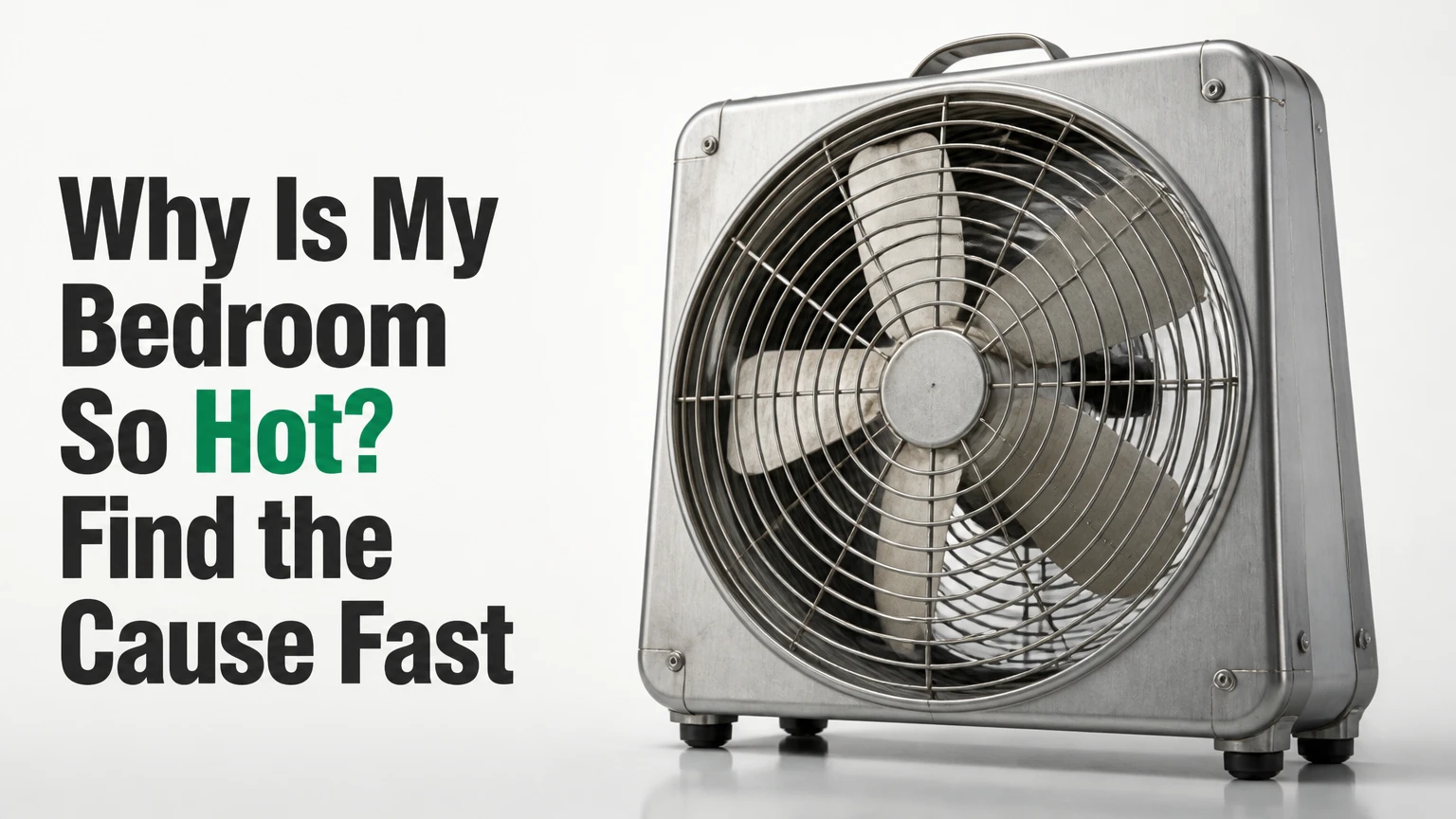
Why Is My Bedroom So Hot? Find the Cause Fast
Your bedroom is hot because it gains heat faster than the room can remove it. The most common causes are solar heat through windows, a hot roof or attic above the room, weak insulation, rising air on an upper floor, restricted HVAC airflow, duct leakage, and indoor humidity. The fastest fix depends on whether the heat comes from sunlight, the building envelope, the air-conditioning system, or internal heat sources.
Key Facts at a Glance
- A sunny window can add substantial radiant heat even when outdoor air feels moderate.
- A ceiling fan makes people feel cooler through moving air, but it does not meaningfully lower room temperature.
- An upstairs bedroom often stays hot after sunset because the roof and building materials release stored heat slowly.
- Closing bedroom vents usually worsens temperature imbalance by reducing conditioned airflow.
- A dirty HVAC filter, blocked return grille, or leaking duct can make one bedroom hotter than the rest of the house.
- Outdoor ventilation helps only when outdoor air is cooler and drier than indoor air.
Why Is My Bedroom So Hot?
A hot bedroom usually has one dominant heat source and one missing removal path. Heat may enter through the window, roof, exterior wall, ceiling, or door gaps, while insufficient supply air, poor return airflow, or high humidity prevents the room from becoming comfortable.
The practical distinction is important. A bedroom that is hot only in the afternoon points toward solar gain. A bedroom that is hot all night points toward stored roof heat, inadequate cooling, poor airflow, humidity, or heat-producing equipment.
The U.S. Department of Energy describes air sealing and insulation as “two of the most cost-effective ways to improve energy efficiency and comfort.” That guidance applies directly to bedrooms with hot ceilings, exterior walls, and noticeable drafts.
| Symptom | Most likely cause | First check | Typical first fix |
|---|---|---|---|
| Hot from 2 p.m. to 7 p.m. | Solar gain through glass | Window orientation and shade | Exterior shade or closed solar curtain |
| Hot only upstairs | Roof heat and rising air | Attic temperature and insulation depth | Attic air sealing and insulation |
| One room hot with AC running | Airflow imbalance | Supply register and return grille | Open, clean, and balance airflow |
| Hot after midnight | Thermal mass or weak cooling | Wall and ceiling surface temperature | Night purge, insulation, or AC service |
| Sticky and hot | High indoor humidity | Hygrometer reading | Dehumidification and moisture control |
| Hot near electronics | Internal heat gain | Computers, televisions, chargers | Turn off or relocate equipment |
How Heat Enters and Stays in a Bedroom
Bedroom heat follows four connected processes: radiation through windows, conduction through the building shell, convection through air movement, and internal heat generation. These processes often overlap, so a room can receive afternoon sun, collect rising air, and lose conditioned air through a leaking duct at the same time.
Solar radiation heats surfaces first
Sunlight passes through clear or lightly tinted glass and strikes floors, bedding, walls, and furniture. Those surfaces absorb short-wave solar energy, become warm, and release heat back into the room over several hours.
South- and west-facing windows generally create the greatest afternoon overheating risk in the continental United States, although local shading, latitude, trees, neighboring buildings, and window size can change the result. Exterior shades work better than interior curtains because they stop sunlight before it enters the glass.
Conduction moves heat through the shell
Roof decks, exterior walls, windows, and ceilings conduct heat from warmer areas toward cooler areas. Poor insulation increases the rate, while thermal bridges such as wall studs, concrete framing, recessed lights, and metal window frames create localized hot spots.
An upstairs bedroom beneath an attic is especially vulnerable. The roof receives solar energy first, the attic air and roof assembly warm up, and the ceiling then transfers heat toward the bedroom.
Convection moves hot air upward
Warm air becomes less dense and rises through stairwells, open doors, wall cavities, and poorly sealed duct paths. A second-floor bedroom can therefore receive heat produced downstairs even when the bedroom itself has no direct sunlight.
Convection is not the same as adequate ventilation. Air movement removes heat only when warmer indoor air leaves and cooler replacement air enters.
Thermal mass releases heat after sunset
Brick, concrete, tile, plaster, and some roof assemblies absorb heat during the day. These materials can continue releasing heat indoors after outdoor air cools, which explains why a bedroom may feel hottest between 8 p.m. and midnight instead of at the afternoon peak.
| Surface or pathway | Heat behavior | Common bedroom sign | Diagnostic method |
|---|---|---|---|
| Single-pane window | Rapid solar and conductive transfer | Warm glass and bright floor patch | Compare shaded and unshaded glass |
| Attic ceiling | Delayed heat transfer | Hot ceiling after sunset | Touch-test carefully or use infrared thermometer |
| Brick exterior wall | High thermal storage | Warm wall at night | Compare exterior and interior wall surfaces |
| Door gap | Air leakage | Hot hallway air entering | Hold tissue near the threshold |
| Duct connection | Conditioned-air loss | Weak supply airflow | Compare register airflow with another room |
| Recessed light opening | Attic leakage and heat | Warm ceiling spot | Inspect only when power is off |
Which Bedroom Conditions Point to Which Cause?
The timing, location, and feel of the heat usually identify the problem faster than buying another fan. Record outdoor temperature, bedroom temperature, humidity, and the time the room becomes uncomfortable for two consecutive days.
A small digital thermometer-hygrometer costing about $10-$25 can reveal whether the problem is temperature, humidity, or both. Compare the bedroom with a nearby hallway and an outdoor shaded location, but do not place the outdoor sensor in direct sun.
| Observation | Likely diagnosis | Confidence | Next action |
|---|---|---|---|
| Ceiling is warmer than walls | Attic heat or insufficient insulation | High | Inspect attic insulation and air sealing |
| Window is hot while curtain is closed | Solar gain through glass | High | Add exterior shade or solar-control film |
| Supply register has weak airflow | Closed damper, blockage, or duct fault | Medium | Check register, filter, and ductwork |
| Bedroom door feels pressurized when closed | Missing return-air path | Medium | Open door or add transfer grille |
| Humidity exceeds 60% RH | Moisture load or oversized AC | Medium | Run dehumidification and inspect moisture sources |
| Room temperature falls quickly with portable AC | Cooling capacity is adequate | Medium | Improve air sealing and distribution |
| Room remains hot with strong AC airflow | Envelope heat or undersized system | Medium | Measure surfaces and request HVAC evaluation |
Why is the bedroom hotter at night?
A bedroom can stay hot at night because the roof, walls, and furniture stored daytime heat and are still releasing it. The effect is stronger upstairs, in masonry buildings, and in rooms with poor insulation or limited nighttime airflow.
Outdoor air temperature alone does not determine comfort. A roof deck may remain warm for hours after sunset, while high indoor humidity slows evaporation from skin and makes the same air temperature feel hotter.
Why is one bedroom hotter than the rest of the house?
One bedroom is hotter when its heat gain or airflow differs from other rooms. Typical causes include a west-facing window, a larger exterior wall, a room above the garage, a closed door without a return path, a long leaking duct run, or a thermostat located in a cooler hallway.
Do not close vents in cooler rooms as the first response. That can raise duct pressure and reduce total system airflow, particularly in forced-air systems with restrictive filters or undersized returns.
How Can You Cool the Bedroom Tonight?
Use a timed sequence: block solar gain, remove internal heat, improve conditioned-air delivery, and ventilate only during the cooler part of the night. The sequence takes about 20-40 minutes and costs nothing if the room already has curtains, a fan, and working HVAC airflow.
- Close blinds or curtains before direct sunlight reaches the glass. Add a white or reflective-facing liner if the existing fabric is dark and thin.
- Turn off computers, televisions, gaming consoles, lamps, and unnecessary chargers. A desktop computer can release roughly 100-300 watts during active use, depending on its components.
- Open the bedroom supply register fully. Remove furniture, rugs, or curtains blocking the grille.
- Open the bedroom door for 15-30 minutes if the hallway is cooler. Closing the door can trap conditioned air in a room without a return grille.
- Run the ceiling fan or a portable fan toward the occupied bed. Airflow improves evaporative cooling for people, even when it does not reduce air temperature.
- Use window ventilation only when outdoor air is cooler and drier. In humid climates, opening windows during a warm evening can increase discomfort.
- Set the AC fan to automatic unless continuous circulation improves distribution. Continuous fan operation can re-evaporate moisture from a cold coil in some systems.
- Measure the result after 30 minutes. A successful intervention lowers the room temperature or reduces humidity, not merely the perceived draft.
Which Fix Works Best for a Hot Bedroom?
The best fix depends on the heat pathway. Exterior shading is usually the highest-value response to direct sun, attic air sealing and insulation address ceiling heat, and HVAC repair is necessary when the system cannot deliver adequate airflow or cooling.
| Fix | Cooling effect | Typical U.S. cost | Installation time | Renter suitability |
|---|---|---|---|---|
| Blackout curtains | Reduces visible light and some radiant gain | $30-$180 per window | 30-90 minutes | High |
| Exterior solar shade | Stops sunlight before glass | $100-$600 per window | 1-4 hours | Medium |
| Removable window film | Reduces solar transmission | $25-$150 per window | 1-3 hours | Medium |
| Ceiling fan | Improves perceived comfort | $50-$350 installed | 1-4 hours | Low to medium |
| Weatherstripping | Reduces air leakage | $10-$60 per door | 30-60 minutes | High |
| Portable AC | Direct room cooling | $300-$700 | 30-60 minutes | High |
| Window AC | Efficient room cooling | $250-$800 | 1-3 hours | Medium |
| Mini-split | Quiet, zoned cooling | $2,000-$6,000 installed | 1 day | Low |
| Attic insulation and sealing | Reduces ceiling heat transfer | $1,500-$6,000 | 1-3 days | Low |
| HVAC duct repair | Restores delivered cooling | $200-$2,000 | 2-8 hours | Low |
Prices are typical U.S. planning ranges, not quotes. Local labor, electrical work, window dimensions, building access, climate, and permit requirements can change the final cost substantially.
Are blackout curtains enough?
Blackout curtains can reduce light and some radiant heat, but they do not repair poor insulation, hot exterior walls, or an undersized air conditioner. Curtains work best when they fit tightly, remain closed before sun reaches the window, and include a reflective or light-colored backing.
Interior curtains still allow the glass to heat up. Exterior shutters, awnings, solar screens, and shade trees generally stop more solar energy before it enters the building.
Does a ceiling fan lower bedroom temperature?
A ceiling fan usually does not lower the room’s air temperature. The fan motor adds a small amount of heat, while moving air increases evaporation from skin and improves comfort for occupants within the airflow pattern.
Set a ceiling fan to produce a downward breeze during warm weather. Direction labels vary by model, so verify airflow from below rather than relying only on clockwise or counterclockwise assumptions.
How Do You Check the HVAC System?
Check airflow before lowering the thermostat further. A bedroom with a fully open register but weak airflow may have a blocked filter, closed damper, disconnected duct, crushed flex duct, inadequate return path, or an HVAC system that is already at capacity.
| HVAC check | Expected finding | Failure sign | Safe response |
|---|---|---|---|
| Air filter | Clean pleated filter | Gray, loaded filter | Replace with manufacturer-approved size |
| Supply register | Strong, cool airflow | Weak or warm airflow | Inspect damper and request duct test |
| Return grille | Unblocked opening | Dust buildup or furniture blockage | Clear 12-24 inches around grille |
| Thermostat | Accurate room reading | Reads cooler than bedroom | Test with separate thermometer |
| Outdoor condenser | Clear airflow path | Leaves or debris within 2 feet | Shut off power before cleaning area |
| Evaporator coil | Adequate airflow | Ice or water accumulation | Turn system off and call technician |
| Duct insulation | Continuous insulation | Sweating or hot duct surface | Repair insulation and air leaks |
Replace a dirty filter with the exact size and a compatible MERV rating. A higher-rated filter is not automatically better if the air handler cannot move air through it; excessive restriction can reduce cooling delivery and increase system strain.
Do not add refrigerant yourself. Low refrigerant, an iced coil, electrical faults, and compressor problems require a qualified HVAC technician.
Why does the bedroom stay hot when the AC runs?
A bedroom stays hot with the AC running when heat gain exceeds delivered cooling or when cooled air does not reach the room. Common causes include an undersized system, duct leakage, weak return airflow, a dirty filter, a thermostat in a cooler location, or major solar gain.
Compare the bedroom supply airflow with a nearby room using a tissue strip or inexpensive anemometer. A professional HVAC technician can measure supply and return temperatures, static pressure, airflow, refrigerant charge, and duct leakage rather than guessing from thermostat settings.
What Permanent Building Fixes Reduce Bedroom Heat?
Permanent improvements should address the largest measured heat pathway first. Sealing attic penetrations and improving insulation often provide more durable results than replacing curtains when the ceiling is the hottest surface.
Attic insulation and air sealing
Air sealing closes paths around recessed lights, plumbing penetrations, wiring, duct boots, and attic hatches. Insulation then slows conductive heat transfer, but insulation cannot perform well when uncontrolled air movement bypasses it.
The U.S. Department of Energy recommends evaluating insulation by climate zone and existing R-value rather than applying one universal target. In many U.S. attics, contractors discuss levels around R-38 to R-60, but the correct specification depends on local code, roof design, ventilation, and existing material.
Window improvements
Low-emissivity double-pane windows reduce conductive and radiant transfer compared with many single-pane units. They cost more than films or curtains, so window replacement usually makes sense when frames are failing, glass is damaged, or a broader renovation is already planned.
Exterior shading can produce a faster room-specific result. Awnings, shutters, solar screens, and properly positioned shade can reduce afternoon solar gain without requiring a new HVAC system.
HVAC zoning
A ductless mini-split can cool a bedroom independently of the rest of the house. It is useful when the bedroom has a different schedule or heat load, but installation requires an outdoor unit, refrigerant lines, condensate management, electrical capacity, and an appropriate wall location.
A dedicated zone does not solve a leaking building envelope. The system may still run frequently if the room receives intense solar gain or roof heat.
How Should Renters and Homeowners Approach the Problem?
Renters should start with reversible measures and document building defects. Homeowners can prioritize envelope and HVAC improvements based on measured temperature differences, surface temperatures, and energy costs.
| Situation | First investment | Second investment | Avoid first |
|---|---|---|---|
| Renter with sunny window | Removable solar film, $25-$150 | Exterior shade with landlord approval | Permanent window replacement |
| Top-floor apartment | Tight curtain and portable AC | Landlord attic or roof inspection | Running an exhaust fan all day |
| Home with hot ceiling | Attic inspection, $150-$400 | Air sealing and insulation | Buying multiple fans first |
| One hot room with central AC | Register and return-air inspection | Duct balancing or repair | Closing other supply vents |
| Humid Gulf Coast bedroom | Dehumidifier, $180-$400 | HVAC moisture evaluation | Open-window ventilation when humid |
| Dry Southwest bedroom | Night ventilation | Exterior shade and insulation | Running a humidifier without measurement |
A portable air conditioner needs a sealed exhaust window kit. Single-hose units can draw replacement air through leaks, reducing efficiency, while dual-hose designs generally control room pressure better but cost more and occupy more floor space.
Common Mistakes That Keep Bedrooms Hot
Running exhaust fans continuously
A bathroom or kitchen exhaust fan can depressurize the home and pull hot, humid outdoor air through cracks. Use exhaust fans during moisture-producing activities and for a short period afterward, rather than running them throughout the day.
Leaving the bedroom door closed without return airflow
A closed bedroom door can prevent conditioned air from returning to the air handler. A door gap, transfer grille, jumper duct, or dedicated return can restore pressure balance, but the correct solution depends on the HVAC design and building code.
Treating a fan as an air conditioner
A fan changes perceived comfort through air speed. It cannot remove heat from the room, so turn it off when the room is unoccupied unless it supports a deliberate ventilation strategy.
Choosing a high-MERV filter without checking compatibility
A restrictive filter may reduce airflow in a system designed for a lower pressure drop. Follow the equipment manufacturer’s filter guidance, and have a technician measure static pressure when airflow remains weak.
Opening windows at the wrong time
Night flushing works when outdoor air is cooler and sufficiently dry. Close windows before outdoor temperatures rise, and avoid the strategy during humid weather when indoor moisture is already elevated.
Using an oversized portable AC
An oversized unit may cool the air quickly while removing too little moisture, leaving the bedroom cold but clammy. Match capacity to room size, climate, insulation, sun exposure, and manufacturer guidance rather than choosing the largest model.
When Is a Hot Bedroom a Health or Safety Problem?
A hot bedroom becomes a health concern when occupants develop confusion, faintness, severe weakness, vomiting, or unusually hot skin. Heatstroke is an emergency: call 911, move the person to a cooler location, and begin cooling while waiting for help.
Older adults, infants, pregnant people, and those with cardiovascular or respiratory conditions can be affected sooner. The EPA recommends keeping indoor relative humidity below 60%, with an ideal range of 30%-50%, to limit moisture-related problems.
Never operate a fuel-burning heater, grill, generator, or gasoline engine indoors or near an open window. Carbon monoxide has no reliable smell, and bedroom cooling must not create a combustion or electrical hazard.
FAQ About a Hot Bedroom
Why is my bedroom hot but the living room is cool?
A bedroom can be hotter because it has greater solar exposure, less insulation, weaker supply airflow, no return path, or a larger exterior surface area. Compare the bedroom register, return grille, window temperature, ceiling temperature, and humidity with the living room before choosing a repair.
Why is my bedroom hot even with blackout curtains?
Blackout curtains block visible light but may not stop all solar heat, especially when the glass becomes hot behind the fabric. They also cannot correct attic heat, warm exterior walls, duct leakage, or high humidity. Exterior shading and window film usually address solar gain more directly.
Should I leave my bedroom door open at night?
Leave the bedroom door open when the hallway is cooler and the room lacks an effective return-air path. Keep it closed when the hallway is warmer, privacy is required, or the HVAC design already provides balanced return airflow. A transfer grille can provide a permanent alternative.
Can electronics make a bedroom significantly hotter?
Electronics can raise bedroom heat when they operate for hours in a small, poorly ventilated space. Gaming computers, monitors, televisions, lamps, and chargers convert electrical energy into heat. Turn them off, use sleep settings, and relocate high-power equipment outside the bedroom.
How long should it take to cool a bedroom?
A properly sized air conditioner may reduce a moderately overheated bedroom by about 2-5°F in 30-60 minutes, although insulation, humidity, sunlight, equipment condition, and starting temperature can change the result. A room that barely cools after two hours needs airflow or HVAC diagnosis.
What humidity level makes a bedroom feel too hot?
Indoor relative humidity above 60% commonly makes a bedroom feel warmer because sweat evaporates less effectively and moisture control becomes poorer. Use a hygrometer at bed height, then compare readings with the thermostat and outdoor conditions before buying a dehumidifier.
The Bottom Line
The answer to “why is my bedroom so hot” is usually solar gain, roof or wall heat, poor HVAC airflow, high humidity, or a combination of these causes. Measure the room during the afternoon and after midnight, block sunlight early, verify supply and return airflow, and inspect the ceiling if the bedroom is upstairs. Start with the largest measured heat pathway, then choose curtains, shading, HVAC repair, dehumidification, insulation, or zoning accordingly.