How to Remove Odor From Couch: A 6-Step Method
To remove odor from a couch, identify the odor source, check the upholstery care code, vacuum loose contamination, apply the correct treatment, extract excess moisture, and dry the couch completely. Baking soda helps with light surface smells, while enzyme cleaners or professional extraction are needed for biological odors embedded in cushions or foam.
Key Facts
Upholstery care codes determine whether water, solvent, or vacuum-only cleaning is permitted.
Baking soda adsorbs some surface odors but cannot digest urine, vomit, smoke residue, or mold.
Enzyme cleaners work best on fresh biological contamination and must remain damp for the label-specified dwell time.
Upholstery should dry fully within 12 hours in normal indoor conditions to reduce mildew risk.
Vinegar should not be mixed with bleach, ammonia, hydrogen peroxide, or commercial cleaners.
A smell that returns after drying usually indicates contamination inside the cushion foam, frame, or carpeting beneath the couch.
Why Couch Odors Return After Cleaning
Couch odors return when odor-producing material remains in upholstery fibers, batting, foam, wood framing, or the floor beneath the sofa. A fragrance spray can reduce perceived odor temporarily, but it does not remove sebum, urine salts, smoke film, food residue, or microbial waste.
Odor control uses several different mechanisms. Adsorption traps some molecules on a solid surface, as baking soda and activated carbon can do. Extraction dissolves and removes contaminants with a suitable cleaning solution and vacuum recovery. Enzymatic digestion breaks down biological residues such as urine proteins and food compounds. Chemical neutralization can alter some odor molecules, but household vinegar is not a universal neutralizer.
A practical distinction matters: odor intensity does not reliably reveal contamination depth. A lightly scented couch may contain old pet urine in foam, while a strongly smoky couch may have residue mainly on exposed fabric, curtains, walls, and hard surfaces.
Check the Upholstery Code First
The upholstery care label usually appears beneath a cushion or on the couch platform. Use only the method permitted by the code, and test every product on a hidden area for color transfer, texture change, and shrinkage.
| Code | Permitted approach | Suitable product type | Main restriction |
|---|---|---|---|
| W | Water-based cleaning | Upholstery detergent, labeled enzyme cleaner | Avoid flooding foam |
| S | Solvent-based cleaning | Upholstery dry-cleaning solvent | Do not apply water |
| S/W | Water or solvent cleaning | Product approved for upholstery | Test both methods |
| X | Vacuum-only maintenance | Vacuum with upholstery attachment | Hire a professional for odor treatment |
| No visible code | Manufacturer guidance first | Care manual or retailer instructions | Do not assume water is safe |
The care code is not a fabric identification system. A “W” code does not mean every household detergent is safe, and an “S” code does not mean a couch can tolerate any solvent. Velvet, silk, rayon, antique textiles, and unstable dyes require additional caution even when a code appears permissive.
How to Remove Odor From Couch Safely
The six-step process takes about 1-2 hours of active work, plus 6-12 hours of drying. Success depends more on matching the treatment to the odor source and controlling moisture than on using a large amount of deodorizing powder.
Before You Start
| Requirement | Typical USA value | Practical specification |
|---|---|---|
| Active labor | 45-90 minutes | One person, removable cushions included |
| Total elapsed time | 7-14 hours | Treatment plus complete drying |
| Basic cost | $5-$20 | Baking soda, vacuum, fan |
| Biological odor cost | $10-$30 | Enzyme cleaner sized for upholstery |
| Equipment | 1 vacuum, 1 fan | Upholstery nozzle and crevice tool |
| Safety items | 2 gloves, 1 mask | Use when handling urine, moldy debris, or heavy dust |
Prepare a vacuum, soft upholstery brush, white cloths, distilled water if the label permits water, a suitable upholstery cleaner, nitrile gloves, and one or two fans. Use a dehumidifier when indoor relative humidity is above 60 percent.
Step 1: Remove Cushions and Dry Debris
Take off removable cushions, blankets, and covers. Vacuum the seat platform, cushion seams, underside, crevices, back, arms, and the floor beneath the couch, because hair, crumbs, and dust often carry the odor source.
Use the crevice attachment first, then the upholstery nozzle with slow overlapping passes. A single quick pass leaves fine particles in the weave, particularly on textured polyester, chenille, and microfiber.
You will know it worked when the vacuum canister collects less debris after two slow passes and no crumbs remain in the seams.
Common mistake: Spraying cleaner before vacuuming. Moisture binds loose soil to fabric and makes later extraction less effective.
Step 2: Apply Baking Soda for Light Surface Odor
For a W or S/W couch with a mild stale or body-oil smell, spread a thin, even layer of baking soda, approximately 1-2 tablespoons per square foot. Leave it for 6-12 hours, then vacuum slowly until no visible powder remains.
Baking soda is an adsorbent and mild alkaline powder. It can reduce some acidic or humid surface odors, but it does not remove contamination deep inside foam. Do not brush large amounts into the cushion because powder left in a damp textile can form residue and attract moisture.
| Odor condition | Baking soda usefulness | Maximum practical dwell time | Next action |
|---|---|---|---|
| Light stale fabric | Moderate | 6-12 hours | Vacuum completely |
| Body oil smell | Limited to moderate | 8-12 hours | Clean oily soil with upholstery detergent |
| Pet urine | Low | 0 hours as sole treatment | Use an enzyme cleaner |
| Cigarette smoke | Low | 6 hours | Clean fabric and surrounding surfaces |
| Mildew | Low | 0 hours as sole treatment | Find and correct moisture source |
You will know it worked when the smell remains reduced after the couch sits closed in the room for 30 minutes.
Common mistake: Treating baking soda as a disinfectant or enzyme. Baking soda does neither.
Step 3: Choose the Odor-Specific Cleaner
Select the cleaner by contamination type, not by scent strength. Apply the smallest amount that wets the affected upholstery according to the product label, and never combine products in the same application.
| Odor source | Best first treatment | Typical dwell time | Avoid |
|---|---|---|---|
| Pet urine | Upholstery-safe enzyme cleaner | 10 minutes-overnight, label dependent | Steam before enzyme treatment |
| Vomit, milk, food | Enzyme or upholstery detergent | 10-30 minutes | Fragrance-only spray |
| Sweat and body oil | Upholstery detergent | 5-15 minutes | Excessive powder |
| Cigarette smoke | Fabric-safe detergent or solvent | Label dependent | Ozone in an occupied room |
| Mustiness | Low-moisture cleaning plus drying | 15-30 minutes | Sealing damp cushions |
| Visible mold | Professional assessment | Same day | Brushing mold indoors |
Enzyme products need the right substrate, temperature, pH, and moisture. They are most useful for organic residues, not general smoke odor or mineral deposits. Follow the label’s contact time, and keep the treated area damp only as long as directed.
You will know it worked when the odor weakens as the area dries instead of becoming stronger again.
Common mistake: Spraying enzyme cleaner over a layer of baking soda or another chemical. Residues can reduce performance and make extraction harder.
Step 4: Blot or Extract Excess Moisture
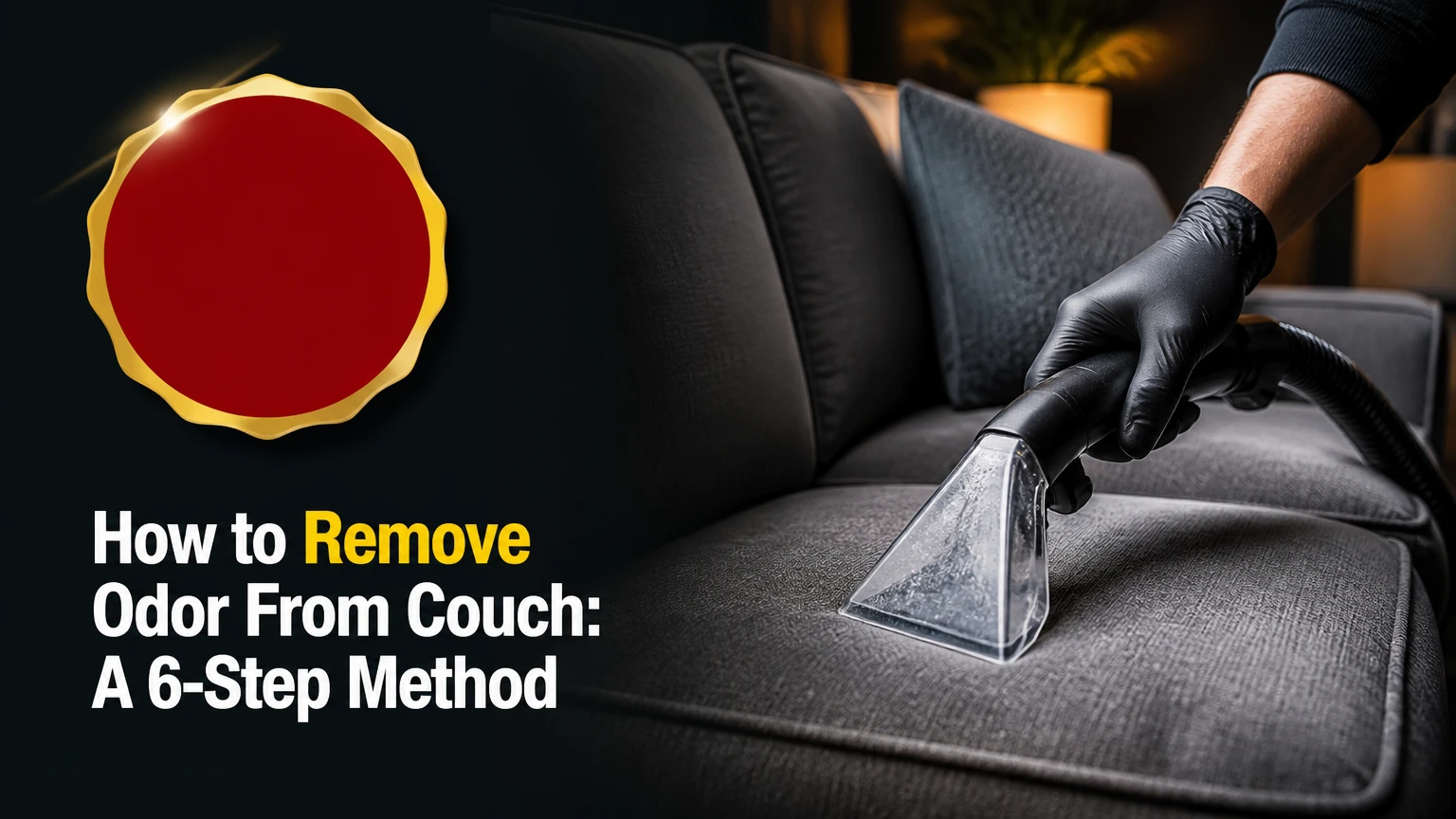
Blot a treated area with clean white towels, pressing vertically rather than rubbing sideways. For a W or S/W couch, use a spot extractor or upholstery machine with controlled suction, making one wet pass followed by two or three dry passes.
Do not saturate the cushion. Liquid that reaches polyurethane foam evaporates slowly and can carry dissolved odor deeper into the filling. A household wet-dry vacuum may remove more moisture than hand towels, but it does not guarantee that the foam interior is dry.
You will know it worked when a dry white towel pressed firmly against the fabric shows little or no transfer and the cushion does not feel cool or heavy.
Common mistake: Using a carpet machine’s full-volume spray setting on a couch. Upholstery generally holds less recoverable moisture than carpet.
Step 5: Dry the Couch Completely
Stand removable cushions on their edges, separate them from the frame, and direct a fan across both sides. Run a dehumidifier in the room, keep interior doors open, and maintain airflow until the fabric and foam feel dry at the center, not only at the surface.
| Drying condition | Typical drying time | Recommended action | Risk level |
|---|---|---|---|
| Thin cushion, 70°F and 40% humidity | 4-6 hours | One fan | Low |
| Thick cushion, 70°F and 60% humidity | 8-12 hours | Fan plus dehumidifier | Moderate |
| Dense foam, 65°F and 70% humidity | 12-24 hours | Professional extraction advised | High |
| Cushion still cool after 12 hours | More than 12 hours | Separate, ventilate, reassess | High |
| Musty odor develops during drying | Immediate | Stop adding liquid and dry aggressively | High |
Avoid a hair dryer’s concentrated high heat, which can damage synthetic fibers, distort foam, or set some stains. Sunlight can help only when the fabric manufacturer permits it; direct ultraviolet exposure can fade upholstery.
You will know it worked when the cushion weighs and feels normal, the seams are dry, and no musty odor appears after 24 hours.
Common mistake: Reassembling cushions while their interiors remain damp. Air cannot circulate through compressed foam.
Step 6: Reassemble and Confirm the Source Is Gone
Replace cushions only after the couch passes a dry-odor test. Close windows and doors for 30-60 minutes, then smell the upholstery, seams, underside, wall behind the couch, and floor beneath it.
If the smell returns immediately when humidity rises or pressure is applied to a cushion, inspect the foam and adjacent materials. Pet urine can reach batting, foam, webbing, and flooring through seams, while smoke residue can remain on walls, rugs, blinds, and wood trim.
You will know it worked when the odor stays absent after the couch is used normally for one day.
Common mistake: Declaring success because perfume masks the smell for an hour. Test the couch without fragrance.
Which Odor Removal Method Works Best?
The best method depends on the contaminant, upholstery code, penetration depth, and available drying capacity. Baking soda is the lowest-cost option for light surface odor, while enzyme treatment is the better choice for urine and other biological residues.
| Method | Typical USA cost | Active time | Best use | Main limitation |
|---|---|---|---|---|
| Baking soda | $3-$8 | 15 minutes | Light stale odor | Does not digest embedded waste |
| Upholstery detergent | $8-$20 | 30-60 minutes | Body oil and food soil | Requires safe water code |
| Enzyme cleaner | $10-$30 | 20-60 minutes | Urine, vomit, milk | Needs label-defined dwell time |
| Portable extractor rental | $30-$60 per day | 1-3 hours | Recoverable liquid contamination | Can over-wet cushions |
| Professional upholstery cleaning | $100-$300 | 2-4 hours | Deep or delicate contamination | Does not repair contaminated foam |
Is Vinegar Safe for Couch Odors?
Vinegar is conditionally safe on some W or S/W upholstery after a hidden spot test, but it is not a dependable treatment for pet urine and can damage dyes, coatings, or natural fibers. Never combine vinegar with bleach, ammonia, hydrogen peroxide, or commercial cleaners.
A diluted vinegar solution may temporarily alter the perception of a stale odor as it evaporates, but urine odor contains multiple compounds and often includes salts that remain after drying. Enzyme treatment and extraction are more appropriate for biological contamination. Use distilled water and a clean spray bottle if the manufacturer permits the solution, and mist rather than saturate.
Can Steam Cleaning Remove Couch Smell?
Steam extraction can remove water-soluble soil when the couch has a W or S/W code, but steam alone does not guarantee deodorization. High heat also fails to remove smoke film from surrounding surfaces and cannot reliably reach contamination sealed inside dense foam.
Use an upholstery tool, low solution volume, and strong recovery suction. Professional cleaners may use low-moisture systems that reduce drying time. Steam cleaning is a poor first choice for pet urine when an enzyme cleaner has not had the required contact time.
Treatments for Specific Couch Odors
How Do You Remove Pet Urine Odor?
Use an upholstery-safe enzyme cleaner that reaches the contaminated layer, allow the labeled dwell time, extract excess liquid, and dry the cushion fully. Surface spraying fails when urine has traveled into foam, so the odor may require cushion-cover removal, professional flushing, or foam replacement.
Do not use bleach or ammonia. Ammonia-like odor can encourage repeat marking in some pets, and bleach can create hazardous vapors when it contacts urine residue. For a removable cover, check whether the manufacturer permits machine washing, and wash the insert only when the care instructions allow it.
How Do You Remove Cigarette Smoke Smell?
Remove cigarette smoke odor by cleaning upholstery, cushions, walls, rugs, curtains, and hard surfaces together. Smoke compounds migrate beyond the couch, so treating only the fabric often produces a temporary improvement.
For W upholstery, use a labeled fabric cleaner and controlled extraction. For S upholstery, use an appropriate solvent-cleaning professional. Activated carbon placed near the couch may reduce airborne odor over several days, but it cannot remove residue bonded to fabric.
Ozone generators are not a routine home solution. The U.S. Environmental Protection Agency warns that ozone can irritate the lungs and does not reliably remove indoor contaminants at concentrations considered safe for occupied spaces.
How Do You Remove Mildew or Musty Odor?
Find the moisture source before deodorizing a musty couch. Check a leaking window, damp wall, basement humidity, wet rug, condensation, or a cushion that never dried internally.
A mild musty smell without visible growth may improve after low-moisture cleaning and rapid dehumidification. Visible mold, extensive water damage, or respiratory sensitivity warrants professional assessment rather than dry brushing, which can spread spores. A couch with mold inside porous foam may be uneconomical to restore.
How Do You Deodorize a Leather Couch?
Vacuum leather seams, wipe the surface with a manufacturer-approved leather cleaner, and condition the leather only after it dries. Baking soda, vinegar, alcohol, and household disinfectants can strip finishes or dry leather.
Odor in leather furniture may originate from unfinished underside fabric, foam, wood, or the floor beneath the couch. Treat those materials separately according to their care instructions. Keep leather away from prolonged direct sun and high heat.
Common Mistakes and How to Fix Them
| Failure mode | Likely cause | Recovery action | Prevention |
|---|---|---|---|
| Odor returns after drying | Foam or batting contamination | Professional extraction or foam inspection | Treat depth, not only surface |
| White powder residue | Baking soda mixed with moisture | Vacuum, then lightly rinse and extract if W-coded | Use a thin powder layer |
| Couch smells worse after cleaning | Damp soil or microbial growth | Stop liquid use, increase airflow | Dry within 12 hours |
| Fabric develops a ring | Uneven wetting or detergent residue | Evenly clean the panel and extract | Feather the damp edge |
| Color fades or transfers | Product incompatibility | Stop treatment and call a cleaner | Hidden spot test first |
| Couch feels stiff | Dried detergent or mineral residue | Controlled rinse extraction | Measure cleaner accurately |
One practitioner rule is especially useful: if a couch still smells after two complete dry cycles, stop adding household remedies. Repeated wetting can turn a solvable odor into a foam and frame problem.
Another counterintuitive point is that “natural” does not mean fabric-safe. Vinegar is acidic, baking soda is alkaline, and essential oils can leave oily residues or irritate pets. Upholstery chemistry matters more than the marketing label.
When Should You Hire a Professional?
Hire a professional when the couch has an X or delicate S code, the odor reaches foam, visible mold exists, smoke contamination is extensive, or a previous cleaning left the interior wet. Ask for an upholstery-specific process, estimated drying time, expected result, and whether odor treatment includes cushion interiors.
| Situation | DIY suitability | Professional option | Typical USA price |
|---|---|---|---|
| One fresh food spill | High | Not usually needed | $0-$20 |
| Light body odor | High | Optional maintenance visit | $100-$180 |
| Pet urine in removable cover | Moderate | Extraction and enzyme service | $120-$250 |
| Pet urine in foam | Low | Deep treatment or insert replacement | $150-$400 |
| Smoke across a furnished room | Low | Upholstery plus surface cleaning | $200-$600 |
| Visible mold in porous cushions | Low | Remediation assessment | $200-$1,000+ |
Prices vary by city, couch size, access, fabric, and contamination severity. A service quote below $100 may exclude travel, enzyme treatment, or cushion-side work, so compare the scope rather than the headline price.
Professional cleaning has limits. Extraction cannot restore fabric damaged by dye loss, remove every odor from degraded foam, or guarantee removal when the source is in the frame or floor. Replacement is sometimes more hygienic and economical than repeated treatment.
Frequently Asked Questions
Does putting a couch outside remove its odor?
Outdoor airflow can reduce volatile odors, but it does not remove embedded urine, grease, smoke residue, or mold. Keep upholstered furniture shaded and dry, because rain, dew, ultraviolet light, and high humidity can create new damage. Outdoor drying works best after an appropriate low-moisture treatment.
How long should baking soda sit on a couch?
Leave baking soda on a compatible dry couch for 6-12 hours, then vacuum it completely. Longer exposure rarely solves deep contamination and increases the chance of powder remaining in seams. Use baking soda for light surface odor, not as the primary treatment for urine, vomit, mildew, or smoke.
Can I use hydrogen peroxide on upholstery?
Hydrogen peroxide can bleach or alter upholstery dyes and should not be used without manufacturer approval and a hidden spot test. It can also react unpredictably with other cleaners. Use a labeled upholstery product matched to the care code instead of improvising a peroxide mixture.
Why does my couch smell only when it rains?
Humidity can increase the volatility of odor compounds and make damp foam, wood, flooring, or microbial residue more noticeable. Inspect beneath the couch, inside cushion seams, and against exterior walls. Dehumidification may reduce the symptom, but source removal is required for a lasting result.
Is activated charcoal better than baking soda for couch odor?
Activated charcoal generally has greater surface area for adsorbing airborne compounds, while baking soda is cheaper and easier to vacuum from dry upholstery. Neither removes biological residue inside foam. Use charcoal as an auxiliary room treatment and use extraction or enzymes for the contamination source.
The Bottom Line
The safest answer to how to remove odor from couch is to check the care code, vacuum first, match the cleaner to the odor source, use minimal moisture, extract thoroughly, and dry every layer within 12 hours whenever possible. Baking soda handles light surface odor; enzyme cleaner handles biological residue; professional treatment is the better choice for delicate fabric, mold, smoke saturation, or odor that returns after drying.