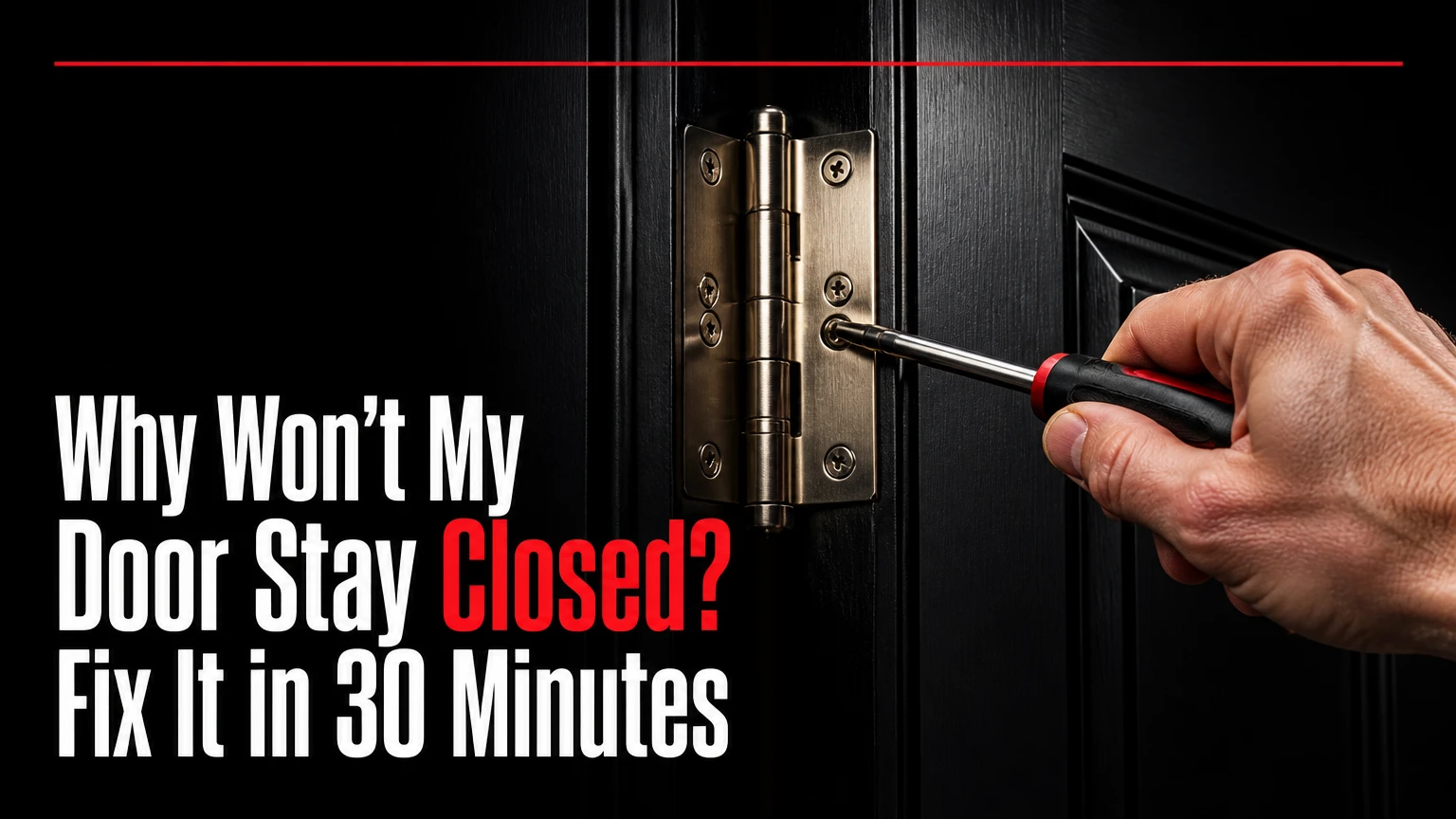
Why Won’t My Door Stay Closed? Fix It in 30 Minutes
A door usually will not stay closed because the latch bolt is not entering the strike plate correctly, the door has sagged on loose hinges, or pressure from hinges and weatherstripping is pushing it back open. A weak or broken latch mechanism is less common, but a door that closes without a firm click should not be treated as secure.
Key Facts
A correctly aligned latch bolt enters the strike box without scraping the strike plate.
A typical interior door has about a 1/8-inch reveal between the slab and jamb.
Loose top-hinge screws are a common cause of a latch missing low or high.
Filing a strike plate is appropriate for small alignment errors, usually under 1/8 inch.
A latch that stays retracted when the knob is released usually needs replacement.
Exterior, fire-rated, and security doors require more care than ordinary interior doors.
How Does a Door Latch Keep the Door Closed?
A door latch keeps a door closed by extending a spring-loaded latch bolt into a recessed strike box in the jamb. The bolt passes through the opening in the metal strike plate, while the beveled face retracts temporarily as the door closes.
The main components are the door slab, hinges, latch body, strike plate, strike box, knob or lever, and, on many locks, a small deadlatch plunger. The deadlatch plunger prevents the main latch from being pushed inward while the door is closed, which helps resist forced entry.
A door can therefore look shut while remaining unlatched. If the latch bolt hits the plate above, below, or beside the opening, the spring pushes it back into the door instead of into the jamb.
What happens when the latch misses?
A latch that misses vertically usually indicates door sag, hinge movement, jamb movement, or a hinge mortise problem. A latch that contacts the plate at the correct height but fails to enter deeply usually indicates a shallow strike box, excessive weatherstrip compression, or a door that is not closing fully.
The latch bolt should project smoothly when the handle is released. A weak spring, sticky latch, or damaged internal mechanism can prevent full extension even when the alignment is correct.
Why Won’t My Door Stay Closed?
The most likely cause is a latch-to-strike misalignment, followed by sagging hinges and excess closing pressure. The correct repair depends on whether the latch misses the opening, reaches the opening but does not extend, or clicks and then releases.
| Symptom | Most likely cause | First test | Typical repair |
|---|---|---|---|
| Latch hits above the opening | Door sag or loose top hinge | Lift door by knob | Tighten hinge or install 3-inch screw |
| Latch hits below the opening | Jamb shift or hinge position | Lipstick mark | Adjust strike plate |
| Latch hits side of opening | Horizontal misalignment | Marker test | File or reposition strike |
| Door pops open immediately | Springing, thick seal, shallow strike | Close slowly by hand | Adjust hinge or weatherstrip |
| Handle works but latch stays inside | Broken latch spring | Release handle | Replace tubular latch |
| Latch clicks but door opens | Deadlatch or strike engagement issue | Push door inward while testing | Repair strike, latch, or lock body |
The distinction matters. Filing metal will not repair a broken latch spring, and replacing a lock will not correct a door that has dropped 1/8 inch below its strike opening.
How Do I Diagnose Latch Alignment?
Use a lipstick or marker transfer test, then check hinge movement and door pressure. The complete diagnosis normally takes 5-10 minutes and requires only a screwdriver, a marker or lipstick, and a flashlight.
Step 1: Mark the latch bolt
Apply a thin layer of lipstick, dry-erase marker, or pencil graphite to the end and sides of the latch bolt. Close the door without forcing the knob, then open it and inspect the transfer mark on the strike plate.
| Mark location | What the mark means | Likely correction |
|---|---|---|
| Upper edge of opening | Latch is too high relative to strike | Raise door or lower strike |
| Lower edge of opening | Latch is too low relative to strike | Correct jamb or raise strike |
| Left or right edge | Horizontal alignment is wrong | Shift or file strike |
| Barely visible mark | Bolt is not entering deeply | Inspect gap, seal, and strike box |
| No mark | Bolt is retracted or misses completely | Inspect knob, latch, and hinges |
A mark on the face of the plate proves contact, not engagement. The latch must enter the recessed hole far enough to resist a light pull.
Step 2: Check hinge play
Open the door about halfway and lift the knob upward with moderate force. Watch the hinge leaves and the top corner of the door.
Any visible movement between the hinge leaf and jamb indicates loose screws, stripped holes, a crushed mortise, or a damaged hinge. The top hinge receives substantial leverage because it is farthest from the lifting force at the knob.
Step 3: Check the door gap
Close the door slowly and inspect the reveal on all four sides. A typical interior-door reveal is approximately 1/8 inch, although manufacturer and installation tolerances vary.
| Door location | Typical interior reveal | Warning sign |
|---|---|---|
| Hinge-side vertical gap | 1/16-1/8 inch | Wood touches jamb |
| Latch-side vertical gap | 1/16-1/8 inch | Gap closes at top or bottom |
| Head gap | 1/8-3/16 inch | Door rubs across head |
| Bottom clearance | 1/2-3/4 inch | Door drags on flooring |
Exterior doors may have tighter perimeter seals, but the slab still needs to close without excessive force. A door that compresses weatherstripping like a spring can defeat a marginal latch.
What Tools and Materials Do You Need?
Most interior-door repairs cost $0-$25 and take 10-45 minutes. Start with a manual screwdriver before using a drill, because power tools can strip soft jamb wood or overtighten hinge screws.
| Item | Typical USA price | Quantity | Use |
|---|---|---|---|
| #2 Phillips screwdriver | $6-$15 | 1 | Existing hinge and strike screws |
| 3-inch structural or wood screws | $2-$8 | 2-4 | Reinforcing hinge attachment |
| Metal hand file | $5-$12 | 1 | Enlarging a strike opening slightly |
| Wood glue and toothpicks | $4-$9 | 1 set | Repairing stripped screw holes |
| 1/8-inch drill bit | $4-$10 | 1 | Pilot holes in jamb or hinge |
| Replacement tubular latch | $10-$25 | 1 | Failed latch spring |
| Thin hinge shim material | $0-$6 | 1 sheet | Correcting hinge depth |
Protect painted surfaces with masking tape when removing a strike plate. Do not use lubricant as a substitute for alignment; lubrication can reduce friction, but it cannot move a latch into the correct hole.
How Do You Fix a Door That Will Not Stay Closed?
Repair the mechanical cause in this order: tighten hinges, confirm the latch mechanism, adjust the strike plate, then address weatherstrip or hinge depth. A minor repair commonly takes 15-30 minutes, while a damaged jamb or warped door can require several hours.
Step 1: Tighten every hinge screw
Close the door and tighten each accessible hinge screw by hand. Begin with the top hinge on the jamb side, because that hinge most often controls a sagging latch edge.
If a screw turns without tightening, remove it and fill the hole with three or four wooden toothpicks coated in wood glue. Break them flush after the glue sets, drill a small pilot hole, and reinstall the screw.
Checkpoint: The hinge leaf should sit flat against the jamb, and lifting the knob should produce no visible hinge movement.
Common mistake: Do not force a long screw through the hinge into plumbing, electrical wiring, or masonry. A 3-inch screw works only where the jamb framing is positioned safely behind the hinge.
Step 2: Test the latch mechanism
Operate the knob or lever while watching the latch edge. Release the handle and confirm that the latch projects fully and springs back sharply.
Compare the extended latch with the door edge. A tubular latch that remains partly retracted, moves unevenly, or has no spring tension is defective. Remove the knob or lever, take out the two latch-body screws, and match the replacement by backset, faceplate shape, and latch length.
Checkpoint: The latch should extend fully without handle pressure and retract completely when the handle turns.
Common mistake: Do not replace only the knob when the latch body is broken. The knob transfers motion, but the latch spring is inside the latch body.
Step 3: Reinforce a sagging top hinge
Replace one jamb-side screw in the top hinge with a 3-inch or 3-1/2-inch screw designed for wood framing. Drive it through the hinge hole into the stud or solid framing, using a pilot hole sized for the screw shaft.
Tighten gradually while checking the door gap. The screw pulls the hinge leaf and nearby jamb toward the framing, which can raise the latch edge enough to restore engagement.
Checkpoint: The latch mark should move toward the center of the strike opening, and the door should close with less lifting or pushing.
Common mistake: Over-tightening can bow the jamb and make the door bind. Stop when the reveal becomes even, not when the screw head disappears into the hinge.
Step 4: Relieve hinge binding
A hinge-bound door presses tightly against the jamb on the hinge side before the latch edge reaches the strike. This commonly occurs when a hinge mortise is too deep, a hinge is bent, or the jamb is twisted.
Loosen the hinge screws slightly and test the door. For a small correction, place a thin shim behind the hinge leaf, then retighten the screws evenly. Cardboard can work temporarily, but plastic laminate or a purpose-made hinge shim resists compression better.
Checkpoint: The door should close without a hard hinge-side push, and the latch should reach the plate without springing backward.
Common mistake: Do not shim the wrong hinge automatically. A shim changes the hinge axis and can worsen the latch position, so retest after each adjustment.
Step 5: Adjust the strike plate
Use a file when the latch misses by no more than about 1/16-1/8 inch and the existing strike position is otherwise sound. Remove the plate, file only the edge contacted by the bolt, clear wood from the strike box if necessary, and reinstall the plate.
For a larger error, relocate the strike plate. Trace the new position, chisel a clean mortise, fill abandoned screw holes with glue and wood slivers, drill pilot holes, and fasten the plate.
Checkpoint: The latch should enter the opening without scraping and should remain extended when the door is pulled lightly.
Common mistake: Filing too much creates a loose latch that rattles during heating or air-conditioning cycles. Preserve enough metal around the opening to support the bolt.
Step 6: Correct spring pressure
If the door aligns but pops open, inspect weatherstripping, hinge depth, latch bevel, and the strike-box depth. Close the door slowly while applying only enough pressure to compress the seal.
A new seal can be too thick for the existing latch. Trim or replace a compressed section rather than forcing the door harder, particularly on exterior doors where excessive pressure can prevent the deadlatch from seating.
Checkpoint: The door remains shut after the knob is released and does not require a shoulder push to latch.
Common mistake: Do not spray oil onto weatherstripping. Petroleum products can degrade some rubber and vinyl seals; use a manufacturer-approved silicone product only when the seal itself is sticking.
Which Repair Method Fits the Symptom?
The best repair is the least invasive correction that restores full latch engagement without creating a new gap or weakening the jamb.
| Repair method | Best mismatch size | Typical time | Typical cost | Permanence |
|---|---|---|---|---|
| Tighten existing screws | 0-1/16 inch | 5-10 minutes | $0 | High if wood holds |
| Install 3-inch hinge screw | 1/16-1/8 inch | 10-20 minutes | $2-$8 | High |
| File strike opening | 1/16-1/8 inch | 15-25 minutes | $5-$12 | High |
| Shim hinge leaf | 1/16 inch | 10-15 minutes | $0-$6 | Moderate |
| Relocate strike plate | 1/8-1/4 inch | 30-60 minutes | $5-$20 | High |
| Replace tubular latch | Mechanism failure | 20-40 minutes | $10-$25 | High |
A strike adjustment is preferable when the door gap is even and the hinges are stable. Hinge correction is preferable when the latch position changes as the knob is lifted or when the door rubs near the top corner.
What Measurements Matter Before You Modify the Door?
Measure the latch offset, door reveal, strike opening, and backset before cutting wood or buying replacement hardware. These values prevent a common failure: correcting the visible symptom while leaving the latch centerline wrong.
| Measurement | Typical value | How to measure | Why it matters |
|---|---|---|---|
| Interior door reveal | 1/16-1/8 inch | Use a feeler or ruler | Shows binding or uneven hanging |
| Strike mismatch | 1/16-1/8 inch | Compare latch center to opening | Determines filing versus relocation |
| Common backset | 2-3/8 or 2-3/4 inches | Door edge to knob center | Selects replacement latch |
| Strike-box depth | About 5/8-1 inch | Measure recessed hole | Allows full latch extension |
| Hinge screw length | 2-3 inches | Compare framing depth | Controls structural grip |
| Latch projection | Often 1/2 inch | Measure bolt from faceplate | Indicates full engagement |
Interior doors do not require a universal 1/8-inch gap in every location. Door construction, climate, flooring, and manufacturer instructions change acceptable clearances, so use the existing even reveal as a baseline rather than cutting to one number blindly.
Why Does Humidity or Season Change Affect Closing?
Wood doors and jambs change dimensionally with moisture, so a door that worked in dry winter air may bind or miss the strike during humid summer weather. The effect is strongest on solid-wood slabs, unfinished edges, poorly sealed exterior doors, and jambs exposed to water.
Seasonal movement often creates a gradual problem rather than a sudden hardware failure. A door may rub at the top latch corner, require a push to close, or miss the strike by a few millimeters.
| Situation | Typical symptom | Safe first response |
|---|---|---|
| Humid summer | Door swells and rubs | Inspect edges and seal, avoid aggressive filing |
| Dry winter | Gaps widen, latch may rattle | Adjust strike only if engagement is shallow |
| Recent repainting | Door sticks at jamb | Check paint buildup and cure time |
| New carpet or flooring | Door drags at bottom | Check clearance before hinge work |
| Foundation movement | Several doors shift | Inspect frame and structure professionally |
Do not plane a swollen door immediately if the condition may reverse. Confirm that the door is sealed and determine whether multiple openings in the home have moved.
How Do Exterior, French, and Fire Doors Differ?
Exterior, French, and fire-rated doors require more than a cosmetic strike adjustment because sealing, security, and life-safety hardware affect the repair. A residential interior-door fix is not automatically appropriate for these assemblies.
French doors can have passive and active leaves, flush bolts, astragals, or multipoint locks. One leaf may appear closed while the top or bottom bolt is not engaged.
Fire-rated doors must self-close and latch under their listing requirements. Removing a closer, disabling a latch, or adding an unapproved shim can compromise the assembly. The National Fire Protection Association, through NFPA 80 requirements, treats fire-door inspections and hardware condition as life-safety matters.
For an exterior door, check the deadbolt separately. A latch may engage while the deadbolt binds against its strike, or a thick seal may keep both from reaching full depth.
What Should Renters Do Without Drilling?
Renters should begin with reversible actions: tighten existing screws, clean debris from the strike box, test the latch, and report structural movement to the landlord. Cardboard or plastic hinge shims may help temporarily, but they can alter door alignment and should not be used on fire or security doors without permission.
| Renter-safe action | Tool or material | Reversible | Appropriate situation |
|---|---|---|---|
| Tighten existing screws | Manual screwdriver | Yes | Loose hinge or strike |
| Clean strike box | Vacuum and brush | Yes | Wood chips or paint buildup |
| Apply dry PTFE or graphite | Lock lubricant | Yes | Sticky latch movement |
| Add thin hinge shim | Cardboard or plastic | Mostly | Minor hinge-bound door |
| File or relocate strike | Chisel and file | No | Ask landlord first |
| Replace lock hardware | Matching latch | Not always | Obtain owner approval |
A renter should document a door that will not latch, especially when it is an entry door, bathroom door, or shared apartment door. A landlord or maintenance provider should handle a warped jamb, loose frame, failed fire door, or security lock.
When Should You Replace the Latch or Call a Professional?
Replace the latch when the bolt lacks spring tension, stays inside the door, or retracts when the knob is released. Call a professional when the jamb is moving, the door is an entry or fire-rated assembly, several doors changed at once, or the repair would require structural cutting.
| Condition | DIY suitability | Reason for escalation |
|---|---|---|
| One interior door misses by 1/16 inch | High | Simple strike adjustment |
| Stripped hinge holes | Moderate | Requires careful wood repair |
| Door frame visibly separates from wall | Low | Possible structural movement |
| Exterior multipoint lock failure | Low | Security hardware needs exact adjustment |
| Fire door will not latch | Low | Life-safety compliance |
| Multiple doors suddenly misalign | Low | Foundation, settlement, or framing issue |
An aligned door that still opens under light pulling may present a security problem. Do not rely on a loose latch to protect an entryway, childproof room, medication cabinet, or privacy-sensitive area.
Common Mistakes That Make the Problem Worse
Filing before checking the hinges
A sagging door often causes the strike mismatch. Filing the plate first may make the opening excessively large after the hinge is later repaired.
Reusing stripped hinge holes
A screw cannot regain holding power in crushed wood by being tightened harder. Fill the hole with glued wood material or install an appropriate repair plug before fastening again.
Using short screws for a heavy door
Many factory hinge screws are about 3/4 inch long and grip only the jamb or casing. A longer screw can reach framing, but only after confirming that the stud location and utility clearance are safe.
Lubricating a misaligned latch
Lubricant reduces friction inside the latch. It does not correct a strike plate that sits 1/8 inch too high, and it can hide a mechanical fault temporarily.
Removing too much weatherstrip
A missing seal can allow drafts, water, insects, and rattling. Adjust the strike or replace an incorrectly sized seal instead of creating a permanent gap around an exterior door.
Forcing the door with a hammer
Hammering the jamb can split trim, damage paint, and conceal movement in the frame. Controlled hinge and strike adjustments are more predictable.
How Much Does Door-Latch Repair Cost?
A simple DIY adjustment typically costs $0-$25 and takes 5-45 minutes. A handyman commonly charges about $75-$200 for a basic door adjustment in the United States, while exterior lock, frame, or structural work can cost $150-$500 or more depending on access and hardware.
| Repair type | DIY material cost | Typical DIY time | Typical professional range |
|---|---|---|---|
| Tighten hinges | $0 | 5-10 minutes | $75-$125 |
| Reinforce top hinge | $2-$8 | 10-20 minutes | $100-$175 |
| File or adjust strike | $5-$12 | 15-30 minutes | $100-$200 |
| Replace tubular latch | $10-$25 | 20-40 minutes | $125-$250 |
| Repair damaged jamb | $15-$60 | 1-3 hours | $200-$500 |
| Exterior lock adjustment | $10-$50 | 30-90 minutes | $150-$400 |
These are typical USA ranges, not guaranteed quotes. Urban labor rates, emergency service, concealed hardware, and replacement finish matching can raise the total.
FAQ
Can a door latch without a strike plate?
A door cannot latch securely without a correctly positioned strike plate and strike box. The metal plate guides and supports the latch, while the recessed box provides the depth needed for engagement. A temporary improvised catch may hold a lightweight interior door, but it is unsuitable for an entry, bathroom, fire, or security door.
Why does my door close but not click?
A door that closes without clicking usually has a retracted, obstructed, or misaligned latch. Inspect whether the bolt extends when the handle is released, then perform a marker test on the strike plate. Paint buildup, debris, thick weatherstripping, or a broken latch spring can all prevent the bolt from seating.
Why does lifting the doorknob help the door close?
Lifting the doorknob temporarily raises the latch edge of a sagging door. The movement indicates hinge play, stripped screws, a worn hinge, or a compressed top hinge mortise. Repair the hinge attachment rather than lifting the knob every time, because repeated force can enlarge the damaged holes.
Is graphite or WD-40 safe for a door latch?
Graphite or a manufacturer-approved dry PTFE lubricant is generally suitable for a sticky latch, but WD-40 is not a complete repair for alignment or spring failure. Use a small amount, operate the latch several times, and wipe away excess. Avoid contaminating weatherstripping or painted surfaces.
Can a warped door be repaired?
A mildly warped door may work after hinge, strike, or weatherstrip adjustment, but a severely twisted or moisture-damaged slab often needs replacement. Measure the gaps with the door closed and inspect the top and bottom edges. Persistent movement after drying and sealing indicates a larger repair than simple latch alignment.
How long should a door repair last?
A properly tightened hinge, correctly located strike, or sound replacement latch can last many years under normal interior use. A cardboard shim or oversized filed opening is less durable because cardboard compresses and excess clearance permits rattling. Seasonal movement may require a minor strike adjustment once per year.
The Bottom Line
Why won’t my door stay closed? In most cases, the latch bolt is missing the strike opening because the door has sagged, the hinges are loose, or the frame has shifted. Mark the latch, lift the door to check hinge play, verify the gap, and only then file or relocate the strike plate. Replace the latch when its spring no longer projects the bolt, and escalate exterior, fire-rated, structural, or security-door problems to a qualified professional.