Why Does Carpet Feel Sticky? Causes and Fixes
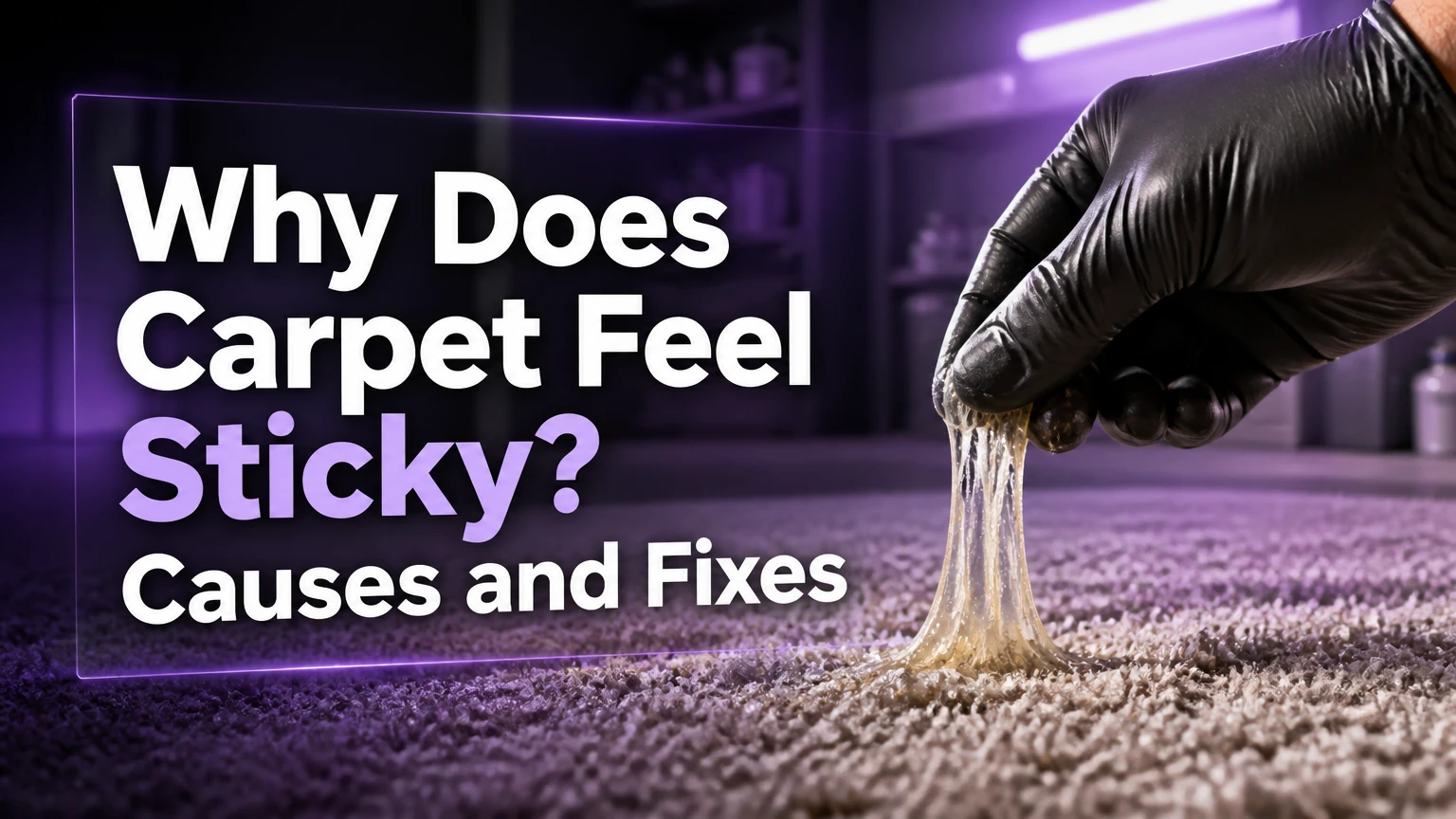
A carpet feels sticky when a tacky substance remains on or below the carpet fibers. The most common cause is dried cleaning-product residue, especially concentrated detergent that was not fully extracted. Localized sugar, grease, pet urine, adhesive transfer, or persistent moisture can create the same sensation, but the location, odor, timing, and texture usually identify the cause.
Key Facts at a Glance
Cleaning residue is the most common reason carpet feels sticky after shampooing or extraction.
A broad sticky area usually indicates detergent residue, while a sharply defined patch usually indicates a spill or pet accident.
Carpet cleaning should remove soil and detergent with controlled water and strong extraction, not add repeated layers of shampoo.
Vinegar is not universally safe for carpet because wool, jute, backing adhesives, and cleaning machines can react poorly to acidic solutions.
Sticky carpet often becomes visibly dirty faster because residue captures dust, skin oils, and soil from footwear.
Professional correction commonly costs about $40-$90 per room in the United States, with larger rooms and severe buildup costing more.
What Makes Carpet Feel Sticky?
Detergent residue makes carpet sticky by leaving surfactants and dissolved soil on the fiber surface after the water dries. Surfactants lower water’s surface tension and help detach oily soil, but excess surfactant becomes a film when extraction removes too little of the cleaning mixture.
Most carpet detergents also contain builders, alkaline ingredients, fragrances, solvents, and polymers. The exact formula varies by manufacturer. The residue may feel tacky, waxy, stiff, or crunchy rather than uniformly wet.
The mechanism is straightforward:
- A cleaner is applied at excessive concentration or excessive volume.
- The solution loosens soil inside the pile and backing.
- Insufficient suction leaves detergent, water, and dissolved soil behind.
- Evaporation removes water faster than the heavier ingredients.
- The remaining film attracts new dust and oily soil.
The Institute of Inspection Cleaning and Restoration Certification, or IICRC, treats cleaning chemistry, fiber type, backing construction, agitation, and extraction as connected parts of carpet cleaning. A detergent cannot be judged separately from how thoroughly the machine removes it.
Why does carpet feel sticky after cleaning?
Carpet feels sticky after cleaning when detergent concentration, water volume, or extraction performance leaves a residue in the pile. A second cleaning with more shampoo usually worsens the problem because it adds more surfactant to the same incompletely rinsed fibers.
A professional cleaner normally controls the problem through correct chemical dilution, sufficient dwell time, agitation suited to the carpet, an appropriate rinse, and multiple extraction passes. Dry vacuum-only passes remove water without adding more solution.
| Observation after cleaning | Likely mechanism | Typical timing | Best first check |
|---|---|---|---|
| Entire room feels stiff | Detergent residue across the pile | 6-24 hours | Review product dilution and rinse steps |
| Traffic lanes become tacky first | Residue capturing body oils and soil | 1-7 days | Compare low-traffic and high-traffic areas |
| Sticky spots reappear overnight | Wicking from backing or pad | 12-48 hours | Inspect moisture at the carpet base |
| Carpet feels wet and tacky | Slow drying or excess water | 24-72 hours | Use fans and measure moisture |
| One small patch feels gummy | Food, drink, grease, or adhesive | Immediate to 2 days | Blot-test the exact spot |
How Does Residue Create Rapid Re-Soiling?
Sticky carpet becomes dirty quickly because the remaining cleaning film captures particles and oils that would normally pass through vacuuming or remain loose. The effect is called rapid re-soiling, and it is especially visible in hallways, around couches, and near exterior doors.
A residue-coated fiber has a different surface than a clean, dry fiber. Dust adheres instead of lifting cleanly. Body oils from bare feet, skin, socks, and pet paws add a second layer of contamination.
The result can look like a cleaning failure even when the original soil was removed successfully. A carpet may appear clean on the first day, then develop dark traffic lanes after several days of use.
Does alkaline detergent cause the stickiness?
Highly alkaline or concentrated detergent can contribute to sticky carpet, but alkalinity alone is not proof of residue. A high pH indicates an alkaline condition, while the tacky feeling usually results from remaining detergent, polymer, dissolved soil, or an organic spill.
Carpet fibers tolerate different chemical conditions. Nylon generally tolerates a broader cleaning range than wool, while wool and natural-fiber rugs require controlled chemistry. A consumer pH strip can provide a rough indication, but it cannot identify every ingredient or prove that the carpet is safe.
Do not neutralize an unknown carpet with a strong acid. Mixing chemical products can create heat, fumes, discoloration, or fiber damage.
Which Causes Make Carpet Sticky?
Cleaning residue, sugary liquids, greasy food, pet contamination, adhesive transfer, and excessive moisture are the main causes of sticky carpet. The fastest diagnosis comes from matching the affected area, odor, timing, and texture to the likely source.
| Cause | Area pattern | Texture or odor | Confirmation clue |
|---|---|---|---|
| Detergent residue | Broad or room-wide | Waxy, stiff, mildly tacky | Began after cleaning |
| Soda or juice | Circular or sharply localized | Intensely tacky, sweet odor | Clear or colored spill history |
| Grease or cooking oil | Path near kitchen or dining area | Oily film, weak odor | White cloth picks up yellow-gray soil |
| Pet urine | Irregular patch or repeated spot | Ammonia or sour odor | Moisture or odor stronger near pad |
| Carpet adhesive | Installation seam or broad new-carpet area | Gummy, solvent-like odor | Appeared after installation |
| Humidity or trapped water | Low spots, edges, or full room | Damp tackiness, musty odor | Moisture remains after 24-48 hours |
| Encapsulation polymer | Commercial low-pile lanes | Soft or gummy film | Polymer fails to dry and vacuum away |
Can humidity make carpet sticky?
High humidity can make carpet feel tacky by slowing evaporation and preventing encapsulation polymers from hardening. Humidity is more likely to cause a damp, soft, or musty feel than the dry waxy texture associated with leftover detergent.
The U.S. Environmental Protection Agency recommends keeping indoor relative humidity below 60%, ideally between 30% and 50%, to limit moisture-related problems. A hygrometer costing about $10-$25 can test room conditions.
Carpet that remains damp for more than 24-48 hours needs attention. Persistent moisture can affect the pad, tack strips, subfloor, and indoor air quality, especially after flooding or a large pet accident.
How Can You Tell Which Substance Is Making Carpet Sticky?
Testing the pattern and transfer is more reliable than guessing from touch alone. Use a clean white cotton cloth, a flashlight, a hygrometer, and, when available, a moisture meter.
Follow this diagnostic sequence:
- Map the area. Mark whether the tackiness affects one spot, traffic lanes, or the whole room.
- Check the timing. Note whether the problem started after cleaning, installation, a spill, or humid weather.
- Perform a dry transfer test. Press a white cloth firmly onto the carpet for 10 seconds. Gray, yellow, or brown transfer suggests soil or residue.
- Check moisture. Compare the sticky section with a dry section using a carpet moisture meter.
- Check odor safely. Do not put your face close to the carpet. Ventilate the room and note whether the odor is sweet, sour, ammonia-like, solvent-like, or musty.
- Inspect the backing if accessible. A carpet professional can test the lower pile and pad without damaging the installation.
| Test result | Strongest indication | Immediate action | Avoid |
|---|---|---|---|
| Dry cloth picks up gray film | Detergent and soil residue | Stop adding shampoo | Repeated wet cleaning |
| Moisture reading remains elevated | Trapped water or urine | Increase airflow and investigate pad | Covering with furniture |
| Sweet odor and one defined patch | Sugar-based drink or food | Blot and rinse with measured water | Scrubbing outward |
| Ammonia odor near a pet area | Urine contamination | Use a carpet-safe enzymatic product | Bleach or ammonia cleaner |
| Solvent odor near seams | Adhesive or protective-film transfer | Contact installer | Heating the carpet |
| No transfer and no moisture | Surface texture or fiber issue | Inspect fiber and backing | Aggressive brushing |
How Do You Fix Sticky Carpet After Cleaning?
The safest general fix is controlled rinsing with clean water and strong extraction, followed by rapid drying. The procedure works best for synthetic carpet with detergent residue, but wool, viscose, jute, glued carpet, and unknown fibers should be assessed before wet treatment.
What to prepare before rinsing
| Item | Typical quantity or setting | Purpose | Typical U.S. cost |
|---|---|---|---|
| Carpet extractor | 1 machine, clean-water tank | Rinse and recover residue | $35-$60 per day rental |
| Clean water | 1-3 gallons per room | Controlled rinse | $1-$5 |
| White cotton towels | 4-8 towels | Transfer and blot checks | $8-$20 |
| Floor fans | 2-3 fans | Increase evaporation | $0 if owned |
| Dehumidifier | 1 unit, 40-50 pint class | Reduce indoor moisture | $25-$50 per day rental |
| Carpet-safe rinse agent | Label dose only | Lower residue after cleaning | $10-$25 |
Step 1: Identify the carpet fiber
Check the installation paperwork, carpet label, or manufacturer website before applying an acid rinse or solvent. Nylon and polyester broadloom are often more forgiving, while wool, viscose, sisal, jute, silk, and unknown natural-fiber rugs can suffer color loss, shrinkage, browning, or texture change.
Test any product in an inconspicuous area. Wait until the test area dries before judging color or stiffness.
Step 2: Remove loose soil
Vacuum slowly in two directions before adding water. One slow pass can remove dry particles that would otherwise become muddy and harder to extract.
Do not use a stiff brush on looped carpet. Aggressive brushing can fuzz cut pile and snag loops.
Step 3: Rinse with measured clean water
Use a carpet extractor with plain warm water or a manufacturer-approved rinse product at its label dilution. Apply enough moisture to flush the affected fibers, but do not flood the carpet or saturate the pad.
A 1:4 vinegar-to-water mixture is not a universal carpet treatment. Vinegar can alter dyes, affect wool scales, damage some backing adhesives, and void equipment guidance. Never put vinegar into a machine unless the machine and carpet manufacturer permit it.
Step 4: Make multiple extraction passes
Release the spray trigger and make three to five slow vacuum-only passes over each wet section. Empty the recovery tank when needed, and watch for cloudy or foamy recovered water.
You will know the rinse is helping when the carpet feels less tacky after drying and the recovered water becomes clearer. The common mistake is judging success while the fibers are still wet, because damp carpet often feels temporarily softer.
Step 5: Dry the carpet completely
Place fans so air moves across the carpet surface, run the dehumidifier with doors and windows managed for the local climate, and keep furniture off the damp area when possible. Aim for complete drying within 12-24 hours for a normal rinse.
Do not walk on the carpet during drying unless necessary. If walking is unavoidable, use clean white socks or protective shoe covers.
Which Cleaning Method Is Best for Sticky Carpet?
Clean-water extraction is the best first-line correction for widespread detergent residue on synthetic carpet. Absorbent treatment suits a small dry spill, while professional hot water extraction is safer for severe buildup, repeated wicking, large wet areas, or uncertain carpet construction.
| Method | Best area size | Typical cost | Drying time | Main limitation |
|---|---|---|---|---|
| Clean-water rental extraction | 1-2 rooms | $35-$90 total | 12-24 hours | Lower suction than truck-mounted equipment |
| Professional hot water extraction | 1-5 rooms | $40-$90 per room | 6-24 hours | Requires appointment and fiber assessment |
| Dry absorbent compound | 1-2 square feet | $10-$30 | 1-4 hours | Poor for residue deep in pad |
| Enzyme spot treatment | 1-10 square feet | $8-$20 | 12-24 hours | Designed for organic contamination |
| Carpet replacement or repair | Damaged sections | $150-$600 per section | 1-4 hours installation | Needed when adhesive or backing is damaged |
Is baking soda safe for sticky carpet?
Dry baking soda can absorb some surface odor and oil, but a wet baking-soda paste is not a reliable treatment for deep sugar, urine, or detergent residue. Powder can lodge in the pile, overload a vacuum, leave alkaline dust, and fail to reach the backing.
For a small, dry, greasy spot, sprinkle a light layer, leave it dry for several hours, and vacuum thoroughly. Do not add enough water to create a paste unless the carpet manufacturer specifically allows that method.
When should you hire a professional?
Hire a professional when sticky carpet covers an entire room, remains wet beyond 24-48 hours, smells like urine or mildew, wicks back after two rinses, or involves wool, viscose, jute, glued carpet, flooding, or unknown chemicals.
Ask the cleaner four specific questions:
- What fiber and backing chemistry will you test?
- What detergent dilution and rinse method will you use?
- How will you prevent overwetting the pad?
- What drying target and post-cleaning inspection are included?
Truck-mounted extraction usually provides stronger water lift than a small rental machine, but equipment strength does not compensate for excessive solution or poor technique.
Why Does Sticky Carpet Return After You Clean It?
Sticky carpet returns when residue remains below the visible pile and migrates upward during drying. The process, called wicking, carries dissolved soil and cleaning chemicals from the backing or pad toward the fiber tips.
Wicking is common after spills, pet accidents, and over-wetting. A carpet can feel clean immediately after extraction, then develop a tacky ring or dark patch 12-48 hours later.
Blotting helps prevent wicking before treatment. For an existing recurring patch, a professional may need to flush the backing, treat the pad, lift a carpet edge, or replace contaminated underlay.
How do pet accidents differ from soap residue?
Pet accidents usually produce a localized irregular area with an ammonia, sour, or musty odor, while soap residue commonly affects broad regions and has little odor. Urine can penetrate the pile, backing, pad, and subfloor, so surface cleaning may leave the source intact.
Use a carpet-safe enzymatic product only as directed by its label. Avoid bleach, ammonia, and mixtures of cleaning chemicals. If the odor persists after drying, ultraviolet inspection and subfloor testing may be appropriate.
What Causes Sticky New Carpet?
New carpet can feel sticky because of adhesive transfer, protective-film residue, manufacturing finishes, or an improperly cured carpet installation. The problem usually affects seams, edges, installation paths, or a broad area soon after fitting.
Protective plastic film is intended to shield some surfaces during installation, but adhesive or plasticizer transfer can remain if the film was exposed to heat, sunlight, or prolonged pressure. Standard carpet shampoo may spread the material rather than remove it.
Document the condition with photographs, installation dates, product information, and room temperature. Contact the installer before applying vinegar, solvent, heat, or abrasive powder because those actions may complicate a warranty claim.
How Should Commercial Carpet Be Treated?
Commercial glue-down carpet requires low-moisture methods, correct encapsulation chemistry, and high-quality vacuuming. Sticky commercial carpet often results when polymer crystallization fails because of excessive product, high humidity, poor dilution, insufficient agitation, or delayed vacuuming.
Encapsulation products are designed to surround soil in a polymer that dries into removable crystals. If the polymer remains soft, the carpet can feel tacky and collect soil in traffic lanes.
| Commercial condition | Typical specification | Risk | Corrective response |
|---|---|---|---|
| Relative humidity | Above 60% | Slow polymer drying | Increase ventilation and dehumidification |
| Product dilution | Below label water ratio | Soft residue film | Stop use and follow manufacturer ratio |
| Vacuuming frequency | Less than 2 times weekly in traffic lanes | Crystals remain in pile | Increase HEPA vacuuming |
| Cleaning interval | More than 6 months in heavy traffic | Soil binds to fibers | Schedule interim low-moisture service |
| Glue-down backing | Direct adhesive installation | Overwetting and adhesive damage | Use controlled moisture only |
A commercial facility should record product batch, dilution, humidity, carpet type, square footage, drying time, and vacuuming schedule. Those records identify process failure faster than tactile complaints alone.
What Mistakes Make Carpet Sticky?
The most damaging mistake is adding more detergent to a carpet that already contains residue. Cleaning chemistry must be removed, not repeatedly layered.
Common failure modes include:
- Using concentrated shampoo. Correct the problem with a clean-water rinse and label-based extraction.
- Skipping vacuum-only passes. Repeat slow extraction without spraying.
- Overwetting the pad. Stop wet cleaning, increase airflow, and call a professional if drying exceeds 24-48 hours.
- Scrubbing sugar deeper. Blot from the outside inward and rinse in controlled sections.
- Using vinegar on wool or viscose. Stop immediately, blot with clean water, and consult a fiber specialist.
- Applying bleach or ammonia. Do not combine chemicals; ventilate and seek professional advice.
- Replacing a spot cleaner with a whole-room machine. Use equipment matched to the area and backing construction.
A useful practitioner rule is one wet extraction pass followed by several dry passes. The exact number varies with machine design and carpet density, but the principle consistently reduces retained moisture.
How Can You Prevent Sticky Carpet?
Prevent sticky carpet by using the lowest effective detergent concentration, removing dissolved soil thoroughly, and drying the carpet quickly. Prevention depends more on extraction discipline and product measurement than on buying a stronger fragrance or applying more shampoo.
| Prevention practice | Recommended frequency or quantity | Benefit | Failure sign |
|---|---|---|---|
| Vacuum entry areas | 2-4 times weekly | Removes dry soil before wet cleaning | Dark doorway lanes |
| Measure detergent | Every tank fill | Prevents surfactant overload | Foamy recovery water |
| Pre-vacuum before extraction | Every wet-cleaning session | Reduces muddy soil | Gray rinse water |
| Use dry passes | 3-5 passes per wet section | Lowers retained moisture | Carpet remains cool and wet |
| Dry with airflow | 2-3 fans for 6-12 hours | Limits wicking and odor | Damp feel next morning |
| Professional cleaning | Every 6-18 months | Controls embedded soil | Persistent traffic lanes |
For homes with children or pets, keep treated carpet inaccessible until completely dry and chemically neutral according to the product label. For renters, photograph the condition before treatment and notify the landlord when stickiness predates occupancy or follows an installation.
How Much Does Sticky Carpet Repair Cost?
Typical U.S. correction costs range from $10-$30 for a small spot treatment, $35-$90 for a rental-machine rinse, and $40-$90 per room for professional extraction. Replacement, pad treatment, or subfloor remediation can raise the total to $150-$600 or more.
Prices vary by region, room size, furniture movement, fiber type, contamination level, and whether the pad or subfloor requires treatment. A low advertised room price may exclude stairs, heavy soil, deodorizer, furniture, or minimum service charges.
Get an itemized estimate that identifies square footage, cleaning chemistry, rinse method, drying expectations, and any separate odor or pad treatment.
FAQ
Can I vacuum sticky carpet?
Vacuuming removes loose dust but does not remove detergent film, sugar, urine, or adhesive. Vacuum slowly before rinsing, then vacuum again after dry absorbent treatment or encapsulation crystals have fully dried.
Will carpet become less sticky on its own?
Light tackiness may decline as residual moisture evaporates, but dry detergent and sugar residue usually remain until removed. If carpet is still damp after 24-48 hours, investigate trapped moisture rather than waiting longer.
Is sticky carpet dangerous for babies or pets?
Sticky carpet is not automatically toxic, but residue can transfer to hands, knees, paws, and toys. Keep children and pets away during treatment and drying, use label-approved products, and obtain professional advice for unknown chemicals or strong odors.
Can I use dish soap to clean carpet?
Dish soap is usually a poor carpet cleaner because it is formulated for manual rinsing rather than fiber extraction. Its high foaming potential and surfactant load can leave a persistent film, especially in rental machines with limited water recovery.
Why does carpet feel sticky only in one area?
A single sticky area usually indicates a localized spill, pet accident, grease deposit, adhesive, or wicking from a contaminated backing. Compare the patch with nearby carpet using a white-cloth transfer test and a moisture reading.
Should I replace carpet that feels sticky?
Replace carpet only when cleaning cannot remove the contaminant, the backing adhesive has failed, urine has damaged the pad or subfloor, or the fiber has permanent chemical or heat damage. Residue on otherwise sound synthetic carpet is usually recoverable.
The Bottom Line
Why does carpet feel sticky? Most often, detergent residue remains after cleaning because the product was overused, the carpet was overwet, or extraction was incomplete. A localized sticky patch points more strongly to sugar, grease, pet contamination, or adhesive. Identify the pattern first, avoid adding more soap, rinse synthetic carpet with controlled clean water, dry it within 12-24 hours, and call a professional for persistent moisture, natural fibers, severe buildup, or recurring wicking.