What Causes Musty Smell in House? Find the Source
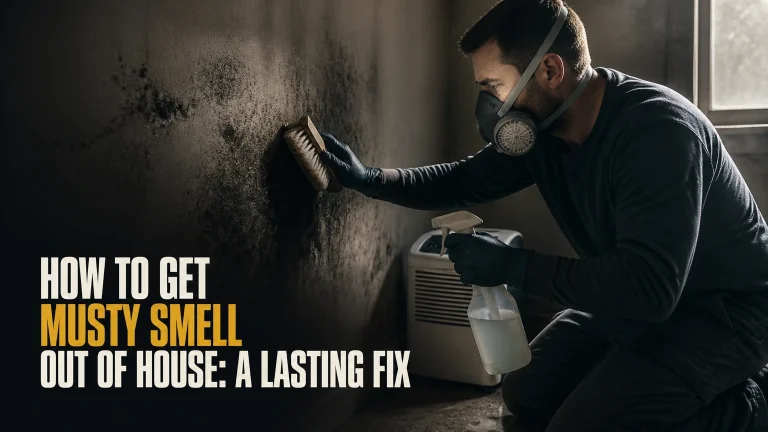
A musty smell in a house is usually caused by moisture allowing mold, mildew, fungi, or odor-producing bacteria to grow on porous materials. Microbial volatile organic compounds, or mVOCs, create the earthy odor, but a musty smell alone cannot prove that mold is present. Hidden leaks, condensation, damp carpets, crawlspaces, and contaminated HVAC components are common sources.
Key Facts at a Glance
- Indoor relative humidity above 60% increases the likelihood of condensation and microbial growth; EPA generally recommends keeping indoor humidity below 60%, ideally between 30% and 50%.
- Musty odor often indicates a moisture problem, even when no mold is visible.
- Mold can grow behind drywall, beneath flooring, inside insulation, under carpet padding, and within HVAC insulation.
- A dehumidifier reduces moisture but does not remove mold colonies, wet building materials, or the original leak.
- Bleach does not reliably remove mold from porous drywall, wood, carpet padding, or insulation.
- Persistent odor after cleaning usually means a hidden reservoir, an unresolved moisture source, or odor absorbed into porous contents.
What Causes Musty Smell in House?
Mold and other microorganisms release mVOCs while growing on damp organic materials. Drywall paper, wood, cardboard, carpet backing, dust, leather, upholstery, and stored clothing can provide food when moisture remains available.
The odor is a warning signal, not a diagnosis. A 2021 review in International Journal of Environmental Research and Public Health describes microbial VOCs as compounds associated with microbial metabolism and notes that odor perception varies widely by compound and person. Geosmin, sulfur compounds, alcohols, aldehydes, and ketones can contribute to earthy, damp, or stale odors.
Moisture usually enters through four routes: liquid water, humid air, vapor migration, and condensation. A basement may have no visible leak but still develop odor because warm humid air reaches a cool concrete wall, window, duct, or floor and deposits water.
The odor can also come from non-microbial sources. Wet insulation, decomposing rodents, sewage gases, stagnant plumbing traps, old smoke, and badly ventilated cooking areas can smell stale or earthy. A qualified inspection should distinguish those sources before anyone removes walls or purchases expensive treatment.
How Does a Musty Odor Develop?
A musty odor develops when moisture persists long enough for microorganisms to metabolize nearby organic matter and release airborne compounds. The sequence is moisture accumulation, microbial growth, VOC release, absorption into contents, and odor circulation through air movement.
The Growth and Odor Sequence
- Moisture reaches a surface. A leak, flood, vapor drive, or condensation raises the moisture content of drywall, wood, flooring, fabric, or dust.
- Microorganisms find suitable conditions. Temperature, food, and time determine whether mold, mildew, or bacteria multiply.
- Growth produces odor compounds. Microbial metabolism releases mVOCs into room air.
- Porous materials absorb the odor. Carpet padding, upholstered furniture, books, and clothing can retain compounds after the original wetting event.
- HVAC airflow distributes the smell. Return-air pressure can pull odor from a basement, crawlspace, wall cavity, or mechanical room into occupied rooms.
- The odor becomes stronger during humid periods. Moist air increases microbial activity and can help release compounds stored in fabrics and wood.
The frequently repeated claim that mold spores activate above a universal “15-20% moisture level” is too broad. Moisture-meter readings depend on the material and instrument, and mold growth cannot be predicted from one universal percentage. Relative humidity, surface temperature, water activity, material type, and duration all matter.
Which Moisture Sources Create Musty Odors?
The main sources are plumbing leaks, rain intrusion, groundwater, high indoor humidity, HVAC condensation, and wet contents. The strongest clue is often the odor’s location and timing rather than visible discoloration.
| Moisture source | Typical locations | Common clue | First inspection |
|---|---|---|---|
| Plumbing leak | Under sinks, behind cabinets, supply lines, appliance hoses | Odor persists regardless of weather | Shutoff valves, fittings, adjacent drywall |
| Roof or window intrusion | Attic, ceiling corners, exterior walls | Odor worsens after rain | Flashing, roof penetrations, window joints |
| Groundwater or seepage | Basement walls, slab edges, crawlspaces | Stronger during wet seasons | Grading, gutters, sump system, foundation |
| High indoor humidity | Closets, bathrooms, bedrooms, basements | Odor increases in summer | Hygrometer readings and ventilation |
| HVAC condensation | Air handler, drain pan, ducts, registers | Smell appears when cooling starts | Coil, pan, condensate line, filters |
| Wet contents | Carpet, furniture, boxes, stored clothing | Localized odor follows an object | Padding, underside, seams, cardboard |
| Sewer or drain issue | Bathrooms, laundry rooms, utility areas | Sulfuric or sewage-like odor | Trap water, drain seals, venting |
Why Can a House Smell Musty Without a Visible Leak?
A house can smell musty without a visible leak because moisture may exist behind finishes, under flooring, inside insulation, or as condensation on cold surfaces. Humid air alone can maintain damp conditions in crawlspaces, closets, and exterior wall cavities without producing a water stain.
Cold surfaces are frequent hidden sources. In summer, a poorly insulated supply duct may sweat inside a ceiling cavity. In winter, warm indoor air can reach a cold exterior wall and condense behind furniture. A slab-on-grade house may also draw water vapor through flooring or porous masonry.
Past water damage creates another common scenario. A repaired pipe may have stopped leaking, while wet drywall paper, carpet padding, or subfloor remains. Odor can continue until those materials dry or are removed.
Where Is the Smell Strongest?
The strongest location narrows the investigation, but odor can travel through air pressure and framing cavities. Check the source room, the room above or below it, and the nearest HVAC return before assuming the strongest-smelling room is the origin.
| Strongest odor location | Likely source | Seasonal or operating pattern | High-value check |
|---|---|---|---|
| Basement | Masonry moisture, sump area, carpet, stored cardboard | Worse after rain or humid weather | RH, wall edges, floor coverings |
| Crawlspace | Standing water, soil vapor, wet insulation, organic debris | Worse in summer | Ground cover, drainage, insulation |
| Bathroom | Fan failure, shower condensation, caulk or wall cavity | Worse after showers | Fan airflow, ceiling, vanity plumbing |
| Attic | Roof leak, inadequate ventilation, wet insulation | Worse after storms | Sheathing, flashing, bathroom exhaust termination |
| Bedroom closet | Damp clothing, exterior wall condensation, carpet | Worse when doors stay closed | Wall corners, clothing, baseboard |
| HVAC register | Wet coil, drain pan, duct liner, nearby cavity | Appears when cooling or heating starts | Filter, pan, coil, supply boot |
| Laundry room | Washer hose, drain standpipe, trapped lint, flooring | Worse after laundry cycles | Hose connections, drain, washer underside |
How Do You Find the Hidden Moisture Source?
Find hidden moisture by measuring indoor humidity, mapping odor intensity, inspecting likely pathways, and confirming suspicious materials with moisture testing. Do not rely on smell, a single meter reading, or a home mold test alone.
Step 1: Measure Relative Humidity
Place a digital hygrometer in the affected room for at least 24 hours. Take readings at morning, afternoon, and evening because cooking, bathing, weather, and air-conditioning cycles change indoor humidity.
| Reading or observation | Interpretation | Recommended response |
|---|---|---|
| 30-50% RH | Generally suitable indoor target | Maintain ventilation and drainage |
| 51-59% RH | Elevated but not conclusive | Monitor cold surfaces and wet rooms |
| 60-69% RH | Moisture control problem likely | Dehumidify and investigate source |
| 70% or higher | High growth and condensation risk | Act promptly and inspect concealed areas |
| RH below 50% with odor | Existing reservoir or non-humidity source possible | Inspect contents, cavities, and HVAC |
EPA guidance recommends indoor humidity below 60%, ideally 30-50%. Very low winter humidity can damage wood and irritate airways, so continuous dehumidification is not appropriate in every season.
Step 2: Isolate the Odor Zone
Close interior doors for several hours, then compare rooms. Run the HVAC normally during one observation and leave it off during another, unless turning it off creates a safety or temperature risk.
A stronger smell only when the system runs points toward the air handler, drain pan, ductwork, filter, or return-air pathway. A smell that increases after rain points toward roof, window, foundation, or grading problems.
Step 3: Inspect Moisture Pathways
Use a flashlight to inspect baseboards, cabinet backs, pipe penetrations, window corners, ceiling joints, attic sheathing, and crawlspace insulation. Look for swollen trim, peeling paint, rusty fasteners, staining, efflorescence, buckled flooring, and compressed or discolored insulation.
Step 4: Use a Moisture Meter Carefully
A pinless meter can compare areas and identify patterns, but it does not prove mold and can give false readings near metal, wiring, salts, or dense materials. A pin meter provides a more localized reading but leaves small holes and still requires material-specific interpretation.
| Tool | Typical USA price | Useful for | Main limitation |
|---|---|---|---|
| Digital hygrometer | $10-$30 | Room RH and temperature | Does not locate a leak |
| Pinless moisture meter | $35-$150 | Comparing wall or floor areas | False positives near metal |
| Pin moisture meter | $40-$200 | Localized wood or drywall testing | Small punctures and calibration needs |
| Infrared camera | $200-$600 rental or purchase | Thermal patterns from wet areas | Temperature pattern is not moisture proof |
| Borescope | $40-$150 | Viewing small cavities | Limited field of view |
| Professional inspection | $300-$800 typical | Integrated moisture and building assessment | Scope varies by provider |
What Should You Do About a Musty Smell?
Stop the moisture source first, dry affected materials, remove unsalvageable porous contents, and clean remaining surfaces using methods appropriate to the material. Odor treatment without moisture correction has a high failure rate because microbial growth or absorbed compounds remain in place.
A Practical Correction Sequence
- Stop active water. Repair plumbing, roof flashing, window drainage, foundation seepage, or HVAC condensate problems.
- Remove standing water and wet contents. Begin extraction quickly after a clean-water event; wet porous materials can deteriorate rapidly.
- Dry the structure. Use air movement and dehumidification while monitoring humidity and material conditions.
- Discard contaminated porous items when necessary. Carpet padding, saturated ceiling tile, heavily affected drywall, and wet insulation often cannot be reliably cleaned.
- Clean hard, salvageable surfaces. Follow product labels and use gloves, eye protection, and ventilation.
- Replace damaged finishes only after drying. Painting over staining before moisture correction hides evidence and traps the problem.
- Verify the source is controlled. Recheck RH and odor over several days, including humid weather or normal HVAC operation.
The EPA states, “The key to mold control is moisture control.” That rule is more useful than a product recommendation because antimicrobial spray, ozone, and fragrance do not correct water entry.
Is a Dehumidifier Better Than an Air Purifier?
A dehumidifier is the better first device when indoor RH exceeds 60%, while a HEPA air purifier is useful for airborne particles but cannot dry walls or remove a hidden colony. Neither device repairs a leak or replaces removal of damaged materials.
| Approach | Typical cost | Best use | What it cannot do |
|---|---|---|---|
| Portable dehumidifier | $150-$400 | Room or basement RH control | Remove wet drywall or fix leaks |
| Whole-home dehumidifier | $1,500-$3,500 installed | Central humidity management | Correct exterior water entry |
| HEPA air purifier | $100-$600 | Reduce airborne particles | Remove source growth or absorbed odor |
| Activated-carbon filter | $150-$700 | Reduce some odor compounds | Provide reliable structural drying |
| Ozone generator | $50-$300 | Not recommended in occupied homes | Safely solve mold or moisture |
| Exhaust ventilation | $150-$1,000 installed | Bathroom and laundry moisture | Work effectively without outdoor air design |
Activated carbon can reduce some VOCs, but filter capacity and airflow determine performance. Ozone can irritate lungs and react with indoor chemicals; EPA and other public-health authorities do not recommend ozone generators as a substitute for mold remediation.
How Much Does Musty-Odor Remediation Cost?
Typical USA costs range from $150-$400 for basic humidity control to $5,000-$15,000 or more for crawlspace encapsulation, drainage work, or extensive structural repair. The cost depends more on the moisture source and damaged materials than on odor intensity.
| Project scope | Typical USA cost | Typical active timeframe | Appropriate scope |
|---|---|---|---|
| Hygrometer and portable dehumidifier | $160-$430 | 1-3 days to stabilize | Elevated RH without visible damage |
| Plumbing or condensate repair | $150-$1,500 | Same day to 3 days | Localized active water source |
| Small professional mold cleanup | $500-$2,000 | 1-3 days | Limited, accessible affected area |
| Larger remediation project | $1,500-$4,000 | 2-5 days | Containment, removal, drying |
| Crawlspace drainage or encapsulation | $5,000-$15,000+ | 1-2 weeks | Ground moisture, standing water, vapor control |
| Major reconstruction | $5,000-$25,000+ | 1-4 weeks | Damaged walls, floors, insulation, framing |
These are typical planning ranges, not national price guarantees. Regional labor rates, containment requirements, demolition, laboratory testing, disposal, and reconstruction can change the final invoice substantially.
Homeowners insurance commonly covers sudden water damage, such as a burst supply line, but often excludes gradual seepage, deferred maintenance, and long-term humidity. Policy language controls. Photograph damage, preserve invoices, and notify the insurer before large-scale demolition when a covered event may be involved.
When Is Professional Remediation Necessary?
Professional help is appropriate when affected material exceeds roughly 10 square feet, sewage or floodwater is involved, HVAC contamination is suspected, hidden cavities are wet, or occupants have significant respiratory vulnerability. The 10-square-foot figure comes from common EPA remediation guidance, but the actual decision also depends on material type and building complexity.
Call a qualified water-damage or mold-remediation professional when:
- Water has remained for more than 24-48 hours.
- The odor returns after source repair and cleaning.
- Visible growth exists in multiple rooms.
- The affected area includes insulation, duct liner, drywall cavities, or structural wood.
- A household member has asthma, severe allergies, immune suppression, or persistent symptoms.
- Sewage, floodwater, or contaminated groundwater entered the building.
- You cannot identify the moisture source.
Mold testing is not always the first step. The CDC and EPA generally emphasize fixing moisture and removing contamination rather than relying on a comparison of indoor and outdoor spore counts, because no universal indoor “safe” mold-count threshold determines whether a building is healthy.
Why Does the Smell Return After Cleaning?
Musty odor returns when the moisture source remains, contaminated porous material was left behind, HVAC pathways redistribute odor, or cleaning removed surface residue without reaching the reservoir. Fragrance, ozone, and a single air scrubber can reduce perception temporarily while the underlying problem continues.
| Failure mode | Why it fails | Corrective action |
|---|---|---|
| Painting stained drywall | Conceals damage without drying paper core | Find moisture, remove damaged board |
| Spraying bleach on drywall | Surface treatment does not penetrate reliably | Remove porous contamination when needed |
| Cleaning carpet but not pad | Pad retains moisture and odor | Lift carpet and inspect pad and subfloor |
| Running purifier alone | Filters air, not wet building materials | Pair filtration with source control |
| Sealing a crawlspace prematurely | Traps or redirects existing water | Correct drainage and dry first |
| Replacing an HVAC filter only | Filter is upstream of contaminated components | Inspect coil, pan, cabinet, and ducts |
| Using a home mold test kit | Results rarely identify the source or remedy | Use visual and moisture investigation |
Bleach is particularly unsuitable for many porous materials. The issue is not simply that bleach contains water; chlorine may fail to reach embedded growth, while wetting can spread contamination or damage the material. Never mix bleach with ammonia, acids, or other cleaners.
How Can You Prevent Musty Odors?
Prevent musty odors by controlling humidity, moving water away from the foundation, exhausting moisture at its source, and responding quickly to leaks. Prevention works when the building remains dry, not when rooms are repeatedly deodorized.
Homeowners should maintain gutters, extend downspouts several feet from the foundation, keep soil sloping away from exterior walls, test sump pumps, and inspect roof penetrations annually. Bathroom exhaust fans should vent outdoors, not into attics or wall cavities.
Basements and crawlspaces need special attention. Store cardboard and textiles above concrete floors, avoid sealing cold masonry with impermeable coatings before diagnosis, and use a dehumidifier with a continuous drain when seasonal RH remains high.
Renters should photograph stains, record hygrometer readings, report leaks in writing, and avoid cutting drywall or using ozone. Property managers should document move-in conditions, inspect HVAC condensate systems, and verify drying after every water event.
The Bottom Line
The answer to what causes musty smell in house is usually persistent moisture supporting microbial growth on porous building materials. Measure humidity, isolate the strongest zone, inspect plumbing, exterior drainage, HVAC components, carpet, insulation, and concealed cavities, then correct the water source before deodorizing. A dehumidifier can control air moisture, but permanent odor removal requires drying, cleaning, or removing the affected reservoir.
Frequently Asked Questions
Does a musty smell mean the house is unsafe?
A musty smell does not by itself establish that a house is unsafe, but it warrants investigation because it often indicates damp materials or hidden microbial growth. People with asthma, allergies, or immune suppression may be more sensitive to damp environments. Find and correct moisture rather than relying on odor intensity to judge risk.
How long does a musty smell take to disappear?
A localized odor may improve within 24-72 hours after a leak is repaired and materials are fully dried. Odor can persist for weeks when carpet padding, insulation, drywall paper, furniture, or duct components absorbed contamination. If smell returns after humidity falls below 50%, inspect hidden materials and HVAC pathways.
Can old houses smell musty even without mold?
Old houses can smell musty without active mold because aged wood, dust, coal soot, damp masonry, crawlspace soil vapor, and stored textiles retain odor compounds. Older construction also has more air leakage and less vapor control. Moisture mapping and inspection distinguish age-related odor from an active water problem.
Should I sleep in a room with a musty smell?
Avoid sleeping in a strongly musty room until the source is evaluated, especially if the room has visible growth, damp carpet, water damage, or poor ventilation. Move vulnerable occupants elsewhere, keep doors closed if practical, and do not use ozone. A HEPA purifier may reduce airborne particles while investigation proceeds, but it is not a cure.
Can baking soda permanently remove a musty odor?
Baking soda can absorb or neutralize limited surface odors in dry, washable contents, but it cannot permanently remove odor from wet drywall, carpet padding, insulation, or a wall cavity. Use it only after drying and cleaning. Persistent odor requires source correction and, when necessary, removal of contaminated porous materials.