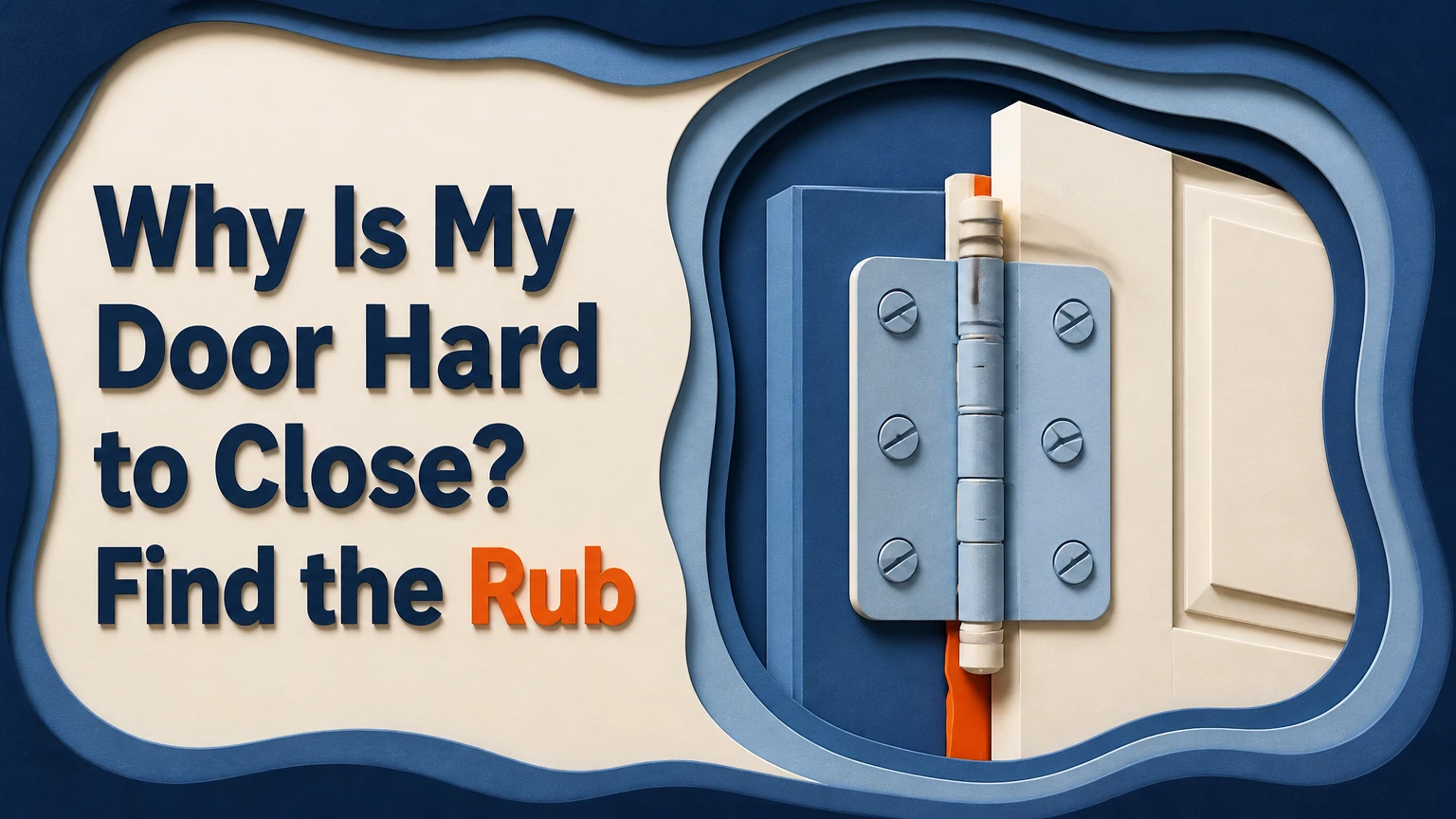
Why Is My Door Hard to Close? Find the Rub
A door is hard to close when the door slab, frame, hinges, latch, lock, or weather seal no longer align with one another. The most common causes are a sagging hinge, a swollen wood edge, a shifted strike plate, compressed weatherstripping, or a frame that has moved out of square. Finding the contact point before adjusting anything prevents unnecessary sanding.
Key Facts at a Glance
- A door that rubs at the latch-side top corner usually has sagging hinges or a shifted frame.
- A wood door that sticks during humid weather often has moisture-related expansion at one edge.
- A latch that strikes metal while the door fits the opening usually needs strike-plate alignment, not door planing.
- A typical interior-door reveal is about 1/16-1/8 inch, or approximately 2-3 mm, but older openings may require a different clearance.
- Tightening hinge screws should happen before removing wood because hinge alignment can change the rubbing point.
- A deadbolt that will not turn with the door closed often indicates frame or strike misalignment rather than a defective cylinder.
Why Is My Door Hard to Close?
A hard-closing door usually has a mechanical alignment problem, not a mysterious failure. The door leaf must remain nearly plumb while the jamb stays square enough for the latch, strike opening, hinges, and weather seal to meet at the same time. A shift of only 1-2 mm can create noticeable friction across a wide door slab.
The hinge jamb carries the door’s weight. The door leaf acts as a lever, so a small movement at the hinges becomes a larger movement at the latch side. This explains why a loose top hinge can make the upper latch-side corner scrape even when the frame looks almost straight.
Use the rubbing location as the first diagnostic clue. A top-corner rub points toward sagging or swelling, while bottom-edge contact suggests settling, carpet interference, or a low threshold. If the slab clears the frame but the latch does not enter the strike, the problem is hardware alignment.
What does a normal door reveal look like?
A normal reveal is a small, reasonably consistent gap between the slab and jamb. Interior doors commonly operate with approximately 1/16-1/8 inch of clearance, although manufacturer specifications, paint thickness, carpet, climate, and historic construction can change the workable gap.
Uniformity matters more than a perfect number. A 3/32-inch gap around a straight modern opening can work well, while a newly planed door with a 1/4-inch gap at one corner may still indicate a structural problem.
Where Is the Door Rubbing?
The contact location narrows the repair more reliably than the amount of force required. Close the door slowly, watch the perimeter, and mark the first point of contact with painter’s tape.
| Contact location | Likely cause | Confirmation test | First repair |
|---|---|---|---|
| Top latch-side corner | Loose top hinge or swollen edge | Lift test plus card test | Tighten hinge screws |
| Bottom hinge-side corner | Sagging slab or shifted jamb | Inspect hinge-side reveal | Correct hinge alignment |
| Entire latch-side edge | Swollen slab or frame movement | Seasonal comparison | Check moisture and frame |
| Bottom edge near threshold | Carpet, threshold, or settling | Slide paper under edge | Adjust threshold or hinges |
| Hinge-side vertical edge | Deep hinge mortise or loose hinge | Open halfway and inspect gap | Shim or reset hinge |
| Latch and deadbolt only | Strike misalignment | Test with door open | Adjust strike plate |
How do you perform the three-minute door tests?
Perform three simple tests before removing screws or wood. The light test reveals an uneven opening, the card test identifies friction, and the lift test detects hinge play.
- Close the door until it first touches the frame.
- Shine a flashlight from the darker side, or inspect daylight around the perimeter.
- Slide a business card through the gap at six positions: both top corners, both side centers, and both bottom corners.
- Open the door halfway and lift gently from the handle side.
- Watch for vertical movement, hinge separation, or a clicking sound.
- Apply lipstick or washable marker to the latch, close the door, and inspect the transfer mark on the strike plate.
A card that sticks at one point identifies the binding zone. A door that lifts noticeably at the latch side has hinge or jamb movement. A latch mark near the strike opening proves that the latch is arriving at the wrong location.
How Do Loose Hinges Make a Door Hard to Close?
Loose hinges let the door sag toward the latch side, reducing clearance at the upper latch-side corner and sometimes increasing contact near the lower hinge side. The top hinge usually deserves attention first because it resists much of the door’s pulling force.
Open the door and tighten every hinge screw by hand. If a screw spins without tightening, the wood fibers may be stripped. Replace one failed screw at a time with a compatible longer screw, commonly a 2-1/2 or 3-inch screw for a wood jamb, provided the screw can reach solid framing without damaging wiring or plumbing.
| Hinge repair | Typical material | DIY time | Main risk |
|---|---|---|---|
| Tighten existing screws | Existing steel screws | 5-10 minutes | Stripping the head |
| Replace one top-hinge screw | 2-1/2 or 3-inch wood screw | 10-15 minutes | Bowing the jamb |
| Fill a stripped hole | Wood glue and toothpicks | 20-30 minutes | Weak repair in soft wood |
| Install a hinge shim | 1/32-1/16-inch shim | 15-25 minutes | Changing alignment too far |
| Replace a damaged hinge | Matching 3-1/2-inch hinge | 30-60 minutes | Different leaf geometry |
Do not drive all long screws into a jamb at once. Over-tightening can pull the hinge side inward and make the door bind along the opposite edge. Tighten, close, and retest after each adjustment.
Can Humidity Make a Wood Door Stick?
Humidity can make a wood door stick because wood absorbs moisture and expands across its grain. Seasonal swelling is likely when the door works normally during dry months, becomes tight during wet weather, and shows rubbing concentrated along one painted edge.
The correct repair depends on whether the door is swollen or the frame has shifted. A moisture meter can help, but the seasonal pattern and a fresh rub mark often provide enough evidence for an initial diagnosis. The U.S. Forest Products Laboratory explains that wood movement is strongly related to moisture content and grain direction, which is why edge swelling is more noticeable than lengthwise growth.
Remove the door only after confirming that hinge adjustment will not solve the problem. Mark the exact rub area, remove the minimum material with a hand plane or fine abrasive, and reseal the exposed edge with primer and paint or varnish. Planing a full inch along an edge can create a visible taper, so work in short passes and test repeatedly.
How much clearance should a swollen wood door have?
A practical target is approximately 1/16-1/8 inch along a modern interior-door edge, with extra allowance where seasonal movement is severe. The correct amount depends on door width, finish thickness, indoor humidity, and whether the opening is conditioned.
Do not remove wood while the door is unusually dry if the sticking occurs every summer. The door may later shrink and leave a large permanent gap. A better long-term approach is to adjust the door during the season when swelling is most severe, then seal the repaired surface.
What If the Latch Hits the Strike Plate?
A latch that hits the strike plate means the latch and frame opening are misaligned, even if the door slab clears the jamb. The fix is usually to move or enlarge the strike opening, not to sand the door edge.
Apply a small amount of lipstick, chalk, or washable marker to the latch bolt. Close the door gently, open it, and inspect the mark on the strike plate. The mark shows whether the strike needs to move upward, downward, toward the room, or toward the stop.
| Strike symptom | Typical movement | Repair method | Security check |
|---|---|---|---|
| Latch mark above opening | 1/16-1/8 inch downward | Loosen and reposition plate | Confirm full latch entry |
| Latch mark below opening | 1/16-1/8 inch upward | Reposition plate | Test handle release |
| Mark on plate edge | 1/16-1/8 inch sideways | File opening carefully | Keep plate screws tight |
| Latch reaches but will not seat | 1/8-1/4 inch depth issue | Adjust stop or plate | Test with deadbolt |
| Deadbolt misses entirely | 1/8-1/4 inch misalignment | Reposition deadbolt strike | Confirm bolt extends fully |
File only the metal area needed for a minor correction. If the plate must move more than about 1/8 inch, repositioning it with filled screw holes is usually cleaner and stronger than creating an oversized opening.
Why Does the Deadbolt Bind?
A deadbolt binds when the bolt is forced sideways or vertically against the strike opening. Test the lock with the door open first. If the deadbolt turns smoothly open but becomes difficult only after the door closes, the frame alignment is the leading suspect.
Do not force a key or thumb turn. Excessive force can damage the cylinder, bend a latch component, or leave the door unsecured. Inspect the bolt mark on the strike, check whether the door is pressing tightly against weatherstripping, and verify that the strike box is deep enough for the full bolt throw.
Graphite or a manufacturer-approved dry lock lubricant may help a dry cylinder, but lubricant cannot correct a shifted frame. The American National Standards Institute and Builders Hardware Manufacturers Association publish hardware standards, but residential installations still require correct physical alignment at the opening.
What Causes Bottom-Edge Rubbing?
Bottom rubbing commonly comes from a sagging door, a shifted frame, thick flooring, carpet, or a threshold that has moved upward. A bottom rub that appeared immediately after new flooring points toward floor clearance rather than foundation settlement.
Check the hinge-side and latch-side reveals before cutting the door. If both side gaps remain even but the bottom edge contacts the floor, adjust the threshold if possible, trim the door only after confirming the finished-floor height, and reseal any exposed wood.
A door that rubs at the bottom latch side and the top latch side may have a frame that has rotated. A door that rubs at the bottom hinge side and top latch side often has a sagging slab. These patterns are more useful than simply measuring how hard the door feels to close.
Can Weatherstripping Make a Door Hard to Close?
Weatherstripping can make a door hard to close when its compression force exceeds the latch or closer’s ability to pull the slab against the stop. New seals are especially likely to cause resistance during the first weeks after installation.
Inspect the seal for crushed sections, folds, paint buildup, and an incorrect profile. Compression bulb seals generally require less closing force than oversized foam products, but the correct replacement depends on the manufacturer’s channel and the existing gap.
| Seal condition | Typical symptom | Correct response | Expected time |
|---|---|---|---|
| New oversized foam | Door springs open | Install thinner compatible seal | 20-40 minutes |
| Crushed bulb seal | Drafts and uneven pressure | Replace damaged section | 20-45 minutes |
| Paint-covered seal | Sticky closing action | Remove paint carefully | 15-30 minutes |
| Loose adhesive seal | Seal pulls away | Clean and replace adhesive | 20-35 minutes |
| Intact seal with latch issue | Hard final inch only | Adjust strike plate | 15-30 minutes |
Do not move the strike plate merely to compensate for a seal that is too thick. The door should close against the stop with moderate, consistent pressure before the latch engages.
Which Repair Should Come First?
Hinge adjustment should come before wood removal, strike filing, or lock replacement because hinge position determines the door’s relationship to every other component. This sequence avoids repairing the wrong symptom and creating a permanent gap.
Use the following order:
- Remove objects, rugs, and temporary obstructions.
- Check the floor, threshold, weatherstrip, latch, and deadbolt.
- Perform the card, lift, and lipstick tests.
- Tighten or replace loose hinge screws.
- Close the door and repeat the tests.
- Adjust the strike plate if the slab now fits but the latch misses.
- Shim or reset a hinge if the hinge-side reveal remains uneven.
- Plane or sand a wood edge only when swelling is confirmed.
- Reseal every exposed wood surface.
- Recheck the latch and deadbolt with the door closed.
You will know the sequence worked when the door closes without force, the latch enters the strike cleanly, and the deadbolt turns without pushing or pulling the slab.
What Can Renters Do Safely?
Renters can usually tighten accessible hinge screws, remove debris, lubricate approved hinge pins, and document seasonal changes without altering the property. Filing a strike plate, chiseling a mortise, planing a door, or replacing hardware should normally receive landlord approval.
A temporary cardboard shim behind a hinge leaf can alter alignment, but it should be thin, fully seated, and reversible. Use one shim at a time and avoid shimming a fire-rated door, exterior security door, or door with a self-closing requirement without professional guidance.
Take dated photographs of the gap and rubbing mark. A record helps distinguish normal seasonal movement from a worsening frame problem that the property owner needs to address.
How Much Does Door Repair Cost in the USA?
Typical USA DIY costs range from $0 to $40 for screws, shims, files, lubricant, and touch-up materials. Professional service commonly ranges from about $75 to $250 for a straightforward adjustment, while frame repair, exterior-door replacement, or foundation-related work can cost substantially more.
| Repair type | Typical DIY cost | DIY time | Typical professional range |
|---|---|---|---|
| Tighten hinge screws | $0-$10 | 5-15 minutes | $75-$150 |
| Replace stripped screws | $5-$20 | 15-30 minutes | $100-$175 |
| Adjust strike plate | $0-$25 | 15-30 minutes | $100-$175 |
| Plane and reseal wood | $10-$40 | 45-90 minutes | $150-$300 |
| Reset hinge mortise | $5-$30 | 30-60 minutes | $150-$350 |
| Correct shifted jamb | $20-$100 | 2-6 hours | $300-$1,000 or more |
Prices vary by region, access, door type, and whether painting is included. Angi and HomeAdvisor cost guides commonly separate basic handyman labor from larger jamb, trim, and frame reconstruction, which is why a simple latch adjustment should not be priced like a structural repair.
When Is Replacement Better Than Repair?
Replacement makes more sense when the slab is severely warped, the core is water-damaged, the frame has rot, the hinge screw holes cannot hold a proper repair, or repeated seasonal adjustments have failed. A sound wood, fiberglass, steel, or composite door usually deserves alignment work before replacement.
| Door condition | Repair outlook | Replacement trigger | Typical decision |
|---|---|---|---|
| Loose screws, intact slab | Excellent | None | Repair first |
| Seasonal edge swelling | Good | Persistent rot or splitting | Plane and seal |
| Warped hollow-core slab | Limited | Twist exceeds usable clearance | Replace slab |
| Rotten exterior jamb | Poor | Soft wood around hinges | Replace jamb |
| Shifted foundation opening | Variable | Active movement or cracks | Structural evaluation |
| Damaged lock hardware | Good | Security rating or parts unavailable | Replace hardware |
A new door installed in a distorted opening can develop the same problem. Correct the frame or confirm that the replacement will be shimmed and fastened to a stable structure.
Common Mistakes That Make the Problem Worse
- Sanding before checking hinges: A sagging door may need alignment, and removing wood first leaves an unnecessary gap after the hinge repair.
- Driving screws too tightly: A jamb can bow inward, creating new rubbing along the latch edge.
- Filing a large strike opening: An oversized opening can reduce latch engagement and weaken security.
- Leaving planed wood unsealed: Exposed end grain and edge fibers absorb moisture faster than finished surfaces.
- Forcing a deadbolt: Side pressure can damage the cylinder and conceal a frame problem.
- Using petroleum lubricant in a lock cylinder: Residue can collect dust and make the mechanism gummy; use the lock manufacturer’s recommended product.
- Ignoring fire and egress doors: A fire-rated or required exit door may need inspection, self-closing force, and latch engagement that ordinary interior-door advice does not address.
One practitioner rule is to adjust the component that moved, not the component that merely reveals the movement. A strike plate often displays the error, but loose hinges may have caused it.
When Should You Call a Professional?
Call a professional when the opening has diagonal drywall cracks, visible foundation movement, rotten jamb material, a fire-rated door problem, a security-door alignment issue, or a deadbolt that remains unreliable after strike adjustment. A professional is also appropriate when the door is heavy, glazed, commercial, or connected to an automatic closer.
Stop DIY work if a screw encounters unexpected resistance, electrical wiring may be behind the jamb, or the frame begins cracking. Exterior doors affect weather resistance and security, so a small alignment error can become water intrusion or an insecure latch.
A locksmith is appropriate for lock-cylinder, latch, and deadbolt faults. A carpenter or door installer is better suited to warped slabs, hinge mortises, jamb reconstruction, and door replacement. Foundation cracks require a qualified building or structural professional rather than repeated hinge adjustments.
FAQ
Why is my door hard to close only at night?
Temperature and humidity changes can alter wood dimensions, weatherseal compression, and metal alignment during the day. Interior heating or cooling may also change pressure around an exterior door. Compare the rubbing mark at different times, then inspect hinges and weatherstripping before sanding the slab.
Why does my door close but not latch?
A door that closes without latching usually has a strike plate positioned too high, low, deep, or sideways relative to the latch. Mark the latch with lipstick or chalk, close the door gently, and adjust the strike only enough to center the opening around the transfer mark.
Can I fix a hard-closing door with WD-40?
WD-40 may temporarily reduce noise on exposed hinge parts, but it does not correct sagging, swelling, or misalignment. Avoid using it as the primary treatment inside a lock cylinder because residue can attract debris. Diagnose the contact point first and use a manufacturer-approved dry lubricant when the cylinder itself is dry.
Why is my new door suddenly hard to close?
A new door can bind because the hinges settled, the fasteners were not anchored firmly, the weatherstrip is over-compressed, or the frame was installed slightly out of square. Check the installation screws and seal before trimming the slab, especially during the installer’s warranty period.
How do I know whether the frame or door is warped?
Close the door slowly and compare the reveals at the top, sides, and bottom. A consistently curved slab with a straight jamb indicates door warping, while diagonal gaps, uneven jamb faces, and nearby drywall cracks indicate frame or building movement. A straightedge can confirm localized slab distortion.
Why is my exterior door harder to close than an interior door?
Exterior doors typically have thicker weatherstripping, a threshold, a deadbolt, and greater exposure to temperature and moisture. Moderate compression is normal, but the latch and deadbolt should engage without force. Check seal pressure, threshold height, hinge screws, and strike alignment in that order.
The Bottom Line
The fastest answer to “why is my door hard to close” is found at the first contact point, not by immediately sanding the door. Test the reveal, card clearance, hinge movement, latch mark, and deadbolt; tighten hinges first, adjust hardware second, and remove wood only after confirming seasonal swelling or a permanent edge obstruction.
A door that remains difficult after these checks may have a shifted jamb, rot, severe warping, or structural movement. Repairing the underlying alignment preserves clearance, security, and weather resistance better than forcing the latch or repeatedly filing hardware.