How to Stop Furniture from Sliding on Hardwood Floors: 5 Fixes
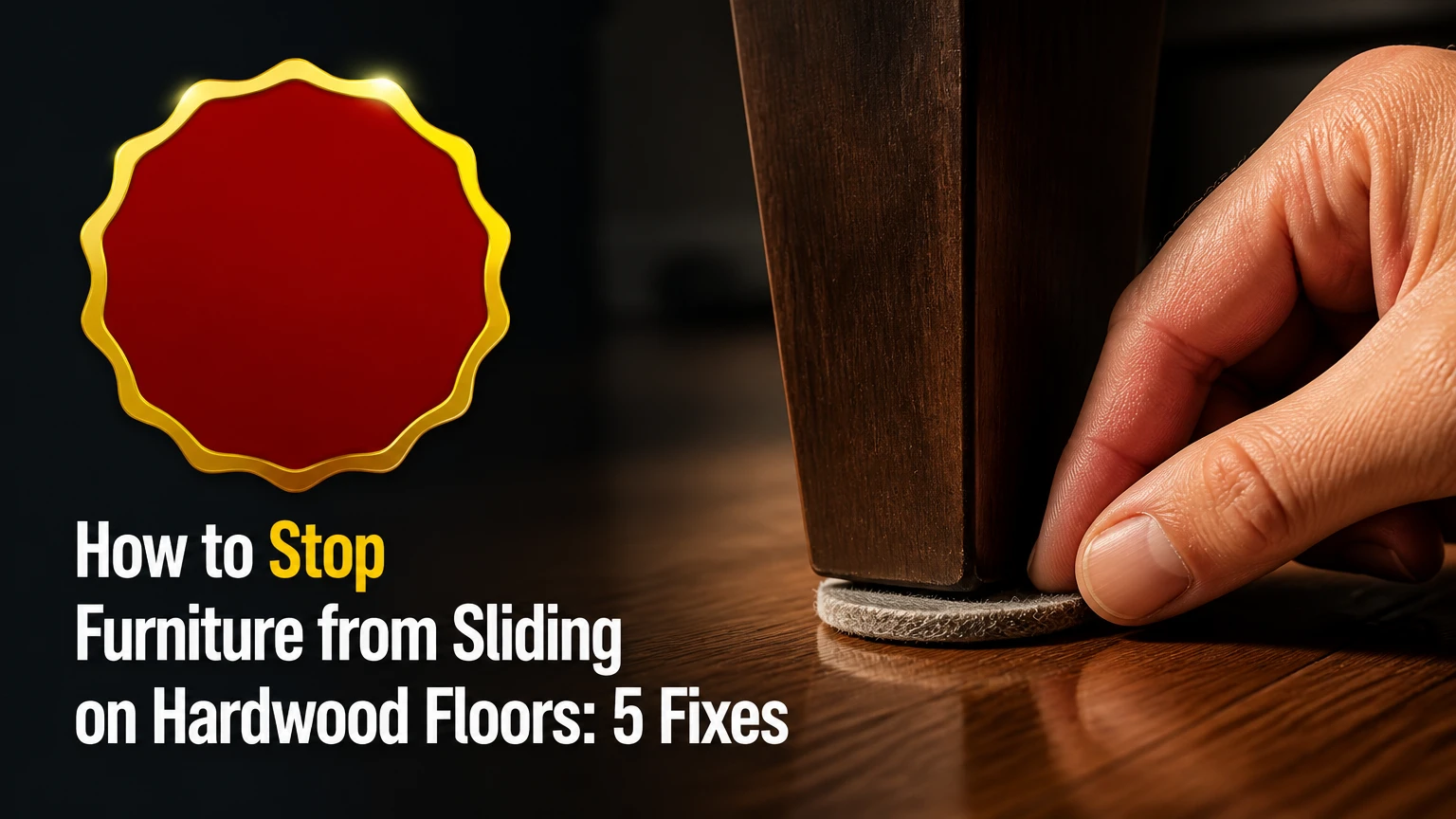
To stop furniture from sliding on hardwood floors, place a correctly sized rubber, silicone, or hybrid grip beneath every load-bearing leg, after cleaning and drying the contact surfaces. Use felt when furniture must move easily, but choose high-friction grippers, furniture cups, or mechanical glides for sofas, beds, desks, and other heavy items that should remain stationary.
Key Facts at a Glance
- Rubber and silicone grippers provide more sideways resistance than ordinary felt pads.
- High-density felt protects a hardwood finish while allowing chairs to move across the floor.
- A pad should cover the complete bottom of the leg without protruding into a walking path.
- Dirty, waxy, or damp leg bottoms are the most common reasons adhesive pads peel away.
- Furniture cups distribute weight under pianos, wardrobes, and narrow casters, reducing dent risk.
- Test every rubber or silicone product in a hidden area because some materials can transfer color or interact with a floor finish.
What Actually Stops Furniture From Sliding?
Furniture stops sliding when the contact between the leg and hardwood produces more friction than the sideways force created by sitting, leaning, opening drawers, or pulling a chair. Rubber, silicone, and other elastomers deform slightly under load, increasing contact area and resisting movement across a smooth polyurethane or oil-finished surface.
Felt works differently. Dense wool or synthetic felt creates a protective, low-abrasion layer that lets furniture glide, so it is useful for dining chairs and end tables that move repeatedly. Felt reduces scratching and noise, but ordinary felt is a poor choice when the goal is to lock a sofa or bed in position.
Floor finish changes the result. A glossy polyurethane coating is often smoother than a worn, textured, or oil-finished floor, while dust, polish, and pet hair reduce predictable contact. The National Wood Flooring Association recommends protective pads under furniture and regular removal of grit, because abrasive particles can scratch a finish when furniture moves.
Friction, Load, and Contact Area
A narrow metal foot puts substantial pressure on a small area, which can dent soft wood even when the furniture does not slide. Oversized rubber pads or cups spread the load across a larger footprint. They do not make hardwood indestructible, but they lower concentrated pressure and create a more stable interface.
A practical rule is to use one protector under every leg that carries weight. A four-legged table needs four pads, while a sectional with six or eight contact points needs protection at each point, including hidden center supports. Missing one support can cause the frame to twist and overload the remaining pads.
Which Pad Material Should You Choose?
The best furniture protector depends on whether the furniture should stay fixed, move regularly, or carry an unusually high load. Rubber or silicone suits stationary heavy furniture, felt suits frequently moved seating, and hybrid pads suit furniture that needs moderate grip plus a soft barrier against the finish.
| Protector type | Typical USA cost | Best load or use | Movement result | Main limitation |
|---|---|---|---|---|
| Rubber gripper | $8-$20 per 4-12 pack | Sofa, bed, desk, cabinet | Low sideways movement | May mark some finishes |
| Silicone cup or cap | $10-$25 per 4-8 pack | Narrow legs, wheels, angled feet | Very low movement | More visible than flat pads |
| High-density felt | $5-$15 per 16-40 pack | Dining chairs, stools, side tables | Smooth repeated movement | Does not lock furniture |
| Felt-rubber hybrid | $12-$25 per 4-12 pack | Recliner, sectional, occasional chair | Moderate movement | Thicker and sometimes bulky |
| Nail-on felt glide | $8-$18 per 12-24 pack | Chairs pulled out daily | Controlled movement | Requires hammer and drilling clearance |
| Furniture cup | $15-$35 per 4-pack | Piano, wardrobe, caster, safe | Minimal movement | Collects grit if left unchecked |
When Should You Use Felt?
Use dense felt for dining chairs, office chairs without rolling casters, and tables that need occasional repositioning. Felt protects the finish by separating hard furniture feet from grit, and a 3/16-inch to 1/4-inch thickness typically provides useful cushioning without making the furniture noticeably unstable.
Do not use ordinary felt as the primary anti-slide solution for a leather sofa or heavy bed. The smooth felt surface is designed to reduce resistance. A hybrid pad with rubber against the floor and felt against the furniture can provide a better compromise when a sofa needs slight repositioning but should not drift.
When Are Rubber or Silicone Better?
Use rubber or silicone under furniture that should remain in one location, especially a sofa, sectional, recliner, bed, writing desk, or storage cabinet. A soft elastomer usually grips better than hard plastic because it conforms to small floor and leg irregularities rather than creating a rigid sliding interface.
Rubber is not automatically safe for every hardwood coating. Dark rubber can transfer pigment, and some plasticizers may interact with older finishes over long periods. Place a sample under an inconspicuous leg or inside a closet for 48-72 hours, then inspect for discoloration, tackiness, or a dull halo.
How Do You Install Furniture Grippers Correctly?
Installing furniture grippers takes about 15-30 minutes for a chair, table, or small sofa, and the cleaning step determines the result more than the adhesive brand. The complete process is: expose each leg, remove residue, measure the footprint, attach the protector, allow adhesive to cure, and test for movement.
Before You Start
| Requirement | Typical specification | Why it matters | USA cost or time |
|---|---|---|---|
| Cleaning cloth | 1 lint-free microfiber cloth | Prevents loose fibers under adhesive | $1-$3 |
| Mild cleaner | 2-4 ounces diluted in water | Removes dust and light residue | $3-$8 |
| Isopropyl alcohol | 1-2 tablespoons for final wipe | Removes oily residue from compatible surfaces | $4-$8 |
| Protector quantity | One pad per load-bearing leg | Prevents uneven weight distribution | $5-$35 |
| Measuring tool | 1 ruler or tape measure | Matches pad diameter to leg footprint | $2-$10 |
| Cure period | 5-24 hours, product dependent | Allows pressure-sensitive adhesive to stabilize | No added cost |
Avoid alcohol on unfinished, waxed, shellacked, or visibly delicate furniture legs unless the manufacturer approves it. Use a barely damp cloth for those surfaces, then allow the wood to dry completely.
Step 1: Clean and Inspect Every Leg
Turn the furniture carefully or raise one side at a time, then wipe each leg bottom with a mild cleaner and microfiber cloth. Remove old adhesive, wax, compacted dust, hair, and grit; a plastic scraper can lift residue without gouging wood or metal.
Allow the surface to dry for at least 10 minutes. Inspect for cracks, loose ferrules, protruding nails, uneven feet, and missing glides before applying anything.
You will know this step worked when the leg bottom feels dry and clean rather than slick or powdery. The common mistake is attaching a pad to furniture wax, which bonds temporarily to residue instead of to the leg.
Step 2: Measure and Size the Contact Point
Measure the width and depth of each leg bottom, then select a protector that covers the entire contact area. For a round foot, a 1.5-inch pad should not be used under a 2-inch foot; undersizing concentrates load and leaves exposed edges that can catch grit.
Choose a cup or oversized pad when the leg is narrow, the furniture is heavy, or the hardwood is soft. A protector that extends 1/8 inch beyond a square leg can work, but excessive overhang may catch shoes and create a trip hazard.
You will know the size is correct when the protector supports the whole foot without folding. The common mistake is choosing a small pad because the package contains more pieces.
Step 3: Attach and Cure the Protector
Center a self-adhesive pad on the clean leg, peel away the backing without touching the adhesive, and press firmly across the entire surface for 30 seconds. For a cup or cap, seat the leg fully and check that the protector does not tilt.
Keep the furniture unloaded and stationary for at least 5 minutes for light pads, or 12-24 hours when the product label specifies a longer cure. Adhesive strength develops gradually, so sliding a sofa immediately after installation can shear the bond before it stabilizes.
You will know the attachment worked when the pad remains centered during a gentle hand test. The common mistake is applying pressure only in the middle while leaving the perimeter unbonded.
Step 4: Set the Furniture Down Without Dragging
Lower the furniture vertically with a second person or use a lifting tool that does not scrape the floor. Do not drag the item into place before the protectors have bonded, because a heavy sofa can peel an adhesive pad in one movement.
Place the furniture on a clean section of floor. If the floor contains sand, pet litter, or renovation dust, vacuum with a soft-floor attachment first and wipe the area with a dry microfiber cloth.
You will know the placement worked when every protector remains aligned and no edge folds under the leg. The common mistake is rotating the furniture on the new pads, which can twist adhesive-backed products sideways.
Step 5: Test for Sliding and Floor Contact
Push the furniture sideways with moderate force, then sit down, open drawers, or pull out the chair as the furniture will be used. A sofa should resist ordinary sitting and standing forces, while a dining chair should move in a controlled straight path.
Check the floor after the first day and again after one week. Look for black transfer, cloudy finish, moisture, indentations, and displaced pads.
You will know the solution is appropriate when the furniture stays within its intended area and the finish remains unchanged. The common mistake is judging success only by traction and ignoring chemical or abrasive damage.
Which Solution Fits Each Furniture Type?
Furniture type determines whether grip, smooth movement, weight distribution, or permanent attachment matters most. Heavy stationary pieces need rubber or cups, daily-use chairs usually need mechanical felt glides, and rolling furniture needs controlled casters rather than a loose pad beneath each wheel.
| Furniture situation | Recommended protector | Typical quantity | Installation choice | Avoid |
|---|---|---|---|---|
| Two-seat sofa | Rubber or hybrid grippers | 4-6 pads | Adhesive after cleaning | Thin craft felt |
| Large sectional | Oversized rubber or hybrid pads | 6-10 pads | Include center supports | Missing middle legs |
| Dining chair | Nail-on felt glides | 4 per chair | Hammer into solid leg base | Adhesive-only pads |
| Platform bed | Rubber pads or cups | 4-8 pads | Match all feet | Small pads under wide feet |
| Standing desk | Rubber or silicone pads | 4-6 pads | Use oversized contact area | Hard plastic discs |
| Piano or safe | Furniture cups | 3-4 cups | Lift into cups carefully | Bare casters |
| Bookshelf or wardrobe | Wide rubber cups | 4-6 cups | Distribute load | Narrow point pads |
| Office chair | Locking soft casters or mat alternative | 5 casters | Replace wheel set | Loose shelf liner |
Daily-Use Chairs and Stools
Nail-on felt glides are usually the longest-lasting choice for dining chairs that move several times each day. The fastener prevents the protector from walking across the leg bottom, while dense felt lets the chair pull out without harsh scraping.
Check the leg construction first. A thin metal tube, hollow plastic foot, or ornate antique leg may not accept a nail safely. Silicone chair caps with felt bottoms are reversible for those designs, although caps can loosen when the leg diameter is between two available sizes.
Sofas, Beds, and Desks
Use thick rubber or a rubber-felt hybrid under sofas, beds, and desks that should remain aligned. Place protectors under every structural support, not only the four visible corners, because a center leg can carry substantial load when someone sits near the middle.
A heavy desk can still shift if the floor slopes or the desk has adjustable leveling feet. Grip pads reduce movement but do not correct a frame that rocks, twists, or transfers load unevenly.
Pianos, Wardrobes, and Casters
Use furniture cups under piano casters, wardrobes, safes, and other concentrated loads. Cups spread pressure and prevent a small wheel or metal foot from denting the hardwood, but the cup must be large enough to contain the caster without allowing it to roll over the rim.
Never lift a piano or safe alone. Professional movers use lifting equipment and floor protection because the weight can exceed what ordinary furniture pads can safely support.
Can Reversible Alternatives Stop Sliding?
Reversible alternatives can reduce movement when adhesive, nails, and screws are unsuitable, but their reliability depends on load, floor cleanliness, and the direction of force. Rubber shelf liner, a correctly sized rug pad, and silicone caps work best for moderate loads and rental homes rather than heavily dragged furniture.
| Alternative | Typical USA cost | Best application | Expected duration | Main risk |
|---|---|---|---|---|
| Rubber shelf liner squares | $5-$15 per roll | Light tables, small chairs | 1-6 months | Curls at exposed edges |
| Silicone leg caps | $8-$20 per 4-pack | Tubular or angled legs | 6-24 months | Wrong diameter slips |
| Area rug with rug pad | $50-$400 total | Sofa group, dining set | 2-5 years | Dirt trapped underneath |
| Cork furniture discs | $6-$15 per 8-pack | Light wood furniture | 3-12 months | Compresses under heavy loads |
| Replacement locking casters | $20-$80 per 5-pack | Office chairs, carts | 1-4 years | Incorrect stem size |
| Removable rubber cups | $12-$30 per 4-pack | Beds, cabinets, pianos | 1-5 years | Visible around feet |
Cut shelf liner into pieces slightly larger than the leg bottom, then inspect the edges weekly during the first month. Do not allow the liner to wrinkle, because a fold can concentrate pressure and create an unstable foot.
Area rugs need a hardwood-compatible, non-staining rug pad. The rug pad should fit inside the rug perimeter by about 1 inch, and the rug should lie flat without exposed material that can catch a toe.
How Do You Handle Uneven Floors and Rolling Furniture?
Grip pads cannot solve a structural instability problem, a sloping floor, or a wheel that continues to roll. First identify whether the furniture is translating across the floor, rocking on unequal legs, or rolling because its casters lack brakes.
| Observed problem | Likely cause | Corrective action | Verification time |
|---|---|---|---|
| Sofa moves only when sitting | Smooth feet and lateral force | Install rubber pads at all supports | Same day |
| Table rocks when touched | Unequal leg lengths | Adjust feet or add a rigid shim | 10-20 minutes |
| Chair drifts backward | Casters or smooth felt | Use locking casters or rubber caps | Same day |
| Cabinet leans toward wall | Sloped floor or uneven base | Level furniture, then anchor if needed | 30-60 minutes |
| Pad slides sideways | Undersized or dirty adhesive | Clean, replace with larger pad | 15-30 minutes |
| Floor shows dark rings | Material transfer or moisture | Remove protector and test finish | 48-72 hours |
For office chairs, replace worn casters with soft, locking casters designed for hard floors. A plastic chair mat can protect some surfaces, but the supplied overview’s blanket warning about every plastic mat is too broad: a mat can still trap grit and scratch hardwood, while many manufacturers discourage mats over certain finishes. A clean, breathable rug pad or direct-use soft casters is often safer.
Anchor tall bookcases and wardrobes to the wall when tip-over is possible. Anti-slide pads address floor movement; they are not a substitute for an anti-tip bracket.
What Causes Pads to Fail?
Furniture pads usually fail because of contamination, incorrect sizing, shear force, incompatible materials, or unaddressed furniture defects. Replacing the product without correcting the failure mode often produces the same result within days.
| Failure mode | Diagnostic sign | Fix | Replacement interval |
|---|---|---|---|
| Dust or wax contamination | Pad peels with residue attached | Clean and dry the leg, then reapply | Immediate |
| Pad too small | Edge compression or floor dent | Use full-foot or oversized protector | Immediate |
| Excessive sideways shear | Pad shifts after dragging | Lift furniture, use mechanical glide | 1-7 days |
| Moisture under rubber | Cloudy ring or tacky finish | Remove, dry, test a new material | 48-72 hours |
| Grit under felt | Fine scratches or dirty fibers | Vacuum, replace felt, inspect monthly | 1-6 months |
| Uneven leg | Furniture rocks despite grip | Level or repair the leg | Before pad installation |
Why Do Adhesive Pads Keep Falling Off?
Adhesive pads fall off when the leg bottom contains wax, oil, dust, loose fibers, or old glue. Adhesive also fails when a small pad is forced sideways by a heavy piece, particularly when the furniture is dragged instead of lifted.
Clean the surface again, use a larger protector, and avoid moving the furniture during cure time. For dining chairs and stools, switch to nail-on glides or fitted silicone caps when repeated shear makes adhesive unreliable.
Why Do Rubber Pads Leave Marks?
Rubber pads can leave marks when pigment, plasticizer, trapped moisture, or finish interaction changes the surface beneath the protector. Heat from radiant-floor systems and prolonged compression can increase the chance of a visible imprint, although the result depends on the rubber formulation and finish chemistry.
Inspect after 48-72 hours, then monthly during the first season. Remove the pad immediately if the finish becomes sticky, cloudy, darker, or lighter.
How Much Do Materials and Installation Cost?
A typical USA DIY installation costs $5-$35 for one table, chair set, or small sofa and takes 15-30 minutes, excluding furniture lifting. A large sectional, piano, or wardrobe can require $20-$80 in protectors and professional handling because the number of supports and total weight increase.
| Project | Protector budget | DIY time | Typical difficulty | Suitable material |
|---|---|---|---|---|
| Four dining chairs | $12-$30 | 20-40 minutes | Low | Nail-on felt |
| Small sofa | $10-$25 | 15-25 minutes | Moderate | Rubber hybrid |
| Platform bed | $15-$40 | 20-35 minutes | Moderate | Rubber cups |
| Sectional sofa | $20-$60 | 30-60 minutes | Moderate | Oversized rubber |
| Piano | $20-$50 | 30-60 minutes with movers | High | Furniture cups |
| Office chair | $20-$80 | 10-20 minutes | Low | Locking soft casters |
Product labels control cure time, load ratings, and finish warnings. Treat the figures above as typical retail ranges in the United States, not guarantees for a specific brand or furniture weight.
What Maintenance Keeps Hardwood Safe?
Inspect protectors every one to three months, and inspect felt more often in homes with pets, construction dust, or frequent chair movement. Replace a pad when it becomes thin, hardened, curled, saturated with grit, or displaced from the leg.
Lift furniture periodically rather than dragging it to inspect the floor. Vacuum debris around the contact points, wipe rubber surfaces with a dry cloth, and replace any protector that has developed a sharp edge.
Three Practitioner Rules That Prevent Damage
- Never trap grit under a stationary protector. A tiny grain of sand can act like an abrasive point under hundreds of pounds.
- Use the largest safe footprint, not the smallest invisible pad. Load distribution protects soft wood better than a tiny high-friction dot.
- Separate movement control from leveling. A gripper stops sliding, while a shim, adjustable foot, or repair corrects rocking.
FAQ
Will rubber furniture pads damage hardwood floors?
Rubber furniture pads can damage or discolor some hardwood finishes, especially when moisture, pigment transfer, heat, or chemical incompatibility is involved. Test the pad in a hidden location for 48-72 hours, keep the floor dry, and inspect for tackiness, cloudiness, or color change before installing it under visible furniture.
How do I stop a couch from sliding on a hardwood floor without glue?
Use removable rubber cups, silicone grippers, or a hardwood-compatible area rug with a non-staining rug pad. Match the protector to every sofa support, including center legs, and lift the couch into position rather than dragging it. Reversible options are useful for renters and antique furniture that should not receive adhesive.
Are furniture pads safe for polyurethane floors?
Furniture pads are generally compatible with polyurethane floors when they are clean, dry, non-staining, and approved for finished wood. Felt reduces abrasion during movement, while tested rubber can provide grip. Avoid leaving an untested material in place for months, because compatibility problems may appear slowly.
How often should felt pads be replaced?
Replace felt pads when they become compressed, dirty, frayed, or thin enough that the furniture foot contacts the floor. In a frequently used dining room, inspection every one to three months is practical, while lightly used side tables may need replacement only once or twice each year.
Can I use silicone caulk under furniture legs?
Silicone caulk is not a dependable furniture protector because it may bond unevenly, cure with an unsuitable shape, and interact with a hardwood finish. A manufactured silicone cap or removable gripper provides a known thickness and cleaner replacement process. Use a product labeled for furniture and finished wood instead.
Should I put a rug under furniture that slides?
A rug can stop a furniture grouping from drifting when it includes a correctly sized, hardwood-compatible rug pad. Keep the rug pad inside the rug edge, remove grit during cleaning, and avoid loose plastic sheets that can trap abrasive debris. For a single heavy sofa, fitted rubber grippers usually cost less and are less visible.
The Bottom Line
The most reliable way to stop furniture from sliding on hardwood floors is to clean every leg, choose a full-size protector, and match the material to the furniture’s intended movement. Use rubber or silicone for stationary sofas, beds, desks, and cabinets; dense felt for chairs that must glide; and furniture cups or mechanical glides for concentrated loads and repeated use.