Why Does New Carpet Smell? VOCs, Safety and Fixes
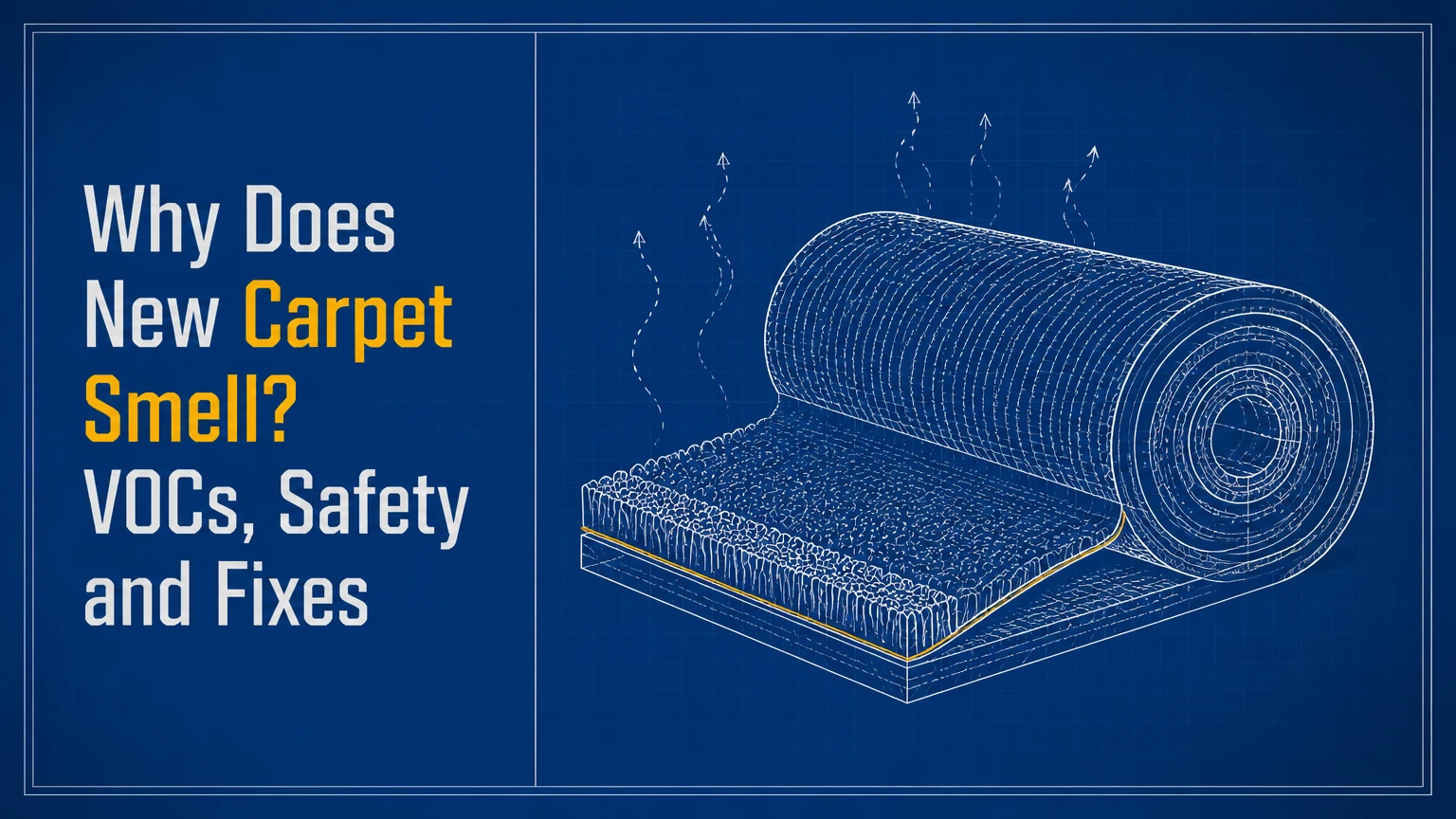
New carpet smells because volatile organic compounds, or VOCs, and other odor-producing chemicals evaporate from carpet fibers, backing, cushion, adhesives, and packaging after installation. The strongest odor usually occurs during the first 24-72 hours, then declines as emissions disperse, although ventilation, humidity, temperature, and product materials can extend the smell for several weeks.
Key Facts at a Glance
- New carpet odor usually comes from several components, not from the visible fiber alone.
- Styrene-butadiene rubber, or SBR, latex backing can release 4-phenylcyclohexene, commonly called 4-PCH, a recognized carpet-odor compound.
- Carpet odor is normally strongest during the first 24-72 hours and often becomes much less noticeable within 7-14 days.
- Odor intensity is not a reliable measure of toxicity because people detect some chemicals at very low concentrations.
- Fresh outdoor air, source removal, and dry conditions reduce odor more reliably than fragrances or household powders.
- CRI Green Label Plus evaluates carpet-related chemical emissions under a certification program, but it does not mean a product has zero emissions.
Why Does New Carpet Smell?
New carpet smells because manufacturing and installation leave volatile chemicals on or inside multiple flooring components. Synthetic fibers can carry processing residues, while latex backing, polyurethane cushion, seam adhesives, tackifier, and installation glue may release different odors at the same time.
A carpet roll also spends time tightly wrapped in plastic, which limits air exchange. Unrolling increases the exposed surface area, and cutting, stretching, and adhesive application release compounds that were previously contained within the product or package.
The odor is therefore a materials-and-ventilation issue. A mechanically attached carpet with low-emission backing may smell far less than a glue-down installation using conventional adhesive, even when both carpets have similar face fibers.
What are VOCs and off-gassing?
VOCs are carbon-containing chemicals that can enter indoor air as gases at ordinary temperatures. “Off-gassing” is the informal term for their release from products such as carpet, paint, furniture, flooring, and adhesives.
The U.S. Environmental Protection Agency explains that source control is generally the most effective way to improve indoor air, while ventilation can reduce concentrations after a source is present. That principle applies to carpet: selecting lower-emission components prevents more exposure than trying to cover the odor later.
Odor and exposure are related but not identical. A person may smell a compound at a concentration below a level associated with health effects, while some harmful pollutants have little or no detectable odor.
Which Materials Create the Smell?
Carpet backing, cushion, adhesive, and packaging often contribute as much odor as the carpet fiber. The compound 4-PCH is associated particularly with SBR latex backing, but a strong new-carpet smell does not prove that 4-PCH is present or identify the only source.
| Component | Common USA materials | Typical odor character | Main variable |
|---|---|---|---|
| Face fiber | Nylon, polyester, olefin, triexta | Plastic, sweet, or faint chemical | Fiber treatment and dye |
| Primary backing | Polypropylene or woven synthetic | Low plastic or neutral | Polymer and finish |
| Secondary backing | SBR latex, polyurethane, polyolefin | Rubber, solvent, chemical | Latex formulation |
| Cushion | Rebond polyurethane, rubber, felt | Foam, tire-like, earthy, or low odor | Binder and recycled content |
| Installation adhesive | Acrylic, pressure-sensitive, solvent-containing | Solvent, sweet, sharp | Adhesive chemistry and coverage |
| Packaging | Polyethylene film and wrap | Plastic or stale chemical | Storage duration and heat |
Does carpet padding smell too?
Carpet padding can smell because foam binders, rubber, recycled materials, or chemical treatments release their own emissions. Rebond cushion, made from recycled polyurethane foam, may have a noticeable foam or chemical odor, while synthetic rubber pads can produce a tire-like smell.
Padding is easy to overlook during diagnosis. If the carpet itself has low emissions but the room remains strongly odorous, ask the retailer or installer for the cushion’s product name, material safety data, and emissions certification.
Adhesive can also dominate the room. Glue-down carpet and broadloom installations with seam sealer may smell sharper than stretch-in installations that rely mainly on tack strips, because the adhesive creates a larger liquid-to-air emission source during curing.
Is 4-PCH the only chemical involved?
No. 4-PCH is one documented compound associated with carpet odor, particularly from some SBR latex backings. Carpet odor may also involve styrene, aldehydes, residual solvents, amines, plasticizers, processing aids, and compounds released by cushion or adhesive.
The exact mixture depends on the manufacturer, product age, backing, storage conditions, and installation method. Retailers cannot reliably identify the chemical source from smell alone, and a home air test that measures only one compound can miss the dominant odor source.
How Long Does New Carpet Smell Last?
New carpet smell typically drops sharply after 24-72 hours and becomes substantially less noticeable within 7-14 days under good ventilation. A faint odor can remain for several weeks, especially when the room is closed, the carpet is glued down, the cushion has strong emissions, or indoor temperature and humidity are high.
There is no scientifically dependable universal timetable such as “all odor disappears after 14 days.” Emissions generally decline over time, but the rate changes with product chemistry and air exchange.
| Situation | Strongest odor window | Common noticeable period | Action point |
|---|---|---|---|
| Stretch-in carpet, open windows | 1-2 days | 3-7 days | Ventilate continuously when outdoor air is suitable |
| Stretch-in carpet, closed room | 2-4 days | 1-3 weeks | Increase outdoor-air exchange |
| Glue-down installation | 2-5 days | 1-4 weeks | Confirm adhesive cure and ventilation instructions |
| New carpet with rebond cushion | 1-4 days | 1-3 weeks | Test cushion and carpet separately if possible |
| Wool carpet or rug | 1-3 days | 2-10 days | Distinguish wool odor from chemical odor |
| Persistent musty or sour odor | Variable | Beyond 2 weeks | Investigate moisture or contamination |
Temperature accelerates evaporation, but deliberately overheating a home is not a safe universal remedy. High heat can increase airborne concentrations faster than ventilation removes them, and it may damage finishes or worsen symptoms.
Is New Carpet Smell Harmful?
New carpet smell is usually a short-term indoor-air concern rather than evidence of serious poisoning, but sensitive occupants can experience headache, eye or throat irritation, nausea, cough, or asthma symptoms. Risk depends on the chemicals, concentration, exposure time, room ventilation, and individual susceptibility.
The U.S. Consumer Product Safety Commission has advised consumers to ventilate newly installed carpeting and avoid prolonged occupancy when strong odors or irritation occur. People with asthma, chemical sensitivity, respiratory disease, infants, and older adults may need a more cautious schedule.
| Response | Likely meaning | Recommended action |
|---|---|---|
| No symptoms, mild odor | Normal early emissions | Ventilate and monitor for improvement |
| Eye or throat irritation | Concentration may be irritating | Leave the room, ventilate, and reduce exposure |
| Headache or nausea | Possible sensitivity or poor ventilation | Use another room and contact the installer |
| Wheezing or breathing difficulty | Asthma or respiratory reaction | Follow the person’s asthma plan and seek medical care |
| Burning, fishy, or solvent odor | Possible adhesive or unusual product source | Stop occupancy and request product documentation |
| Musty odor with dampness | Moisture or microbial concern | Inspect pad, subfloor, and room humidity |
A strong odor alone cannot establish whether a carpet is unsafe. Conversely, a weak odor cannot certify that indoor air is healthy. When symptoms continue after leaving the room, contact a healthcare professional or poison control service in the USA at 1-800-222-1222.
Can children and pets stay in a newly carpeted room?
Children and pets should avoid a strongly odorous room until ventilation has reduced the smell and no one develops symptoms. Infants spend more time near the floor, while pets may contact and lick fibers, adhesive residue, or loose installation materials.
Keep pets away until the installer confirms that adhesives are cured and the carpet is dry. Do not place food, water bowls, bedding, or toys on the floor during the initial installation period.
Which Carpet and Cushion Produce Less Odor?
Lower-emission carpet usually results from the complete flooring system, not from choosing wool or a particular fiber in isolation. Ask for emissions information for the carpet, cushion, adhesive, and seam products together.
| Flooring system | Odor potential | USA certification or specification | Typical material cost |
|---|---|---|---|
| Nylon with conventional SBR backing | Medium to high | Product-specific disclosure | $2.00-$6.00/sq. ft. |
| Polyester with low-emission backing | Low to medium | CRI Green Label Plus when listed | $1.50-$5.00/sq. ft. |
| Triexta with thermoplastic backing | Low to medium | Product-specific emissions data | $3.00-$8.00/sq. ft. |
| Wool with jute or synthetic backing | Low chemical, possible wool odor | Product-specific disclosure | $6.00-$20.00/sq. ft. |
| Needle-punched felt or natural-fiber rug | Low to medium | Material and backing disclosure | $4.00-$18.00/sq. ft. |
| Carpet with conventional rebond pad | Medium to high | Cushion certification varies | $0.25-$1.00/sq. ft. |
| Carpet with low-emission felt pad | Low | Product-specific emissions data | $0.75-$2.50/sq. ft. |
Wool can produce a natural lanolin, hay, or wet-animal odor, especially in humid conditions. That smell is different from a sharp solvent or rubber odor, but “natural” does not mean odorless or automatically suitable for every chemically sensitive occupant.
The fiber label also has limits. Nylon, polyester, olefin, and triexta describe the face fiber, not the backing, dye system, cushion, or glue. A buyer who compares only fiber names is comparing an incomplete system.
What does CRI Green Label Plus mean?
CRI Green Label Plus is a Carpet and Rug Institute program for low-emitting carpet products and is useful for narrowing a purchase shortlist. The designation does not mean zero VOCs, zero odor, zero health risk, or identical performance among all certified products.
Ask the retailer to provide the current certification for the exact style and construction. Then check the cushion and adhesive separately, because a certified carpet installed over a strongly emitting pad can still produce an unpleasant room odor.
FloorScore is another USA indoor-air emissions certification used for some flooring products. Certification is most useful when combined with source control, product disclosure, and a low-odor installation method.
How Can You Reduce the Smell Safely?
The safest odor-reduction method is to increase outdoor-air exchange without creating unsafe temperature, humidity, or combustion conditions. Ventilation works best when the room is unoccupied by sensitive people and outdoor air quality is acceptable.
- Ventilate the room. Open windows and interior doors when outdoor air is clean and weather permits. Use a box fan exhausting outward from one window, while another opening supplies replacement air.
- Run the HVAC fan appropriately. Use the system’s fan according to the manufacturer’s instructions, but do not assume recirculation removes VOCs. A portable air cleaner with substantial activated carbon can help with gases, while HEPA filtration mainly captures particles.
- Keep the carpet dry. Maintain ordinary indoor humidity, commonly about 30%-50%, and avoid steam cleaning during the initial cure period unless the installer specifically recommends it.
- Remove residual packaging. Take plastic wrap, carpet scraps, adhesive containers, and discarded cushion out of the living area.
- Limit occupancy. Keep people and pets away while the odor is intense or symptoms occur.
- Document the system. Record carpet, cushion, adhesive, lot, and installation dates if the odor persists.
You will know ventilation is helping when the smell is weaker after the room has been aired and returns when the room is sealed. That pattern indicates airborne accumulation, although it does not identify a specific chemical.
Do not perform a high-temperature “bake-out” in an occupied home. Heating to 85°F, or 29°C, can raise emissions faster than fans remove them and has no universal safety protocol for residential carpet.
Which odor remedies help?
Activated carbon can reduce some airborne organic compounds when the filter contains enough carbon and receives adequate airflow. A small bowl of charcoal is not equivalent to a properly sized air cleaner, and ordinary HEPA-only units do not remove gases efficiently.
Baking soda may help with some surface odors, but it does not reliably capture airborne VOCs released from carpet backing or adhesive. Fragrance sprays mask odor and add more chemicals to indoor air.
| Method | What it can do | Main limitation | Use decision |
|---|---|---|---|
| Outdoor-air ventilation | Dilutes airborne emissions | Depends on weather and outdoor pollution | First choice when conditions permit |
| Exhaust fan | Moves contaminated air outside | Requires replacement air | Useful for isolated rooms |
| HEPA filter | Captures particles | Little gas removal without carbon | Add carbon for VOC concerns |
| Activated-carbon filter | Adsorbs some gases | Capacity declines as carbon fills | Use a substantial replaceable filter |
| Baking soda | May reduce surface odor | Does not solve emission sources | Optional, not primary treatment |
| Fragrance spray | Masks smell briefly | Adds irritants and VOCs | Avoid as a control strategy |
| Steam cleaning | Cleans soil after installation | Adds moisture and does not remove backing emissions | Delay unless professionally advised |
Why Does the Smell Persist?
A carpet odor that remains strong beyond two weeks often comes from a continuing source or a different problem rather than ordinary fiber off-gassing. Common causes include adhesive curing, cushion emissions, dampness, contaminated subfloor, poor ventilation, or a rug backing that reacts with the floor.
Use location and odor character to narrow the diagnosis. A rubber smell concentrated at seams suggests backing or adhesive; a musty smell that intensifies during humid weather suggests moisture; a sharp solvent smell suggests adhesive or another nearby product.
| Symptom pattern | Probable source | Diagnostic check | Corrective action |
|---|---|---|---|
| Rubber odor strongest at edges | SBR backing or seam adhesive | Compare edge and center areas | Ask installer for backing and seam products |
| Foam odor across the room | Cushion | Lift a corner if permitted | Replace cushion if emissions remain high |
| Musty odor near exterior wall | Damp subfloor or wall | Check moisture and baseboard | Correct water intrusion before replacement |
| Odor after carpet cleaning | Wet pad or dirty subfloor | Measure drying and inspect pad | Dry rapidly and investigate contamination |
| Solvent odor near transitions | Glue or seam sealer | Review installation map | Confirm cure time and product instructions |
| Odor returns when windows close | Inadequate air exchange | Compare open and closed readings by smell | Improve mechanical or natural ventilation |
Do not automatically deodorize a damp carpet. Moisture correction comes first because ozone, fragrance, powders, and repeated cleaning cannot fix wet materials or hidden microbial growth.
If the installer cannot explain the odor after 14-30 days, request the product technical sheets and emissions documentation. For severe symptoms or a suspected building moisture problem, an independent indoor environmental professional is more useful than a generic carpet deodorizing service.
How Should You Choose Low-Odor Carpet?
Choose the lowest-emission complete system that meets the room’s performance needs, then plan ventilation before installation. The key purchasing questions concern backing, cushion, adhesive, certification, storage, and installation method, not only whether the face fiber is synthetic or natural.
| Buyer situation | Recommended specification | Installation preference | Typical installed cost |
|---|---|---|---|
| Odor-sensitive household | Certified carpet, low-emission cushion, disclosed adhesive | Stretch-in with tack strips | $4-$12/sq. ft. |
| Family room on a budget | Polyester or nylon with documented emissions | Stretch-in | $3-$8/sq. ft. |
| Premium natural-material project | Wool with disclosed backing and pad | Mechanical installation where suitable | $9-$25/sq. ft. |
| Rental or short renovation window | Low-emission synthetic system | Avoid unnecessary wet adhesive | $3-$9/sq. ft. |
| Glue-down commercial-style room | Certified carpet tile or broadloom, low-emission adhesive | Follow adhesive cure schedule | $5-$15/sq. ft. |
Typical USA installation labor ranges from about $1.00-$3.00 per square foot, excluding furniture moving, floor preparation, stairs, removal, and disposal. Urban markets, complex layouts, and subfloor repairs can raise the total substantially.
Request samples before ordering. Place carpet, cushion, and adhesive samples in separate clean glass containers for 48 hours, then compare odors outdoors or in a ventilated area. This is not a laboratory test, but it can reveal a strong cushion or adhesive odor before installation.
What should you ask the retailer?
Ask for the exact product name, backing type, cushion composition, emissions certification, adhesive technical data sheet, and recommended ventilation or cure time. Also ask whether the carpet can be unrolled and aired at the warehouse before delivery.
Warehouse airing may reduce odor, but it cannot convert a high-emission product into a low-emission product. The most effective decision is to select better materials first and use airing as an additional measure.
What is the main trade-off?
Low odor does not equal maximum durability, lowest price, or best stain resistance. Wool can cost several times more than entry-level polyester, while felt cushion may have different compression and moisture characteristics than rebond foam.
A low-emission label also cannot predict every person’s response. Chemical sensitivity varies, and a certified product may still produce an odor that one household member finds unacceptable.
Common Mistakes and Better Fixes
- Closing every window: Sealing the room allows indoor concentrations to accumulate. Ventilate when outdoor air is safe and avoid opening windows during wildfire smoke, high ozone, or severe outdoor pollution.
- Blaming the fiber alone: The cushion and adhesive can dominate emissions. Test or document every flooring component.
- Using a fragrance deodorizer: Fragrance covers odor without removing the source. Use outdoor-air ventilation and source control instead.
- Running an air purifier with HEPA only: HEPA captures particles, not most gaseous VOCs. Choose a unit with a substantial activated-carbon stage.
- Overheating the room: Heat can accelerate release faster than removal. Use normal thermostat settings and prioritize controlled air exchange.
- Steam cleaning immediately: Added water can wet the pad and subfloor. Follow the installer’s cure instructions and keep the system dry.
- Assuming a two-week deadline proves safety: Timelines are typical, not guarantees. Investigate strong odor, symptoms, dampness, or poor improvement.
One practitioner rule is especially useful: if the odor becomes much stronger when the room is closed, ventilation is part of the problem; if it remains equally strong outdoors or at the carpet edge, source identification matters more than air cleaning.
Frequently Asked Questions
Does new carpet smell worse in summer?
New carpet may smell stronger in warm, humid weather because higher temperature increases evaporation and humidity can alter how people perceive odors. Summer ventilation can help when outdoor air quality is good, but hot outdoor air is not automatically cleaner or safer than conditioned indoor air.
Can I sleep in a room with new carpet?
Sleep elsewhere if the room has a strong odor or causes headache, throat irritation, cough, or breathing symptoms. A healthy adult without symptoms may tolerate the room after adequate ventilation, but infants, people with asthma, and chemically sensitive occupants should use a more conservative schedule.
Why does wool carpet smell like a barn?
Wool carpet can have a natural lanolin, hay, or wet-wool odor from animal fibers and backing materials. Humidity often intensifies that smell. A barnyard odor differs from a solvent, plastic, or rubber odor, but persistent dampness still requires inspection.
Can carpet odor enter furniture and walls?
Airborne odor compounds can be absorbed temporarily by porous furnishings, textiles, and dust, especially in a closed room. Ventilation reduces the airborne source, while laundering or airing removable textiles helps. Odor absorbed into materials usually declines after the original carpet emissions decrease.
Should I remove carpet that still smells after a month?
Do not remove carpet solely because a faint odor remains after one month, but investigate a strong or irritating smell that has not improved. Check the cushion, adhesive, subfloor moisture, and ventilation first; replacement may be necessary when a component continues releasing odor or has been contaminated.
The Bottom Line
Why does new carpet smell? VOCs and other volatile chemicals leave the carpet system, cushion, adhesive, and packaging after installation, with the strongest release usually occurring during the first 24-72 hours. Ventilate with suitable outdoor air, keep the floor dry, use activated carbon only as a supplement, and investigate any strong, irritating, rubber-like, solvent, or musty odor that persists beyond 14-30 days.