Why Does My Room Smell Like Onions? Find the Source
A room that smells like onions usually has a source releasing sulfur-like volatile compounds, such as damp fabric, sweat, pet residue, microbial growth, cooking odor, a drain, or a hidden pest. A sharp smell near an outlet, appliance, or wall may indicate overheating insulation or plastic, so treat that pattern as an electrical warning rather than a cleaning problem.
Key Facts at a Glance
- An onion-like room odor most often comes from contaminated fabric, footwear, food residue, pets, drains, or airflow, not from invisible onions.
- Relative humidity above 60% makes damp textiles, carpet padding, and microbial odors more likely; EPA guidance favors keeping indoor humidity below 60%, ideally 30-50%.
- A smell that starts when an air conditioner, heater, outlet, power strip, or appliance runs needs mechanical or electrical investigation.
- Activated carbon can reduce airborne odor, but it cannot remove moisture, a dead animal, contaminated padding, or a failing wire.
- Never use ozone in an occupied home, and never mix bleach with vinegar, ammonia, or other cleaners.
- A burning-plastic smell, warm outlet, smoke, buzzing, sparking, or worsening odor requires leaving the area and contacting emergency services or a licensed electrician.
Why Does My Room Smell Like Onions?
An onion-like room odor occurs when sulfur-containing or sulfur-resembling compounds reach your nose from a material, biological source, appliance, or airflow pathway. The most useful diagnostic clues are location, timing, humidity, and whether the odor returns after cleaning.
Onion is a description, not a diagnosis. Human odor perception groups several sharp smells together, including cooked alliums, sweaty clothing, dirty socks, sulfurous drain gas, musty microbial compounds, hot plastic, and decomposing organic matter. A person may call the same source “garlic,” “sour,” “fishy,” “burnt,” or “chemical.”
The phrase “thiols” also needs care. Thiols are sulfur compounds associated with strong odors, but not every onion-like household odor has been chemically identified as a thiol. Carpet bacteria, skin oils, food residue, damp wood, sewer gas, and overheated polymers can produce overlapping odor impressions without sharing one exact chemical cause.
Can bacteria make a room smell like onions?
Bacteria can create an onion-like smell when they metabolize sweat, skin oils, food residue, or other organic material on a damp surface. The strongest sources are usually gym clothes, shoes, mattress covers, carpet padding, towels, laundry hampers, and pet-soiled flooring.
The smell often returns because the visible surface is clean while the padding, foam, or backing remains wet. Washing a shirt may solve the immediate problem, but a hamper, shoe insole, mattress edge, or carpet underlay can continue releasing odor into the room.
EPA states, “The key to mold control is moisture control.” That principle also applies to many non-mold odors: cleaning removes residue, while drying prevents the biological activity from returning.
What Source Pattern Matches the Odor?
The source pattern usually narrows the diagnosis faster than the odor description. Compare where the smell is strongest, when it appears, and whether the room contains a moisture source.
| Odor pattern | Most likely source | Diagnostic trigger | First safe action |
|---|---|---|---|
| Strongest near laundry or shoes | Sweat, bacteria, damp fabric | Odor increases after closed-door storage | Remove, wash, and dry textiles |
| Strongest at carpet edge or floor | Pet urine, wet padding, spill, mold | Water mark, tack strip odor, soft flooring | Stop moisture and inspect padding |
| Appears when AC starts | Evaporator coil, drain pan, filter | Odor follows fan or cooling cycle | Replace filter and schedule HVAC service |
| Appears near a drain | Dry P-trap or sewer gas | Room has an unused sink or floor drain | Add water to the trap if accessible |
| Sharp smell near outlet or appliance | Overheated plastic or wiring | Warm plate, buzzing, discoloration | Leave it off and call an electrician |
| Concentrated in wall or ceiling | Dead pest or hidden leak | Flies, stains, gnawing, damp drywall | Contact pest or water-damage professional |
| Present after renovation | Paint, adhesive, flooring VOCs | Started within days of installation | Ventilate and follow product instructions |
| Follows clothing or bedding | Body odor or contaminated laundry | Odor travels with one item | Isolate and launder the item |
Why is the odor only in one room?
A localized odor usually indicates a source inside that room, an air leak into it, or a branch of the HVAC or plumbing system serving it. Closed doors, low air exchange, carpet, upholstered furniture, and exterior-wall condensation can make one bedroom smell different from the rest of a home.
A bedroom may also receive odor from an adjacent unit, attic, crawlspace, hallway, or shared wall. Smoke, cooking exhaust, and laundry odors can travel through electrical boxes, recessed lights, plumbing penetrations, return-air gaps, and undercut doors.
Test the room only after ruling out immediate hazards. Close the door for 30-60 minutes, then compare the odor at the doorway, floor, closet, vent, and soft furnishings without putting your face against an outlet or appliance.
How Does Moisture Change the Diagnosis?
Moisture makes biological odors more likely and can also accelerate material degradation. Use a digital hygrometer rather than guessing: sustained indoor relative humidity above 60% deserves correction, while 30-50% is a practical target for many occupied USA homes.
| Moisture clue | Typical reading or timing | Likely implication | Recommended response |
|---|---|---|---|
| Dry room with no stains | 30-50% RH | Odor may be textiles, airflow, or electrical | Inspect movable sources first |
| Humid room after showers | 60-70% RH for hours | Damp fabrics or microbial activity | Run exhaust fan and dehumidifier |
| Condensation on windows | Visible droplets below room temperature | Surface humidity and possible mold risk | Reduce humidity and improve airflow |
| Carpet feels cool or damp | Moisture persists over 24 hours | Padding, leak, or pet contamination | Use moisture meter or professional inspection |
| Musty odor after rain | Stronger within 1-12 hours | Exterior leak, crawlspace, or wall moisture | Inspect roof, window, and exterior wall |
| Odor after AC shutdown | Damp coil or drain pan | HVAC microbial buildup or poor drainage | Have the system serviced |
Humidity alone does not prove mold. Mold requires moisture and a food source, and an onion smell does not identify mold species or confirm a health hazard. Do not cut into drywall or disturb moldy material merely to chase an odor, particularly if anyone in the home has asthma or immune suppression.
Could the HVAC System Be Causing It?
An HVAC system can distribute an onion-like odor when a dirty filter, damp evaporator coil, condensate pan, wet insulation, or contaminated return air carries odor through the ductwork. If the smell begins within minutes of turning on the fan, cooling, or heat, HVAC moves near the top of the diagnostic list.
“Dirty sock syndrome” is a recognized description for unpleasant odors from some air-conditioning systems, especially when microbial growth develops on a wet evaporator coil or drain pan. The odor is often described as dirty socks, vinegar, mildew, or onions rather than one consistent chemical smell.
Start with the filter. Use the size printed on the existing filter, install the airflow arrow toward the furnace or air handler, and never operate a system with a missing filter. A filter replacement can improve recirculated odor, but it cannot clean a contaminated coil or correct standing condensate.
HVAC checks and limits
- Note whether the odor appears with fan-only operation, cooling, heating, or every mode.
- Replace a visibly dirty filter with the manufacturer’s specified size and rating.
- Look for water around the indoor air handler, rust on the drain pan, or a blocked condensate line.
- Keep electrical panels, blower compartments, and refrigerant components closed.
- Schedule an HVAC technician if the odor persists, airflow falls, water leaks, or the coil needs cleaning.
Do not spray household disinfectant into supply vents. Do not use a foaming coil cleaner unless the product is designed for the specific coil and you can protect electrical components, insulation, and condensate drainage.
When Is an Onion Smell an Electrical Emergency?
An onion-like odor is an electrical emergency when it is localized near an outlet, switch, power strip, appliance, breaker panel, charger, or wall and has a hot-plastic, fishy, acrid, or burning quality. Heat, discoloration, crackling, buzzing, flickering, smoke, and melted plastic increase the danger.
Electrical failures do not always smell exactly like burning rubber. Heated PVC insulation, circuit-board resin, dust, and plastic housings can produce unfamiliar odors that occupants describe as fishy, chemical, garlic-like, or onion-like. The smell may appear only when a high-load device runs.
Use distance, not touch, to assess the situation. Unplug a portable device only if there is no smoke, sparking, heat, or visible damage and the plug is safely accessible; otherwise leave the area and switch off the circuit only if the breaker is safely reachable.
| Warning sign | Risk level | Immediate action | Who to contact |
|---|---|---|---|
| Mild odor, no heat or damage | Moderate | Stop using suspected device | Licensed electrician |
| Warm outlet or switch plate | High | Leave circuit off if safe | Licensed electrician promptly |
| Buzzing, crackling, flickering | High | Leave room and cut power if safe | Electrician or emergency services |
| Smoke or melted outlet | Extreme | Evacuate and call 911 | Fire department |
| Burning odor from breaker panel | Extreme | Do not open panel | 911 and electrician |
| Odor with headache or dizziness | High | Move into fresh air | 911 or Poison Control, 1-800-222-1222 |
The Consumer Product Safety Commission advises consumers to stop using products that show damaged cords, overheating, or unusual odors. A cleaning spray or carbon filter cannot make a failing connection safe.
Can Pests or Plumbing Cause the Smell?
Pests and plumbing can both create onion-like odors, but their patterns differ. A dead rodent usually produces a localized, worsening decomposition odor near a wall, ceiling, vent, or inaccessible void, while a dry drain trap produces an odor that changes when water runs or air pressure shifts.
A dead animal may also attract flies, cause staining, or become stronger over several days before gradually fading. Do not open walls without checking for electrical wiring, plumbing, and pest-control requirements. A pest professional can locate the source with a borescope or targeted inspection.
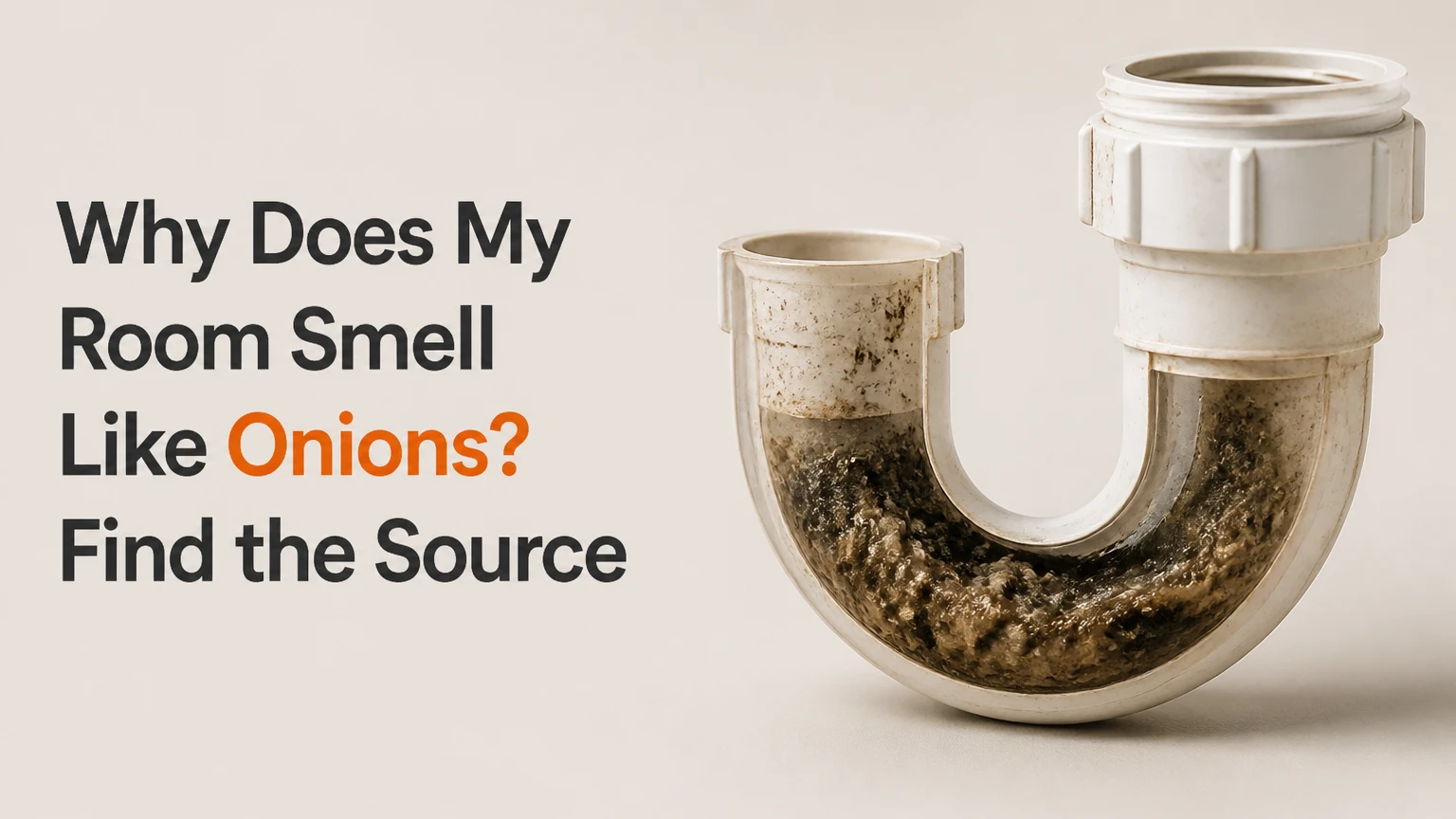
A dry P-trap allows sewer gas to enter from an unused sink, shower, floor drain, or utility drain. Add approximately 2 cups of water to an accessible trap, then monitor the room for 30-60 minutes. For a floor drain, a small amount of mineral oil placed over the water can slow evaporation, but confirm local plumbing guidance first.
| Source | Odor behavior | Additional clue | Typical USA service cost |
|---|---|---|---|
| Dry sink P-trap | Improves after water enters trap | Unused bathroom or utility sink | $0 DIY, $150-$350 plumber |
| Floor-drain trap | Returns after days or weeks | Basement, laundry room, garage | $0-$250 |
| Dead mouse or rat | Intensifies for 2-7 days | Flies, wall or ceiling location | $150-$600 |
| Rodent nest | Persistent, dusty, musky odor | Droppings, gnaw marks, insulation damage | $300-$1,500 |
| Hidden pet urine | Strongest near flooring | Repeated marking or staining | $150-$800 cleaning |
| Sewer-line defect | Whole-room or whole-home odor | Multiple drains or recurring backups | $300-$3,000+ repair |
Never pour bleach into a suspected sewer-gas problem and assume the source is fixed. Sewer gas may contain irritating or hazardous compounds, and plumbing defects require correction rather than fragrance.
How Can You Locate the Source Safely?
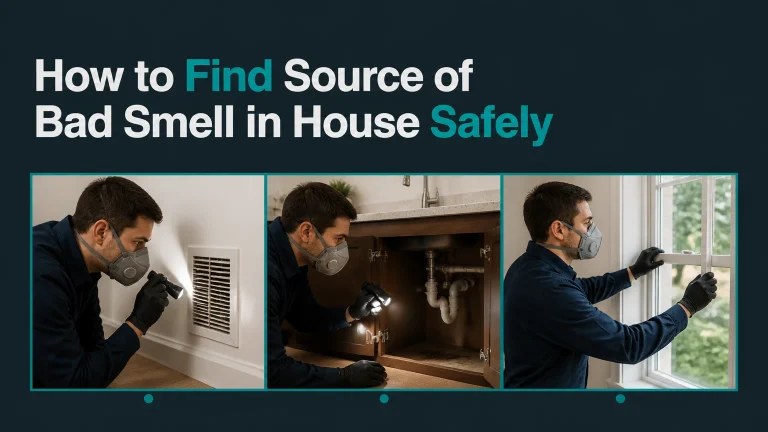
A controlled inspection can identify many household odor sources in 30-60 minutes, provided there is no smoke, heat, sparking, gas odor, or significant illness. The most reliable method is to isolate zones, change one condition at a time, and record where the odor intensifies.
Step 1: Check for immediate danger
Leave the room if the odor resembles burning plastic, smoke, fuel gas, or solvent, or if anyone develops dizziness, nausea, breathing difficulty, or severe headache. Call 911 for smoke, fire, sparking, or a suspected gas emergency, and do not create a flame to test an odor.
Checkpoint: no emergency symptoms, visible damage, or hot electrical equipment are present.
Common mistake: pressing your nose against an outlet or touching a suspicious plate.
Step 2: Record timing and airflow
Write down whether the smell appears after cooking, showering, rain, laundry, sleep, HVAC operation, or a particular appliance. Turn off nonessential portable devices, then observe whether the smell changes over 15-30 minutes.
Checkpoint: you have identified at least one trigger or confirmed that the odor is continuous.
Common mistake: running several appliances and the HVAC at once, which destroys the comparison.
Step 3: Inspect removable sources
Take laundry, shoes, gym bags, bedding, trash, food containers, pet items, and damp towels outside the room. Check under the bed, behind furniture, closet corners, and the hamper without disturbing suspected pests or mold.
Checkpoint: the room smells substantially better after 30 minutes with suspect items removed.
Common mistake: spraying fragrance before removing the source.
Step 4: Measure moisture
Place a hygrometer in the room away from a vent or window. Inspect window frames, exterior corners, baseboards, carpet edges, mattress undersides, and walls for condensation, staining, softness, or peeling paint.
Checkpoint: humidity is recorded and visible moisture has a documented location.
Common mistake: drying only the top of a carpet while leaving wet padding underneath.
Step 5: Test HVAC and plumbing separately
Run the HVAC fan briefly and note whether air from one register carries the odor. Run water in unused fixtures, then monitor changes. Do not dismantle HVAC panels, gas appliances, or electrical equipment as a homeowner diagnostic step.
Checkpoint: the odor has a repeatable relationship with airflow or water use.
Common mistake: assuming every odor from a vent originates inside the duct.
Step 6: Escalate based on the evidence
Call an electrician for heat, electrical odor, buzzing, or discoloration; an HVAC technician for coil, drain-pan, or airflow triggers; a plumber for recurring drain odors; and a pest or water-damage specialist for hidden organic or moisture sources.
Checkpoint: the professional receives your timing notes, photos, humidity readings, and suspected location.
Common mistake: purchasing an ozone generator before identifying the source.
How Should You Remove the Odor?
Remove the contaminant, clean the affected material, and dry it completely. Ventilation and filtration reduce airborne odor, but neither can permanently solve wet carpet padding, contaminated foam, sewer gas, a dead pest, or overheated wiring.
| Source material | Appropriate treatment | Drying or waiting time | When treatment fails |
|---|---|---|---|
| Washable clothing | Detergent wash at care-label temperature | 4-24 hours | Odor remains in hamper or shoes |
| Hard floor | Neutral cleaner and clean water | 30-90 minutes | Subfloor or grout is contaminated |
| Carpet surface | Enzyme product for pet residue | 12-48 hours | Padding remains wet or stained |
| Mattress cover | Wash and sun or air dry safely | 4-12 hours | Foam core contains odor |
| HVAC filter | Correct-size replacement | Immediate airflow change | Coil or pan is contaminated |
| Painted wall | Mild detergent test on small area | 1-4 hours | Moisture is inside wall |
| Drain trap | Add water and inspect plumbing | 30-60 minutes | Trap leaks or sewer line is defective |
For washable items, follow the care label and dry them fully before returning them. For pet urine, use an enzyme cleaner labeled for that material and saturate only as much as the product instructions permit, because excessive liquid can drive contamination deeper.
For carpet, remove the contamination with hot-water extraction or professional cleaning when the backing and padding are involved. Do not apply pure bleach to carpet, and never mix bleach with vinegar or ammonia. Bleach can damage fibers while failing to reach the odor source.
Which fixes work, and which only mask odor?
Activated carbon is the most useful portable filter media for many gaseous odors, while HEPA filtration targets particles rather than odor molecules. Baking soda and charcoal bags may absorb limited odor in small spaces, but they are supplementary controls rather than source removal.
| Method | Best use | Typical cost | Main limitation |
|---|---|---|---|
| Activated-carbon purifier | Airborne VOC and sulfur-like odor | $100-$600 | Carbon saturates and needs replacement |
| True HEPA purifier | Dust, spores, and particles | $80-$500 | HEPA alone does not remove gases |
| Dehumidifier | Humidity above 60% RH | $150-$350 | Does not clean contaminated materials |
| Carpet extractor rental | Surface and padding contamination | $40-$80 per day | Poor drying can worsen odor |
| Baking soda | Small dry textile odor | $5-$15 | Weak against hidden or wet sources |
| Ozone generator | No occupied-home use | $50-$300 | Can irritate lungs and damage materials |
The EPA does not recommend ozone generators for occupied spaces. Ozone is not a safe substitute for ventilation, cleaning, moisture control, or professional remediation.
What Does Professional Help Cost?
Typical USA costs range from $0 for a filter or trap adjustment to more than $3,000 for concealed water, plumbing, electrical, or structural work. The final price depends on access, region, emergency timing, contamination depth, and whether materials must be removed.
| Professional task | Typical USA price | Typical duration | Best trigger |
|---|---|---|---|
| HVAC diagnostic visit | $100-$250 | 1-2 hours | Odor follows fan or cooling |
| HVAC coil or drain cleaning | $150-$600 | 2-5 hours | Wet coil, pan, or biofilm |
| Licensed electrical repair | $150-$500 diagnostic, more for repair | 1-4 hours | Heat, buzzing, burning odor |
| Carpet extraction | $120-$400 per room | 2-6 hours | Odor is in carpet or padding |
| Pest inspection and removal | $150-$600 | 1-4 hours | Flies, droppings, wall odor |
| Leak or moisture inspection | $200-$700 | 2-6 hours | Stains, rain-related odor |
| Plumbing odor repair | $150-$3,000+ | 1 day to several days | Recurring drain or sewer odor |
Get a written scope that identifies the source, affected materials, drying method, and follow-up test. A company that promises to “seal” or “neutralize” an unexplained odor without locating it may only conceal the problem.
What Should Renters Do?
Renters should document the odor, avoid opening walls or modifying wiring, and notify the landlord or property manager when the smell persists beyond basic laundry and ventilation checks. Electrical, sewage, mold, pest, and water-leak concerns should be reported promptly in writing.
Include the date, room, odor description, triggers, humidity reading, photographs, and any symptoms. Ask for a written inspection rather than relying on an air freshener or a casual verbal visit.
| Renter situation | Document | Appropriate request |
|---|---|---|
| Smell near outlet | Location, heat, discoloration, timing | Licensed electrical inspection |
| Smell after rain | Stains, humidity, affected wall | Leak and moisture assessment |
| Smell from vent | HVAC mode and register location | HVAC filter, coil, and drain check |
| Smell near floor | Carpet condition and pet history | Padding and subfloor inspection |
| Smell in shared wall | Neighbor activity and timing | Building-envelope or pest inspection |
| Symptoms indoors | Onset and improvement outdoors | Immediate ventilation and medical advice |
Do not drill, pull up carpet, run ozone, or apply strong chemicals in a rental without authorization. Those actions can worsen damage and complicate responsibility for remediation.
What Common Fixes Fail?
Air fresheners fail when they cover the odor without removing its source. Fragrance can also make diagnosis harder, and aerosol products may irritate occupants with asthma or chemical sensitivity.
| Failed approach | Why it fails | Better replacement |
|---|---|---|
| Candles or fragrance sprays | Masks odor and adds airborne chemicals | Remove source and ventilate |
| Bleach on carpet | Damages fibers and misses padding | Enzyme treatment or extraction |
| Vinegar mixed with bleach | Produces irritating chlorine gas | Use one labeled cleaner only |
| Ozone in a bedroom | Occupants may inhale ozone | Carbon filtration and source control |
| Sealing a wall immediately | Traps moisture or decomposition | Inspect and remediate first |
| Replacing only the filter | Leaves coil, pan, or source intact | Inspect the full HVAC pathway |
| Drying with heat alone | Can drive odor deeper or damage materials | Controlled airflow and dehumidification |
A counterintuitive rule from odor work is that “clean” does not mean “dry.” A freshly shampooed carpet can smell worse for 24-48 hours if its padding stays wet, so drying equipment and moisture measurements matter as much as detergent.
When Should You Call a Professional?
Call a professional when the smell lasts more than 24-48 hours after removing obvious sources, returns after cleaning, spreads through vents, or comes with water damage, pests, or electrical warning signs. Immediate escalation is appropriate for smoke, sparks, hot outlets, gas-like odors, or breathing symptoms.
Use the symptom pattern to select the trade:
- Electrician: hot outlet, melted plastic, flickering, buzzing, tripped breaker, or odor tied to a load.
- HVAC technician: odor starts with fan or cooling, water near the air handler, weak airflow, or repeated filter contamination.
- Plumber: odor changes after running water, comes from a drain, or accompanies slow drainage or sewage backup.
- Pest professional: flies, droppings, gnaw marks, scratching, or a strong wall or ceiling source.
- Water-damage or mold professional: persistent dampness, soft drywall, visible growth, or recurring rain-related odor.
- Medical or emergency help: breathing difficulty, confusion, severe headache, smoke, fire, or suspected gas exposure.
No home odor test can reliably identify a chemical compound or prove that a room is safe. A professional inspection is warranted when the consequences of guessing are high.
How Do You Prevent the Smell From Returning?
Prevent recurrence by keeping indoor humidity at 30-50%, drying wet textiles within 24-48 hours, washing bedding weekly or according to household needs, and replacing HVAC filters on the manufacturer’s schedule. Inspect leaks, drains, shoes, hampers, pet areas, and under-bed storage during routine cleaning.
Keep furniture a few inches from cold exterior walls when condensation is a problem. Use bathroom and kitchen exhaust fans during moisture-producing activities, and avoid drying large loads of laundry in a closed bedroom.
A carbon purifier can provide temporary odor control, but filter mass and replacement frequency matter more than a “HEPA” label for gases. HEPA is valuable for particles; activated carbon is the component that addresses many airborne odors.
FAQ
Can a dirty mattress make a bedroom smell like onions?
A mattress can develop an onion-like odor from sweat, skin oils, body lotions, dampness, or microbial contamination in its cover and foam. Wash removable bedding, dry it completely, and inspect mattress seams and the underside. If odor persists in the foam, professional treatment or replacement may be more practical than repeated surface sprays.
Why does the smell disappear when I open the window?
Opening a window dilutes indoor contaminants and changes pressure, so the odor may disappear without the source being removed. Compare the room after the window closes for 30-60 minutes. If the smell returns, inspect textiles, HVAC airflow, drains, wall penetrations, and adjacent spaces rather than relying on ventilation alone.
Can a room smell like onions because of my body?
Body odor can resemble onions because sweat, skin bacteria, clothing, and shoes release overlapping sulfur-like compounds. Remove clothing and shoes from the room, shower, launder fabric, and clean footwear according to its care instructions. If unusual body odor persists despite hygiene changes, discuss it with a healthcare professional.
Do bedbugs smell like onions?
Bedbug infestations can produce a sweet, musty, or oily odor in heavy infestations, but an onion smell alone cannot identify bedbugs. Look for live insects, dark fecal spotting, shed skins, or blood marks near mattress seams and bed frames. A licensed pest inspector can confirm the source without spreading the infestation.
Can cooking odor travel into a bedroom?
Cooking odor can travel through open doors, shared ventilation, return-air pathways, clothing, and porous bedding, especially in apartments. Run the kitchen exhaust during cooking, keep bedroom doors closed when practical, wash exposed fabrics, and inspect the range hood filter. A neighbor’s exhaust may require building-management investigation.
Why does my room smell like onions after rain?
Rain can reveal a roof, window, foundation, crawlspace, or exterior-wall leak and can also increase humidity around carpet and drywall. Inspect for stains, bubbling paint, damp trim, and musty areas within 24 hours. Persistent rain-related odor requires moisture-source repair, not fragrance or repeated surface cleaning.
The Bottom Line
Why does my room smell like onions? The cause is usually a damp or contaminated household material, HVAC odor, drain, pest, cooking transfer, or chemical source, but a sharp smell near wiring or an appliance can signal overheating. Start with safety, timing, humidity, and location; remove obvious textiles; test HVAC and plumbing separately; and escalate electrical, sewage, pest, or moisture problems instead of masking them.