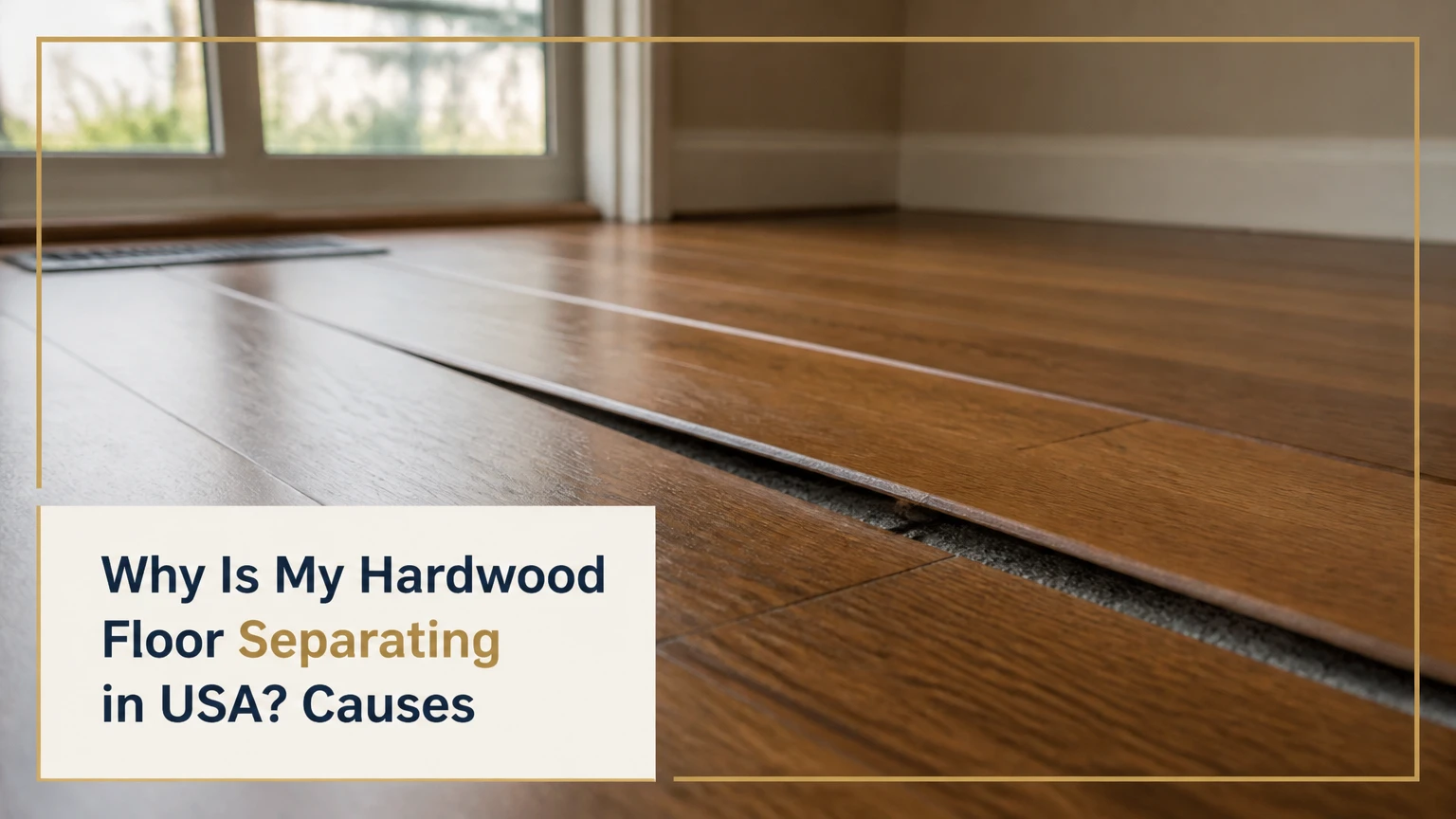
Why Is My Hardwood Floor Separating in USA? Causes
Hardwood floor separation, commonly called gapping, usually occurs because wood boards lose moisture and shrink across their width. In the USA, winter heating, regional humidity changes, installation errors, wet subfloors, plumbing leaks, and inadequate acclimation can all create gaps. Gaps that close during humid weather are usually seasonal; gaps that remain indicate a persistent moisture or installation problem.
Key Facts at a Glance
- Hardwood flooring performs most predictably at approximately 35%-55% indoor relative humidity and 60-80°F.
- Winter heating commonly reduces indoor humidity enough to expose gaps between solid-wood boards.
- A fixed five-to-seven-day acclimation period is not appropriate for every species, product, building, or climate.
- Engineered flooring resists width change better than solid hardwood, but it can still gap after moisture exposure or poor installation.
- Wood filler is unsuitable for gaps that open and close with seasonal humidity.
- A gap beside a dishwasher, refrigerator, exterior door, vent, or bathroom deserves a moisture investigation before cosmetic repair.
Why Is My Hardwood Floor Separating in USA?
Hardwood floor separation happens because the flooring’s moisture content is changing, because boards were installed under unsuitable conditions, or because the subfloor and fastening system are moving. The most common pattern is widespread winter gapping caused by dry indoor air, while isolated gaps more often indicate local moisture, loose fastening, subfloor movement, or damaged boards.
Wood is hygroscopic, meaning it exchanges moisture with surrounding air until it reaches equilibrium. The National Wood Flooring Association describes wood as “a hygroscopic material,” and that property explains why a floor can change dimension without any visible water leak. Wood changes far more across the grain than along its length, so a row of boards can become visibly narrower as indoor RH falls.
The first useful question is not whether a gap exists, but whether the gap changes with the seasons. Record the widest gap with a ruler, photograph it, and measure room RH for several weeks. That evidence distinguishes normal movement from a repairable defect.
Seasonal or Permanent Separation?
Seasonal gapping becomes smaller during humid weather, while permanent separation remains substantially unchanged after indoor humidity returns to its normal range. A floor that gaps across many rooms during January and tightens in July usually needs climate stabilization, not filler.
| Observation | Most likely cause | First action | Typical urgency |
|---|---|---|---|
| Gaps across several rooms in winter | Indoor RH below 35% | Measure RH and add controlled humidity | Low to moderate |
| One gap beside a dishwasher | Plumbing or appliance leak | Inspect supply and drain connections | High |
| Gaps unchanged for 12 months | Installation or permanent shrinkage | Obtain flooring inspection | Moderate |
| Boards move underfoot | Loose fasteners or subfloor defect | Stop cosmetic repair and inspect structure | Moderate to high |
| Dark edges, odor, or soft wood | Persistent moisture or fungal decay | Locate water source promptly | High |
A seasonal gap can still become damaging if boards repeatedly experience extreme drying and rewetting. The goal is not to stop every natural change, but to reduce severe humidity swings.
How Does Hardwood Flooring Move?
Hardwood flooring expands when it absorbs moisture and contracts when it dries, with the greatest dimensional change occurring across the board width. Heating systems, air conditioning, coastal humidity, slab moisture, and ventilation therefore influence the width of joints between adjacent planks.
Solid oak, maple, ash, and hickory respond differently because species have different shrinkage characteristics. Narrow boards usually show smaller individual gaps, while wide-plank flooring makes the same percentage of movement easier to see. Quarter-sawn and rift-sawn boards generally move less across their face than plain-sawn boards.
A finish slows moisture exchange but does not make wood waterproof. Polyurethane, oil finishes, and factory-applied coatings cannot prevent movement caused by prolonged low RH or moisture beneath the floor.
Which Flooring Types Separate?
Solid hardwood has the greatest seasonal width movement, engineered hardwood usually has greater dimensional stability, and floating systems can develop joint movement when the locking mechanism or subfloor is unsuitable. Product construction matters more than the word “hardwood” alone.
| Flooring system | Construction | Common separation pattern | Moisture sensitivity |
|---|---|---|---|
| Solid hardwood | One wood species, commonly 3/4-inch thick | Seasonal face gaps or board shrinkage | Highest across width |
| Engineered hardwood | Wood veneer over cross-layered core | Open joints, edge peaking, or delamination | Moderate |
| Floating engineered floor | Click-lock boards over underlayment | End-joint opening or plank migration | Moderate, plus movement system |
| Historic strip floor | Often narrow solid boards over older subfloor | Irregular seasonal gaps and loose boards | High and variable |
Engineered flooring is not immune to gapping. Its cross-layered construction limits movement, but a wet concrete slab, plumbing leak, dry room, or failed click joint can still separate the visible surface.
What Humidity Should Hardwood Flooring Have?
A practical target for most U.S. homes is 40%-50% RH, kept within the broader NWFA-referenced operating range of 35%-55% RH and approximately 60-80°F. A digital hygrometer is more useful than guessing from outdoor weather because indoor RH depends on heating, ventilation, air sealing, and the building envelope.
Place one hygrometer at floor level in the affected room and another in a central living area. Compare readings morning and evening for at least seven days. A single reading cannot establish the cause, especially during a cold snap or after a humidifier has run.
| U.S. setting | Common indoor risk | Useful monitoring point | Practical response |
|---|---|---|---|
| Upper Midwest winter | RH below 25%-30% | Living room and affected bedroom | Controlled humidification |
| Northeast older home | Dry heat plus air leakage | Perimeter rooms and basement | Seal drafts, inspect HVAC |
| Southeast summer | RH above 55%-60% | Main floor and crawlspace | Dehumidification and vapor control |
| Southwest desert | Very dry outdoor air | Rooms over slab or crawlspace | Humidification and leak checks |
| Pacific Northwest | Damp subfloor or crawlspace | Flooring and crawlspace | Moisture inspection, ventilation |
A humidifier should not be adjusted solely to close a visible gap. Excess humidity can cause cupping, condensation, mold growth, and paint damage. Use a humidistat, keep water reservoirs clean, and stop increasing RH if window condensation appears.
How Can You Diagnose the Cause?
Diagnose hardwood separation by combining four observations: seasonal timing, gap location, board movement, and moisture measurements. A professional should use a pin or pinless moisture meter on the flooring and subfloor, but homeowners can gather useful evidence without drilling or removing boards.
Start with a floor plan. Mark each gap, measure its width, and note whether it follows a wall, a board end, a heating register, an appliance, or a doorway. Check whether boards squeak, flex, feel hollow, or move sideways when pressed.
Use This Diagnostic Sequence
- Measure room RH and temperature. Record readings for seven days.
- Measure the gap. Use a ruler or feeler gauge at the same location each time.
- Check nearby water sources. Inspect toilets, supply lines, dishwashers, refrigerators, washing machines, radiators, and exterior doors.
- Inspect accessible edges. Remove a shoe molding section only if permitted, then look for a missing expansion space or dampness.
- Identify the installation system. Determine whether boards are nailed, glued, stapled, or floating.
- Check the underside conditions. Inspect a crawlspace, basement ceiling, or slab perimeter for damp insulation, standing water, or vapor-barrier defects.
- Review installation records. Product instructions, moisture readings, date of installation, and warranty terms can determine responsibility.
Do not rely on a consumer moisture meter’s number without considering its calibration and species setting. Use the reading to locate differences, then have a flooring professional confirm abnormal areas.
Can Moisture From a Slab, Crawlspace, or Leak Cause Gaps?
Moisture from a concrete slab, crawlspace, basement, or plumbing leak can cause hardwood flooring to separate, cup, stain, or lose adhesion. Localized moisture often produces a different pattern from dry-air shrinkage: the affected boards may swell first, develop edge damage, and later leave gaps after drying.
Concrete slabs can release moisture long after construction, especially when a vapor retarder is missing, damaged, or poorly lapped. Crawlspaces can transfer moisture through high RH, wet soil, plumbing leaks, or inadequate ground covers. A basement leak may affect only boards near one wall.
| Moisture source | Clues on the finished floor | Confirmatory check | Corrective work |
|---|---|---|---|
| Dishwasher supply or drain | Gap, stain, or raised edges near kitchen | Run appliance while inspecting cabinet | Repair plumbing and dry assembly |
| Crawlspace humidity | Widespread cupping or musty odor | Measure crawlspace RH and inspect ground cover | Drainage, ground vapor barrier, ventilation |
| Concrete slab vapor | Repeated failure over slab | Professional slab moisture test | Moisture mitigation and flooring repair |
| Exterior door or window | Darkened edge and seasonal swelling | Inspect flashing, sealant, and threshold | Repair water entry |
| HVAC condensate | Damage below or near air handler | Check drain pan and condensate line | Clear drain and replace damaged material |
Drying the visible floor does not solve an active source. A professional may need to remove baseboards, test the subfloor, and document moisture before replacement.
Did Poor Acclimation or Installation Cause the Separation?
Poor acclimation or installation can cause permanent gapping when flooring is installed before its moisture content suits the building, when the subfloor is too wet, or when boards lack the required perimeter and intermediate movement space. Acclimation is not a universal five-to-seven-day ritual; the manufacturer’s instructions and moisture-content readings control.
The installer should compare flooring moisture content with the wood subfloor, concrete condition, and expected indoor environment. A shipment stored in a dry warehouse may need more time than boards already near the home’s equilibrium condition. Conversely, unboxing flooring in a damp garage can make acclimation worse.
Expansion requirements also vary. A stated 1/2-inch or 3/4-inch perimeter gap may be typical for some 3/4-inch installations, but board width, room size, species, product instructions, transitions, and climate can change the requirement. The installation manual is authoritative for that product.
| Installation issue | Typical symptom | Why separation follows | Inspection target |
|---|---|---|---|
| Wet subfloor | Gaps, cupping, finish failure | Boards change after installation | Subfloor moisture readings |
| No perimeter clearance | Buckling, pressure, later joint opening | Expansion forces have nowhere to go | Walls, cabinets, door jambs |
| Incorrect fastener spacing | Squeaks and lateral board movement | Boards are not held firmly | Fastener type and spacing |
| Adhesive failure | Hollow areas and moving planks | Bond loses contact with substrate | Adhesive transfer and substrate |
| Poor transition detail | Gaps at doorways or large rooms | Movement concentrates at breaks | T-moldings and field divisions |
For a recent installation, photograph the gaps, preserve invoices, and request the installer’s moisture records before attempting repair. Sanding or gluing first can weaken a warranty claim.
Which Repairs Work for Which Gaps?
The correct repair depends on whether the gap is seasonal, permanent, isolated, and associated with solid, engineered, or floating flooring. Climate correction comes first; mechanical closure suits some floating floors, while board replacement or professional filling suits selected permanent gaps.
| Repair method | Suitable floor | Typical U.S. cost | Typical duration | Main limitation |
|---|---|---|---|---|
| RH stabilization | All wood floors | $150-$600 portable; $1,500-$4,000 whole-home | 2-4 weeks | Does not correct installation defects |
| Floating-floor gap tool | Floating engineered floor | $25-$80 DIY; $250-$600 professional | 1-3 hours | Usually unsuitable for nailed floors |
| Individual board replacement | Nailed or glued flooring | $300-$1,200 localized | 4-12 hours | Matching color and finish is difficult |
| Sand, fill, and refinish | Selected solid floors | $7-$15 per square foot for gap work; $3-$8 refinishing | 3-5 days | Filler can crack during movement |
| Full floor replacement | Severe or wet-damaged floor | $10-$25 per square foot typical installed range | 3-10 days | Highest cost and disruption |
Costs are typical U.S. planning ranges, not fixed quotes. Metropolitan labor rates, furniture moving, finish type, subfloor repairs, and hazardous-material requirements can change the total substantially.
Should You Use Wood Filler?
Wood filler should not be used in gaps that open and close with seasonal humidity because summer expansion can crush, eject, or fracture the hardened material. Filler is more appropriate for stable, narrow defects after moisture has been controlled and the flooring professional confirms that movement is minimal.
Flexible gap products may tolerate limited movement better than rigid putty, but they still cannot correct loose boards, active leaks, or missing expansion space. Large gaps filled across an entire floor often become visible seams after the next humidity cycle.
For historic strip flooring, tightly packed natural rope or cotton cord can provide a reversible visual treatment for seasonal gaps. It does not restore structural strength, stop drafts, or repair a wet subfloor.
Can You Fix Separating Boards Yourself?
A homeowner can safely address humidity measurement, leak detection, debris removal, and some floating-floor joint movement. Nailed, glued, wet, buckling, soft, or historically valuable floors usually require professional evaluation because aggressive pulling, glue injection, or sanding can create permanent damage.
For a floating floor, clean the joint, confirm that the plank is not swollen, and use a manufacturer-approved gap-closing block. Do not strike the finished edge directly. Avoid adding glue unless the product instructions specifically permit it, because adhesive can prevent future service and invalidate a flooring warranty.
A clean, taped wood block and suitable double-sided flooring tape may move a floating plank, but the technique is not appropriate for every locking profile. It cannot pull a nailed board sideways without damaging the tongue, fasteners, or finish.
Common DIY Mistakes
- Filling winter gaps immediately: Wait through a controlled humidity cycle before deciding that the gap is permanent.
- Using a steam mop: Steam can drive moisture into joints and damage finish adhesion.
- Over-humidifying: Raising RH above 55% can create cupping, condensation, and biological growth.
- Gluing nailed boards: Surface adhesive rarely corrects movement below the board.
- Ignoring a localized gap: A small gap near plumbing can represent a larger concealed leak.
- Sanding before diagnosis: Refinishing removes evidence and may expose fastener or moisture defects.
When Is Separation a Structural or Warranty Problem?
Professional inspection is appropriate when gaps exceed approximately 1/8 inch, boards flex, the floor buckles, moisture readings differ sharply from adjacent areas, or separation began soon after installation. New floors should be documented before repair because installation warranties often depend on evidence of substrate preparation and acclimation.
A flooring contractor should identify the product, installation method, moisture conditions, expansion clearances, fastener schedule, and finish history. An NWFA-certified professional can provide a more systematic evaluation, although certification does not guarantee a particular repair outcome.
Seek urgent help for soft wood, black staining, persistent odor, visible mold, active leaks, electrical equipment exposed to water, or rapid floor movement. Do not walk repeatedly across a visibly swollen or unstable area.
How Much Does Hardwood Gap Repair Cost?
Typical U.S. hardwood separation repairs cost $150-$600 for portable humidity equipment, $250-$600 for professional floating-floor joint closure, $7-$15 per square foot for extensive gap repair, and $10-$25 per square foot for replacement when subfloor or boards are damaged. Inspection, moisture remediation, and furniture handling may add separate charges.
| Project scope | Typical planning range | Labor time | Best use case |
|---|---|---|---|
| Hygrometer and basic monitoring | $15-$60 | 15 minutes to install | First diagnostic step |
| Portable humidifier or dehumidifier | $50-$600 | 1-3 hours setup | Seasonal RH correction |
| Localized professional inspection | $150-$500 | 1-3 hours | Unknown cause or warranty issue |
| Local board repair | $300-$1,200 | 4-12 hours | One to several damaged boards |
| Room refinishing | $1,500-$4,500 typical | 3-5 days | Stable floor with cosmetic defects |
Repair estimates become unreliable when contractors quote filler before testing moisture. Ask whether the price includes source correction, subfloor work, board replacement, finish blending, and dust control.
How Do You Prevent Hardwood Gapping?
Prevent hardwood gapping by keeping indoor RH near 40%-50%, controlling crawlspace and slab moisture, following the product’s acclimation instructions, and preserving the required expansion space around walls and fixed cabinets. Prevention begins before installation because a dry or wet substrate can create movement that finish work cannot reverse.
Use a hygrometer year-round, especially in cold northern states and dry western states. Have HVAC equipment serviced, keep humidifiers clean, and avoid directing supply registers at the floor. In humid regions, improve drainage and use dehumidification rather than sealing the floor surface with unapproved coatings.
For a new installation, retain cartons, product instructions, moisture reports, invoices, and photographs. Those records help distinguish normal seasonal behavior from an installation defect.
The Bottom Line
Why is my hardwood floor separating in USA? The most likely explanation is seasonal moisture loss when indoor RH falls below about 35%, but permanent or localized gaps require inspection for leaks, wet subfloors, missing expansion space, poor acclimation, loose fastening, or damaged boards. Measure RH, map the gaps, check nearby water sources, and stabilize the climate before choosing filler or replacement.
A floor that closes during humid weather needs controlled environmental management. A floor that stays separated, moves underfoot, smells musty, or sits beside a water source needs a flooring and moisture diagnosis.
FAQ
Will hardwood gaps close in the summer?
Seasonal hardwood gaps often become smaller during humid summer conditions, especially in solid strip flooring. Closure is not guaranteed if boards suffered permanent shrinkage, the installation lacks adequate expansion space, the subfloor remains unstable, or the floor has lost material at its edges. Photograph and measure the same gap across seasons.
Are gaps between hardwood boards normal?
Small seasonal gaps can be normal in solid hardwood because wood responds to indoor humidity. Gaps are less acceptable when they remain year-round, exceed roughly 1/8 inch, occur with loose boards or cupping, or appeared soon after installation. Product instructions and local moisture conditions determine whether a specific gap is expected.
Is engineered hardwood better for humid states?
Engineered hardwood generally handles width movement better than solid hardwood because its cross-layered construction reduces dimensional change. It still requires a dry, properly prepared subfloor and controlled indoor RH. Flooding, slab vapor, high crawlspace humidity, or failed joints can separate engineered boards in Florida, Louisiana, and other humid states.
Can a dehumidifier fix separated hardwood floors?
A dehumidifier can reduce further movement when indoor RH is persistently above 55%, but it usually cannot close gaps caused by permanent shrinkage, loose fastening, or damaged boards. Monitor RH with a hygrometer and correct leaks or crawlspace moisture first. Excessive drying can create new gaps elsewhere.
Should I replace the whole hardwood floor?
Whole-floor replacement is usually unnecessary when gaps are seasonal or limited to a few repairable boards. Replacement becomes more reasonable when moisture has caused widespread delamination or decay, the subfloor is unsuitable, boards cannot be matched, or repeated repairs have failed. Obtain a moisture-focused inspection before authorizing replacement.