Why Does My House Smell Like Rotten Eggs? Find the Source
A house that smells like rotten eggs may contain hydrogen sulfide from sewer gas or sulfurous water, or mercaptan added to natural gas and propane. Because mercaptan signals a potentially explosive gas leak, treat a widespread or appliance-area odor as an emergency: leave immediately, avoid electrical switches and flames, and call 911 or your gas utility from outside.
Key Facts at a Glance
- Natural gas and propane are odorless before suppliers add mercaptan, an odorant that resembles rotten eggs.
- Hydrogen sulfide can enter from sewer plumbing, contaminated water, water heaters, septic systems, or decomposing organic material.
- A smell that occurs only during hot-water use commonly points to the water heater, while an odor in cold and hot water points toward the supply.
- A dry P-trap can allow sewer gas into a room, especially through basement floor drains, guest bathrooms, and utility sinks.
- Natural gas has a lower explosive limit of about 5% by volume in air and an upper explosive limit near 15%.
- Smell is not a reliable safety instrument because prolonged hydrogen sulfide exposure can reduce the ability to detect it.
Why Does My House Smell Like Rotten Eggs?
The odor usually comes from one of two chemical signals: mercaptan in fuel gas or hydrogen sulfide in sewer gas and sulfur-containing water. Location and timing provide the first useful clues, but a strong, widespread odor near a gas appliance must be treated as a gas emergency rather than investigated indoors.
Mercaptan, also called a thiol, is added to natural gas and propane because the fuels have no natural smell. A loose connector, damaged service line, failed appliance valve, extinguished pilot, or leaking propane cylinder can release the odorant before a homeowner notices any visible evidence.
Hydrogen sulfide, written as H₂S, forms when bacteria break down sulfur compounds without much oxygen. Sewer systems, stagnant water heaters, private wells, septic components, wet organic debris, and some drains can produce or transport it. H₂S is toxic at high concentrations, and the odor threshold is far below the level at which many people would consider the smell overwhelming.
The National Institute for Occupational Safety and Health warns, “Do not rely on your sense of smell to indicate the continuing presence of this gas,” because odor fatigue can occur. That limitation matters during any suspected sewer-gas or H₂S event.
Is a Rotten-Egg Smell in a House Dangerous?
A rotten-egg smell is potentially dangerous when it is widespread, strongest near a gas appliance, accompanied by hissing, or noticed after a gas service interruption. Leave without operating switches, thermostats, garage-door openers, phones, vehicles, or flashlights inside, then call 911 or the gas utility from outdoors.
Do not search for the leak, relight a pilot, shut off an appliance, or use a combustible-gas detector inside a suspected leak area. If the meter is outside and the utility has provided specific shutoff instructions, follow those instructions only when doing so does not delay evacuation or require entering the building.
Gas utilities commonly provide emergency leak response at no charge, although private repairs, appliance replacement, or customer-owned piping may cost money. In the USA, a typical private gas-line repair may cost $150-$700, but excavation, concealed piping, permits, and appliance work can raise the bill substantially.
H₂S presents a different hazard. Headache, dizziness, nausea, eye irritation, confusion, breathing difficulty, or sudden loss of smell require fresh air and medical help. Never enter a confined space, septic tank, crawlspace, or sump pit to investigate an odor. Fire departments and hazardous-material teams have respiratory protection and gas-monitoring equipment.
Where Is the Rotten-Egg Odor Strongest?
The strongest location narrows the source, but it does not eliminate the gas-leak possibility. A room-by-room inspection is appropriate only after a gas utility or emergency responder has ruled out a fuel-gas emergency.
| Odor pattern | Most likely source | Urgency | First action |
|---|---|---|---|
| Whole house, near stove or furnace | Natural gas or propane | Immediate | Evacuate and call outside |
| Bathroom or basement drain | Dry P-trap or sewer vent | Same day | Refill trap if gas is ruled out |
| Only hot water | Water-heater bacteria or anode | Low to moderate | Stop drinking affected water and arrange diagnosis |
| Hot and cold water at every tap | Well or municipal supply | Same day | Use bottled water and request testing |
| Kitchen sink or disposal | Food residue, drain biofilm, sewer connection | Low to moderate | Clean the removable parts and trap area |
| Garage or utility room | Propane cylinder, vehicle, drain, battery, or gas appliance | Immediate if gas is possible | Leave and call for an inspection |
| One wall, cabinet, or floor area | Hidden drain leak, dead animal, wet insulation | Moderate | Isolate the room and call a plumber or pest professional |
Airflow can mislead diagnosis. A bathroom vent, return-air grille, sump basin, or furnace can move an odor several rooms away from its source, so the strongest-smelling room is not always the origin.
How Can You Tell Whether the Smell Is Gas?
A suspected fuel-gas odor cannot be safely confirmed with a smell test, candle, lighter, or consumer detector. If natural gas or propane is plausible, evacuate first and let the utility or fire department use a calibrated combustible-gas meter.
Natural gas is lighter than air, while propane is heavier than air and can collect near floors, pits, and low crawlspaces. Both can ignite when their concentration reaches a flammable range. The approximate natural-gas flammable range is 5%-15% by volume in air, but concentration changes continuously with ventilation and leakage.
| Gas-related clue | What it may indicate | Safe homeowner response | Do not do |
|---|---|---|---|
| Hissing near a pipe or appliance | Pressurized gas escape | Leave immediately | Do not inspect with a flame |
| Odor after pilot failure | Unburned fuel | Evacuate and call utility | Do not relight the pilot |
| Smell near propane tank | Cylinder, regulator, or line issue | Move away and call propane supplier | Do not close valves unless instructed |
| Carbon-monoxide alarm | Separate combustion hazard | Leave and call emergency services | Do not assume CO smells |
| Odor disappears outdoors | Indoor concentration or airflow issue | Report the original location | Do not re-enter to verify |
Carbon monoxide has no smell. A carbon-monoxide alarm does not detect natural gas, propane, hydrogen sulfide, or sewer gas, and a combustible-gas alarm does not replace a carbon-monoxide alarm.
What Does a Dry P-Trap Smell Like?
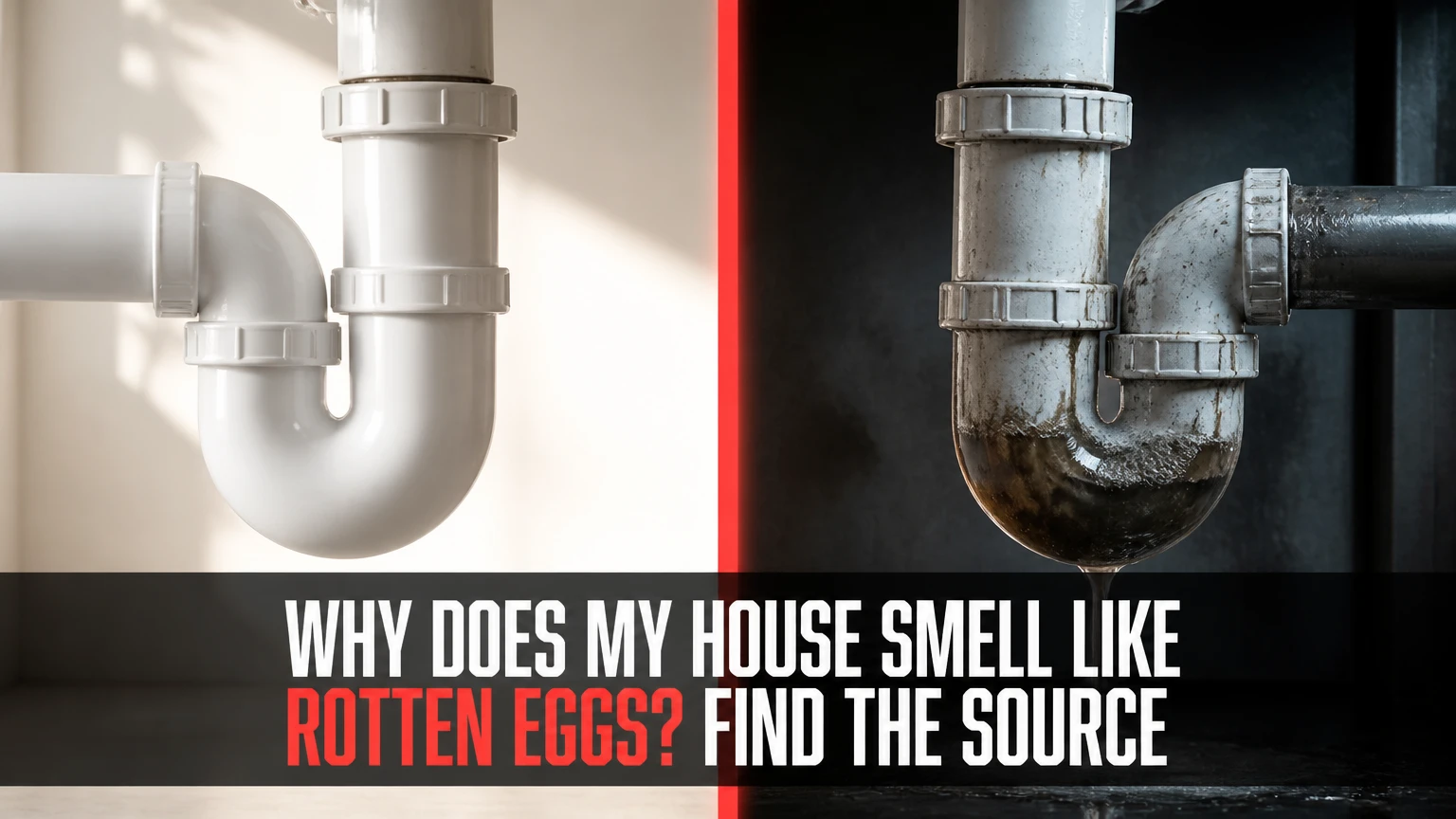
A dry P-trap can produce a rotten-egg or sewage odor because the water seal has evaporated and no longer blocks sewer gases. The usual locations are infrequently used showers, basement floor drains, laundry sinks, condensate drains, and guest bathrooms.
After fuel gas has been ruled out, slowly pour about 1 gallon of water into the suspect drain. Run the nearby fixture for 30-60 seconds, then close the room for several hours. You should notice improvement within minutes if evaporation caused the odor.
A toilet can smell like sewer gas even when nearby sink traps contain water. A failed wax ring, loose toilet flange, cracked drain connection, blocked vent, or damaged sewer line can allow gases around the toilet base. Water around the toilet, movement, bubbling, or a smell that returns after trap refilling warrants a plumber.
| Plumbing observation | Likely fault | Typical USA diagnostic cost | Typical resolution |
|---|---|---|---|
| Odor stops after adding water | Evaporated trap seal | $0 | Add water monthly |
| Odor returns within days | Leak, siphoning, or vent fault | $150-$400 | Repair trap or vent |
| Toilet smells at its base | Failed seal or flange | $150-$600 | Reset toilet and replace seal |
| Multiple drains smell | Vent or sewer-line issue | $250-$1,500 | Smoke test, camera, or repair |
| Basement pit smells | Sump cover, drain, or sewer gas | $150-$700 | Seal cover or correct piping |
Do not pour bleach, drain opener, or acid into a drain to solve an unidentified sewer odor. Chemical reactions can create toxic fumes, damage seals, and conceal a venting or sewer-line defect.
Why Does Hot Water Smell Like Rotten Eggs?
Hot water can smell like rotten eggs when sulfate-reducing bacteria react with sulfate in the water and the water heater’s magnesium anode rod. The odor usually appears at hot taps but not cold taps, and the source is often the tank rather than the household drain.
An anode rod protects a steel tank by corroding preferentially. Magnesium rods provide strong protection but can contribute to sulfur odor under certain water conditions. A plumber may recommend an aluminum-zinc rod or powered anode after checking tank compatibility, water chemistry, manufacturer requirements, and remaining tank life.
A tank flush may reduce sediment but does not always remove the cause. Water heaters contain scalding water, electrical connections, gas burners, and pressurized plumbing, so turn off the correct energy source and follow the manufacturer’s procedure. A professional anode replacement typically takes 45-90 minutes and costs about $200-$400, including common labor and parts.
| Hot-water finding | Likely explanation | Practical next step | Typical timeframe |
|---|---|---|---|
| Odor only at hot taps | Water heater | Test anode and tank | 1-3 days for service |
| Odor strongest after vacation | Stagnant tank water | Flush and test | Same day |
| Odor with rusty water | Tank corrosion or sediment | Inspect tank and anode | Same week |
| Odor remains after anode change | Sulfur in incoming water | Test cold water and supply | 1-2 weeks |
| Tank older than 10 years | End-of-life risk | Compare repair and replacement | Planned decision |
A different anode is not automatically better. Removing a functioning anode without replacing it can shorten tank life, while an incompatible powered rod can damage equipment or void a warranty.
What If Cold and Hot Water Both Smell?
If rotten-egg odor occurs in both cold and hot water, the likely source is the incoming water, a private well, a building service line, or a plumbing biofilm. If the odor affects only one faucet, a contaminated aerator or local supply branch becomes more likely.
Fill a clean glass from the suspect cold tap, carry it away from the sink, and smell the water outdoors or in a well-ventilated area. If the glass smells, the water itself contains the odor. If the glass does not smell but the sink area does, the drain or overflow is more likely.
Private well owners should request a certified laboratory test for coliform bacteria, E. coli, sulfate, iron, manganese, pH, and sulfur-related odor conditions. A sulfur smell does not prove that water is unsafe, and lack of smell does not prove that it is safe. Follow the laboratory and local health department guidance.
| Water pattern | Probable source | Useful test | Treatment direction |
|---|---|---|---|
| One faucet, cold only | Aerator or branch pipe | Remove and sanitize aerator | Replace or disinfect parts |
| Every faucet, cold and hot | Well or supply | Certified water analysis | Oxidation, filtration, or disinfection |
| Hot only | Water heater | Compare cold and hot glasses | Anode and tank service |
| Intermittent after rain | Well intrusion or plumbing change | Coliform and well inspection | Correct well seal or drainage |
| Municipal homes on one street | Distribution event | Contact water utility | Follow boil-water notice |
Municipal-water customers should contact the water department when the odor affects several homes, began after utility work, or comes with discoloration or a pressure change. A whole-house filter is not a substitute for identifying the contaminant.
What Is the Safest Way to Isolate a Non-Gas Odor?
The safest isolation method is to compare air near drains with water samples after a qualified emergency check excludes fuel gas. Use a clean glass, cold water first, hot water second, and a separate location away from the sink; never create a spark or enter a confined space.
- Check whether the odor is strongest near a gas appliance, meter, propane cylinder, or utility room. If yes, leave immediately.
- If the utility has ruled out gas, run cold water into a clean glass and smell it away from the fixture.
- Repeat with hot water, avoiding steam near your face.
- Smell the drain opening without placing your face over it.
- Refill unused traps with water and record whether the odor changes.
- Compare neighboring fixtures, including a basement drain and an outdoor hose bib.
- Photograph leaks, water discoloration, appliance labels, and affected plumbing before calling a professional.
| Test result | Most probable interpretation | Confidence | Follow-up |
|---|---|---|---|
| Air smells, glass does not | Drain, overflow, or nearby material | High | Clean or inspect drain |
| Hot glass smells, cold glass does not | Water heater | High | Service anode and tank |
| Both glasses smell | Incoming water | Moderate to high | Certified water test |
| Only one faucet smells | Aerator or local branch | Moderate | Remove and sanitize aerator |
| Odor returns after trap refill | Vent, seal, or sewer defect | High | Plumbing diagnosis |
These tests identify patterns, not hazards. A negative home test cannot certify that a building is free of natural gas, propane, methane, or H₂S.
Which Sources Need a Plumber, Utility, or Water Specialist?
A gas utility or fire department handles suspected fuel gas, a licensed plumber handles drainage and venting, and a certified water professional or laboratory handles persistent supply odors. Choosing the wrong professional delays repair and can encourage unsafe DIY work.
| Source | Correct professional | Typical USA cost | Typical resolution time |
|---|---|---|---|
| Natural gas or propane leak | Utility or emergency responder | $0 emergency utility visit | Immediate assessment |
| Sewer vent or drain defect | Licensed plumber | $150-$600 diagnosis | 1-3 hours diagnosis |
| Buried sewer line | Plumber or sewer contractor | $500-$5,000+ | 1 day to several days |
| Water-heater odor | Plumber | $200-$400 anode service | 45-90 minutes |
| Private-well sulfur odor | Certified lab and water contractor | $150-$3,000 treatment | 1-7 days |
| Dead animal or organic debris | Pest or remediation professional | $150-$800 | Same day to several days |
A typical well treatment may involve shock chlorination, aeration, hydrogen peroxide injection, or another oxidation system. Treatment depends on test results, flow rate, iron and manganese levels, pH, bacterial findings, and whether the odor originates in the well or the plumbing.
What Other Causes Mimic Sewer Gas?
Dead rodents, decaying food, garbage-disposal buildup, sulfur-producing bacteria in a washing machine, and overheated electrical components can mimic rotten eggs. Electrical burning often smells sharp, acrid, or fish-like rather than distinctly sulfurous, but any burning odor near a panel or outlet requires immediate circuit isolation by a qualified professional.
A furnace or air handler can distribute an odor from a nearby drain, crawlspace, dead animal, or condensate pan. HVAC equipment itself generally does not create mercaptan, so a rotten-egg smell near a furnace still requires a gas-leak check before an HVAC diagnosis.
Garbage disposals collect biofilm beneath splash guards and inside the grinding chamber. After gas is ruled out, clean the splash guard and disposal according to the manufacturer’s instructions, then flush with cold water. Never mix vinegar, bleach, ammonia, or commercial drain chemicals.
How Much Does Rotten-Egg Odor Diagnosis Cost?
Diagnosis costs range from $0 for a utility emergency response or a dry-trap refill to $3,000 or more for private-well treatment. The final price depends on whether the source is fuel gas, an accessible fixture, concealed plumbing, a buried sewer, or water chemistry.
| Repair or investigation | Typical USA price | Typical duration | DIY suitability |
|---|---|---|---|
| Utility gas-leak response | $0 | 15-45 minutes arrival varies | No |
| Refill dry P-trap | $0 | 5 minutes | Yes, after gas exclusion |
| Faucet aerator replacement | $5-$25 | 10-20 minutes | Yes |
| Plumbing smoke test | $250-$500 | 1-3 hours | No |
| Water-heater anode replacement | $200-$400 | 45-90 minutes | Experienced owners only |
| Certified well-water panel | $100-$300 | 3-14 days laboratory | No sampling shortcuts |
| Well shock chlorination | $150-$400 | 24-48 hours | Often professional |
| Sulfur treatment system | $800-$3,000 | 1 day installation | Usually no |
Ask for a written scope that identifies the suspected source, diagnostic method, permit requirements, parts, labor, restoration, and warranty. An unusually cheap quote that only deodorizes the room may leave the hazardous cause untouched.
What Mistakes Make the Odor Worse?
The most dangerous mistake is treating every rotten-egg odor as a cleaning problem. Masking the smell with candles, air fresheners, incense, or ozone delays diagnosis and can add ignition, respiratory, or chemical hazards.
Common failure modes include:
- Testing with a flame: A lighter can ignite a fuel-air mixture. Evacuate instead.
- Relighting a pilot: A failed pilot may accompany a valve or ventilation fault. Let a professional inspect it.
- Trusting odor disappearance: Olfactory fatigue can make H₂S or mercaptan seem absent while exposure continues.
- Pouring chemicals into drains: Bleach and acids can release dangerous gases and damage plumbing.
- Replacing the anode blindly: A second magnesium rod may recreate the sulfur condition.
- Using a carbon filter for severe well sulfur: Carbon can saturate quickly and does not correct bacterial or chemical causes.
- Assuming a carbon-monoxide alarm covers gas: CO alarms detect carbon monoxide, not methane, propane, or H₂S.
An experienced plumber also checks whether a trap is being siphoned by poor venting. Repeatedly adding water may temporarily suppress the odor while the underlying vent defect continues.
What Should Renters and Well Owners Do?
Renters should evacuate for any suspected gas odor, contact emergency services or the utility from outside, and submit written maintenance requests for non-emergency plumbing odors. Do not remove anode rods, open walls, chlorinate plumbing, or alter gas appliances in a rental property.
Private-well owners should stop using affected water for drinking and cooking until testing clarifies the condition, especially when odor is accompanied by gastrointestinal symptoms, cloudy water, recent flooding, or a failed well cap. Septic-system owners should also inspect tank access, cleanouts, drain fields, and plumbing vents through licensed contractors.
| Situation | Immediate decision | Documentation | Escalation |
|---|---|---|---|
| Apartment-wide gas odor | Evacuate | Time and location from outside | 911, utility, landlord |
| Rental bathroom odor | Refill no fixtures until gas ruled out | Written maintenance ticket | Property manager |
| Private well after flooding | Use bottled water | Flood date and lab sample | Health department |
| Septic odor outdoors | Avoid tank and pit areas | Weather and location notes | Septic professional |
| Recurrent basement odor | Keep room ventilated without switches | Photos and frequency log | Plumber and landlord |
How Can You Prevent Rotten-Egg Odors?
Preventive maintenance reduces recurring drain, water-heater, and well odors but cannot replace emergency response to a suspected gas leak. Run water through unused drains monthly, maintain working gas and carbon-monoxide alarms, inspect water-heater components on schedule, and test private wells at least annually.
Keep drain covers and toilet seals intact, prevent sump-pit openings from venting into living spaces, and avoid storing organic waste in warm utility areas. Water-heater owners should inspect the anode according to the manufacturer’s maintenance schedule, commonly every 2-3 years in odor-prone water.
Private-well households should use a certified laboratory and retain baseline results. Test after flooding, repairs, changes in taste or odor, or a positive coliform result. Do not select aeration, oxidation, chlorination, or filtration from odor alone.
FAQ About Rotten-Egg Smells in Houses
Can a dead animal cause a rotten-egg smell?
A dead mouse, rat, bird, or other animal can create a sulfurous decomposition odor, particularly inside a wall, attic, crawlspace, chimney, or duct. A dead animal is more likely when the smell is localized, does not involve water, and intensifies over several days. Do not open walls near gas piping without professional guidance.
Why does the smell appear only when I run the water?
Running water can disturb sewer gases, draw air through a failed vent, or release sulfur compounds from the water itself. Compare cold and hot water in a clean glass away from the sink. If the glass is odorless but the room smells, inspect the drain, overflow, trap, and vent.
Can sewer gas make people sick?
Sewer gas can contain hydrogen sulfide, methane, ammonia, and other contaminants. Low-level exposure may cause irritation, headache, nausea, or dizziness, while high concentrations can impair breathing and smell detection. Leave areas with strong odor or symptoms, avoid confined spaces, and contact emergency responders rather than attempting a gas test.
Should I drink water that smells like sulfur?
Do not assume sulfur-smelling water is safe or unsafe solely from odor. Stop drinking it temporarily when the odor is new, severe, or accompanied by illness, discoloration, flooding, or a failed well component, then obtain certified testing and follow local health-department advice.
How long does a water-heater sulfur smell last after repair?
A water-heater odor may improve immediately after a successful flush but can take 24-48 hours of normal hot-water use to clear. If the smell returns within days, the anode, bacteria, incoming water, temperature setting, or tank condition may still be contributing.
Is a sulfur smell from an HVAC vent a gas leak?
An HVAC vent can distribute a gas odor from another room, but the vent itself does not make a suspected fuel-gas release safe. Evacuate when natural gas or propane is possible, then have the utility check the building before investigating the furnace, condensate drain, filter, crawlspace, or ductwork.
The Bottom Line
Why does my house smell like rotten eggs? The answer is usually mercaptan from natural gas or propane, hydrogen sulfide from sewer plumbing, sulfurous water, or a water-heater reaction. Because fuel gas can ignite and H₂S can harm health, evacuate for a widespread or appliance-area odor, call the utility from outside, and use drain or water troubleshooting only after professionals exclude gas.