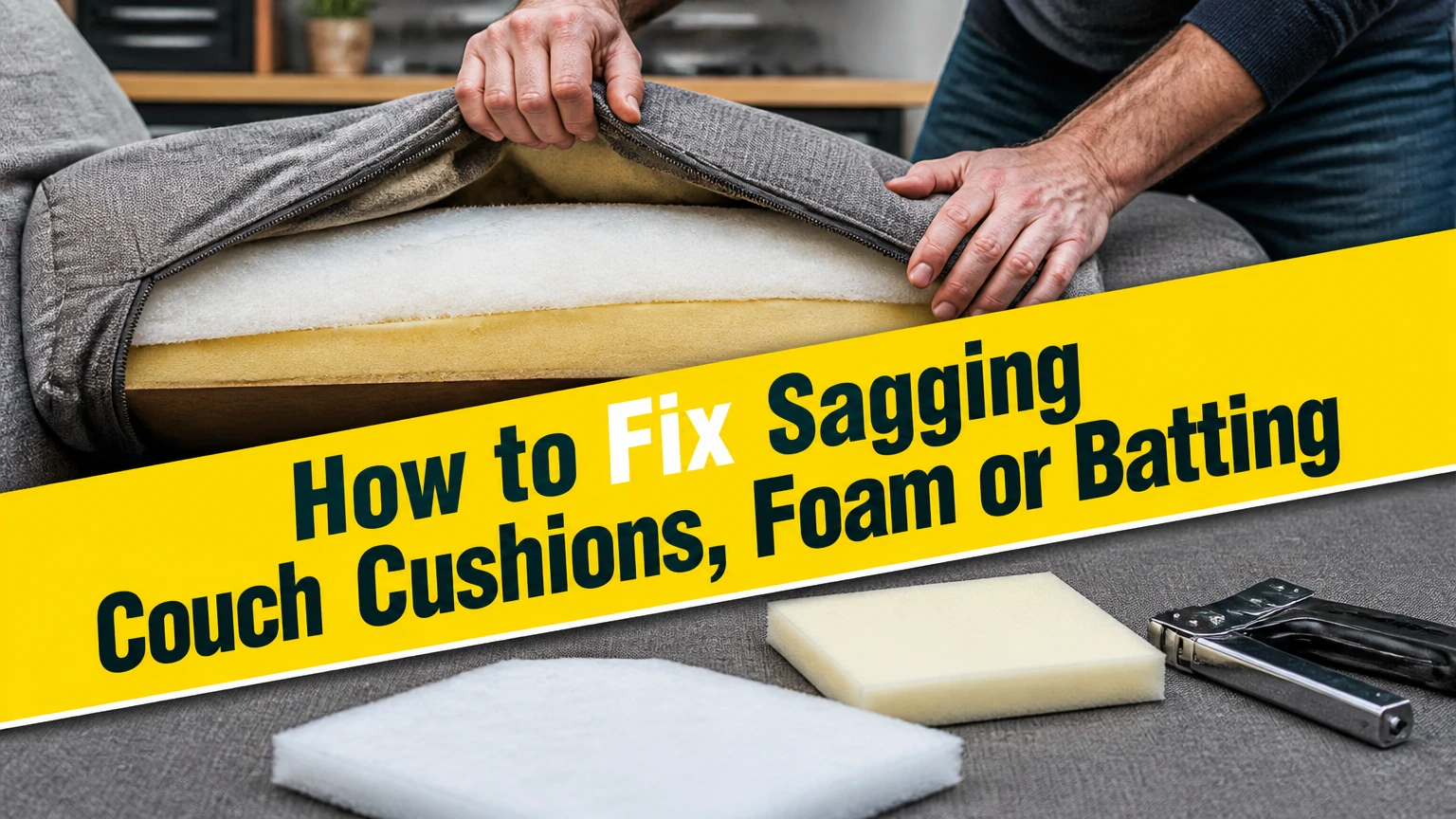
How to Fix Sagging Couch Cushions, Foam or Batting
To fix sagging couch cushions, first identify whether the failure is in the foam, fiberfill, cushion cover, deck, springs, or frame. Add batting for a quick plush correction, install a firm support panel for a weak base, or replace degraded foam for the longest-lasting repair. Most cushion repairs take 30-90 minutes and cost $15-$250.
Key Facts at a Glance
A cushion that remains compressed after 24 hours usually needs new foam, not more fluffing.
High-resilience upholstery foam around 2.5-3.0 lb/ft³ typically provides better long-term seat support than low-density foam.
Polyester batting usually costs $10-$35 per cushion and improves loft, but it does not repair broken springs or a damaged frame.
A correctly sized support board can reduce deck sag immediately, but it may make the sofa feel firmer.
Measure the cushion cover at its widest usable dimensions, not the old compressed insert.
New seat foam commonly costs $60-$180 per cushion in the USA, depending on size, density, and supplier.
What Is Actually Sagging?
A sagging couch cushion has lost height or support because its filling, cover, base, or frame no longer distributes body weight properly. The fastest diagnosis is to remove every cushion, inspect the inserts and platform, then compare the empty seat deck with the cushion resting on a flat floor.
Start with a visual and physical check. Lay each insert flat and measure its height at the center and at an undamaged edge. A center depression of 1-2 inches that remains after the foam rests overnight points toward permanent compression. If the insert looks sound but the sofa deck dips, the support system is the problem.
| Symptom | Likely failed component | Confirmation test | Appropriate repair |
|---|---|---|---|
| Center stays 1-2 inches low | Seat foam | Leave insert flat for 24 hours | Replace foam or add thin batting |
| Cushion feels lumpy | Fiberfill or down blend | Press and locate loose clumps | Redistribute or replace filling |
| Entire seat deck dips | Webbing, springs, or plywood | Test the empty frame | Support panel or upholstery repair |
| Cushion slides into a gap | Cover or frame dimensions | Check side and rear clearances | Correct insert size or frame alignment |
| One corner collapses | Foam edge or spring | Compare corner firmness | Replace insert or repair spring |
| Back cushion has no shape | Fiberfill or loose casing | Open zipper and inspect stuffing | Break up fill and add polyester fiber |
| Frame creaks or twists | Loose joint or broken rail | Lift one front corner slightly | Tighten hardware or hire an upholsterer |
Why do couch cushions sag?
Couch cushions sag because polyurethane foam loses resilience, fiberfill compresses, feather filling migrates, or the seat structure beneath the cushion weakens. Repeated loading in the same spot accelerates the defect, especially when one person always sits on one side or the cushion is never rotated.
Poor fit also creates sagging symptoms. A cover that is too large allows the insert to migrate, while a cover that is too tight can fold the foam and create edge collapse. Heat, humidity, pet moisture, and frequent sleeping on the sofa can further shorten filling life.
Which Repair Method Fits the Failure?
The best repair depends on the failed layer. Batting works for a slightly undersized or mildly flattened insert, a support board works for a sagging platform, and replacement foam works when the cushion core has permanently lost resilience.
Do not use one method for every couch. A board cannot restore dead foam, and loose fiberfill cannot stabilize a broken frame. The table below separates short-term comfort improvements from repairs that address the underlying cause.
| Repair method | Typical USA cost | Time | Expected service life | Best use |
|---|---|---|---|---|
| Rotate and flip cushions | $0 | 5 minutes | 1-6 months of improvement | Uneven wear without permanent compression |
| Polyester batting wrap | $10-$35 | 20-45 minutes | 6 months-3 years | Mild flattening and loose-fitting covers |
| Loose fiberfill refill | $15-$50 | 30-90 minutes | 6 months-3 years | Back cushions and fiber-filled seats |
| Support board | $20-$90 | 15-40 minutes | 2-10 years | Sagging deck or weak webbing |
| New upholstery foam | $60-$180 per cushion | 45-120 minutes | 7-15 years typical | Permanently compressed seat foam |
| Professional reupholstery | $1,000-$3,500 per sofa | 1-4 weeks | 8-15 years | Structural, fabric, and filling failure |
Does steaming fix flattened foam?
Steaming may relax wrinkles in upholstery fabric or temporarily expand some fiber materials, but steam does not reliably restore polyurethane foam that has permanently lost resilience. Moisture can also remain inside the cover, encourage odor, and damage leather or delicate upholstery.
Use a clothes steamer only on suitable fabric, with the insert removed if the manufacturer permits it. Keep the nozzle moving, avoid soaking the material, and let the cover dry completely. A visibly flat foam core will usually need batting or replacement rather than heat.
Before You Start
A basic cushion refresh needs 30-60 minutes, beginner skill, and $10-$50 in materials. A foam replacement needs 1-2 hours per cushion, intermediate handling, and approximately $60-$180 for a USA-made foam insert, depending on dimensions and density.
Materials and tools checklist
| Repair goal | Materials | Quantity per cushion | Typical USA price |
|---|---|---|---|
| Batting refresh | Polyester upholstery batting | 1-2 yards | $10-$35 |
| Fiber refill | Bonded polyester fiberfill | 2-5 pounds | $15-$50 |
| Foam replacement | Upholstery foam, 2.5-3.0 lb/ft³ | 1 cut insert | $60-$180 |
| Foam wrap | Dacron or polyester batting | 1-2 yards | $10-$30 |
| Support panel | 1/2-3/4 inch plywood or sofa support board | 1 panel | $20-$90 |
| Cutting | Serrated bread knife or electric carving knife | 1 tool | $15-$60 |
| Installation | Upholstery adhesive spray | 1 can | $10-$18 |
| Measuring | Tape measure, ruler, marker | 1 each | $8-$20 |
Before cutting or buying material, photograph the cushion orientation and check the care label. Mark “front,” “top,” and “left” on masking tape because reversible cushions can look symmetrical while having different seams or compression patterns.
Option 1: Add a Batting Wrap
A polyester batting wrap is the quickest improvement for a cushion that is slightly flat but still structurally sound. One or two even layers add loft around the foam, fill small gaps, and soften hard edges without requiring sewing.
Step 1: Open and inspect the cushion
Find the zipper along the rear, underside, or a concealed seam. Remove the insert carefully, vacuum loose debris from the cover, and inspect the foam for crumbling, odor, dampness, or tears.
If the foam breaks into powder when rubbed, batting is a temporary cosmetic measure. Replace the insert instead.
Step 2: Add one even batting layer
Place the foam on a clean floor and wrap it like a parcel, keeping the batting smooth across the top and bottom. Use one layer for a 1/2-inch height correction and two layers for a looser cover that needs approximately 1 inch of additional loft.
Avoid creating a thick ridge at the front edge. Secure overlapping seams with a small amount of upholstery adhesive, not household glue.
Step 3: Reinsert and check the fit
Compress the wrapped foam lengthwise, guide the rear corners into the cover, then work toward the front corners. Close the zipper gradually while keeping the batting flat.
You will know the wrap worked when the cover is full without diagonal wrinkles and the cushion rebounds after a firm hand press. If the zipper requires force, remove one layer rather than stretching the seam.
Option 2: Replace the Foam Core
Replacing degraded foam is the most durable cushion repair because it restores the load-bearing material instead of hiding its compression. A properly fitted insert should fill the cover firmly, support the sitter without bottoming out, and regain most of its shape after use.
Step 1: Measure the cover
Measure the inside dimensions of the empty cover at the longest length, widest width, and deepest usable height. Measure twice, record the smallest dimension where seams or piping restrict the opening, and do not copy the old foam if it has collapsed.
For a standard boxed seat cushion, order foam close to the cover dimensions. A typical cover may accept foam equal to its length and width, with a height 1/2-1 inch greater than the relaxed cover depth. Confirm the supplier’s fit guidance because a cover with a tight zipper needs less oversizing.
| Measurement point | What to measure | Common target | Why it matters |
|---|---|---|---|
| Length | Inside front-to-back or side-to-side span | Cover length, within 0-1/2 inch | Prevents end gaps |
| Width | Widest interior panel | Cover width, within 0-1/2 inch | Controls side fullness |
| Height | Finished boxed depth | Cover depth plus 0-1 inch | Creates crown and loft |
| Foam density | Weight per cubic foot | 2.5-3.0 lb/ft³ | Indicates durability |
| Foam firmness | ILD or supplier firmness rating | 30-40 ILD for many seats | Controls sitting feel |
| Batting thickness | Dacron or polyester wrap | 1/2-1 inch | Softens edges and hides foam |
Step 2: Choose density and firmness
Choose foam density and firmness separately. Density predicts wear resistance, while firmness describes initial feel; a dense foam can be soft, and a low-density foam can feel firm when new but break down quickly.
For everyday adult seating, 2.5-3.0 lb/ft³ high-resilience or quality polyurethane foam is a practical target. A 30-40 ILD range often suits standard sofa seats, while heavier users or people who dislike sinking may prefer a firmer specification. The foam supplier should confirm the exact rating.
Step 3: Cut the insert safely
Mark the foam with a straightedge and use a serrated bread knife, turkey-carving knife, or electric carving knife. Cut with long strokes and keep the blade perpendicular to the foam so the sides do not taper.
Test the cut against the cover before applying adhesive. Small irregularities can disappear under batting, but a 1-inch angle across an entire side will create a visible lean and uneven support.
Step 4: Wrap the foam
Apply upholstery adhesive sparingly to one face at a time if the batting needs to stay in place. Wrap the insert with Dacron or polyester batting, overlap the seam on the underside, and leave the zipper path free of excess material.
Batting creates a rounded crown and reduces the hard, square feel of freshly cut foam. It does not compensate for a foam block that is substantially too small.
Step 5: Insert and evaluate
Compress the wrapped foam evenly and feed the far corners into the cover first. Close the zipper while pushing the near edge into place with your hands, never with a sharp tool that could puncture the cover.
Sit in the center for 30 seconds, then stand and inspect the recovery. The cushion should support the pelvis without touching the deck, and the cover should have smooth tension rather than stretched seams.
Option 3: Install a Support Board
A support board corrects sagging beneath the cushion when the deck, webbing, or springs flex too far. A panel is a useful reversible repair for a rental or an older sofa, but it cannot replace a broken frame rail or safely repair a damaged metal spring.
Use a purpose-made sofa support board when possible. If cutting plywood, choose 1/2-3/4 inch material, round the corners, smooth every edge, and cover the panel with felt or thin foam to prevent fabric abrasion and noise.
How should a board fit?
The panel should span the weak seating area without pressing sharply into the front or rear frame. Leave approximately 1/2 inch of clearance at constrained edges, and divide a wide sectional into separate panels so the sofa can flex at its joints.
| Base condition | Panel choice | Seating effect | Repair limit |
|---|---|---|---|
| Mild webbing sag | 1/2-inch plywood | Moderately firmer | Does not tighten loose webbing |
| Deep center dip | 3/4-inch plywood | Firm, stable base | May expose frame weakness |
| Sectional joint | Two smaller panels | Preserves movement | Requires careful alignment |
| Rental furniture | Removable support board | No permanent alteration | Temporary rather than structural |
| Broken rail | No board-only repair | Uneven pressure remains | Needs carpentry or upholstery work |
Place the board under all seat cushions, not under only the visibly worst cushion, unless the sofa design has independent compartments. Check for rattling after sitting and remove the board if it contacts a sharp spring or creates a concentrated pressure point.
Which Material Should You Choose?
High-density foam is the best choice for heavy daily use, polyester batting is the best low-cost correction, and loose fiberfill is better for back cushions than for primary seat cushions. Down offers a soft luxury feel but needs frequent redistribution and rarely provides firm, low-maintenance support.
| Material | Typical lifespan | Feel | Maintenance | Typical USA cost |
|---|---|---|---|---|
| 2.5-3.0 lb/ft³ foam | 7-15 years | Supportive, available from 30-40 ILD | Rotate every 1-2 weeks | $60-$180 |
| Polyester batting | 6 months-3 years | Soft, rounded, moderately plush | Rewrap as it compresses | $10-$35 |
| Loose polyester fiberfill | 6 months-3 years | Soft and irregular | Fluff every 1-4 weeks | $15-$50 |
| Down and feathers | 3-8 years with care | Very soft, sinking | Daily or weekly fluffing | $100-$300 |
| Foam and down hybrid | 7-12 years | Supported with a soft surface | Periodic reshaping | $150-$400 |
| High-resilience foam | 10-15 years typical | Resilient and springy | Low maintenance | $90-$250 |
The most important specification is not a vague label such as “high density.” Ask the supplier for density, firmness, dimensions, and whether the foam is intended for seat use. A low-density foam core wrapped in thick batting may feel comfortable initially but often bottoms out sooner.
What Do Materials and Repairs Cost?
A DIY batting repair typically costs $10-$50, a support-board repair costs $20-$90, and a replacement seat insert usually costs $60-$180 per cushion. Professional reupholstery commonly ranges from $1,000-$3,500 for a sofa in the USA, with regional labor and fabric selection creating major variation.
| Project | Materials | DIY time | Typical total cost |
|---|---|---|---|
| Flip and rotate | None | 5-10 minutes | $0 |
| One cushion batting wrap | Batting, adhesive | 20-45 minutes | $15-$50 |
| Three-seat foam replacement | Three foam inserts, batting | 2-5 hours | $220-$650 |
| Support board installation | Panel, felt, edge treatment | 15-40 minutes | $25-$100 |
| Fiber-filled back refresh | Fiberfill, zipper access | 30-90 minutes | $20-$70 |
| Full professional restoration | Labor, foam, fabric | 1-4 weeks | $1,000-$3,500 |
Prices are typical retail ranges, not quotes. Shipping can add $20-$100 for bulky foam, while custom cuts, unusual wedge shapes, latex, feather blends, and premium fabrics increase the total.
How Do You Fix Special Couch Designs?
Attached cushions, leather covers, sectionals, and zipperless cushions require different techniques because the cover cannot always be removed or freely overfilled. The safest approach is to improve access and support without forcing material into a closed seam.
Attached back cushions
Reach through the lower zipper if one exists and break up compacted polyester fill by hand. Add small handfuls of high-loft polyester fiber, approximately 2-4 ounces at a time, then distribute it from the center toward the corners.
Do not pack the entire cavity tightly. An attached back cushion needs enough fill to form a shape while retaining some give for lumbar comfort.
Zipperless seat cushions
Use a removable support board beneath the cushions or place a thin, firm upholstery pad under the existing insert. Avoid placing a household bed pillow inside a tightly fitted cover because the pillow can bunch, shift, and stress the seams.
A cushion cover can sometimes be opened by an upholsterer and fitted with a zipper, but cutting a finished seam is risky for inexperienced DIY work.
Sectional sofas
Repair each section separately. Measure chaise cushions, wedge cushions, and rectangular cushions independently because their angles and cover depths differ.
Use separate support panels at sectional joints. One long rigid board can prevent normal movement and transfer weight into the connecting brackets.
Leather cushions
Do not steam leather or force an oversized foam block into a leather cover. Leather can stretch permanently, discolor from moisture, and split at stressed seams.
For leather, use a correctly sized foam insert with a thin batting wrap. Condition the leather only with a product approved for its finish, and ask a leather upholsterer to repair torn panels or weakened stitching.
Common Mistakes and How to Fix Them
Overstuffing the cover
Overstuffing creates diagonal wrinkles, zipper stress, and a hard edge that does not improve internal support. Remove material until the cover closes without force, then add only enough batting to eliminate visible slack.
Measuring compressed foam
Old foam understates the dimensions required for a full cushion. Measure the cover’s interior panels and compare the measurement with the manufacturer’s recommended compression allowance.
Choosing firmness by density
Density and firmness are different specifications. A 3.0 lb/ft³ foam can still feel soft if its ILD is low, so request both values before ordering.
Using a board on a broken frame
A support panel distributes weight but can worsen pressure on a cracked rail. If the frame moves independently, creaks sharply, or shows split wood, stop using the sofa until the frame is repaired.
Applying household adhesive
Construction adhesive, hot glue, and aerosol products not designed for upholstery can harden, stain fabric, or degrade foam. Use upholstery-rated spray adhesive and follow its ventilation and curing instructions.
Treating one cushion in a matching set
A new insert beside two worn inserts can create different seat heights. Replace all cushions that share the same use level when their height difference exceeds approximately 1 inch.
How Can You Make the Repair Last?
Rotate loose seat cushions weekly and flip reversible cushions every one to two weeks. Do not flip cushions with a one-sided design, attached fabric, directional nap, or manufacturer warning.
Vacuum crumbs and pet hair from the cover and deck every one to two months because grit accelerates fabric wear and can work into foam. Keep cushions dry, prevent children from jumping on them, and avoid using a sofa as a regular sleeping surface unless the frame and foam are designed for it.
A practical practitioner rule is to diagnose the empty sofa before buying supplies. If the empty deck sags, foam work alone will not solve the seating height. If the deck is flat and the insert remains low, structural materials are unnecessary.
When Is Replacement the Better Decision?
Replace the foam when the insert crumbles, smells musty, bottoms out, or remains visibly compressed after 24 hours. Repair the sofa structure when the frame is sound, the upholstery is serviceable, and the restoration cost remains below roughly 50%-70% of a comparable replacement sofa.
Replacement becomes less attractive when the frame has multiple broken rails, the fabric is brittle, pests or moisture have contaminated the padding, or the sofa has poor dimensions for the room. A well-built hardwood-frame sofa with replaceable covers can justify new foam, while an inexpensive particleboard frame may not.
| Condition | Recommended decision | Reason | Approximate threshold |
|---|---|---|---|
| Foam flat, frame sound | Replace foam | Restores support | $60-$180 per cushion |
| Fiber compressed, cover sound | Refill or rewrap | Low-cost improvement | Under $70 per cushion |
| Deck sagging, frame intact | Add support panel | Reversible correction | $25-$100 |
| Broken rail or joint | Professional repair | Board may worsen stress | $150-$600 typical |
| Fabric worn and foam failed | Compare reupholstery | Multiple layers need work | $1,000-$3,500 |
| Frame cracked in several places | Replace sofa | Restoration cost escalates | Over 70% of replacement value |
FAQ
Can a bed pillow fix a sagging couch cushion?
A firm bed pillow can provide a temporary lift behind a loose back cushion or beneath a lightly used seat, but it is not a durable foam replacement. Bed pillows compress unevenly, shift inside the cover, and can create pressure ridges. Use a correctly sized upholstery pad or foam insert for regular seating.
How often should couch cushions be rotated?
Rotate loose seat cushions weekly during the first month after a repair, then every two to four weeks once wear is even. Flip only cushions designed for two-sided use. Rotate attached cushions by redistributing their filling instead of forcing the upholstery into a new orientation.
Why does new couch foam feel too firm?
New foam feels too firm because it has not developed the compression pattern of the old cushion, and a higher ILD creates greater initial resistance. Allow several weeks of normal use before changing the specification, but return the insert if it causes pain, prevents the cover from closing, or bottoms out despite its firmness.
Can I fix a sagging cushion without sewing?
You can fix mild sagging without sewing by wrapping the insert in batting, adding a removable support panel, or replacing the foam inside an existing zippered cover. Zipperless covers limit access, and cutting them without upholstery experience can damage piping, seams, and fabric alignment.
Is a support board better than new foam?
A support board is better when the seat deck or webbing sags beneath a structurally sound cushion. New foam is better when the insert remains compressed on a flat surface. When both layers have failed, use a repaired base and new foam, because either single fix will leave the other weakness in place.
How long will a couch cushion repair last?
A batting refresh commonly lasts 6 months-3 years, while quality replacement foam typically lasts 7-15 years under normal residential use. Lifespan depends on foam density, sitter weight, daily hours of use, humidity, cushion rotation, and whether the sofa supports sleeping or repeated impacts.
The Bottom Line
To fix sagging couch cushions, inspect the cushion and the sofa base separately before choosing materials. Use batting for mild flattening, a support board for a sagging deck, and 2.5-3.0 lb/ft³ upholstery foam when the insert has permanently collapsed. Measure the cover, control the finished height, and test the repaired cushion before committing to adhesive or permanent alterations.